
It speaks the way your customers speak
Most support tools treat Arabic as a translation problem — take the English product, add a language file, ship it. Takallam was built here, in the UAE, with Arabic in the room from the first line. Emirati and Gulf dialect in voice and in text, customers who switch to English mid-sentence, and right-to-left across the whole customer experience.
What Arabic support actually has to cover
Built for Arabic. Not translated into it.
There is a real gap between a product that supports Arabic and a product that was designed with Arabic speakers in the room. English-first platforms are often very good at Arabic text — they will read an Arabic message and answer in clean Modern Standard Arabic, and their infrastructure is mature and well documented. The gap opens the moment the customer stops typing and starts talking.
- A translation layer converts the answer. It does not change what the system was trained to hear.
- Modern Standard Arabic is nobody's first language. It is the language of the news bulletin, not the language of a guest asking for a late checkout.
- When Arabic is added at the end, it lands on the customer-facing text and stops there — voice, forms, dates, names and layout stay English-shaped.
- Takallam starts from the sentence a real customer says, in Sharjah, at 11pm, half in English.
What "dialect" actually means for a voice agent
People use the word as if it were an accent setting. For a support agent it is four separate problems, and a product can solve one of them and still fail the customer.
Vocabulary
شحالك is not كيف حالك. أبي is not أريد. A guest asks for بو ساعتين زيادة, not فترة إضافية مدتها ساعتان. An agent that only knows the textbook words hears an unfamiliar sentence and guesses.
Pronunciation
Gulf speech moves sounds around — the ق, the ج, the ك shift depending on the word and the speaker. Speech recognition tuned on Modern Standard or Egyptian Arabic mishears them, and every downstream answer inherits the error.
Register and politeness
Knowing when تسلم, الله يعافيك or إن شاء الله belongs in a reply — and when it sounds forced. Knowing when to address someone as plural out of respect. Getting this wrong does not read as a bug; it reads as rudeness.
Code-switching
A real caller says "ابي اسوي check-in بدري, is that possible?" in one breath. That is not two languages taking turns. It is one sentence, and it has to be understood as one sentence.
What your customer actually sounds like
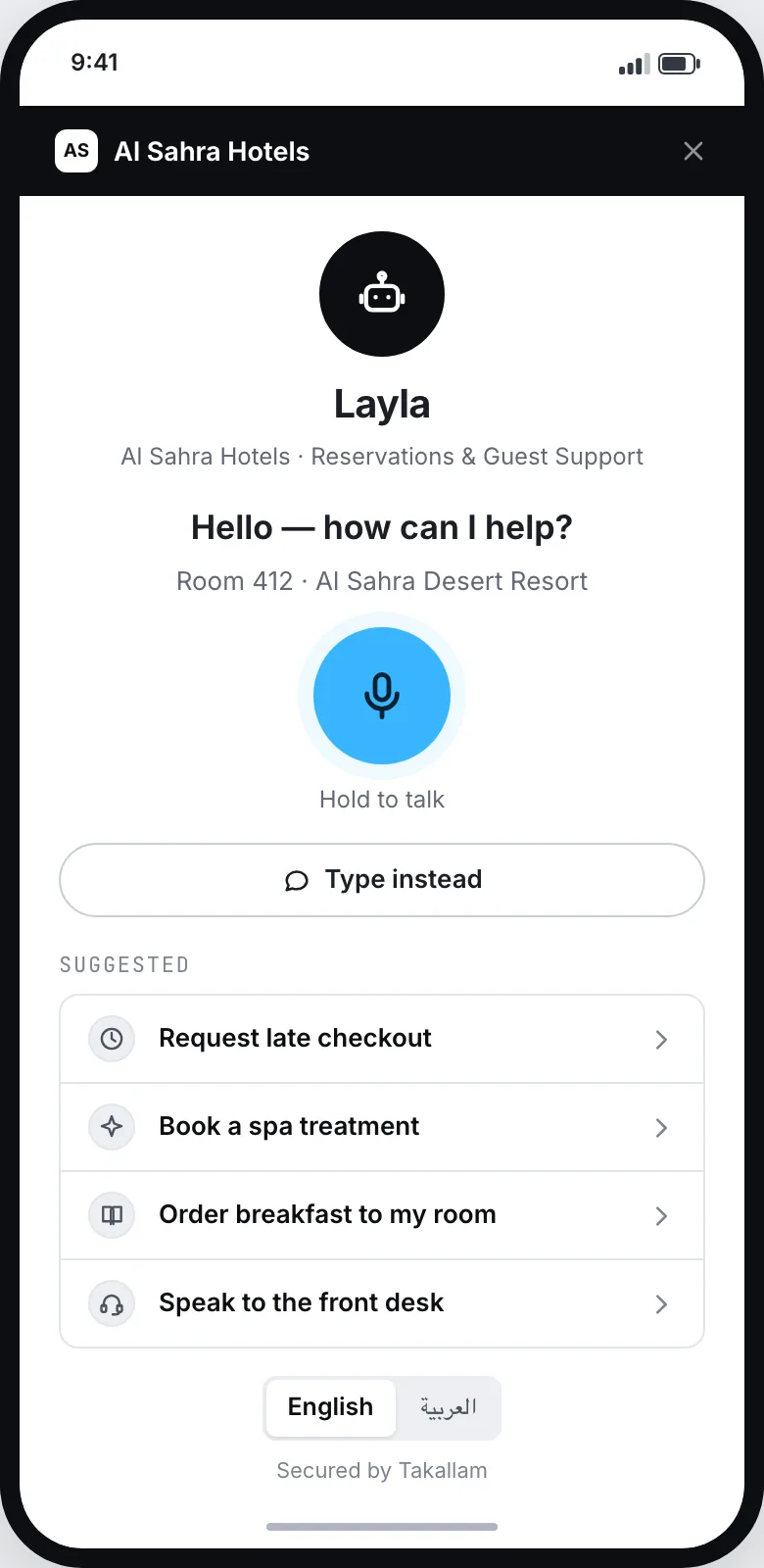
A guest scans the code on the hotel room door and says: "شحالك، ابي late checkout لو سمحت." No queue, no app, no menu tree. The agent understands the request, checks the policy it learned from your website, and answers back in the same register the guest used.
- Emirati dialect first, wider Gulf dialects understood — not Modern Standard Arabic with a Gulf voice pasted on top.
- It answers in dialect, not only in fusha. Understanding and speaking are two different capabilities and Takallam does both.
- The same agent on the phone line: a caller at 3am gets Arabic on the first ring, and as many callers at once as you get.
- When it is out of its depth it hands to a person — with the Arabic transcript attached, so nobody starts over.
Right-to-left is not a stylesheet
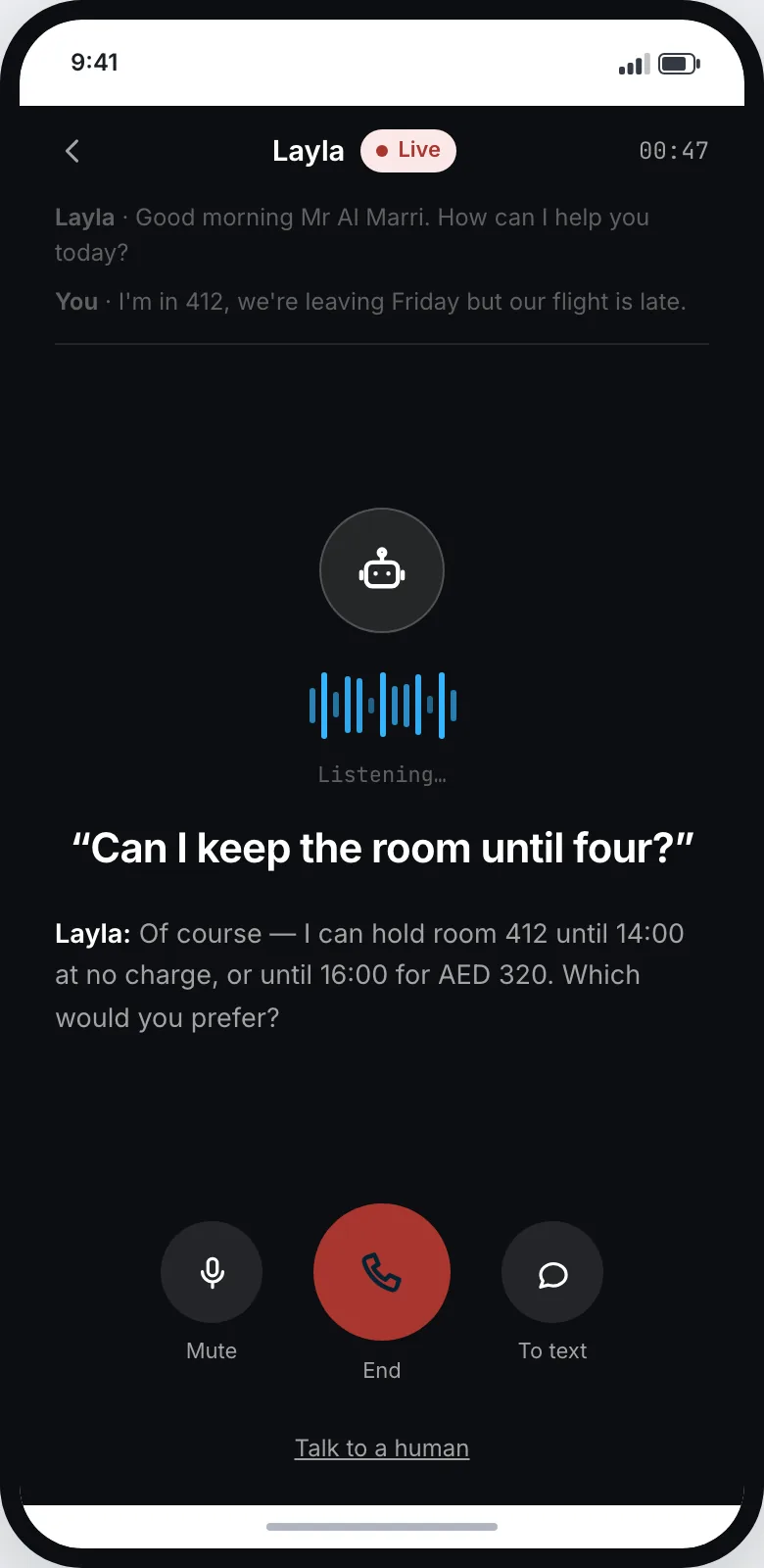
Flipping the direction of a page is the easy ten percent. The rest is the punctuation that has to mirror, the numbers and prices that do not, the mixed Arabic-English line that has to stay readable, the timestamps, the names, the order of a date. Takallam handles the customer experience in Arabic end to end — the chat, the QR flow, the email reply, the transcript the customer can read back.
- Chat on your website or inside your app, in Arabic, laid out right-to-left.
- An email answered in Arabic, in the same thread, sent from your own address.
- Mixed Arabic and English inside a single message renders correctly instead of scrambling.
- Numbers, prices, order references and phone numbers stay legible and in the right direction.
- The customer can switch from voice to text mid-conversation without losing the thread or the language.
You set the register, not the model
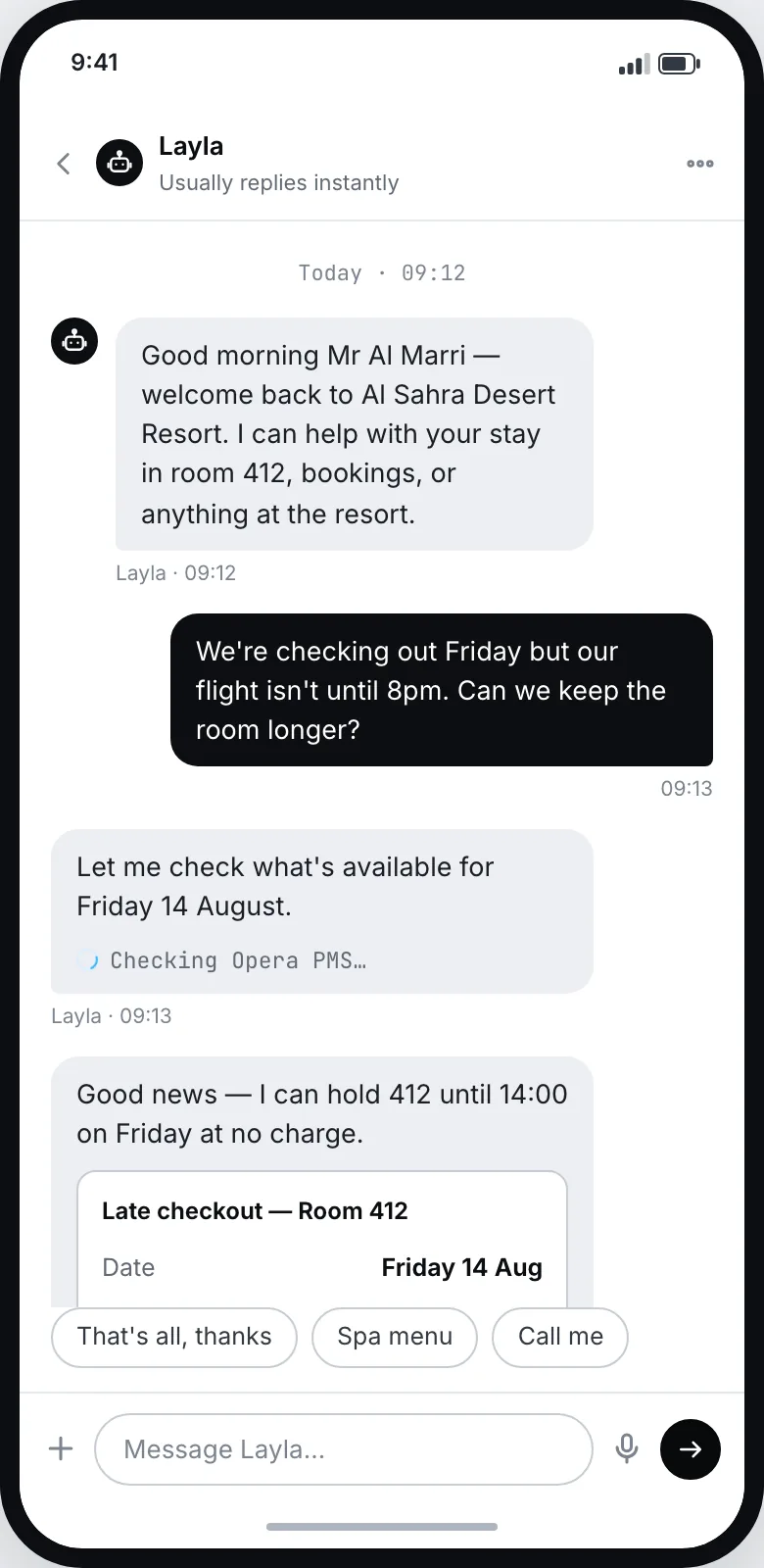
Dialect is not one dial. A private bank and a food delivery app both want Emirati Arabic, and they do not want it to sound the same. When you build an agent you give it a name, a role, a voice and the languages it works in — and you write how it should sound.
- Choose which languages the agent works in, and which one it opens with.
- Set the tone: formal and brief, or warm and conversational.
- Decide whether English product names stay in English — because your customers say "check-in", not تسجيل الوصول.
- Test it against real Arabic questions before a single customer sees it.
Built for Arabic vs. an English product with Arabic added
Not a slur on English-first platforms — several of them are excellent products with mature integrations, strong reporting and years of reliability behind them. This is only about what happens when your customer speaks Gulf Arabic.
| Takallam | English product with Arabic translation | |
|---|---|---|
| Understands Emirati and Gulf dialect | ||
| Replies in dialect, not only Modern Standard | ||
| Arabic in voice as well as text | ||
| Answers an Arabic email in dialect, in-thread | ||
| One sentence with Arabic and English in it | ||
| Right-to-left across the customer experience | ||
| Register and politeness you can set | ||
| Knowledge base read in Arabic and English | ||
| Arabic answers reviewed by Arabic speakers | ||
| Data resident in the UAE by default | Usually EU or US |
A category comparison, not a specific product. Capabilities vary by vendor, plan and region, and several English-first platforms handle written Arabic well. Named comparisons are on the comparison pages.
Which dialects, and which ones are not here yet
We would rather tell you what is missing than let you find out on a live call.
Emirati — the default
The dialect Takallam was built around, in voice and in text. It is what an agent uses when you set its language to Arabic for a UAE audience.
Wider Gulf
Saudi, Kuwaiti, Qatari, Bahraini and Omani speakers are understood without switching agents. A Kuwaiti caller does not have to flatten their speech to be heard.
Modern Standard Arabic
For anything formal — written policies, notices, replies where fusha is what the customer expects. Set it per agent, not per company.
Levantine and Egyptian — planned
On the roadmap, not live today. If your customers are mostly Levantine or Egyptian speakers, tell us on the waitlist form — it moves the order of work.
Tell us which dialect you needFacts about how Arabic is handled
Capability facts, not usage figures. Takallam is pre-launch and has no published results to quote.
What people ask about Arabic
Does Takallam really understand Emirati Arabic, or just Modern Standard?
Emirati dialect, in voice and in text — not Modern Standard Arabic with a Gulf accent on the output. It understands the words people actually use and answers in the same register. Modern Standard is available too, per agent, for cases where formal Arabic is what your customer expects.
Which Arabic dialects are supported today?
Emirati is the default, and wider Gulf speech — Saudi, Kuwaiti, Qatari, Bahraini and Omani — is understood without changing agents. Modern Standard Arabic is supported for formal replies. Levantine and Egyptian are on the roadmap and are not live yet.
What happens when a customer mixes Arabic and English in one sentence?
It is handled as one sentence, which is the only way it works in practice. Someone saying "ابي اسوي check-in بدري" is making a single request, not two. The agent answers in whatever mix the conversation is actually in rather than forcing the customer back into one language.
Can the agent speak dialect, or only understand it?
Both. Understanding and speaking are separate capabilities and a lot of tools only do the first — they hear dialect and reply in stiff fusha, which is why those conversations feel like talking to a form. Takallam replies in the register you set for that agent.
Is the customer experience right-to-left?
Yes, across the whole customer experience — chat on your site or in your app, the QR voice flow, and the transcript the customer reads back. Mixed Arabic and English text, numbers, prices and references stay in the right direction rather than scrambling.
Does it answer email in Arabic?
Yes. You forward your support address to Takallam or connect the mailbox, and the agent replies in the same thread, from that same address, in the language and register the customer wrote in — including Emirati and Gulf dialect, and including a message that is half English. Attachments are read too, so a document sent in with the question is part of what it answers from.
Is the admin console in Arabic?
Not yet. The customer-facing experience is fully Arabic and right-to-left; the console your team uses is English today, with Arabic planned. We would rather say that than show you a screenshot that does not exist.
Where is Arabic voice data stored?
In the UAE region, me-central-1, by default. Audio, transcripts and knowledge bases stay in-region, and you decide what is retained and for how long.
Can we control how formal the agent sounds?
Yes. Tone, formality, greetings, whether English product terms stay in English — you set it per agent when you build it, and you can test it against real questions before going live.
Hear it in your own dialect
Tell us the kinds of questions your Arabic-speaking customers actually ask — the messy ones, the half-English ones — and we will show you how the agent handles them.
Pay per interaction · priced per channel · no seats, no minimums