
Questions people ask before they sign up
Everything below is answered in the first sentence. If something you need is missing, ask us directly and we will add it here rather than only replying to you.
The basics
What is Takallam?
Takallam is an AI customer-support platform built in the UAE.
You create AI agents, connect them to your knowledge, and put them in front of customers on four channels — a QR code they scan and speak to, chat on your website or inside your app, your support inbox, and a phone number. Behind those sits a support console: one inbox across all four channels, human takeover in the same conversation, tickets and SLAs, a knowledge base, analytics, and a workflow builder for what happens after the conversation ends.
One agent. Every channel. One platform instead of a ticketing suite, plus an AI add-on, plus a separate voice vendor.
How long does setup take?
Most businesses can have a first agent answering the same day.
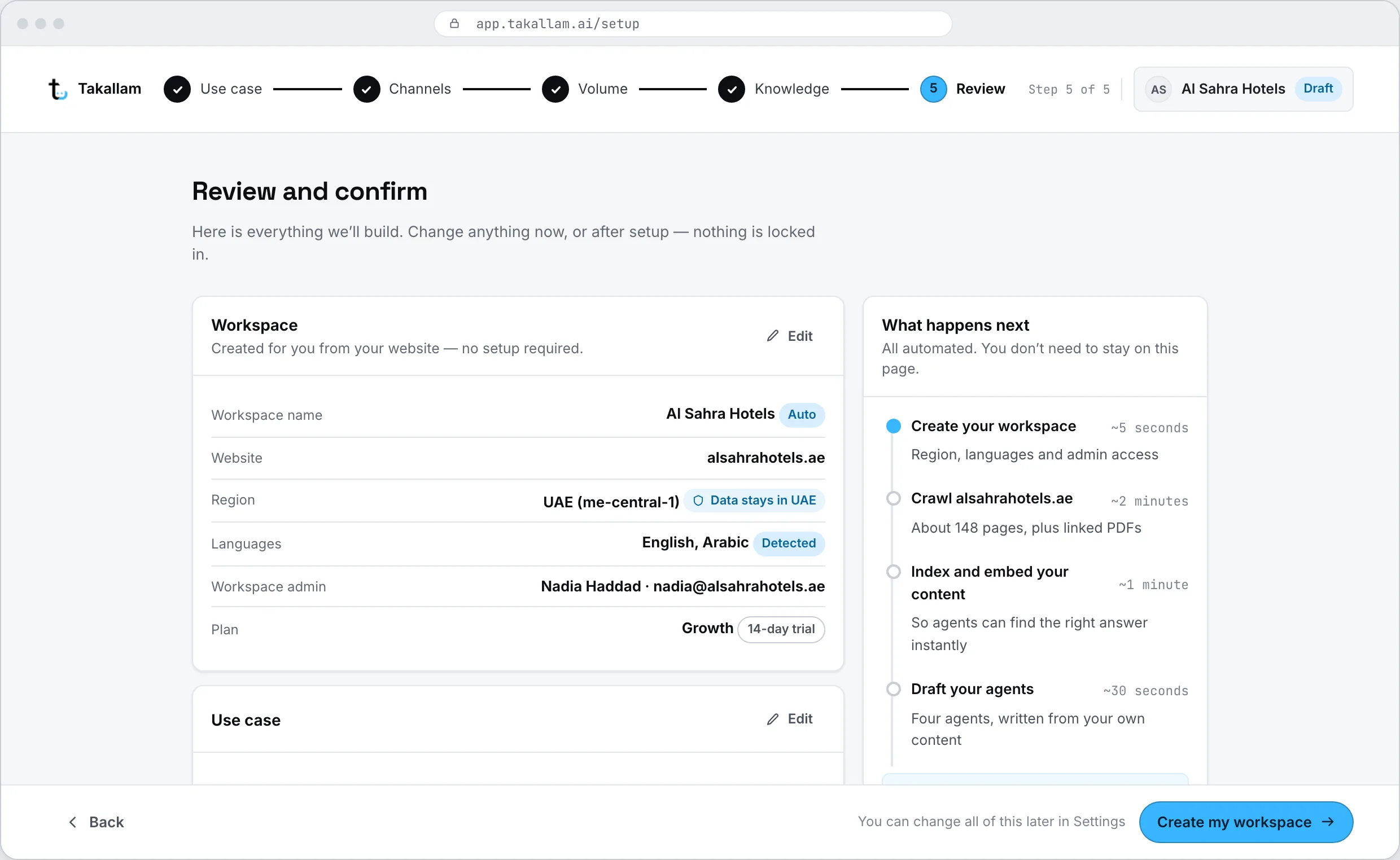
You answer four questions at sign-up and give Takallam your website. It provisions the workspace, crawls your site, builds a knowledge base from what it found, and drafts your first agents. The time you actually spend is on reviewing what it learned and deciding what each agent is allowed to do.
Do we need a developer to set it up?
No — onboarding, the knowledge base, the agent builder and all four channels are point-and-click. A developer is only needed if you want the mobile SDK inside your own app, or if you want to drive Takallam from your own backend through the API.
What actually happens when you sign up
Four questions and your website address. Takallam provisions the workspace, reads your site, builds a knowledge base from what it found and drafts a first set of agents. You review it, adjust it, test it and publish.
- No implementation call needed to get started.
- Every page it read is listed, and you can remove any of it.
- Nothing is visible to a customer until you publish it yourself.
QR voice, chat, email and phone
What is the QR channel, exactly?
It is a printed code that a customer scans with their phone camera and then speaks to.
The page opens voice-first — no app to download, no number to dial, no queue — and the customer can switch to text mid-conversation without losing the thread. You print a different code for each location, so a code on a hotel room door and a code on a shelf edge are separate and separately measurable.
Does the same agent work across all four channels?
Yes, and it keeps one record of the customer across them. Someone who called this morning and emails this afternoon does not start again. You can also run a different agent per channel if the jobs are genuinely different — reservations on the phone, billing in chat.
Do we have to use all four channels?
No. Turn on the ones you want and leave the rest off. Plenty of teams start with chat on the website or a QR code in one location, then add the support inbox and the phone line once they have watched the agent handle real questions.
How does the email channel work?
You forward your support address to Takallam, or connect the mailbox directly.
The agent reads the whole thread, replies in-thread from your own address in the language the customer wrote in, and reads attachments — an invoice, a booking confirmation, a photo of a damaged item. What it should not answer is tagged by intent, routed by your rules, and escalated to your team with the full thread attached. You can run it in draft mode first, where the agent writes and a person approves, until the team trusts it.
Can we keep our existing phone number?
Yes. Point an existing number at Takallam or take a new one. Either way, calls the agent cannot handle route to your team with the full transcript attached, and you define what happens after hours.
How it handles Arabic
Does Takallam really understand Emirati Arabic?
Yes — Emirati and wider Gulf dialect, in voice and in text.
This is the reason Takallam exists rather than being a translation layer bolted onto an English-first product. Dialect is the default case here, not an edge case someone remembered to test.
What if a customer switches between Arabic and English mid-sentence?
The agent follows them. Code-switching is normal in the UAE, so Takallam tracks the language the customer is actually using and answers in the same register rather than forcing them back to one language.
Which languages can an agent answer in?
English and Arabic, and you choose per agent. Arabic covers Modern Standard as well as Emirati and Gulf dialect, and you set the register the agent replies in — a hotel front desk and a bank should not sound the same.
Where the answers come from
Where does the AI get its answers from?
From your knowledge base, not from the open internet.
Takallam builds that base by crawling your website, and you add documents, price lists and policies on top. In testing, every answer shows the source it came from, so you can tell a knowledge gap from a tone problem.
What if our website does not have all the answers?
Then you add them. Upload PDFs and documents, write entries directly, or connect the system where the answer actually lives — a PMS, a booking system, an order database. The website crawl is a starting point, not the ceiling.
What stops it from making something up?
It answers from your knowledge base and is instructed to escalate rather than guess.
You set the line: which topics it must never answer alone, what it says when it does not know, and what confidence level sends a conversation to a person. The test screen exists so you can push it with your awkward questions — refunds, complaints, the things it should refuse — before anyone outside sees it.
The handover a customer never notices
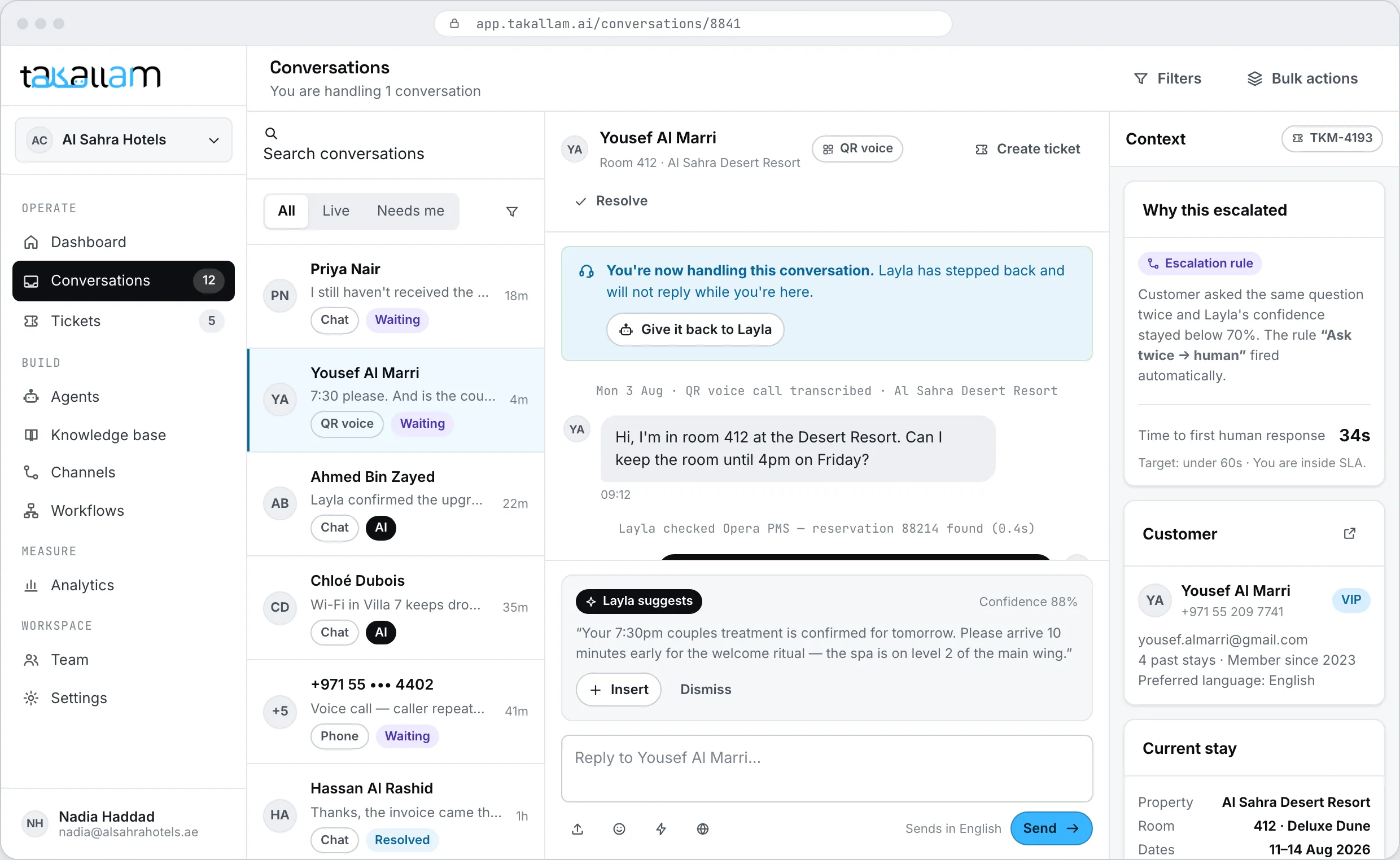
When the AI escalates, the conversation moves to your console with the transcript, the sources it used and the reason it stopped. Your agent reads it and continues in the same thread. There is no ticket number to quote and no "let me transfer you".
- Escalation rules written per agent and per channel.
- Tickets and SLAs for the things that need tracking past the conversation.
- Analytics that show what people ask and where the agent gives up.
When a person needs to step in
What happens when the AI cannot help?
A person on your team takes over in the same conversation. Takallam flags it, puts it in the console with the full transcript, and your agent continues in the same thread — so the customer does not repeat themselves and never sees a ticket number.
Can we control when it escalates?
Yes, per agent and per channel. Common triggers are low confidence, a tone the agent reads as unhappy, a topic it is not allowed to touch, or an explicit request for a human. You can also set different rules for a phone call than for a chat message.
Do we still get tickets and SLAs?
Yes. Anything that outlives the conversation becomes a ticket with an owner, a state and an SLA clock. The difference is that the ticket is a record for your team, not something the customer has to quote back to you.
Where your data lives
Where is our data stored?
In the UAE region by default — me-central-1. Conversations, transcripts and knowledge bases are data resident in-region, and you decide what is retained and for how long.
Who can see our conversations?
Your team, according to the roles you set in the console. Access is role-based, data is encrypted in transit and at rest, and retention windows are yours to configure rather than something you inherit.
Is Takallam certified for SOC 2 or ISO 27001?
Not today, and we will not claim otherwise.
Takallam is pre-launch. What exists now is architectural: data resident in the UAE region by default, encryption in transit and at rest, role-based access in the console, and retention you control. The platform is built to support formal compliance work, and we will say so plainly when a certification is actually held rather than in advance of it.
What it costs and how to get in
What does Takallam cost?
You pay per interaction, and each channel is priced separately.
A phone call, a chat message and an email do not cost the same to deliver, so they are not priced as if they did. An email thread that keeps going is not counted again each time it continues. There are no per-seat licences and no minimum commitment. Takallam is pre-launch, so rates are being set with the first cohort — we quote against your real volume rather than publish a number that would not fit you.
Does adding people to the console cost more?
No. There are no seats, so putting your whole support team in the console changes nothing on the bill. You are charged for what your customers do, not for how many colleagues can log in.
What does joining the waitlist actually do?
It puts you in front of the first cohort. You tell us which channels you need and roughly what volume you handle; we come back with a rate and a setup slot. There is no payment and no commitment at that point.
API, SDKs and webhooks
Is there an API?
Yes. Every action in the console is an endpoint — create agents, push knowledge, start conversations, read tickets, trigger workflows — over a REST API at https://api.takallam.ai/v1, with signed webhooks for conversation, escalation and workflow-run events.
Can we put the agent inside our own mobile app?
Yes. There is a drop-in embed for the web and SDKs for iOS and Android, so the agent runs inside your product rather than in a window next to it, and hands over to your team without leaving the app.
Still have a question?
Ask it directly. If it is a good question we will answer you and add it to this page, so the next person does not have to ask.
Pay per interaction · priced per channel · no seats, no minimums