
Takallam vs Vapi
Vapi is one of the best ways to build a voice agent. It is infrastructure — you bring engineers, and you get control over the model, the providers, the telephony and the latency. Takallam is a finished support operation: a console, an inbox, human takeover, tickets, a knowledge base, workflows and analytics, with voice as one of four channels. This page is about telling which one you actually need.
One is a toolkit. The other is the operation.
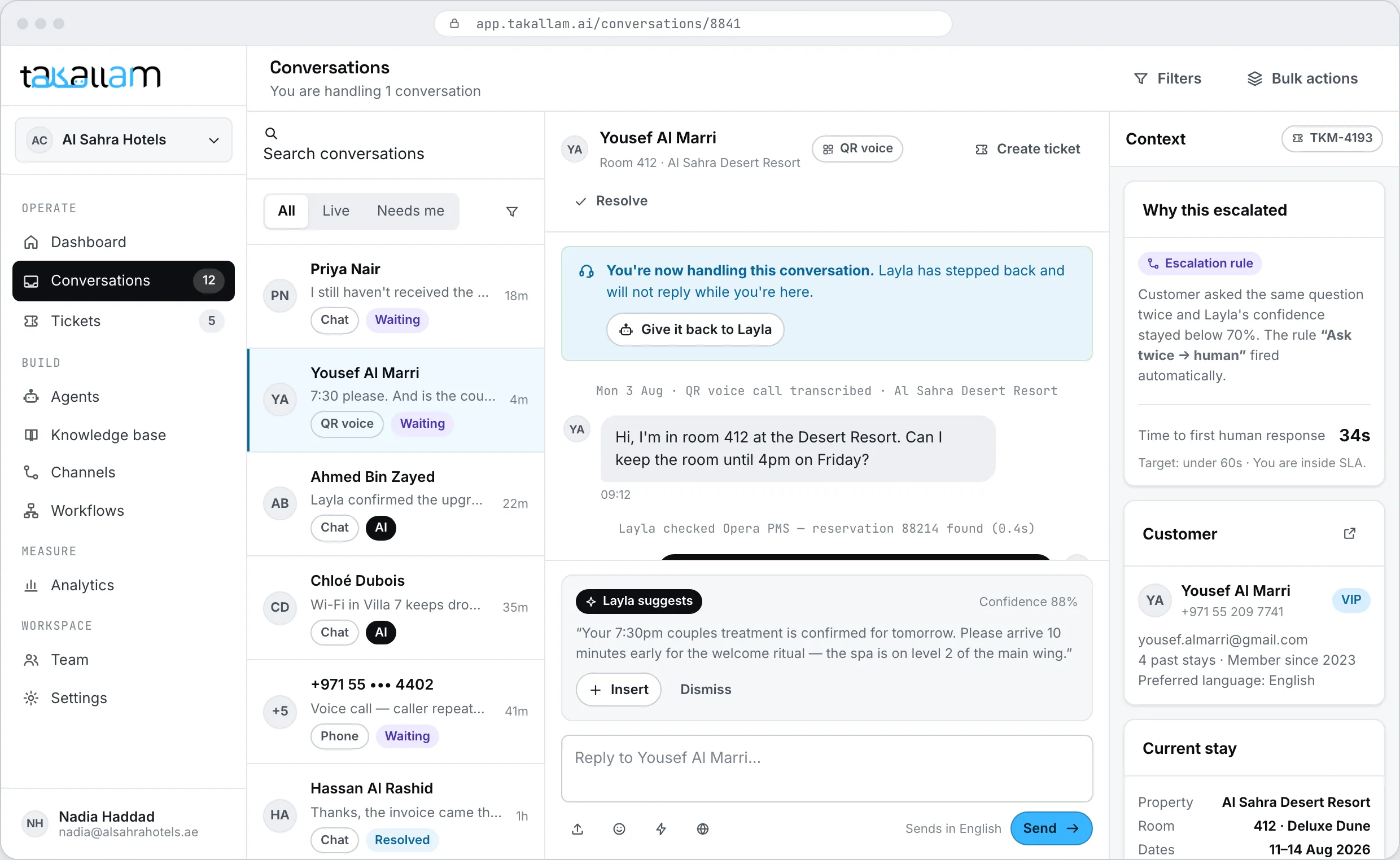
Vapi hands a developer the pieces of a voice agent: pick the model, pick the speech providers, wire the telephony, tune the turn-taking until it feels instant. That is a genuine advantage if you have engineers and you want the stack in your hands. Takallam starts at the other end of the problem. It assumes nobody on your team writes code, and it ships the parts a support team actually sits inside all day.
- With Vapi you build the agent, then build everything that surrounds it.
- With Takallam the surrounding is the product — inbox, takeover, tickets, knowledge, workflows, analytics.
- A guest scans a QR code, a customer messages in your app, someone emails your support address, someone calls the number: all four land in one queue.
- If you have engineers who want to own the voice stack, take the toolkit. That is a real answer, not a hedge.
Three cases where the infrastructure is the right call
These are not concessions. If any of them describes you, Vapi is the better purchase and you should make it.
You want the stack in your hands
Model choice, speech-to-text and text-to-speech provider choice, prompt-level control, your own orchestration logic. Vapi is deliberately unopinionated so you can swap any layer. Takallam is deliberately opinionated so you do not have to.
Latency is the differentiator
Vapi is built around low-latency voice orchestration, and if a few hundred milliseconds of turn-taking is the thing your product competes on, you want to own that number rather than inherit it.
The voice agent is not support
A voice interface inside a product that is not a helpdesk — an in-car assistant, a drive-through, a screening call, an interface in your own app. A support console would be dead weight. Telephony primitives are exactly what you need.
What each one ships with
Capability, not price. The point of the table is the shape of the two products: one is a platform to build on, one is a support operation you configure.
| Capability | Takallam | Vapi |
|---|---|---|
| Inbound phone number | ||
| Scan-a-QR-code voice channel | ||
| In-app and web chat | ||
| Email support channel | ||
| Shared inbox for your team | ||
| Human takeover mid-conversation | ||
| Tickets, SLAs and a support queue | ||
| Knowledge base built from your website | ||
| Workflow automation without code | ||
| Analytics built for a support team | Call logs and metrics | |
| Emirati and Gulf dialect voice | Depends on your providers | |
| Choice of model and speech provider | ||
| Latency tuning at the stack level | Managed for you | |
| Engineering required to launch | None to go live | Yes, you build it |
| Data resident in the UAE by default | Not by default |
Capability comparison as of 2026, based on public documentation for each product. A half-mark means the capability can be assembled from the platform APIs but does not ship as a finished product surface. Vapi is a developer platform by design, and what you end up with depends on the providers and plan you choose.
Building the agent takes a week. Building the operation takes the year.
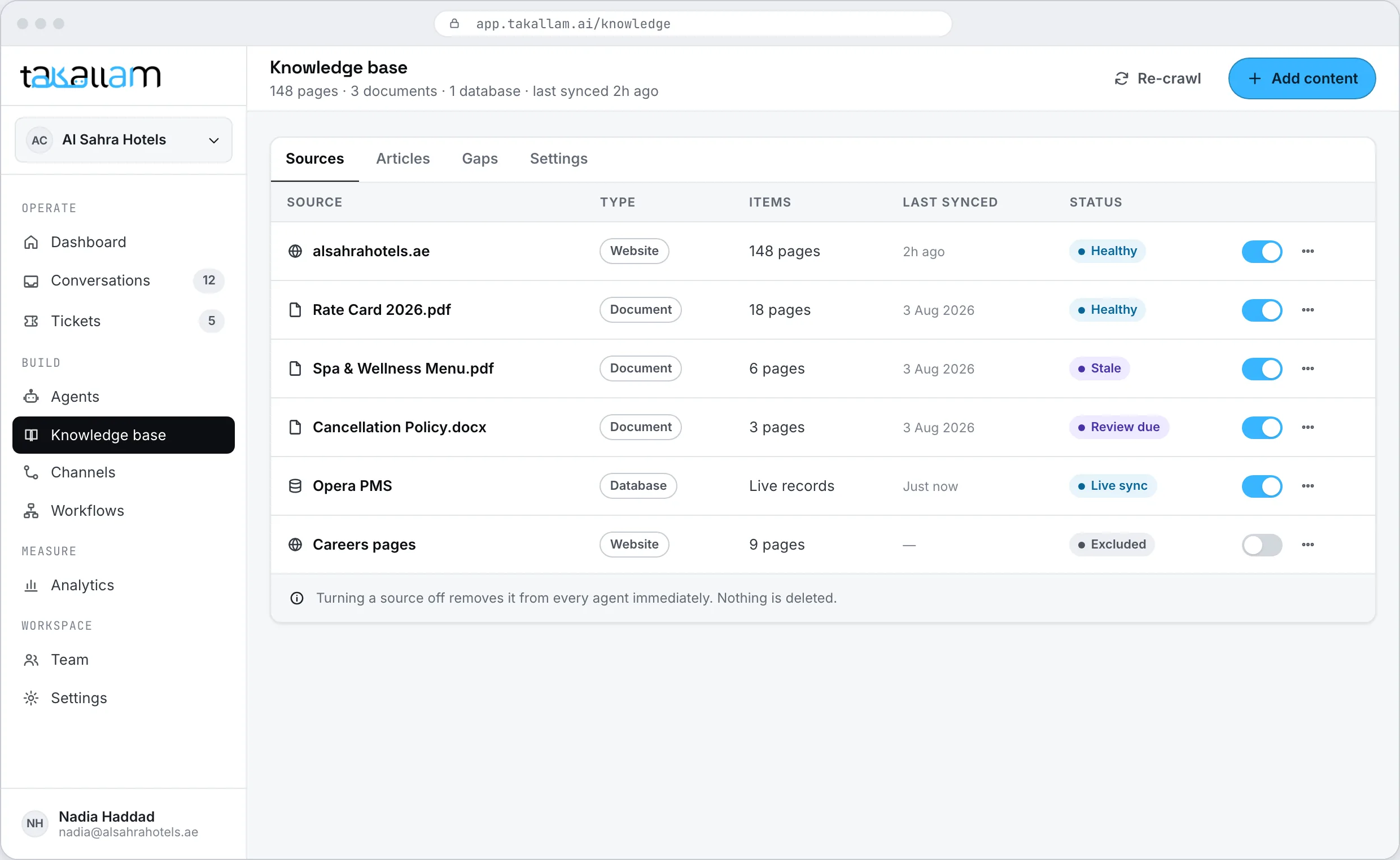
The demo is the easy half. The hard half is what a support manager asks for in month two: where did that conversation go, who answered it, why did the answer change, what is the SLA on a refund, and can we see what customers keep asking about. Takallam ships that half.
- A knowledge base built from your website that stays editable, so answers change when your policy changes.
- One inbox holding QR voice, chat, email and phone conversations in a single queue.
- Human takeover in the same thread, with the transcript and what the AI already tried.
- Tickets, SLAs, workflow automation and conversation analytics, included rather than integrated.
Arabic is not a voice setting
On an infrastructure platform, Arabic quality is whatever your chosen speech providers give you, and Gulf dialect is usually the first thing to break. Takallam was built in the UAE for this specific problem: Emirati and Gulf dialect in voice and text, and callers who start a sentence in Arabic and finish it in English.
- Emirati and wider Gulf dialect on the phone and on a QR scan, not only Modern Standard Arabic.
- Code-switching handled inside one conversation rather than treated as an error.
- Right-to-left across the whole customer experience, not a translation layer on an English product.
- Data resident in the UAE region by default, with retention you control.
What you get without writing any of it
Every one of these is configured in a console. None of it is a build.
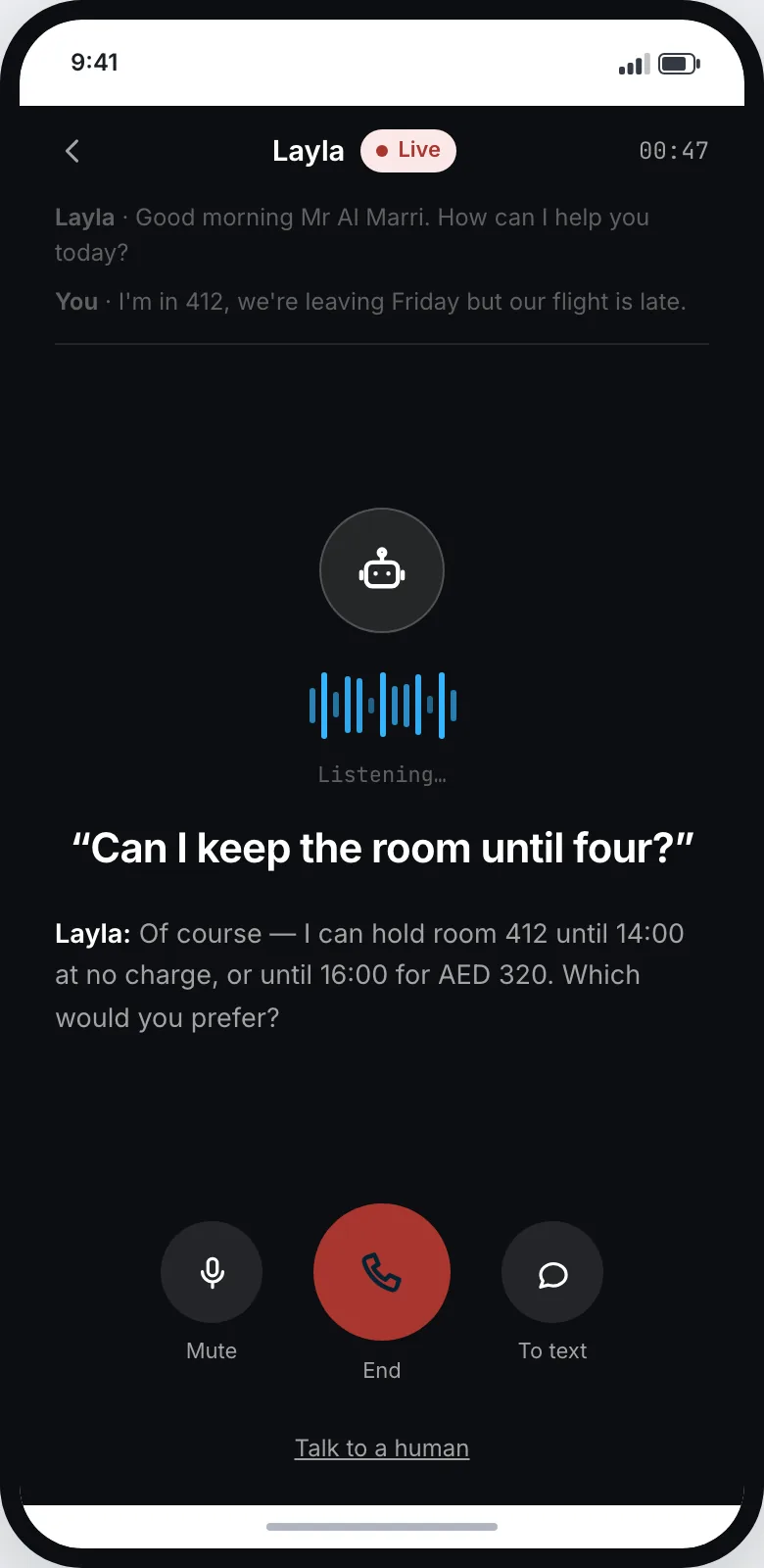
Scan-to-speak QR
Print a code, put it where the question happens, and the customer scans and talks. No app, no download, no number to dial. This channel does not exist on a voice API.
See the QR channelIn-app and web chat
The same agent as an embed on your site or an SDK inside your app, picking up a conversation that started on the phone an hour earlier.
See the chat channelEmail support
Forward your support address or connect the mailbox. The agent reads the whole thread, replies from your own address, and triages the rest before anyone opens the inbox.
See the email channelInbound phone
A new number, or your existing one pointed at Takallam. It answers on the first ring, in Arabic or English, with no queue behind it.
See the phone channelHuman takeover
Escalation rules you write per agent and per channel. Your team continues in the same thread instead of restarting the customer.
See the consoleWorkflow automation
When a call is handled, summarise it, check whether it changed a booking, update the PMS and text the guest. Built by dragging blocks.
See the workflow builderConversation analytics
What customers ask, what the AI resolved, where it handed over and which questions keep coming back — across all four channels, not per call.
See analyticsChoosing between them
Is Takallam a Vapi competitor?
Only partly. Vapi is infrastructure for building voice agents; Takallam is a support platform that happens to include voice. You would compare them if the job is "answer our customers", and you would not compare them if the job is "build a custom voice product". Plenty of teams should buy Vapi.
Could we just build all of this on Vapi ourselves?
Yes, and some teams should. What you are signing up to build is the console: an agent inbox, conversation state across channels, human takeover, ticketing and SLAs, a knowledge base with crawling and re-indexing, a workflow engine, analytics, roles and permissions.
That is a product team, not a sprint. Takallam exists for the businesses that want to be answering customers rather than maintaining a support platform.
Does Takallam let us choose our own model or voice provider?
Not the way an infrastructure platform does. You choose the agent's voice, languages, persona, knowledge and what it is allowed to do — the underlying stack is managed. That is the trade: less control, nothing to operate. If provider-level choice is a requirement, Vapi is the correct answer.
Which one is better for Emirati Arabic?
On Vapi it depends entirely on the speech providers you select and how much tuning you do, because the platform is neutral about it. Takallam was built in the UAE specifically for Emirati and Gulf dialect in both voice and text, including customers who code-switch mid-sentence.
We already run a voice agent. Can we move to Takallam?
Yes. Phone numbers are portable — you can point your existing number at Takallam instead of taking a new one, and your knowledge is rebuilt from your website automatically rather than migrated by hand. Nothing you built stops working while you evaluate.
Do we need a developer to launch Takallam?
No. You answer four questions, Takallam crawls your website and drafts your first agents, and you review and go live. There is a full REST API and signed webhooks if you want them, but nothing about launching requires code.
How does the pricing model differ?
Takallam is billed per interaction, priced separately for each channel, because a phone call and a chat message do not cost the same to deliver. There are no per-seat licences and no minimum commitment. Takallam is pre-launch, so rates are being set with the first cohort — join the waitlist and we will quote against your real volume.
Not sure which side of the line you are on?
Tell us what your customers ask and how they reach you. If the honest answer is that you need infrastructure, we will say so. If you need a support operation, we will show you what going live looks like.
Pay per interaction · priced per channel · no seats, no minimums