
Answers the status question. Never touches a held transfer.
Where is my transfer, what is the rate to Manila today, how much can I still send this month, which documents do I need, is the branch open after Isha. Takallam answers those on four channels in English and Emirati Arabic. Anything touching compliance, AML, a blocked or held transaction, or proving who somebody is goes to a person every single time — with no AI attempt at all.
What the counter and the phone get asked
It is the 28th, the queue is at the door, and the phone has not stopped
Payday concentrates a month of demand into three days. The counter is serving, the phone is ringing, and most of what is on the phone is one of five questions that has nothing to do with the person standing at the window. Where is my transfer. What is the rate today. Am I still under my limit. What do I need to bring. Are you open on Friday. None of them need a teller, and every one of them currently takes one.
- Five questions make up most of the call volume, and all five are answered from information you already publish.
- Payday, Eid and the last three days of the month are a spike, not a baseline — you cannot staff for it, and paying for seats all year to survive it is the wrong shape.
- A status question asked at the counter, on the phone and by email gets three slightly different answers, and at least one of them is a guess.
- Customers who would rather speak Arabic get a proper conversation only when the right teller is free.
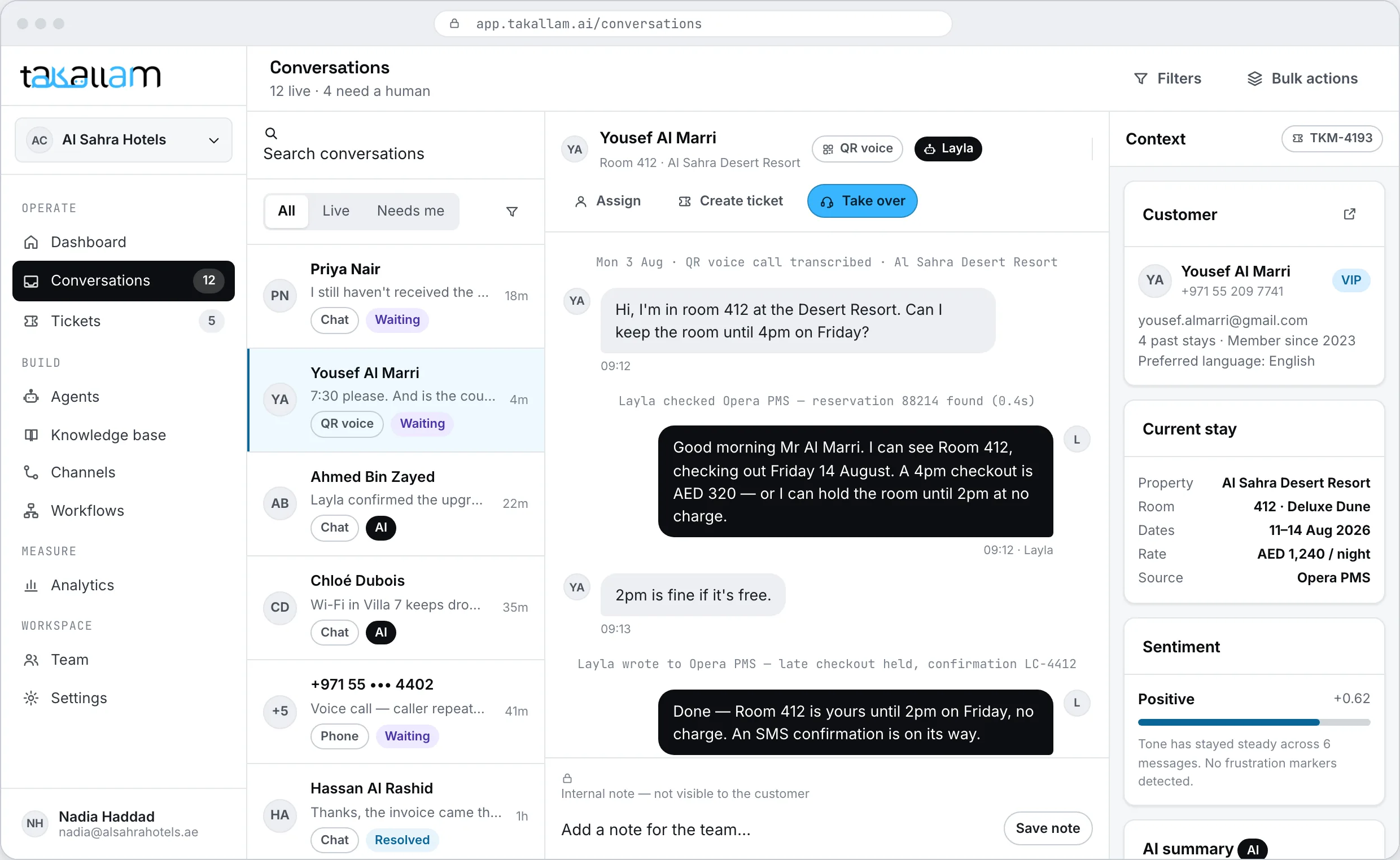
The five questions that fill the phone
Every one of these has a published answer. None of them requires system access to a transaction, and that is precisely the point.
Where is my transfer
The most-asked question in the sector. The agent explains the corridor timing, the cut-off, why a bank credit lands the next working day and why a cash payout does not. If you connect your core system and authorise a read, it can also give the real status of a reference number — read-only, and never for anything held.
Today's rate, and the fee on top of it
The rate for a corridor, whether it changes after a cut-off, how a promotional rate works, and what the transfer fee is on top of it. It reads from wherever you already publish rates, so the board, the app and the agent never disagree. It quotes; it does not negotiate and it does not lock a rate.
How much can I send
Monthly limits, why a first-time sender has a lower one, what a salary transfer changes, what a corporate account allows. Answered as published policy, in the wording you approved — as information, never as an approval or a decision about a specific customer.
What do I need to bring
Emirates ID, a salary certificate, a labour contract, a trade licence for a corporate account, what the beneficiary IBAN has to look like, what a first-time transfer needs that a repeat one does not. This is the single most repeated answer at any counter, and the one that most often sends someone home and back again.
The email channelBranch hours and locations
Which branch is open after Isha, which one sits inside a mall and follows mall hours, Friday and Ramadan timings, which branch handles corporate accounts, and which is nearest to where the customer is standing right now.
Arabic and English at the window
Emirati and wider Gulf dialect in voice and text, including customers who switch between Arabic and English mid-sentence. English and Arabic are what Takallam does properly today, and we would rather say that than claim a list of languages.
How Takallam handles ArabicThe customer third in line can ask while they wait
The person at the window asks the teller. The person third in line stares at a queue number for eleven minutes. A printed code turns that wait into the answer they came for — and quite often means they never reach the window at all, because the question was the hours, the rate or a document they already have.
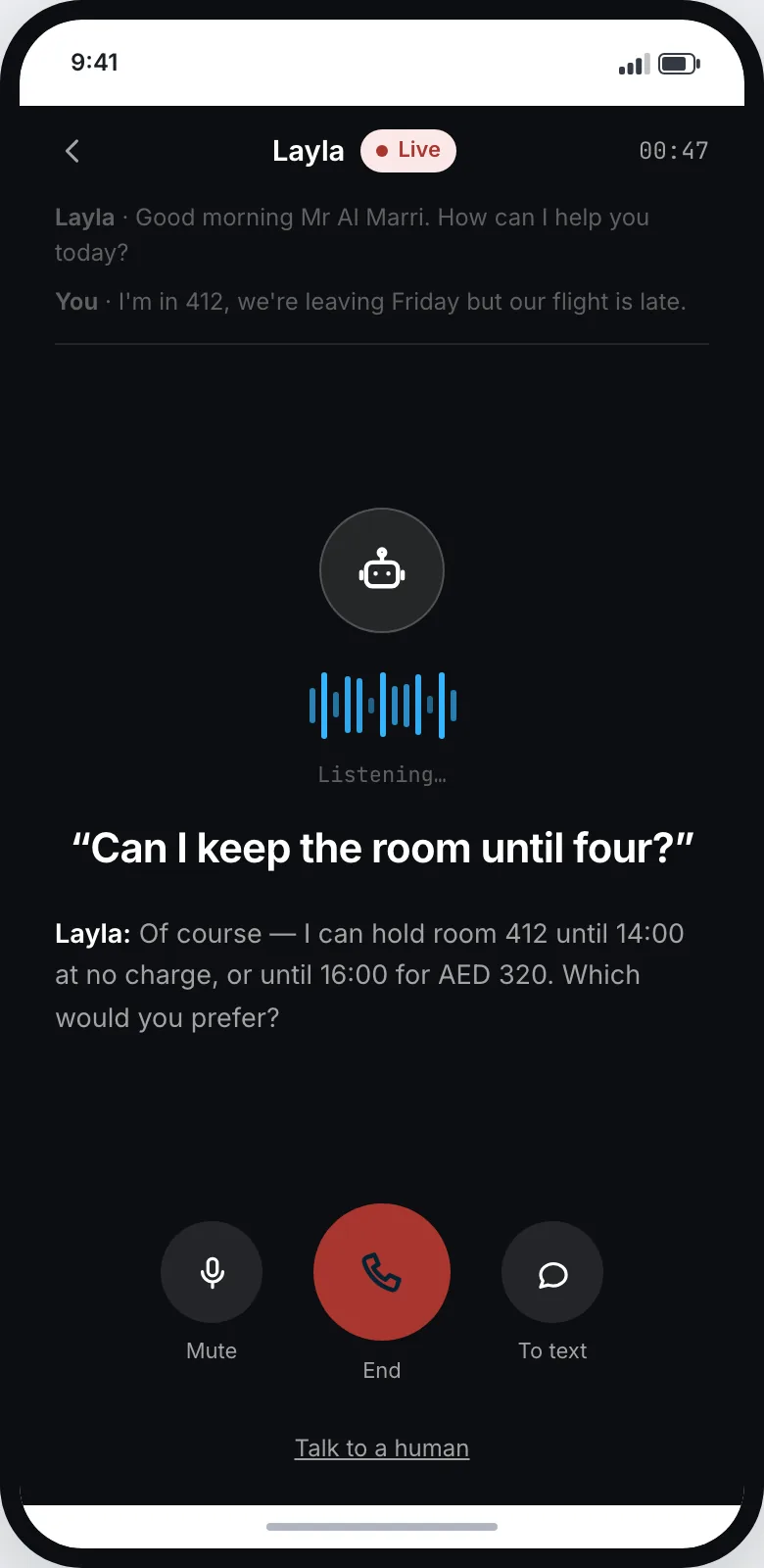
- Opens straight into voice. No app to download, no number to dial, no menu to sit through.
- Switches to text mid-conversation, which matters in a branch where nobody wants to say a reference number out loud.
- Every scan carries the code it came from, so you know a question came from the Deira counter and not from a partner shop.
- A customer who scanned at the branch and calls the next morning gets the same agent, with the earlier conversation already there.
Where the code goes
Put it where the person is already waiting. A code in the queue answers queue questions; a code on the receipt answers the question they would otherwise phone in tomorrow morning.
The counter and the glass
A code at the window itself, so the customer who has just been told they are missing a document can ask what else they need without rejoining the queue behind eleven people.
The queue and the ticket slip
The minutes a customer spends holding a printed number are the most captive and the most wasted time in the branch. A code on the queue screen and on the slip itself turns the wait into a self-service answer.
The receipt
Print it next to the reference number on every transfer receipt. The status question that would have been a phone call at nine tomorrow morning becomes a scan tonight, with the reference already in front of the customer.
Partner retail points
Grocery shops, mobile kiosks and the counters inside supermarkets where your agent network sits. Those staff field support questions they were never trained for. A code takes it off them and keeps the answer consistent with the branch.
The rate board
The board answers one question and creates three: is this the rate for my corridor, does it change later today, and what is the fee on top. A code under the board answers all three without anyone leaving the wall.
A different code for every branch
Separate codes per branch, per queue, per receipt run and per partner point. The analytics show which branch generates which questions, and which document requirement keeps sending people home to fetch something.
Inside the consoleIt never touches a held transaction
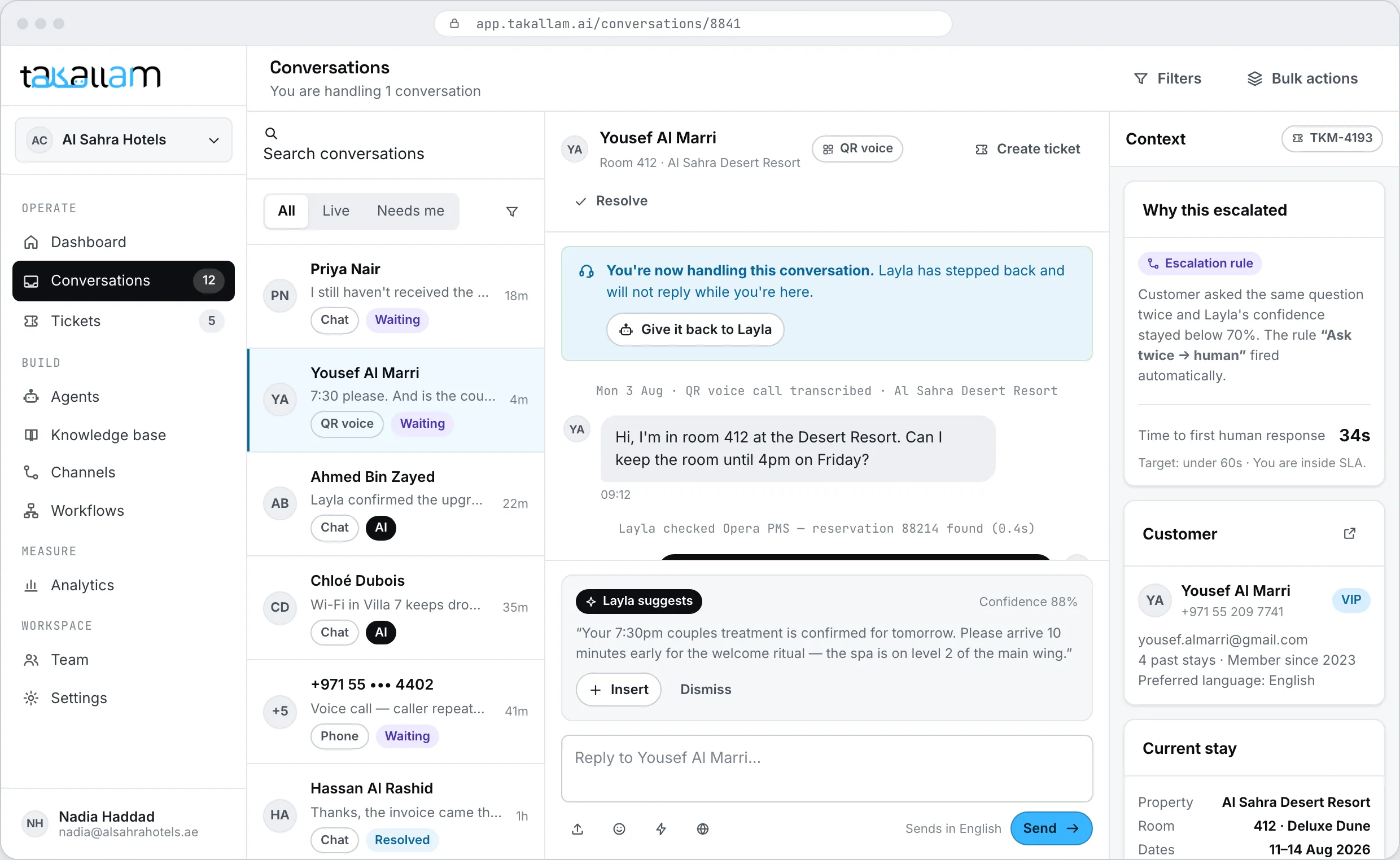
This is the paragraph your compliance officer is looking for, so it is written plainly and it is written early. Takallam answers status, rates, limits, hours and document lists. It does not release, hold, cancel, amend or re-route a transaction. It does not verify anyone’s identity. It does not explain why a transfer is under review. The moment a conversation touches compliance, AML, sanctions screening, a blocked or held transfer, source of funds, or proof of identity, the agent stops, says a person will take it, and routes to the queue you nominate. There is no confidence threshold on this and no clever exception. It is a hard rule, not a fallback.
- Hard escalation on intent, evaluated before the agent composes anything: held, blocked, under review, compliance, AML, sanctions, source of funds, fraud, chargeback.
- There are no transaction actions to enable. The agent cannot release, cancel, amend a beneficiary or change a limit — these are not switches somebody can turn on later by accident.
- Identity verification stays with your team and your existing KYC process. The agent never accepts a document as proof and never confirms who somebody is.
- It will not speculate about a delay. It gives the published corridor timing, and if the specific transaction is flagged in any way it hands over without offering a reason.
- You write the refusal sentence yourself, in both languages, so the wording that reaches a customer is wording your compliance team approved.
- Every conversation is logged with the transcript, the escalation trigger that fired and what the agent declined to do, kept for the retention window you set, in the UAE region.
A status lookup that reads, and only reads
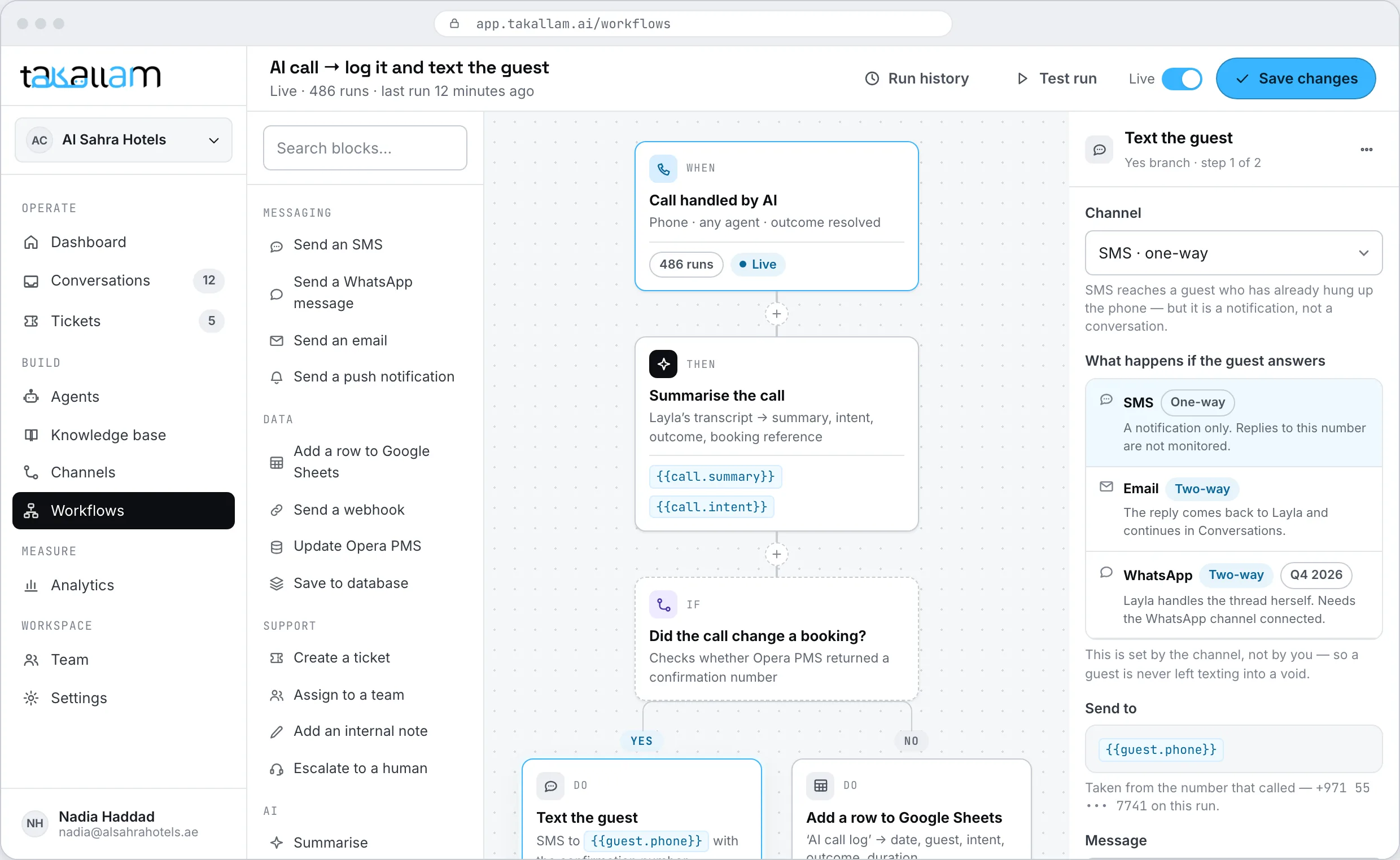
Most of the phone volume is one question whose answer is already sitting in your core remittance system. A workflow can go and read it — the state of a reference number, whether the payout partner has confirmed, which corridor timing applies — and return it inside the conversation. Reading is the only thing it does. There is no write path from a conversation into a transaction, and if the system does not answer, the agent says so rather than guessing.
- Connect your core remittance system and a workflow can look up a transfer by reference number, read-only, returning the status wording you approved.
- If the lookup returns anything marked held, blocked or under review, the workflow stops and escalates instead of reading the state out loud.
- Rates come from wherever you already publish them, so the board, the app, the website and the agent stay in step.
- When something has to go to a person, open a ticket with the reference, the branch and the channel, and start an SLA clock on it.
- Takallam does not ship a pre-built connector for every remittance platform. It ships a workflow builder, a REST API and signed webhooks. If your system can be called, a workflow can call it.
What the platform gives an exchange house
These are capabilities of the platform, not results from a deployment. Takallam is pre-launch and has no published performance figures.
What operations and compliance ask first
What happens if a question touches compliance or a held transfer?
It goes to a person. Every time, with no exception and no attempt at an answer. Held, blocked, under review, AML, sanctions, source of funds, fraud and chargeback are hard escalation triggers evaluated before the agent composes a reply.
The agent does not explain why a transaction is under review, does not estimate when it will clear, and does not soften it. It says a member of your team will handle it, captures the reference and routes to the queue you nominate, with the whole conversation attached.
Can it tell a customer where their transfer is?
Yes, if you connect your core remittance system and authorise a read. The lookup is read-only and returns the status wording you approved. If the transaction comes back held, blocked or flagged in any way, the workflow does not read the state out loud — it escalates. Without that connection, the agent still answers the corridor timing, the cut-off and the process, which is what most callers actually want.
Can it verify a customer’s identity?
No, and this is deliberate rather than a limitation we plan to remove. Identity verification stays with your team and your existing KYC process. The agent never accepts a document image as proof, never confirms who somebody is, and never uses identity as a condition for giving out information.
Can it give today’s rate?
Yes. It reads from wherever you already publish rates, so the board, the website, the app and the agent give the same number, and it states the fee on top rather than leaving it to be discovered at the counter. It quotes a published rate — it does not negotiate one, lock one or promise one for later in the day.
What about cancelling a transfer or fixing a wrong beneficiary detail?
The agent explains the process, what is possible at which stage, what the customer needs to bring and what the form is. It does not perform the cancellation or the correction. Anything that changes an actual transaction is a human action, so the conversation is handed over with the reference number and the correction already written down.
Where is the data held, and are you certified?
Data is resident in the UAE region, me-central-1, by default. You set retention windows per channel so transcripts and call recordings are deleted on a schedule rather than kept indefinitely, and access in the console is role-based, so not everyone sees every conversation.
On certification we will be direct: Takallam does not hold SOC 2, ISO 27001 or PCI DSS certification today and will not imply otherwise. What we can show you is the architecture, the residency, the retention controls and the access model, and the fact that the agent has no path to a transaction at all.
Does it work in Arabic for Gulf customers?
Yes — Emirati and wider Gulf dialect in voice and text, including customers who mix Arabic and English in the same sentence. Being honest about the rest: a lot of your customers speak neither Arabic nor English as a first language, and today the platform covers English and Arabic. Tell us your customer mix before you join and we will be straight about what that means for you.
What does it cost?
You pay per interaction, and each channel is priced separately because a phone call and a chat message do not cost the same to deliver. There are no per-seat licences and no minimum commitment, which matters when payday and Eid produce most of the year’s volume in a handful of days. Takallam is pre-launch, so rates are being set with the first cohort — join the waitlist and we will quote against your real volume.
Take the status calls off the counter
Tell us how many branches you run, which corridors carry most of your volume and what your core system is, and we will come back with a rate against your real volume — and a written answer on exactly what the agent will and will not touch.
Pay per interaction · priced per channel · no seats, no minimums