
Takallam vs Intercom
Intercom is very good at what it was built for. Fin is one of the strongest AI agents in written support, and nobody does in-product messaging better. Takallam is built for a different moment: the customer who is not signed in, not at a keyboard, and speaking Arabic. Here is the honest split.
Intercom is best when your customer is signed in
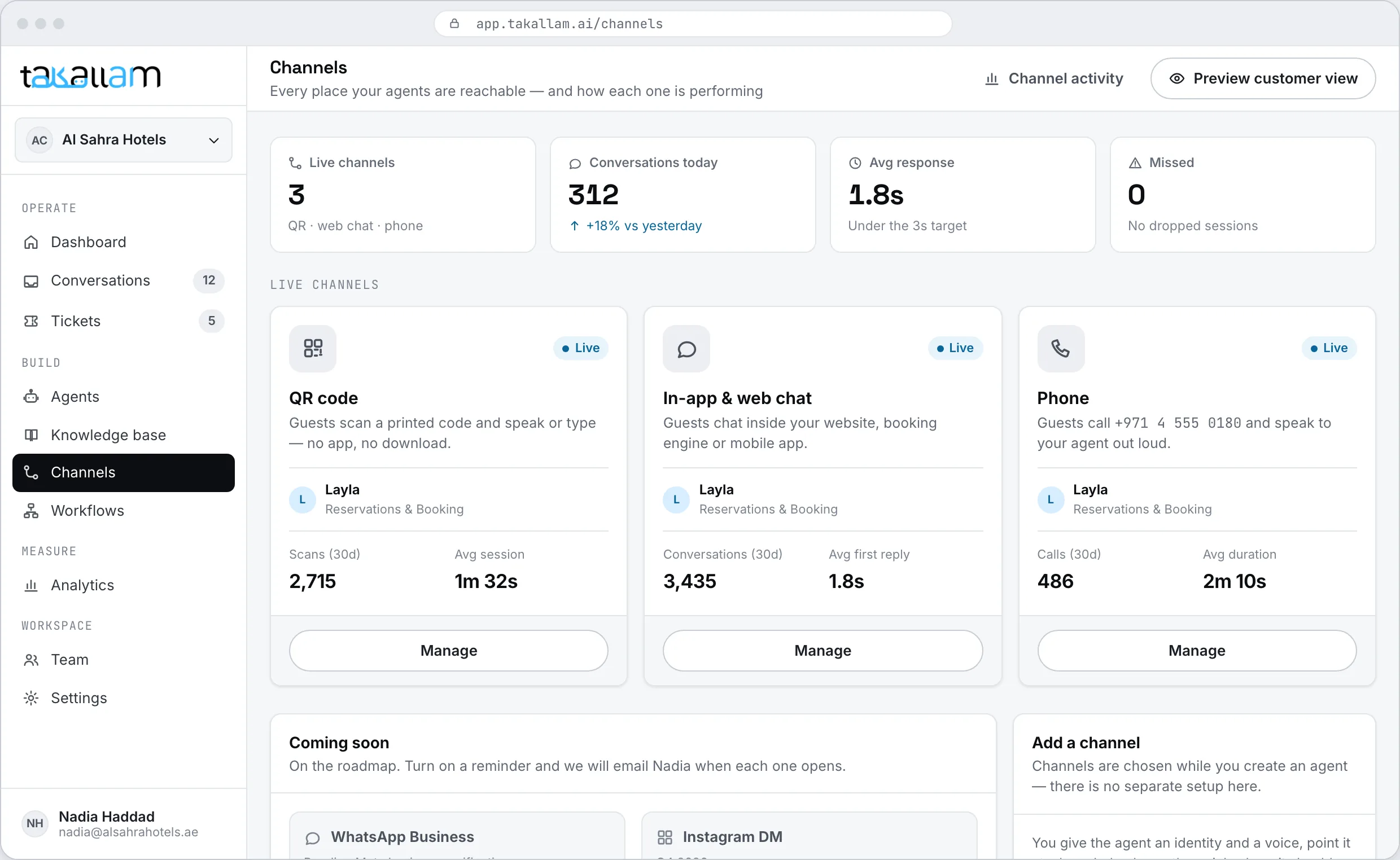
The whole shape of Intercom assumes a logged-in user inside a product: a messenger in the corner, a known account, product events to trigger on, a tour to launch. That is a strong position and it is why SaaS companies love it. Takallam assumes the opposite — a guest standing in a hotel corridor, a shopper in front of a shelf, a caller at 3am. The customer is not identified, has nothing installed, and would rather talk than type.
- Intercom is chat- and web-first, with voice added to a written product. Takallam was voice-native from the first line of code.
- A printed QR code that someone scans and speaks to has no equivalent in a messenger, because a messenger needs a page to sit on.
- Intercom meters seats alongside AI resolutions. Takallam meters interactions only, priced separately for each channel.
What Intercom does better than almost anyone
If a comparison page only lists the other product losing, it is marketing rather than help. Three things Intercom is genuinely excellent at:
Fin is a strong AI agent
For written English support with a good help centre behind it, Fin resolves a serious share of conversations, cites its sources and is tuned carefully. We are not going to pretend otherwise, and we do not publish head-to-head deflection numbers we cannot substantiate.
In-product messaging set the standard
Proactive messages, product tours, checklists, banners and lifecycle campaigns triggered on what a user actually did. Takallam does not do this at all — it is a support platform, not a product-engagement one.
Built for product-led SaaS
Onboarding, activation, expansion and support in one place, tied to your product data. If your customers live inside a web app and your support is written English, Intercom fits the way you already work.
Capability by capability
Capabilities only, at the level of what each product includes — not which plan you are on and not what it costs. Intercom ships quickly, so check its current documentation before deciding anything on this table alone.
| Takallam | Intercom | |
|---|---|---|
| Voice-first answers from a printed QR code | ||
| AI answers inbound phone calls | ||
| In-app and web chat | ||
| AI answers your support email inbox | ||
| Proactive messages, tours and onboarding | ||
| Email tickets, queues and SLAs | ||
| Knowledge base built from your website automatically | ||
| Human takeover inside the same conversation | ||
| One agent shared across QR voice, chat, email and phone | ||
| Emirati and Gulf dialect voice | Not a focus | |
| Visual workflow builder with run history | ||
| App marketplace and product integrations | API and webhooks | |
| Priced per interaction, per channel, no seats | Seats + resolutions | |
| Data resident in the UAE by default | Other regions |
Capability-level comparison written in 2026 from publicly documented behaviour. Three rows above favour Intercom and they are there on purpose — proactive messaging, workflow depth and the app ecosystem are real strengths. The Intercom documentation is the authority on Intercom.
A code on the door that answers out loud
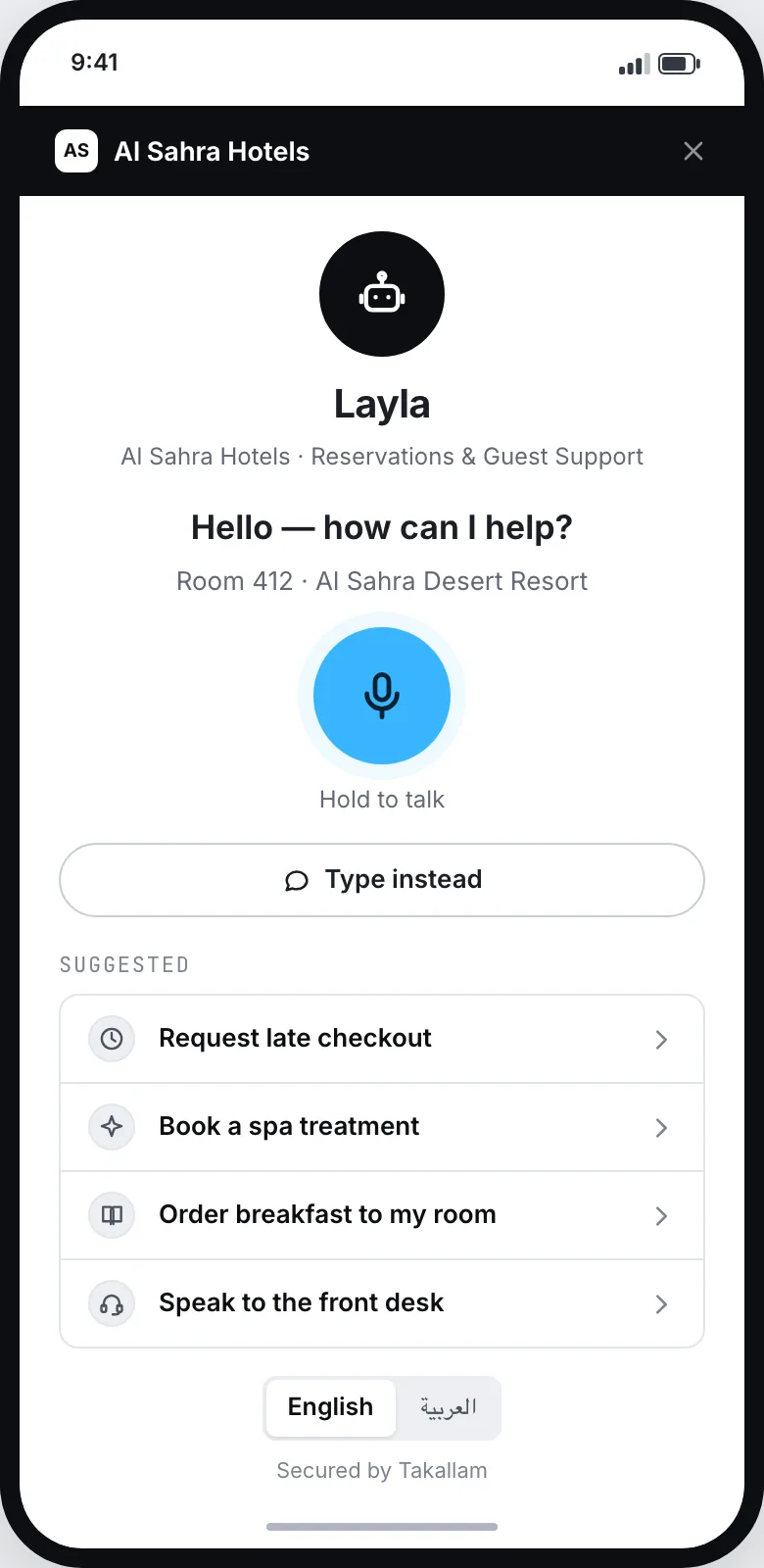
Print a QR code and put it where the question actually happens — a hotel room door, a shelf edge, a clinic reception, the side of a delivery box. The customer scans it and starts talking. No app, no sign-in, no number to dial, no queue. Mid-conversation they can drop to text and keep the same thread, and the whole thing lands in the same inbox as your chat, your support email and your phone.
- Opens straight into voice. The customer just speaks, in Arabic or English.
- Works for people who have never installed anything and never will.
- Different codes for different places, so you can see which location produces which questions.
Gulf dialect out loud, not Arabic as a locale
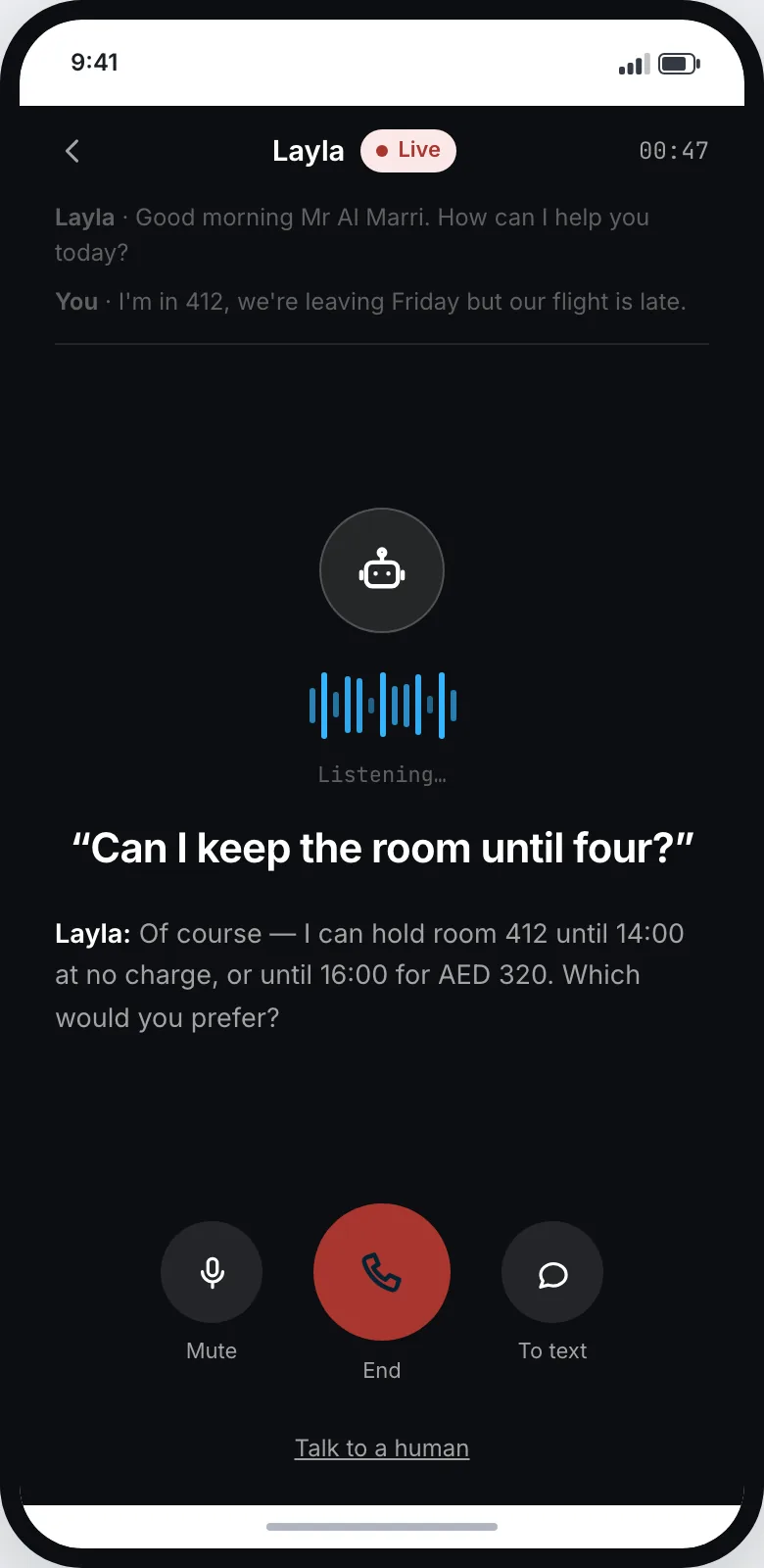
Support platforms built in San Francisco or Dublin treat Arabic as a localisation setting: the messenger flips right-to-left and the AI answers in careful Modern Standard Arabic. That reads fine and sounds wrong. Takallam handles Emirati and wider Gulf dialect in voice and in text, including the caller who begins a sentence in Arabic and finishes it in English, because that is how people here actually talk.
- Dialect in voice, not only Modern Standard Arabic in text.
- Code-switching handled inside the same turn.
- Right-to-left across the whole customer experience, not a translated skin.
- Conversations, transcripts and knowledge stay in the UAE region by default.
Which one you should actually pick
Choose Intercom if…
You sell software, your customers are signed in when they need help, and most of your support is written English. You want onboarding tours, proactive in-product messages and lifecycle campaigns in the same tool as support. Or you already run Fin on a mature help centre and it is working.
Choose Takallam if…
Your customers are physically somewhere — a room, a shop, a clinic, a warehouse — rather than logged into an app. The phone matters and nobody wants to staff it overnight. Your customers speak Gulf Arabic. Or you would rather pay for conversations than for seats.
What people ask when they are comparing the two
Is Takallam a replacement for Intercom?
It depends on what you use Intercom for. If it is your support platform — inbox, AI agent, help centre, tickets, your support email — then yes, Takallam covers that ground and adds QR voice and a phone line on top.
If you also use Intercom for product engagement — onboarding tours, proactive messages, lifecycle campaigns — then no. Takallam does not do product marketing messaging and has no plans to. Teams in that position usually keep Intercom for engagement and use Takallam for the live support channels.
Is Takallam better than Fin at answering chat?
We are not going to claim that without evidence we can show you. Fin is one of the strongest written-support agents available, and if your help centre is mature and your customers type in English, it will do well. Where Takallam differs is not chat quality — it is that the same agent also answers a QR scan, your support email and a phone call, in Emirati dialect, from one knowledge base and one inbox.
Intercom does voice now. What is actually different?
Fin can take calls, and that is a real capability. The difference is centre of gravity. Intercom added voice to a chat-first product; Takallam started with voice and built chat and tickets around it. In practice that shows up in the things next to the call — a printed code that opens in voice, dialect handling, per-channel pricing, and a console designed around spoken conversations rather than written threads.
What is the QR voice channel?
A printed code a customer scans and then speaks to. No app, no download, no sign-in, no phone number. It opens in voice and can drop to text mid-conversation. It exists because a lot of questions happen away from a screen — in a hotel room, at a shelf, at a service counter — and a messenger has nowhere to live in those moments.
Which one is better for Arabic?
For written Arabic in a messenger, Intercom will serve you. For spoken Arabic in Emirati or Gulf dialect, Takallam — that is the reason it was built here rather than localised into the region afterwards. If your customers only ever type, and only ever in English, this difference will not matter to you and you should weight the other rows instead.
How do the pricing models compare?
They are measured in different units, so a like-for-like figure would be misleading. Intercom charges for seats alongside AI resolutions. Takallam charges per interaction, priced separately for each channel, with no seats and no minimum commitment — a phone call and a chat message do not cost the same to deliver, so they are not billed the same. Takallam is pre-launch and rates are being set with the first cohort.
Can we run both?
Yes, and several early conversations have gone exactly that way. Takallam takes the voice channels — QR and phone — while Intercom keeps the in-product messenger and engagement campaigns. Conversations and escalations move between them through the API and webhooks.
Where does our data live?
In the UAE region by default. Conversations, transcripts and knowledge bases stay in-region, and you set what is retained and for how long.
Compare it against your own support, not a table
Tell us which channels you actually need and roughly what volume you handle. We will come back with a rate against your real numbers and show you the console with your own content inside it.
Pay per interaction · priced per channel · no seats, no minimums