
Half the calls into your workshop are two words: is it ready
Book a service, is my car ready, what does the warranty cover, is that part in stock, can I take a test drive on Saturday, when does my registration expire. Takallam answers all of it — from the sticker on the windscreen, inside your app, in the service inbox and on the phone, in English and Emirati Arabic. A recall or a suspected safety fault is never answered conversationally; it goes to a person the same day.
What the service line is asked all day
It is four in the afternoon and the advisor has eleven cars and forty calls
The workshop closes at six. Every customer whose car went in this morning wants the same two words, and the only person who knows the answer is standing in the bay with another customer. Meanwhile the parts counter is on hold, someone wants a test drive on Saturday, and an email asking whether a repair is covered has been sitting since yesterday afternoon.
- "Is it ready" is the highest-volume call in the building and the one an advisor could answer in four seconds — if they could get to the phone.
- The same question arrives by phone, by email, through the website form and at the counter, and comes back with four different collection times.
- Saturday morning and the hour before closing are when the calls peak and the team is least able to take them.
- Customers who would rather speak Arabic get a proper answer only when the right advisor is on shift.
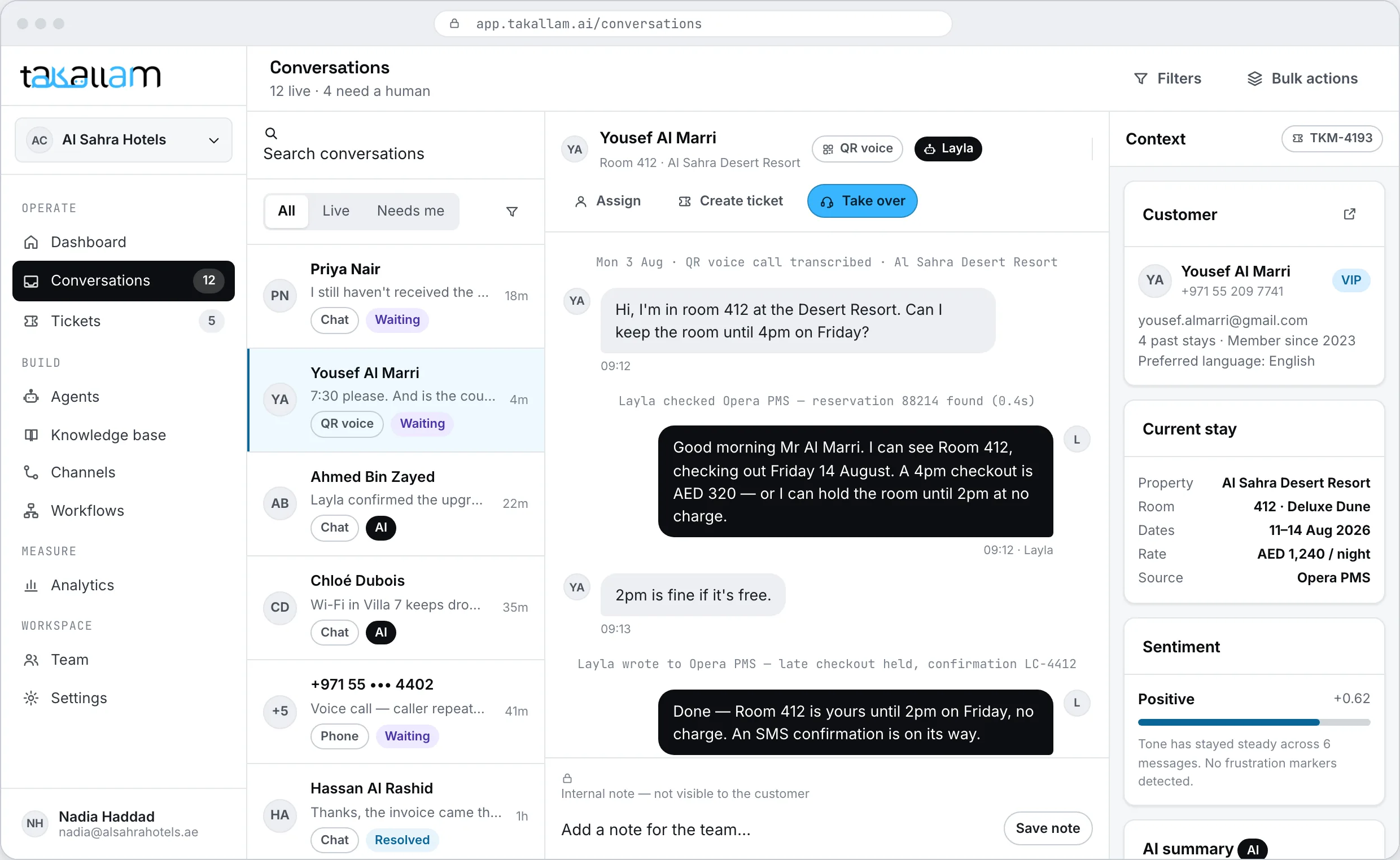
The calls that empty the service desk
Not the difficult diagnostics. The six questions that repeat every hour and take an advisor away from the customer standing in front of them.
Booking a service, and moving it
The slot, the drop-off window, whether a courtesy car comes with it, what a major service includes, and the reschedule two days later when the customer's week changes. High volume, low judgement, and it never justified another advisor. You pay for it by the interaction.
How pricing worksIs my car ready
The agent reads the job status and gives the real answer — the stage it is at, the promised time, and the reason if it slipped, because "we are waiting on a part" is a better answer than a ringing phone. If the status has not changed, it says so instead of inventing an hour.
Inside the consoleWhat the warranty covers — and who decides
It explains the coverage you published: the term, the mileage limit, what counts as a wear item, what a missed service interval does, what the extended plan adds. It does not approve a claim, deny one, or hint at an outcome. That decision is a person's, every time.
What an agent may doParts: on the shelf, on order, or neither
Whether the part is in stock, what it costs, how long an order takes, and whether a genuine and an aftermarket option both exist. An enquiry it cannot close becomes a ticket at the parts counter with the VIN and the part on it, rather than a note somebody wrote on the back of a job card.
How the knowledge base is builtRegistration, insurance renewal and the paperwork
When the registration expires, what the test needs, what to bring, whether the dealership can handle the renewal, and what happens to the warranty when the insurance changes. Most of it arrives by email a week before the deadline, in a thread with a photo of the old card attached.
The email channelTest drives, trade-ins and the follow-up nobody made
Which models are on the floor, what a Saturday slot looks like, what licence and documents a test drive needs, and how a trade-in valuation works. The enquiry that arrived at 9pm gets an answer at 9pm, and reaches sales the next morning with the model and the day already in it.
The windscreen sticker is the support channel you already print
Every car leaves your workshop with a small sticker in the corner of the windscreen showing the next service date and mileage. It is the one piece of your branding a customer looks at every single day for a year. Put a code on it and it stops being a reminder and starts being a way to reach you.
- Opens straight into voice — no app to install and no number to look up. Most people scan it standing next to the car, not moving.
- Emirati and wider Gulf Arabic in speech, not a formal register nobody uses at a service desk, and it follows a customer who starts in Arabic and finishes in English.
- Each scan carries the code it came from, so a question off the service sticker arrives tagged as service and not routed to sales.
- A customer who scanned on Tuesday and calls on Thursday gets the same agent, with the earlier conversation already there.
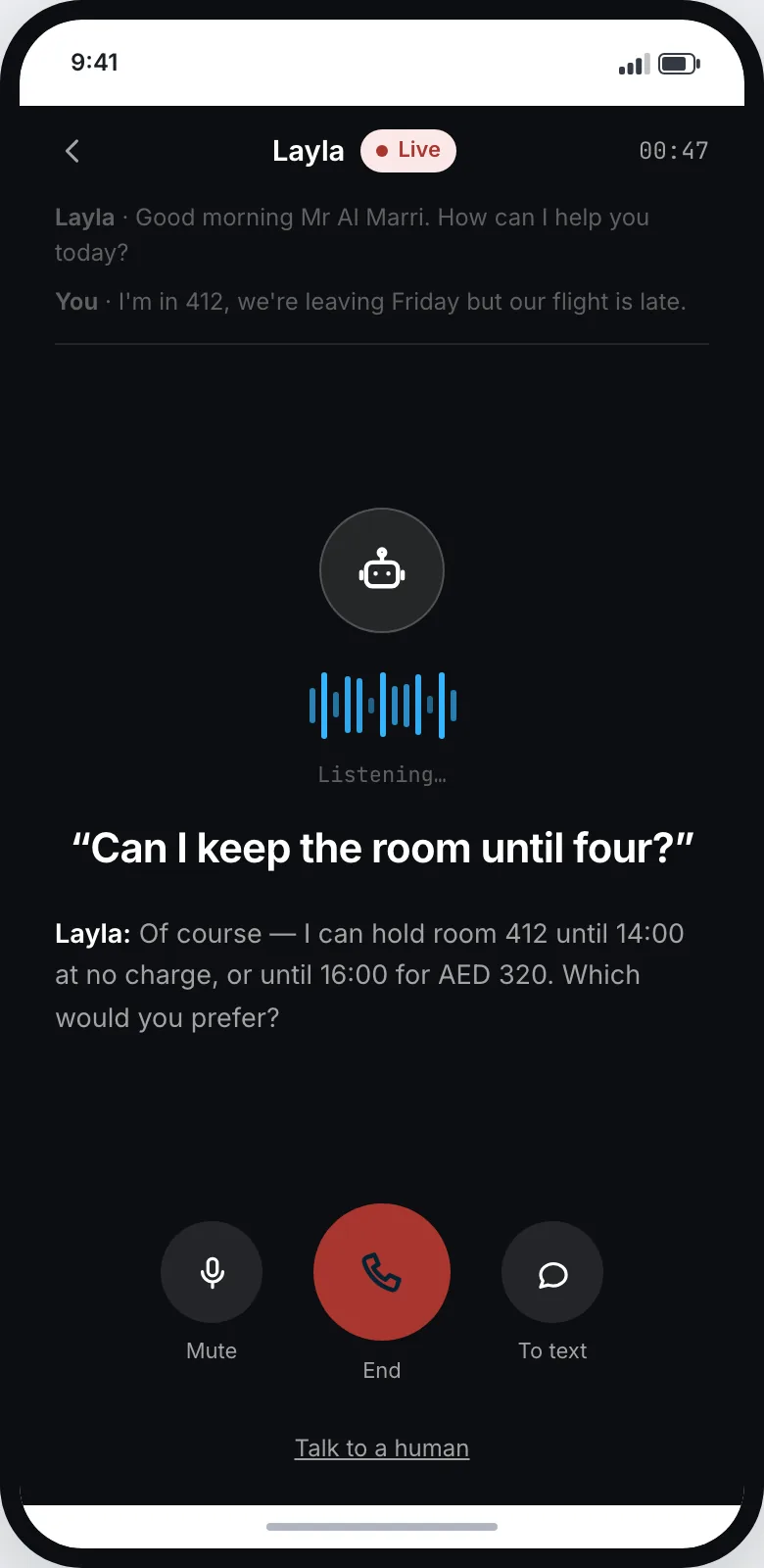
Where the code goes
Put it where the question happens. A code at service reception answers service questions; a code on a showroom car answers sales questions. Print a different one for each and you find out what each spot generates.
The windscreen service sticker
The next-service reminder you already print, with a code beside the date. Twelve months of visibility on the one surface every driver looks through. It answers the question that made them call: what is due, when, and how much.
Service reception and the waiting area
For the drop-off queue at eight in the morning and the customer waiting on a job. Wifi, how long the wait is, what the courtesy car policy is, whether the wash is included. The questions that interrupt an advisor mid-handover.
On the cars in the showroom
A code on the window card of every car on the floor. Specification, trim differences, what is in stock in which colour, the finance question, and a test drive booked without waiting for a free salesperson on a Saturday.
The parts counter
The queue at the parts window is the most repetitive queue in the building. A code takes the part number, checks availability and price, and opens a ticket when the answer is an order rather than a shelf.
The invoice, and a code per place
"What was this line for" arrives three days after collection, usually by email. A code on the invoice takes it straight to the agent with the job attached. Separate codes for service, sales, parts and the sticker mean the analytics show which one earns its ink.
Inside the consoleThree brands, five sites, one platform
A group running several franchises and a bodyshop prints its own codes per site and per department, while keeping one knowledge base, one inbox and one set of escalation rules. Takallam works the same way across other sectors.
Every sector Takallam coversA safety recall is never a conversation with an AI
Two things on this page are human-only, and they are the two that carry real risk. First: a recall, or a customer describing something that could be a safety fault — brakes, steering, a warning light they are still driving on, smoke, a seatbelt, an airbag — is not handled conversationally. The agent captures the VIN or the plate, gives only the safety instruction you have written yourself, and routes it to a named person the same day. It does not diagnose, it does not reassure, and it does not sit behind a parts enquiry in a queue. Second: warranty decisions belong to a person. The agent explains what the coverage says; it never approves, denies or predicts a claim outcome.
- A recall enquiry is captured with the VIN or plate and handed to the person you nominate, same day, with the routing logged and timestamped.
- A described symptom that could be a safety fault escalates on the first message. The agent does not attempt a diagnosis over voice, chat or email.
- The agent explains coverage. It does not approve a claim, deny one, quote a goodwill contribution or suggest what the outcome will probably be.
- Anything involving an accident, an injury or an insurance dispute goes to a person immediately, in any language and on any channel.
- The handover carries everything already collected, so your advisor opens the conversation with the VIN, the mileage and the customer's own description in front of them.
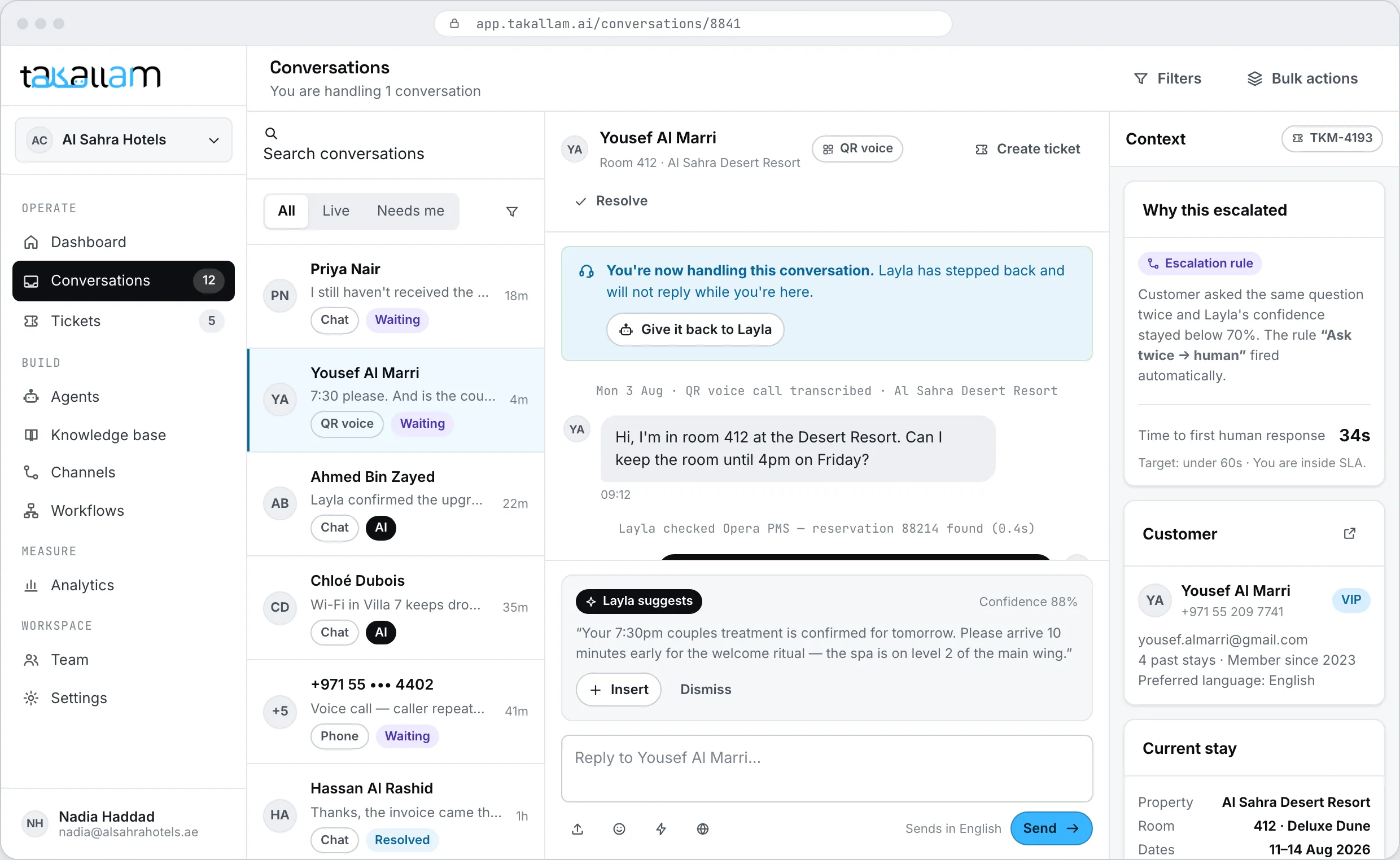
"Is it ready" has a real answer, and it lives in your DMS
The agent can only give a status if something told it the status. That part is a workflow: when this happens, do that, and if this other thing is true, do something else instead. The conversation is the front half; writing back to the systems that run the workshop is the half that makes it useful.
- When a customer asks about their car, look the job up by plate or VIN in your dealer management system and read back the real stage and the promised time.
- When a service is booked, hold the slot, put it in the workshop diary, and confirm the date, the drop-off window and whether a courtesy car is attached.
- When a job moves to ready, send the message your advisor never had time to send, in the language the customer asked in.
- Takallam does not ship a pre-built connector for every dealer management system. It ships a workflow builder, a REST API and signed webhooks — if your DMS can be called, a workflow can call it.
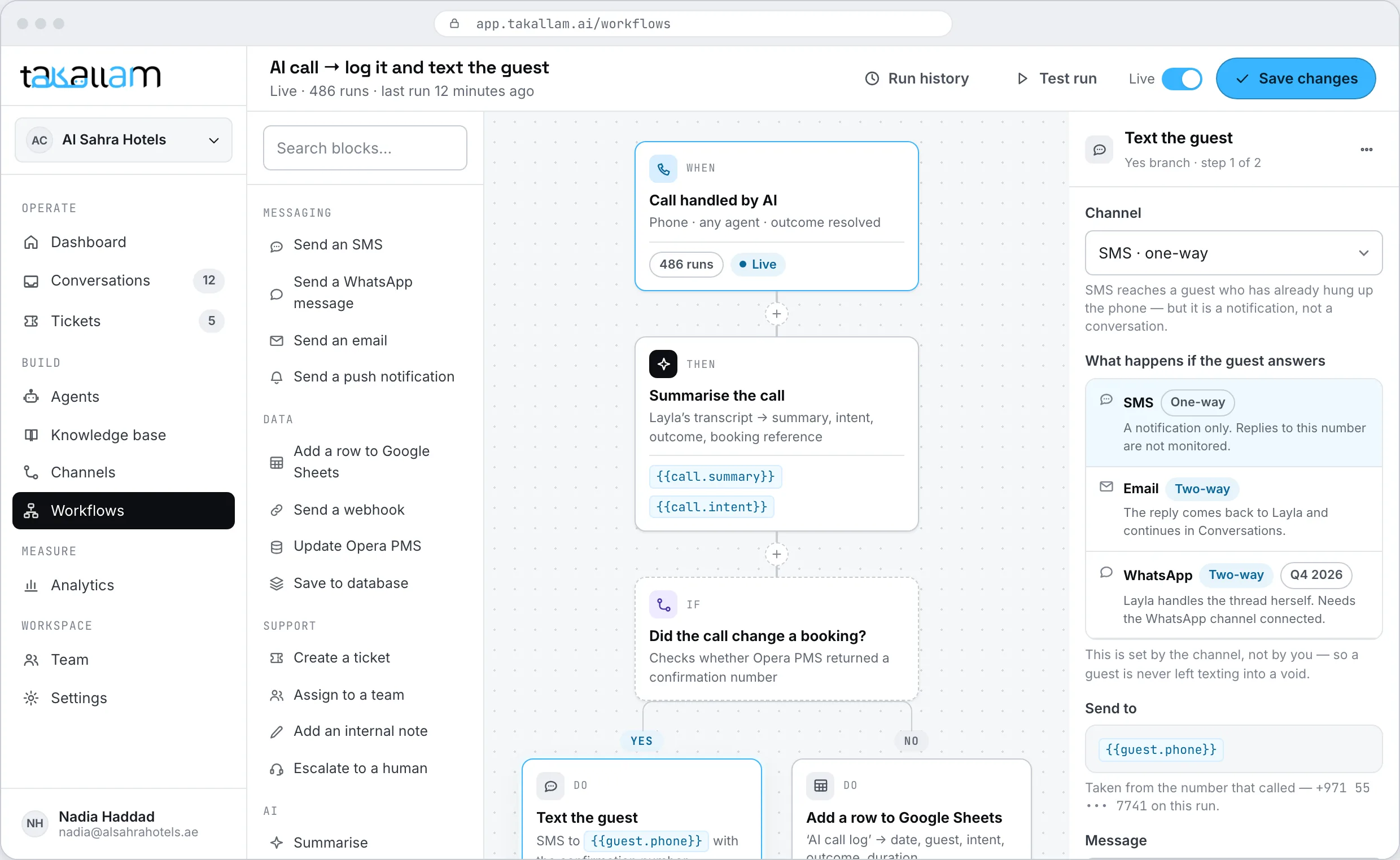
What the platform gives a dealership
These are capabilities of the platform, not results from a deployment. Takallam is pre-launch and has no published performance figures.
What service managers ask before anything answers a customer
Can it tell a customer whether their car is ready?
Yes, if you connect it to the system that holds the job. A workflow looks the job up by plate or VIN in your dealer management system and the agent reads back the real stage and the promised time. Without that connection it will not guess — it takes the plate, tells the customer an advisor is checking, and routes it with the details already captured.
What happens with a recall, or a customer who says something feels unsafe?
It stops being a conversation. A recall enquiry, or a description that could be a safety fault — brakes, steering, a warning light they are still driving on, smoke, a seatbelt, an airbag — is escalated on the first message to a person you nominate, and reaches them the same day.
The agent captures the VIN or plate, gives only the safety wording you wrote yourself, and does not diagnose, reassure or estimate. The routing is logged with a timestamp so you can show what happened and when.
Can it approve a warranty claim?
No, and it is not configurable to. The agent explains what your published coverage says — the term, the mileage limit, wear items, what a missed service interval does — and hands any actual decision to a person. It never approves, denies, quotes a goodwill figure or predicts an outcome, because a customer treats any of those as a promise.
Where do we put the QR code?
Wherever the question happens: the next-service sticker on the windscreen, service reception and the waiting area, the window card on every showroom car, the parts counter, and the invoice. Print a different code for each so you can see which placement customers actually use and which department each one feeds.
Does it connect to our DMS?
It connects to systems that can be called. Takallam gives you a workflow builder, a REST API and signed webhooks, so a workflow can read a job status, hold a service slot, check a part or write a note in any system that exposes an interface.
What Takallam does not do is claim a pre-built, certified integration with every dealer management system on the market. Tell us what you run and we will be straight with you about what the connection looks like.
Can it actually book the service, or does it only answer questions?
Both, and you choose which. In the agent builder you decide the actions each agent may take — hold a service slot, request a courtesy car, book a test drive, open a parts ticket — or leave it read-only. Every action is logged against the conversation that caused it, so you can audit exactly why a slot was taken.
Does it handle customers who speak Arabic?
Yes — Emirati and wider Gulf dialect in both voice and text, including customers who switch between Arabic and English mid-sentence, which is most of a UAE service reception. This is the reason Takallam exists rather than being an English-first product with translation added later. English and Arabic today; if your customer mix needs more, tell us before you join.
What does it cost, and how long does setup take?
You pay per interaction, and each channel is priced separately because a phone call and a chat message do not cost the same to deliver. No per-seat licences and no minimum commitment, which matters when service volume swings with the season and a plate-renewal month. Setup is short: Takallam reads your website, builds the knowledge base from your service, warranty and model pages, and drafts your first agents for you to review. Rates are being set with the first cohort — join the waitlist and we will quote against your real volume.
Put a code on the sticker and stop answering "is it ready"
We are onboarding a first cohort of UAE dealerships and service centres. Tell us how many sites you run, which channels you need and what your dealer management system is, and we will come back with a rate against your real volume.
Pay per interaction · priced per channel · no seats, no minimums