
One agent. Every channel.
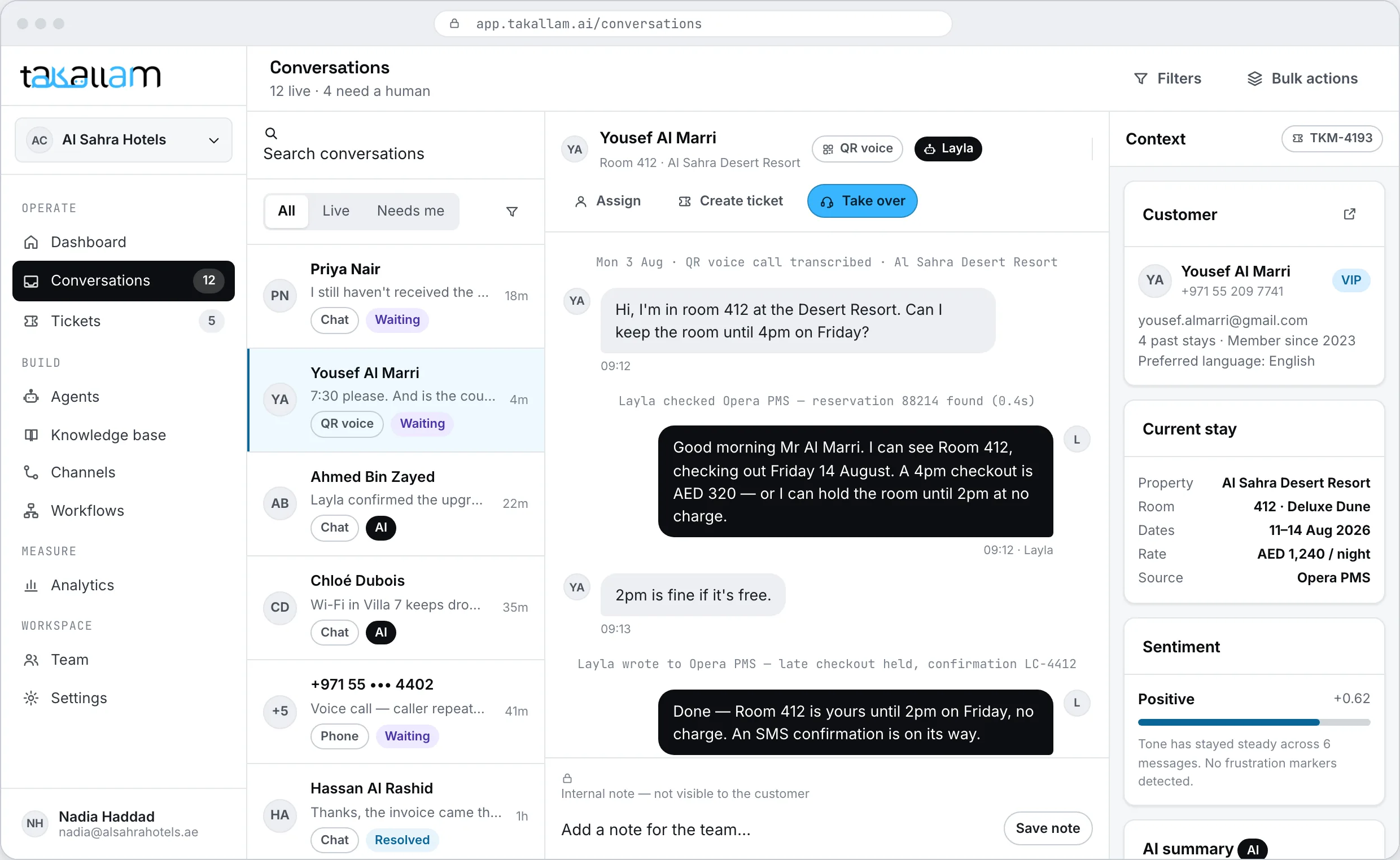
Takallam answers your customers on a QR scan, inside your app, in your support inbox and on the phone — in English and Emirati Arabic. It resolves most conversations on its own, and hands the rest to your team in the same thread.
Resolves ~80% of conversations automatically. No seats, no minimums.
Estimate. Takallam auto-resolves ~80% of conversations, freeing both talk time and after-call work; its cost covers talk time only, at the AED 0.75/min Pro voice rate.
One platform, the whole support surface
Your customers are on five channels. Your team is in five tools.
A helpdesk for email. A chat widget that only does chat. A voice vendor bolted on for the phone line. A separate automation tool to connect them. Every one of them bills you, and none of them share a memory of the customer.
- The same question gets answered three different ways depending on where it lands.
- Nobody can tell you what customers actually ask, because the record is split across vendors.
- A guest who called at 9pm has to explain themselves again when they message at 9am.
- Arabic support means either hiring for it around the clock, or not really offering it.
Live in an afternoon, not a quarter
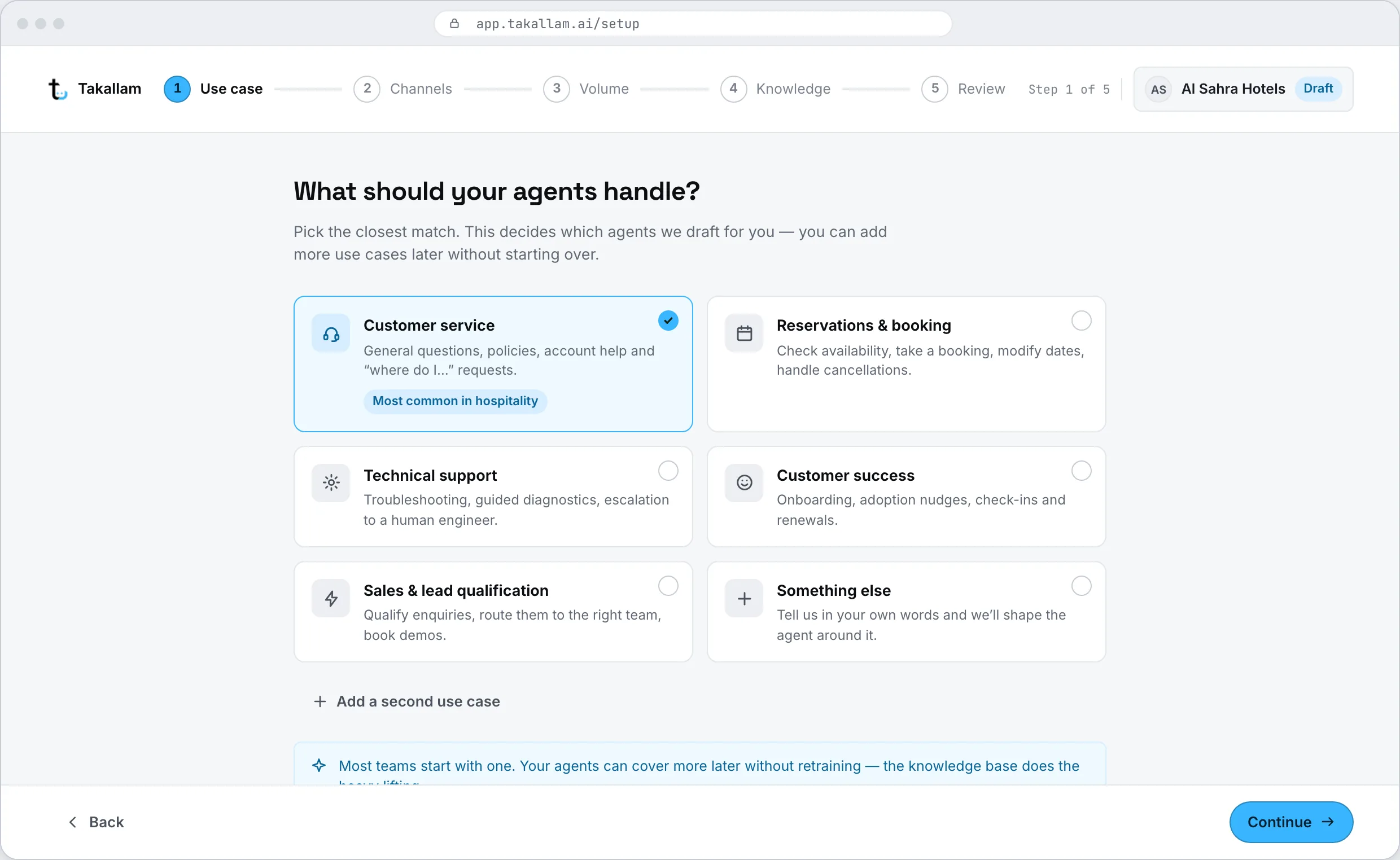
Takallam reads your website, builds your knowledge base and drafts your first agents before you have finished your coffee. You review, you adjust, you go live.
Answer four questions
What you do, where your customers reach you, roughly how many conversations a month, and what systems you want connected. That is the whole setup form.
- No implementation call required to get started.
- Your workspace is created and named from your own domain.
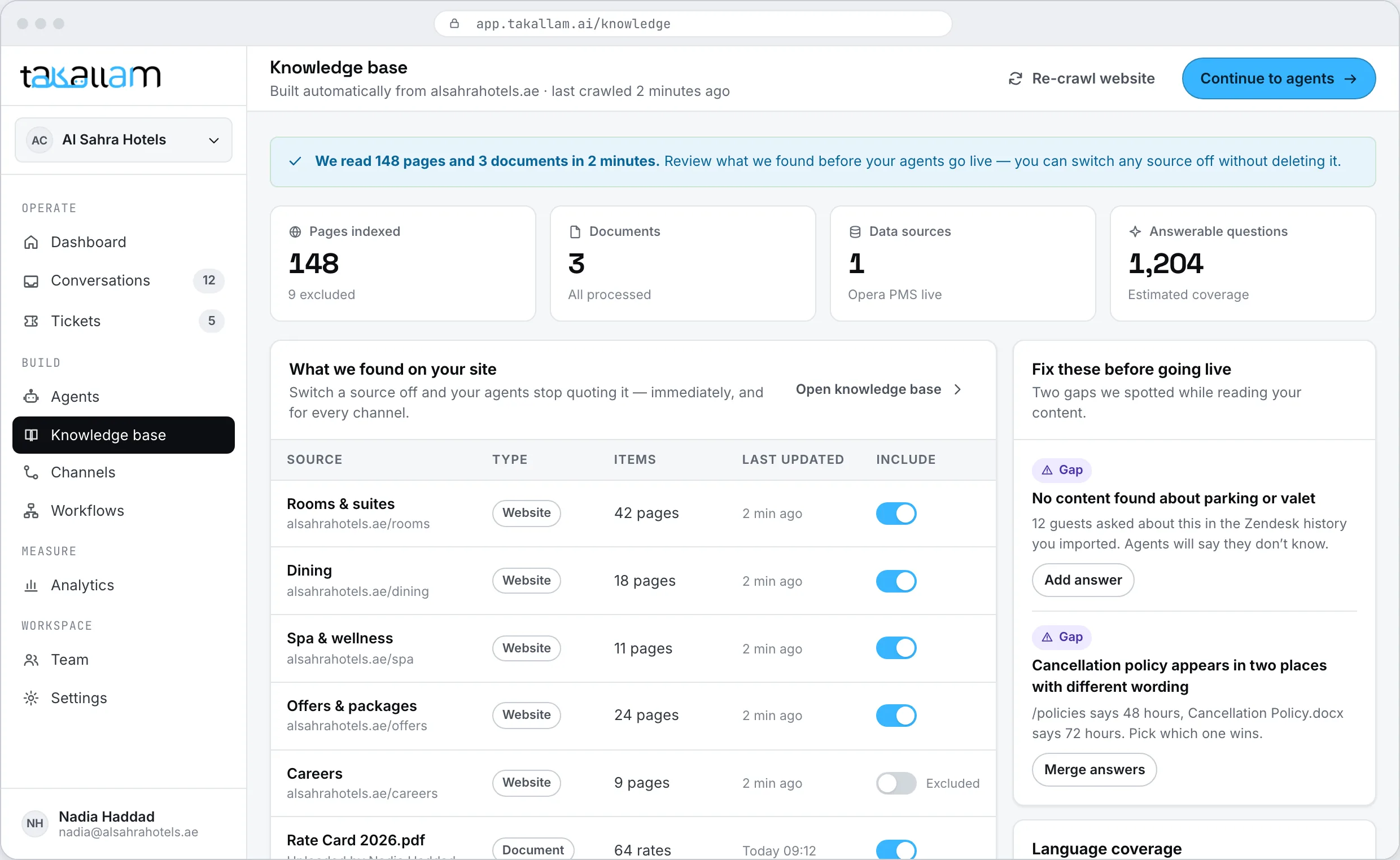
Your knowledge base builds itself
Takallam crawls your website, pulls in your policies, rates and FAQs, and shows you exactly what it learned. Add documents or connect a database if you have one. Everything stays editable.
- You see every page it read and can remove anything it should not use.
- Upload PDFs and documents, or connect a system like a PMS or an order database.
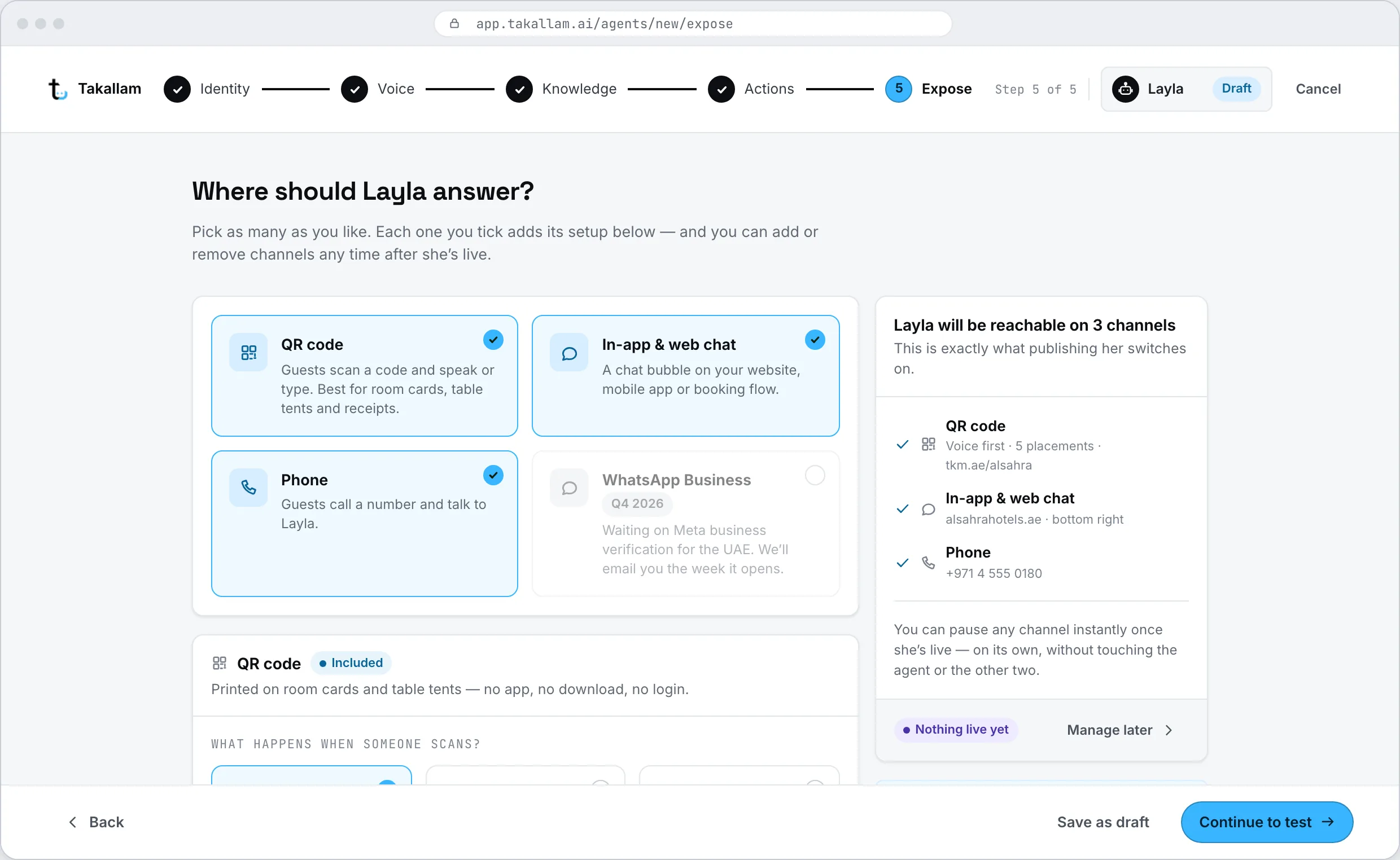
Build an agent and choose where it answers
Give it a name and a role, pick its voice and languages, point it at what it knows, decide what it is allowed to do — then tick the channels. QR, chat, phone. The setup for each one appears as you tick it.
- One flow from identity to live, not five disconnected settings screens.
- Test it against real questions before anyone outside sees it.
The same agent, wherever the customer is standing
One agent, one knowledge base, one record of the customer. The channel changes; the answer does not.
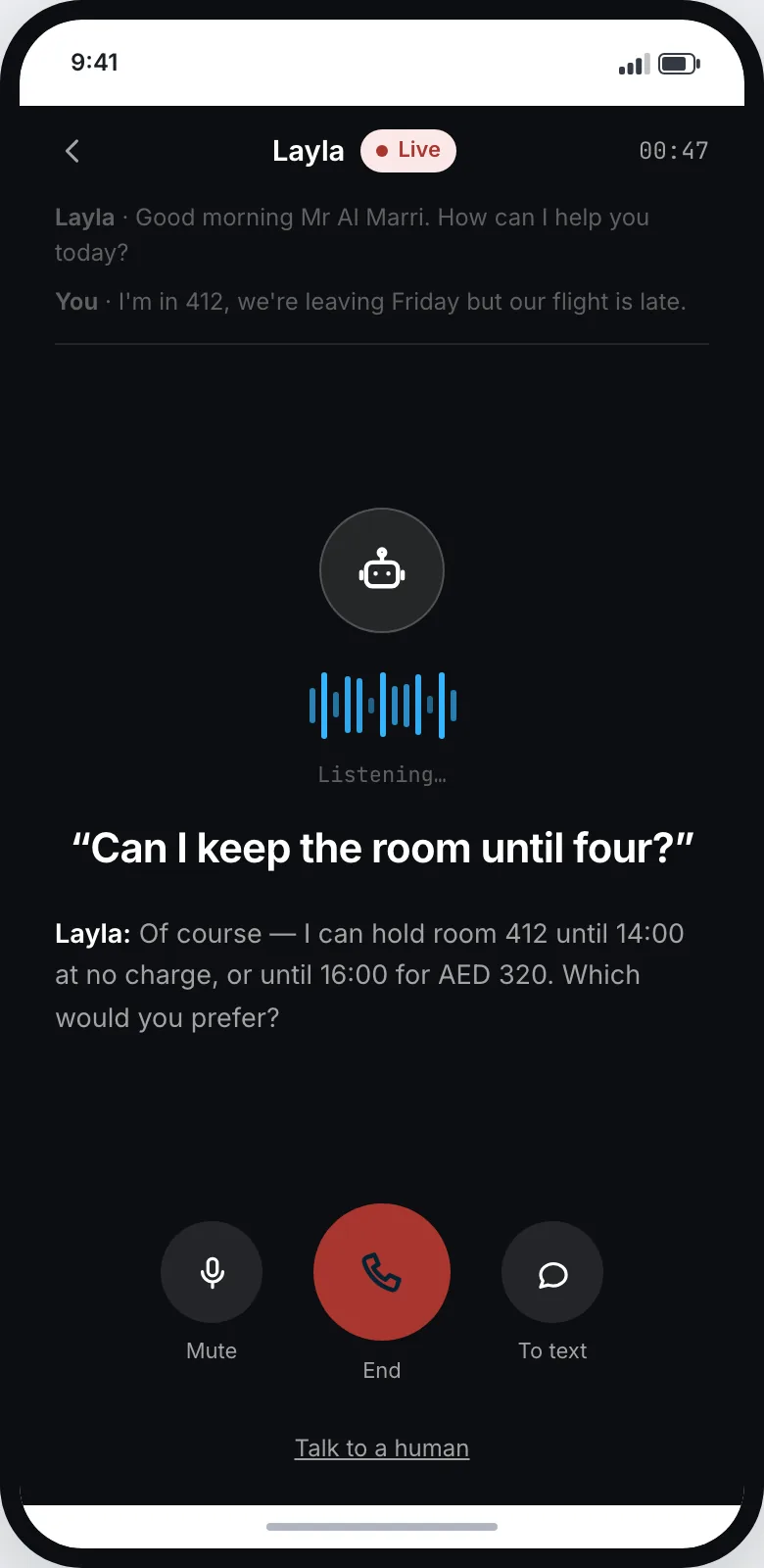
A sticker on the door that talks back
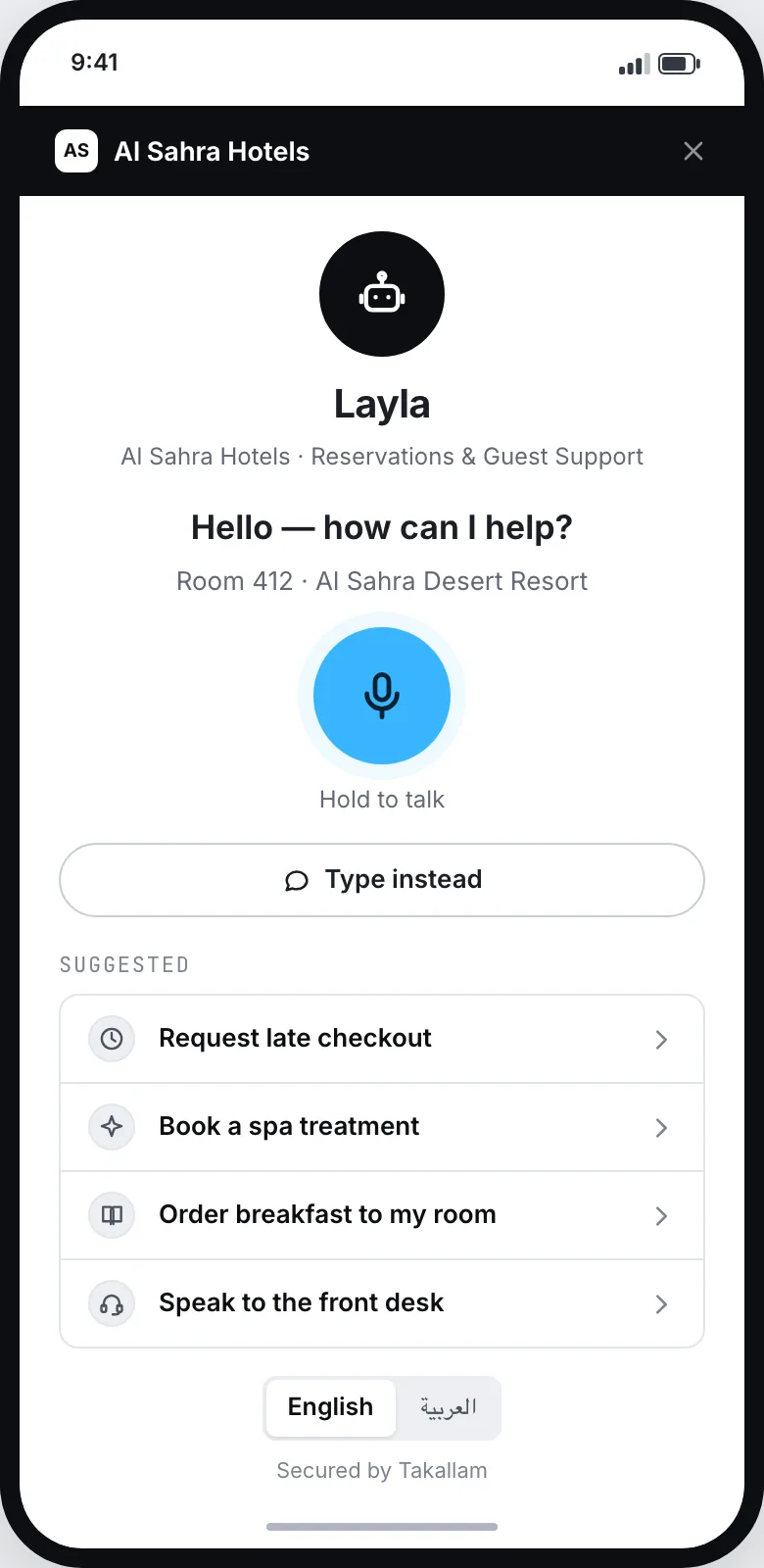
Print a code and put it where the question happens — a hotel room, a shelf edge, a service counter, a delivery box. The customer scans, speaks, and gets an answer. No app to download, no number to dial, no queue.
- Opens straight into voice — the customer just talks.
- Switch to text mid-conversation without losing the thread.
- Different codes for different places, so you can see which one gets used.
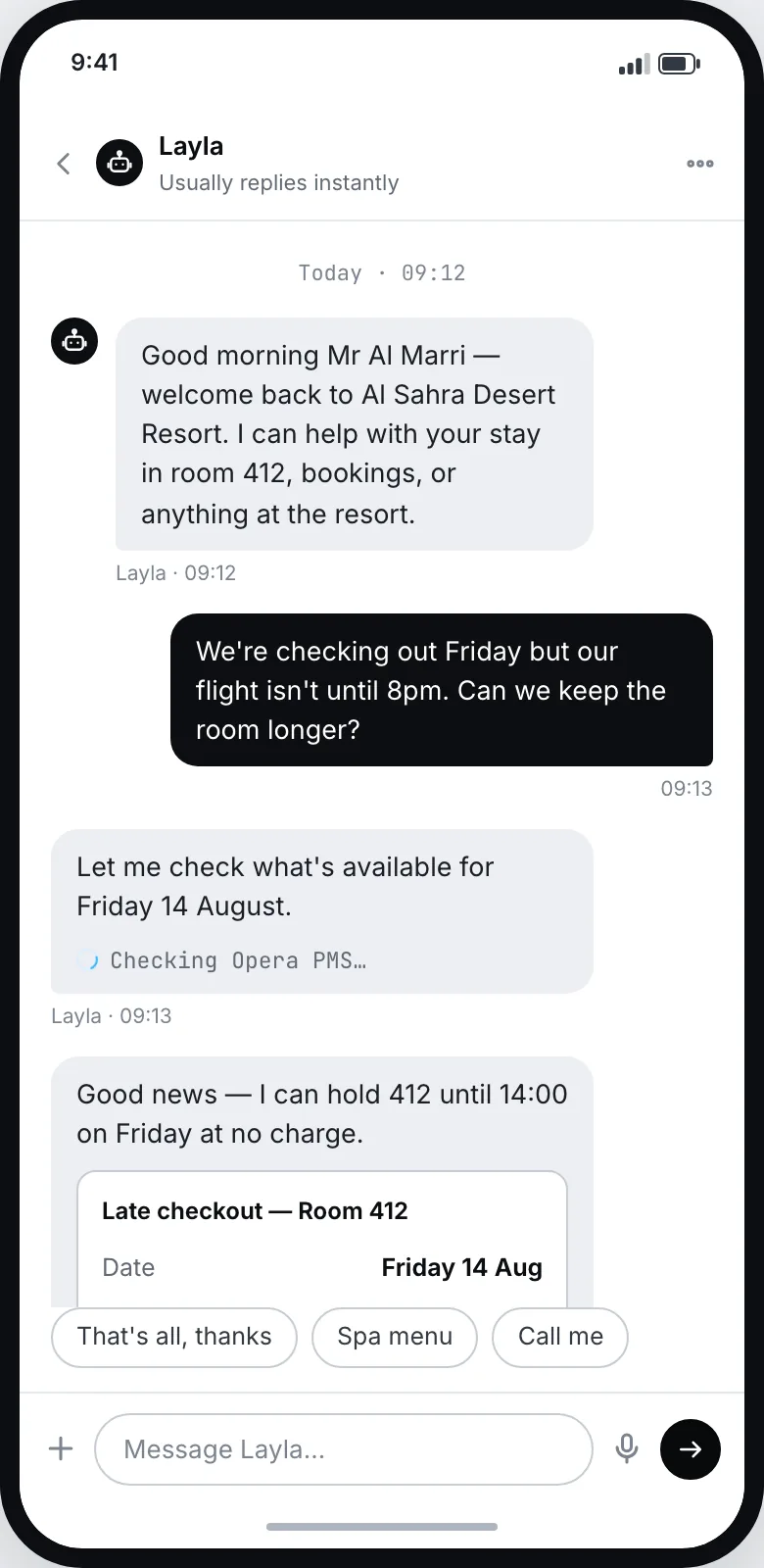
One snippet on your site or inside your app
The same agent, embedded where your customers already are. It knows your catalogue, your policies and your hours, and it can act — not just answer.
- Drop-in embed for a website, or an SDK for a mobile app.
- Picks up a conversation that started on the phone an hour ago.
- Hands over to a person without restarting the conversation.
Your support inbox, actually answered
Forward [email protected], or connect the mailbox. The agent reads the whole thread, replies from your own address, and triages the rest before anyone opens the inbox.
- Replies in-thread, from your domain, in the language the customer wrote in.
- Reads attachments — an invoice, a booking confirmation, a photo of a damaged item.
- Run it in draft mode first and approve replies until you trust it.
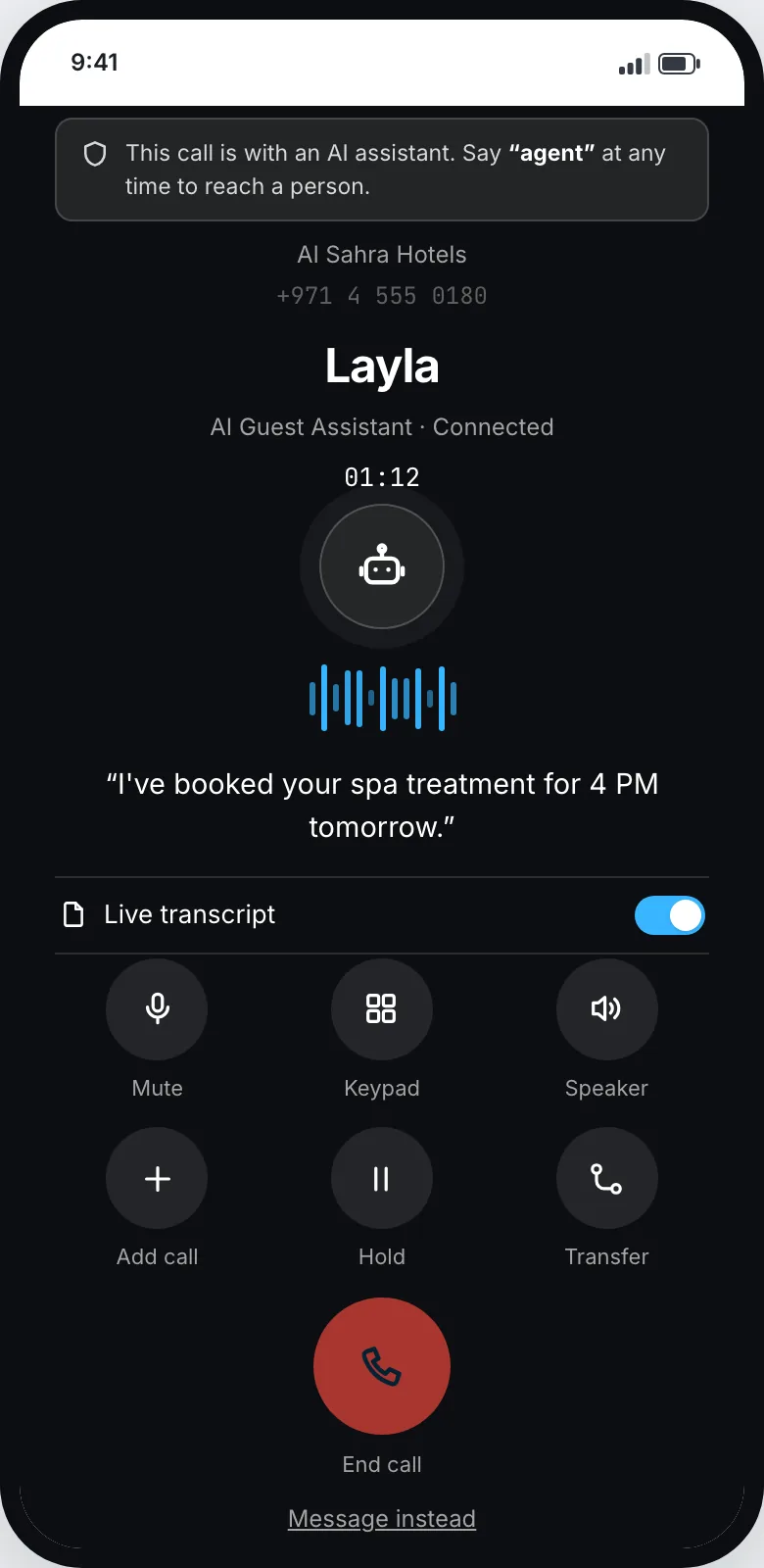
A number that always picks up
Give the agent a real phone number, or point your existing one at it. It answers on the first ring, at 3am, in Arabic or English, as many callers at once as you get.
- No hold music, because there is no queue.
- Escalates to a human with the full conversation attached.
- After-hours behaviour you set, not a voicemail box nobody checks.
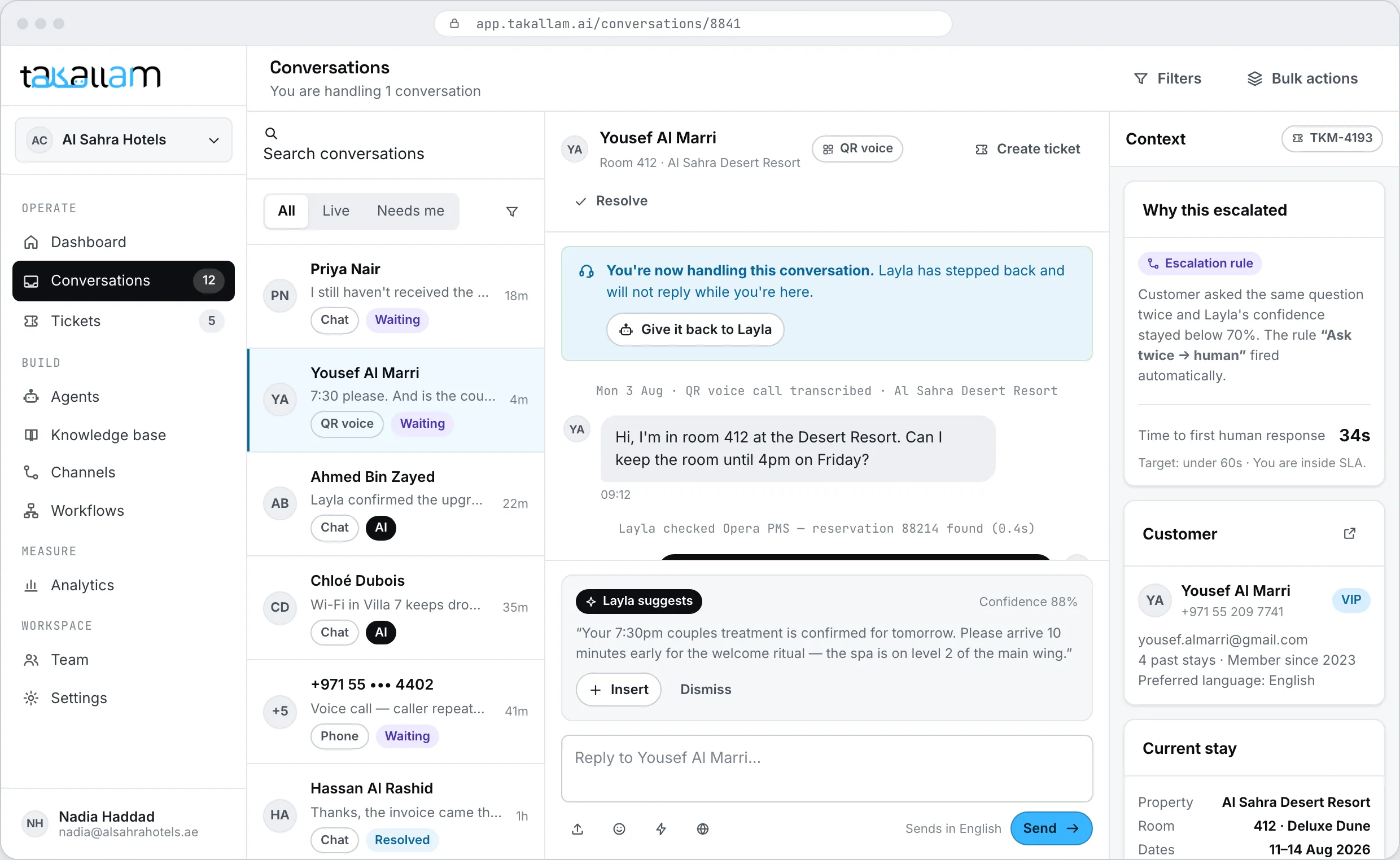
A person takes over. The customer never starts again.
Takallam flags the conversations that need a human — low confidence, an angry tone, a request it is not allowed to fulfil — and puts them in front of your team with everything already there. Your agent reads the transcript, sees what the AI tried, and continues in the same thread.
- No ticket number to quote, no "let me transfer you".
- Escalation rules you write, per agent and per channel.
- Tickets and SLAs for the things that genuinely need tracking.
What happens around the conversation
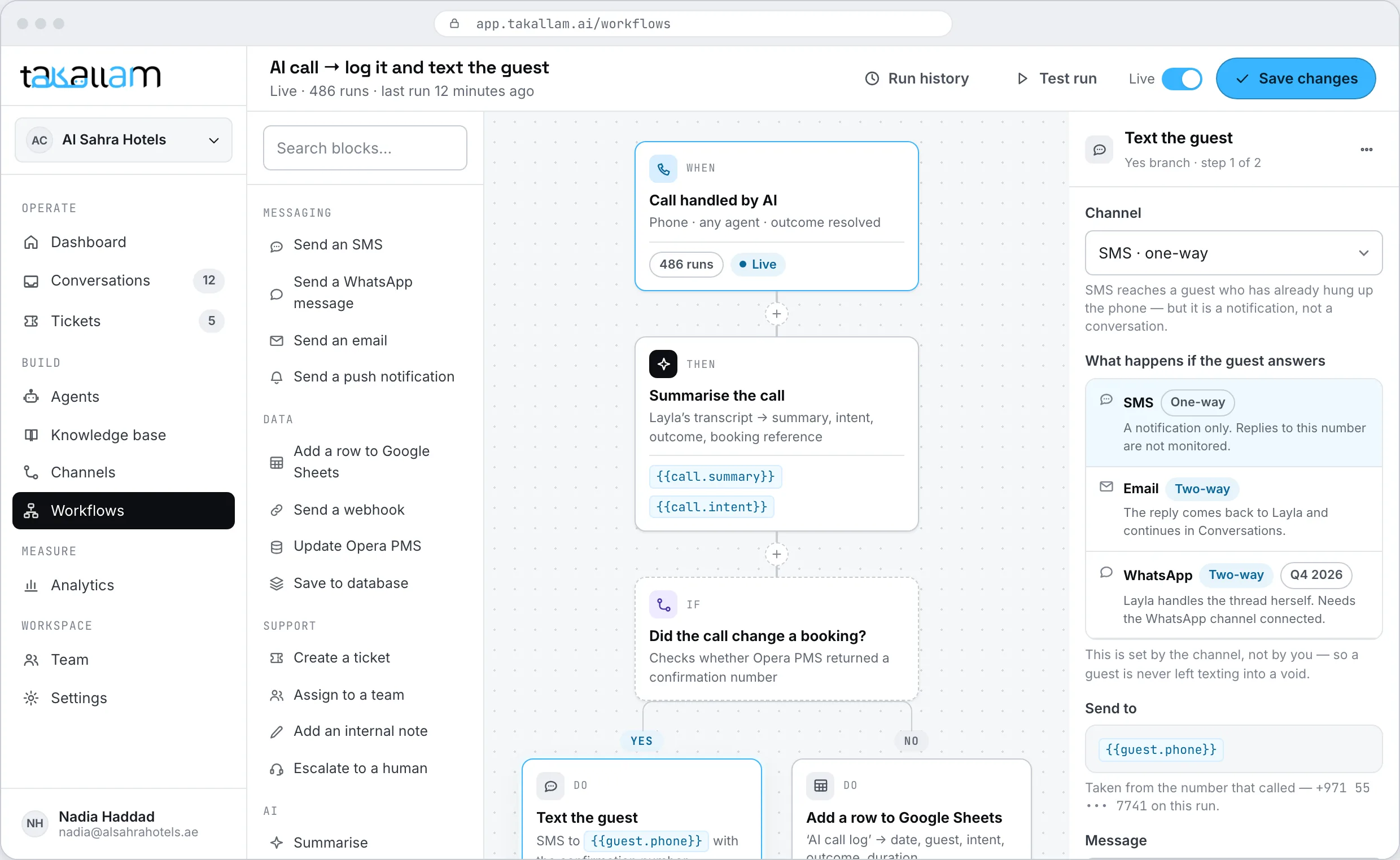
An agent decides what to say. A workflow decides what happens next — where the record goes, who gets told, what the customer receives afterwards. Build it by dragging blocks, not by filing a ticket with engineering.
- When a call is handled → summarise it → did it change a booking? → text the guest their confirmation and update the PMS.
- Branches, conditions and merge fields, with a live preview of the message a real customer would get.
- Run history that answers "did it actually work?" step by step.
It speaks the way your customers speak
Most AI support tools treat Arabic as a translation problem. Takallam is built here. It handles Emirati and Gulf dialect in voice and text, switches between Arabic and English mid-sentence the way real customers do, and writes back in the register you set.
- Emirati and Gulf dialect for voice, not just Modern Standard Arabic.
- Code-switching handled — a caller can start in Arabic and finish in English.
- Right-to-left throughout the customer experience, not a bolted-on translation.
- Data stays in the UAE region by default.
An API under everything you can click
Every action in the console is an endpoint. Create agents, push knowledge, start conversations, subscribe to events. Ship the embed in one line, or drive the whole thing from your own backend.
- REST API with predictable resources and cursor pagination.
- Signed webhooks for every conversation, escalation and workflow run.
- Embed snippet for the web, SDKs for iOS and Android.
# Point an agent at a phone number and go live
curl https://api.takallam.ai/v1/agents \
  -H "Authorization: Bearer $TAKALLAM_KEY" \
  -d '{
    "name": "Layla",
    "role": "reservations",
    "languages": ["ar-AE", "en"],
    "knowledge_base": "kb_live",
    "channels": {
      "phone":  { "number": "+971 4 555 0180" },
      "qr":     { "mode": "voice_first" },
      "chat":   { "embed": true }
    },
    "escalate_when": ["low_confidence", "refund_requested"]
}'One app instead of a stack
Most teams end up buying a ticketing suite, bolting an AI add-on onto it, and signing a separate contract for the phone line. Here is what that actually costs you in capability.
| Takallam | Ticketing suite + AI add-on | Voice-agent API | |
|---|---|---|---|
| Answers on the phone | |||
| Answers from a QR scan | |||
| In-app and web chat | |||
| Answers your support inbox | |||
| Knowledge base built from your website | |||
| Human takeover in the same thread | |||
| Tickets, SLAs and a support queue | |||
| Workflow automation included | |||
| Emirati and Gulf dialect voice | |||
| One vendor, one bill, one record of the customer | |||
| Priced per interaction, not per seat |
Categories, not specific products — capabilities vary by vendor and plan. Named, sourced comparisons are on the comparison pages.
See it against what you are using now
Against ticketing suites
Zendesk, Freshdesk, Intercom and Salesforce Service Cloud are excellent at tracking work. They were not built to pick up a phone in Emirati Arabic at 3am.
Compare with ticketing platformsAgainst AI voice agents
Vapi, Retell, Bland, PolyAI and ElevenLabs give developers superb voice infrastructure. They do not give your support team an inbox, a ticket or a knowledge base.
Compare with voice-agent toolsThe things people ask first
What exactly is Takallam?
Takallam is an AI customer-support platform. You create AI agents, connect them to your knowledge, and expose them to your customers over four channels — a QR code they scan and speak to, chat inside your website or app, your support inbox, and a phone number. Anything the AI cannot resolve is handed to your team in the same conversation, with tickets and workflows behind it.
How is this different from adding AI to Zendesk or Intercom?
A ticketing suite with an AI add-on is still a ticketing suite: it is organised around tickets, queues and seats. Takallam is organised around conversations and is voice-native — the phone line and the QR code are first-class channels, not integrations. You also buy one thing rather than a suite plus an AI add-on plus a voice vendor.
How is this different from a voice-agent API like Vapi or Retell?
Those are excellent building blocks for developers who want to construct a voice bot. Takallam is the finished support operation: the agent builder, the knowledge base, the human console, tickets, SLAs, workflows and analytics are all included, and voice is one of four channels rather than the whole product.
Does it really handle Emirati Arabic?
Yes — Emirati and wider Gulf dialect in both voice and text, including customers who switch between Arabic and English mid-sentence. This is the reason Takallam exists rather than being a translation layer on top of an English-first product.
What does it cost?
You pay per interaction, and each channel is priced separately, because a phone call and a chat message do not cost the same to deliver. There are no per-seat licences and no minimum commitment. Takallam is pre-launch, so exact rates are being set with the first cohort — join the waitlist and we will quote against your actual volume.
Where does our data live?
In the UAE region by default. Conversations, transcripts and knowledge bases stay in-region, and you decide what is retained and for how long.
How long does setup take?
Most of it is automatic. You answer four questions, Takallam reads your website and builds the knowledge base, and it drafts your first agents for you. The work you actually do is reviewing what it learned and deciding what each agent is allowed to do.
Can we keep our existing phone number?
Yes. You can point an existing number at Takallam, or take a new one. Calls the AI cannot handle route to your team with the transcript attached.
Be one of the first businesses on Takallam
We are onboarding a first cohort in the UAE now. Tell us which channels you need and we will come back with a rate against your real volume.
Pay per interaction · priced per channel · no seats, no minimums