
Takallam vs Retell AI
Retell AI makes good phone agents. The voice is natural, the call-handling primitives are solid, and putting a working agent on a number is straightforward. Takallam is a different kind of product: a support operation where the phone is one of four channels, sitting on top of a console, an inbox, human takeover, tickets, a knowledge base, workflows and analytics. Which you need depends on whether the call is the job, or the start of it.
A phone agent is not a support team.
Retell gives you a voice agent that answers well. That solves the moment the phone rings. It does not answer what happens next: who owns the issue, where it is tracked, how the customer follows up tomorrow in your app, what the SLA is, and who reads the transcript when the caller was unhappy. Takallam is built around that whole arc, and the call is one channel inside it.
- Retell is a very good way to build a phone agent. This page does not argue otherwise.
- Takallam adds the parts around the call: an inbox, a person who can step in, a ticket, a follow-up, a record.
- The same customer scans a QR code in the lobby, emails in the afternoon, calls in the evening and messages in the app the next morning — one thread, not four.
- If phone is the only channel you will ever run and you have a developer, the specialist tool may be the better buy.
Three cases where the phone specialist is the right call
Said plainly, because pretending otherwise would waste your time. If one of these is you, buy the specialist.
The call itself is the product
Retell puts real effort into how a call sounds and how the agent handles interruption and turn-taking. If your entire value is a phone conversation that feels human, that focus is worth paying for.
Phone is the only channel
Outbound qualification, appointment reminders, a screening line, a single number that books a slot. If no part of the job touches chat, email, a QR code or a shared inbox, a support console is overhead you do not need.
You are wiring it into your own systems
A developer building a bespoke call flow against your own backend, with your own state and your own UI. That is a build, and a focused voice product with clean primitives is the right foundation for it.
What each one ships with
Capability, not price. Both products answer the phone well. The difference is everything that happens on either side of the call.
| Capability | Takallam | Retell AI |
|---|---|---|
| Inbound phone number | ||
| Natural conversational voice on calls | ||
| Scan-a-QR-code voice channel | ||
| In-app and web chat | ||
| Email answered from your support address | ||
| Shared inbox for your team | ||
| Human takeover mid-conversation | Transfer to a person | |
| Tickets, SLAs and a support queue | ||
| Knowledge base built from your website | Yes, for the agent | |
| Workflow automation after the call | ||
| Analytics across every channel | Call analytics | |
| One conversation record per customer | ||
| Emirati and Gulf dialect voice | ||
| Engineering required to launch | None to go live | Some, for integrations |
| Data resident in the UAE by default | Not by default |
Capability comparison as of 2026, based on public documentation for each product. A half-mark means the capability exists in some form but is scoped to the voice agent rather than to a support team. Retell AI is a voice-agent platform by design, and it is a good one — the comparison is about product shape, not quality.
A good call is not the same as a resolved issue.
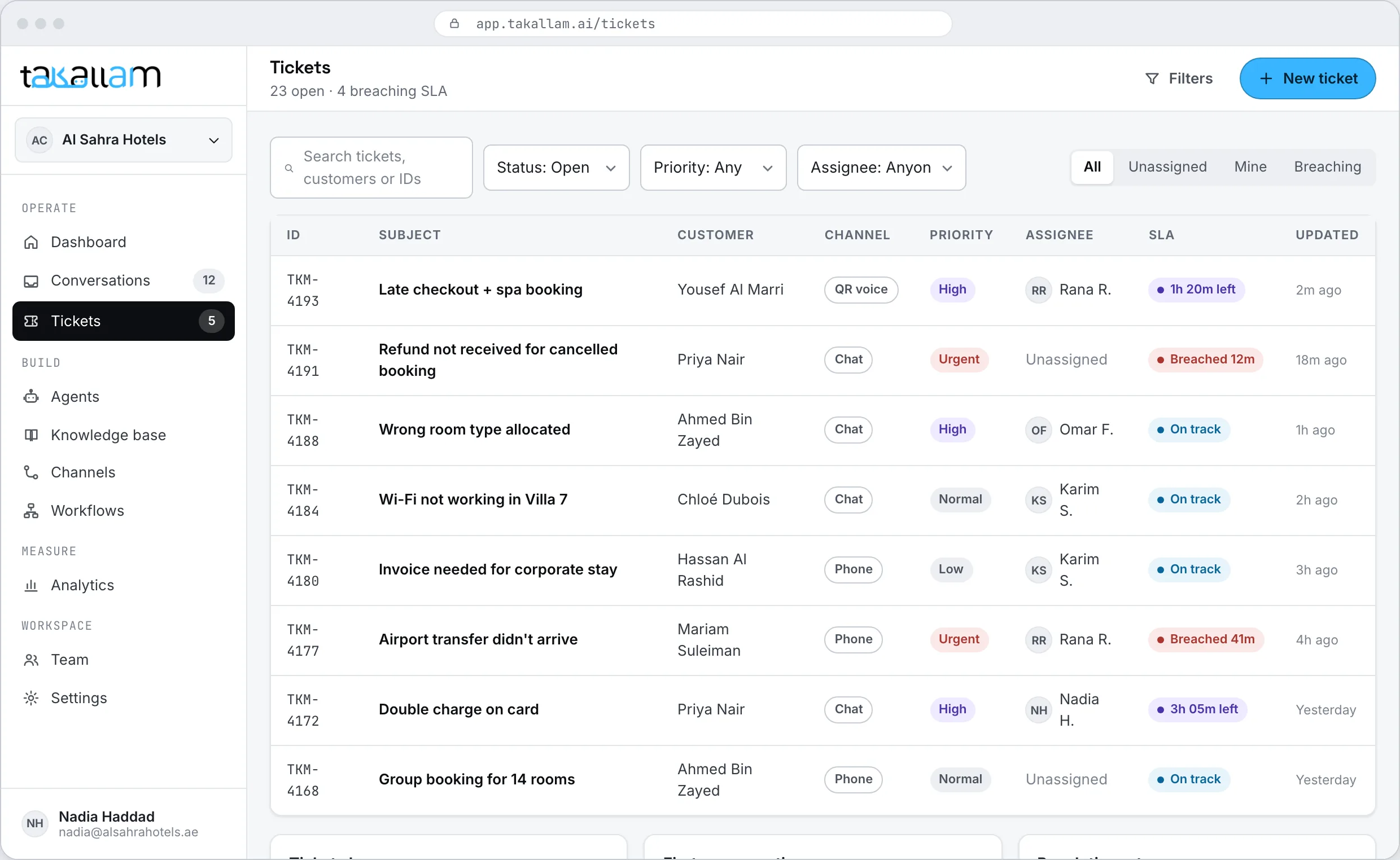
Half of support is what happens once the customer hangs up. The refund still has to be approved. The maintenance request still has to reach housekeeping. Somebody has to notice that the same question came up eleven times this week. Takallam turns a conversation into a tracked piece of work without anyone retyping it.
- Tickets with owners, priorities and SLA timers, created straight out of the conversation.
- The transcript, the channel and what the AI already tried, attached to the ticket rather than described in it.
- Workflows that fire around the conversation — update the PMS, text the confirmation, log it to a sheet.
- Analytics that tell you what customers keep asking, so the knowledge base gets fixed instead of the team getting blamed.
Emirati on the phone, not Arabic in the abstract
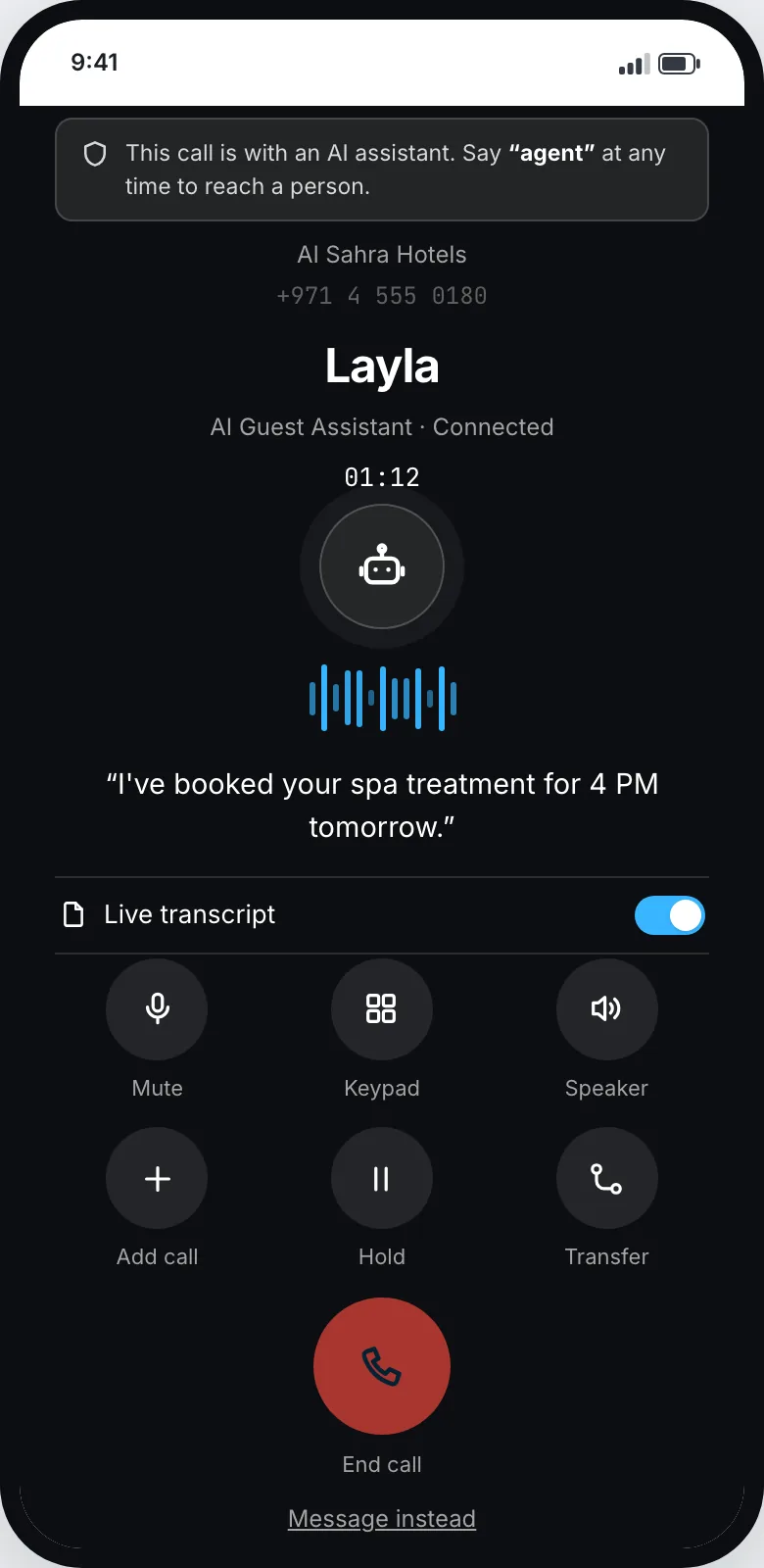
Plenty of voice products support Arabic. Far fewer hold up when a caller in Dubai speaks the way people in Dubai actually speak, or starts a sentence in Arabic and finishes it in English. Takallam was built in the UAE for exactly that call, and the same agent carries it into the QR code, chat and email without changing register.
- Emirati and wider Gulf dialect in voice and in text, not only Modern Standard Arabic.
- Code-switching treated as normal conversation rather than a failure to parse.
- Right-to-left across the whole customer experience, including the QR and chat surfaces.
- Data resident in the UAE region by default, with retention you control.
What sits behind the conversation
None of this is an integration you go and buy. It is the product.
Knowledge base from your site
Takallam crawls your website, pulls in your policies, rates and FAQs and shows you what it learned. You remove what it should not use and add documents of your own.
See the knowledge baseOne inbox for four channels
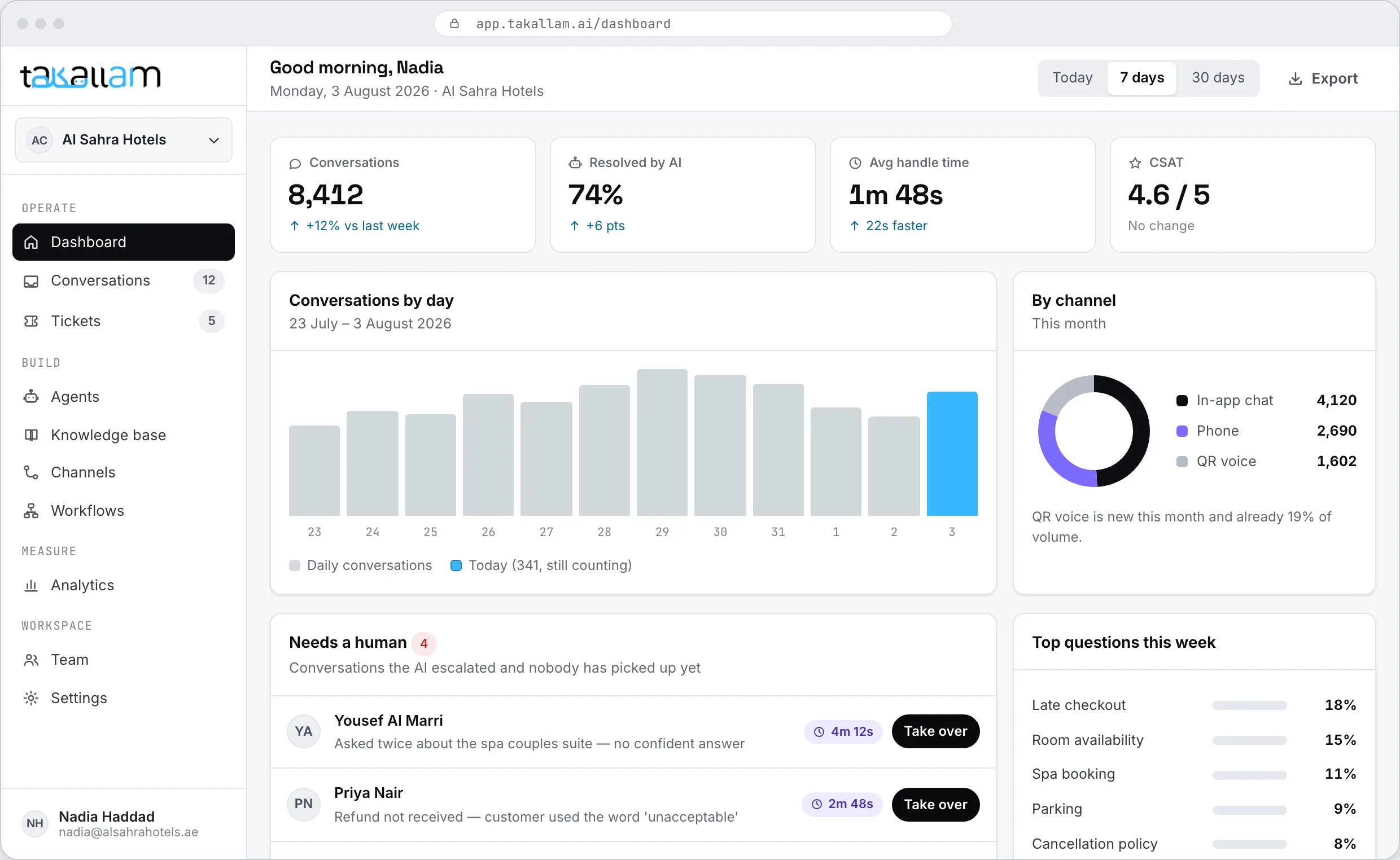
QR voice, chat, email and phone conversations in a single queue, assignable to people, with the history of the customer attached rather than searched for.
See the inboxHuman takeover in the thread
Low confidence, an angry tone, a request the agent is not allowed to fulfil. Your team continues the same conversation instead of starting a new one.
See handoverTickets and SLAs
For the things that genuinely need tracking: owners, priorities, due times and a queue that shows what is about to breach.
See ticketsWorkflows around the call
When a call is handled, summarise it, branch on what changed, update the system that owns the record and message the customer. Built by dragging blocks.
See the workflow builderThe channel that has no number
A printed code on a door, a shelf or a delivery box that the customer scans and speaks to. No app, no download, nothing to dial.
See the QR channelThe inbox you already have
Forward your support address, or connect the mailbox. The agent reads the whole thread, replies from your own address, and triages the rest before anyone opens it.
See the email channelChoosing between them
Is Takallam better than Retell AI?
They are different products, so the honest answer depends on the job. Retell AI is a voice-agent platform and a good one. Takallam is a support platform with voice inside it. If you need a phone agent, compare them on the call. If you need customers answered across a QR code, chat, email and the phone with humans in the loop, they are not really competing.
Can Retell AI do QR scan-to-speak?
No product in this category does — scan-to-speak is not a phone or chat channel, it is a printed code that opens straight into a voice conversation in the browser. It is the channel Takallam was designed around, and it is why a guest can ask about a late checkout from the door of the room without dialling anything.
What happens when the AI cannot answer?
On a voice-agent platform the usual answer is transferring the caller to a phone number, which is a real capability and often enough. In Takallam the conversation moves to a person inside the same thread, on any channel: they see the transcript and what the AI already tried, and they reply without the customer repeating themselves.
Which one handles Emirati Arabic better?
Takallam, because it is the reason the product exists. Emirati and Gulf dialect in voice and text, code-switching between Arabic and English inside a single sentence, and the same register carried across the QR code, chat, email and the phone rather than tuned for one channel.
We already have a voice agent on a number. Can we switch?
Yes. You can point your existing number at Takallam rather than taking a new one, and your knowledge base is rebuilt from your website automatically instead of being migrated by hand. You can run the two side by side while you compare.
Do we need engineers to launch Takallam?
No. You answer four questions, Takallam reads your website, builds the knowledge base and drafts your first agents, and you review and go live. There is a REST API and signed webhooks for teams that want them, but launching does not require code.
How is Takallam priced against a per-minute voice product?
Takallam bills per interaction and prices each channel separately, because a phone call and a chat message do not cost the same to deliver. There are no per-seat licences and no minimum commitment. Rates are being set with the first cohort — join the waitlist and we will quote against your real volume.
Is the call the job, or the start of it?
Tell us how your customers reach you and what happens after they hang up. If a phone agent is all you need, we will tell you. If you need the operation around it, we will show you what going live looks like.
Pay per interaction · priced per channel · no seats, no minimums