
Most of the queue is someone trying to read their own policy
What does my policy cover, where has my claim got to, can I add my newborn, is that garage in Al Quoz approved, what documents do you still need from me. Takallam answers all of it from a code on the policy document, in chat, in your inbox and on the phone — in English and Emirati Arabic. It never decides a claim. That goes to a person, with the file already complete.
What policyholders call about
Half the queue is not a claim. It is a question about a claim.
The lines open and the queue is already deep. One caller wants to know whether physiotherapy is covered. One wants to know whether the garage down the road is approved. One is trying to add a newborn before the window closes. One has sent the same three documents twice and cannot understand why nothing has moved since Tuesday. None of those are decisions. All of them take an agent seven minutes.
- The same questions arrive by phone, by a forwarded message, by email and at the branch counter, and get four slightly different answers.
- Most claim-status calls have nothing to do with the claim. They exist because nobody told the customer anything for four days.
- Renewal season triples the volume for three weeks, so you are either overstaffed in June or drowning in December.
- A policy wording is forty pages of language nobody outside the industry reads — and that is exactly why the phone rings.
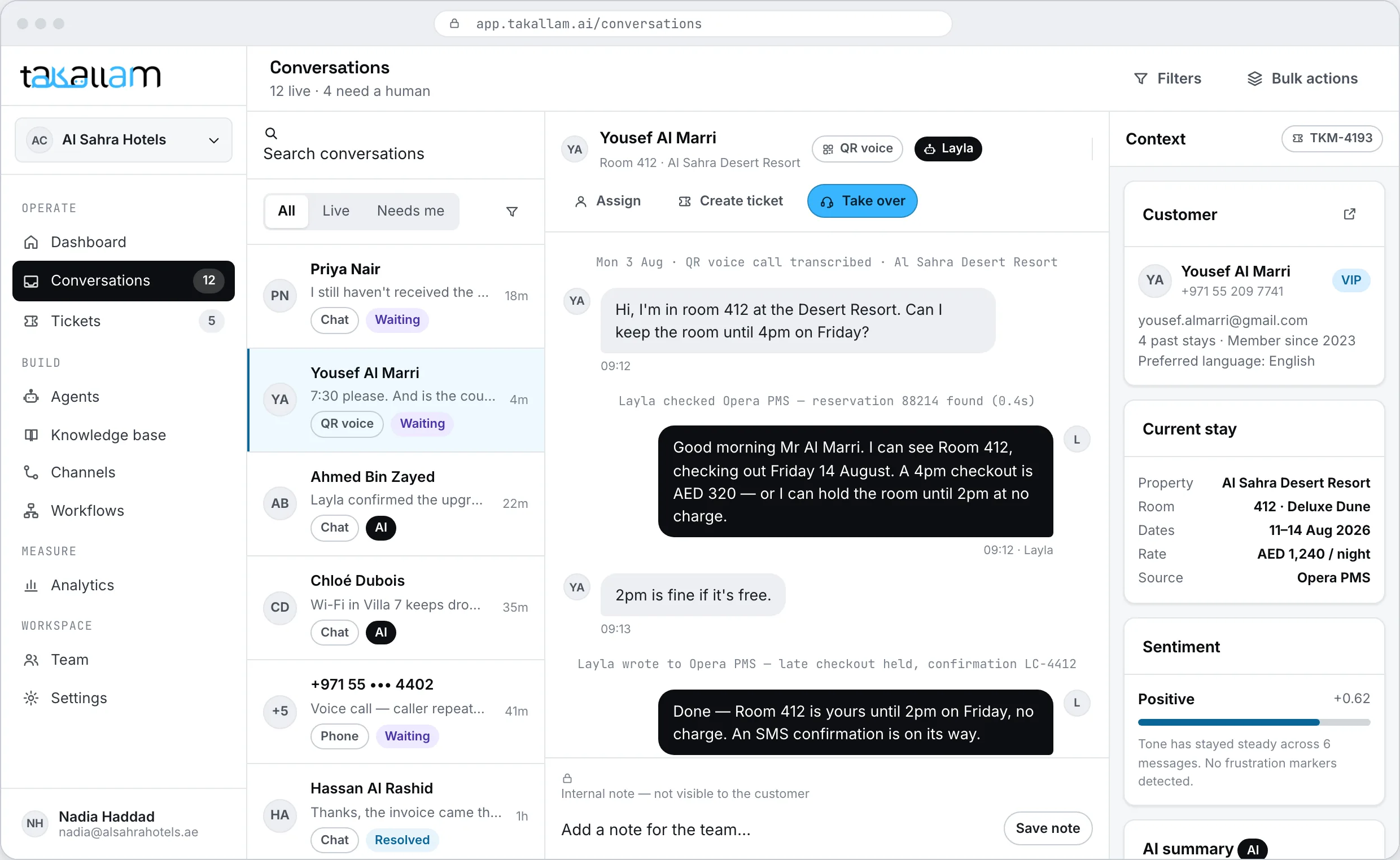
The ones that repeat all day and are not decisions
Every one of these is a lookup or an explanation. None of them requires an adjuster. All of them are currently taking one.
What does my policy actually cover
Answers from the policy wording, the schedule of benefits and the table of limits you loaded — quoting the clause, the limit and the excess. Where the answer depends on an assessment, it says so rather than rounding it into a yes.
How the knowledge base worksWhere has my claim got to
Reads the case from your claims system and gives the real position and what it is waiting on — a missing invoice, an assessment, a bank detail. When the honest answer is that it has been sitting there, it opens a ticket with a clock on it.
Tickets and SLAsRenew, amend or cancel
The renewal date, what changed on the new premium, adding a rider, removing a cover, and what the refund calculation is on a cancellation. It collects everything an amendment needs before a person ever opens the case.
Add a dependant or a vehicle
A newborn, a spouse, a second car, a change of plate. The agent knows which documents each one needs, checks what has already been received, and chases the one that is missing instead of rejecting the request in silence.
Which hospitals and garages are in network
One of the most-asked questions on any insurance line, and the one most likely to be answered from an out-of-date list. Answered from your current network by emirate, with the caveat stated when a facility is in network on one plan and not another.
What documents do you still need
The police report, the tax invoice, the discharge summary, the Emirates ID copy. Listed once, checked against what has already arrived, and chased in the same email thread from your own address.
The email channelA code on the policy document, and the customer just talks
The policy schedule is the one document every customer keeps. Print a code on it and every question that document creates has somewhere to go that is not the call centre. No app, no download, no menu of six options where none of them is the reason you called.
- Opens straight into voice, and switches to text when the customer is standing in a hospital corridor and cannot speak freely.
- Every scan carries the code it came from — the policy document, a garage counter, the branch, the renewal letter — so you know where the question was asked.
- Answers in English or Emirati Arabic, and follows a customer who starts the sentence in one and finishes it in the other.
- A customer who scanned at the garage on Monday and calls on Wednesday gets the same agent, with the earlier conversation already there.
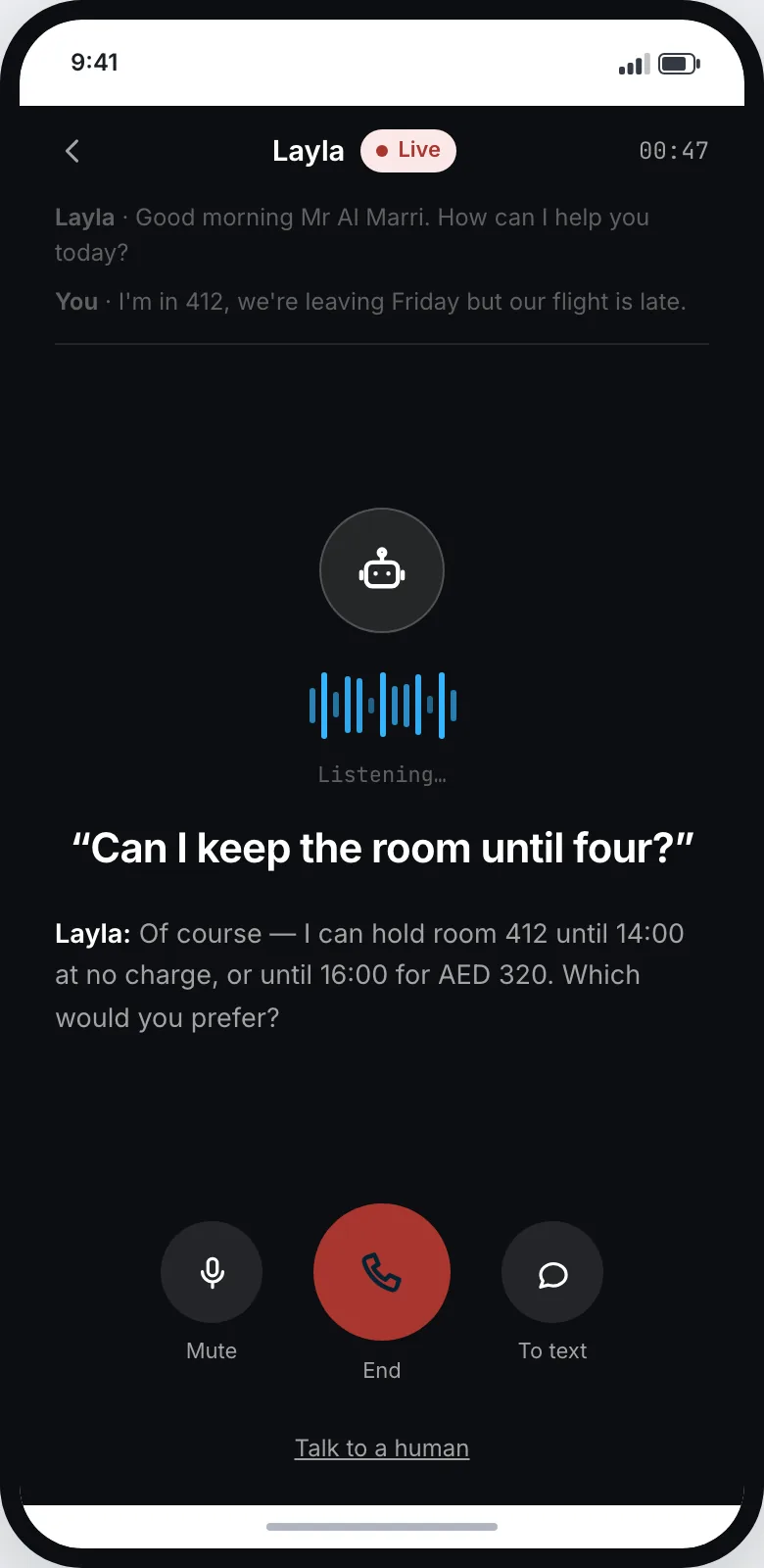
Where the code goes
Put it where the question happens. A code on the policy answers cover questions; a code at a garage counter answers "do I pay for this now". Print a different one for each spot and you find out which document is generating which calls.
On the policy document and schedule
Printed on the page the customer actually keeps. This is where "what is my excess", "am I covered for this" and "what is the deductible on the second claim" are asked — usually at the worst possible moment.
At partner garages and clinics
A code at the counter of an approved garage or a network clinic. The customer is standing there right now asking whether this is covered, whether they pay and claim back, and what the approval takes. Today that is a phone call your partner makes on their behalf.
On the renewal letter
The renewal notice is the moment a customer either renews, shops around, or does nothing at all. A code turns a letter that only invites questions into something that answers them.
In the branch and on the counter
For the queue, and for the customer who came in with a question no form covers. It also gives the counter staff somewhere to point when the answer is a lookup rather than a conversation.
On the claim acknowledgement
The email or message that confirms a claim was received. That is where "where has it got to" gets asked, over and over, for as long as the file is open.
A different code per placement
Separate codes for the policy, the garage, the branch and the renewal letter. The analytics show which document is generating which questions — which is usually an argument for rewriting the document.
Inside the consoleIt never decides whether you are covered
This is the most important paragraph on this page. The agent explains what the policy document says. It does not make a coverage determination and it does not decide a claim. Those are accountable judgements made by a person who can be held to them, and a confident sentence from a model is not the same thing. What the agent does is read the wording accurately, tell the customer what it says, collect what the file needs, and hand it to an adjuster with everything already gathered.
- Explains the clause, the limit and the excess. Does not conclude "you are covered" or "that is declined".
- Where the answer depends on an assessment, it says so and routes to the adjuster rather than filling the silence with something reassuring.
- Collects the documents, the dates and the details the file needs, so the person who picks it up starts with a complete file instead of a phone call.
- A medical emergency ends the conversation with the AI. It routes to a human immediately, or to an emergency number you nominate. It does not triage, and it does not ask someone in an emergency to wait for a callback.
- Complaints, regulator references and anything a customer frames as a dispute go to a person by default — not by confidence score.
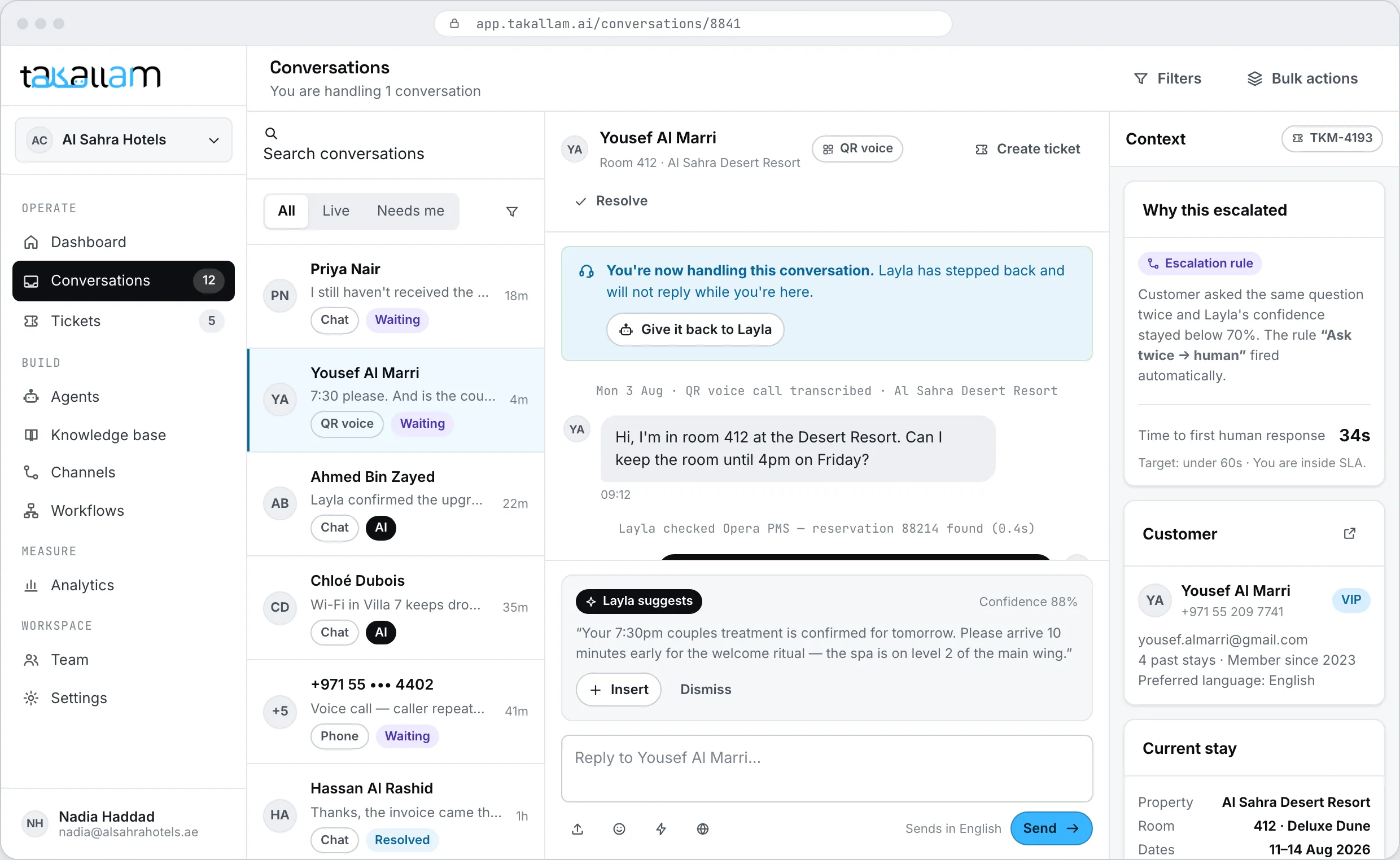
An amendment that actually reaches the policy system
Telling a customer their newborn can be added is half the job. The other half is the case being opened, the documents being attached, the endorsement being issued and the customer being told in writing. That part is a workflow: when this happens, do that, and if this other thing is true, do something else instead.
- When a dependant is added, collect the documents, check what is missing, open a case in your policy administration system, and confirm to the customer in writing.
- When a claim status is asked, read the case from your claims system and answer with the real position and what it is waiting on.
- When a renewal falls due, send the notice, answer the questions it generates, and route anyone who wants to negotiate the premium to a person.
- Takallam does not ship a pre-built connector for every policy administration or claims platform. It ships a workflow builder, a REST API and signed webhooks — if your system can be called, a workflow can call it.
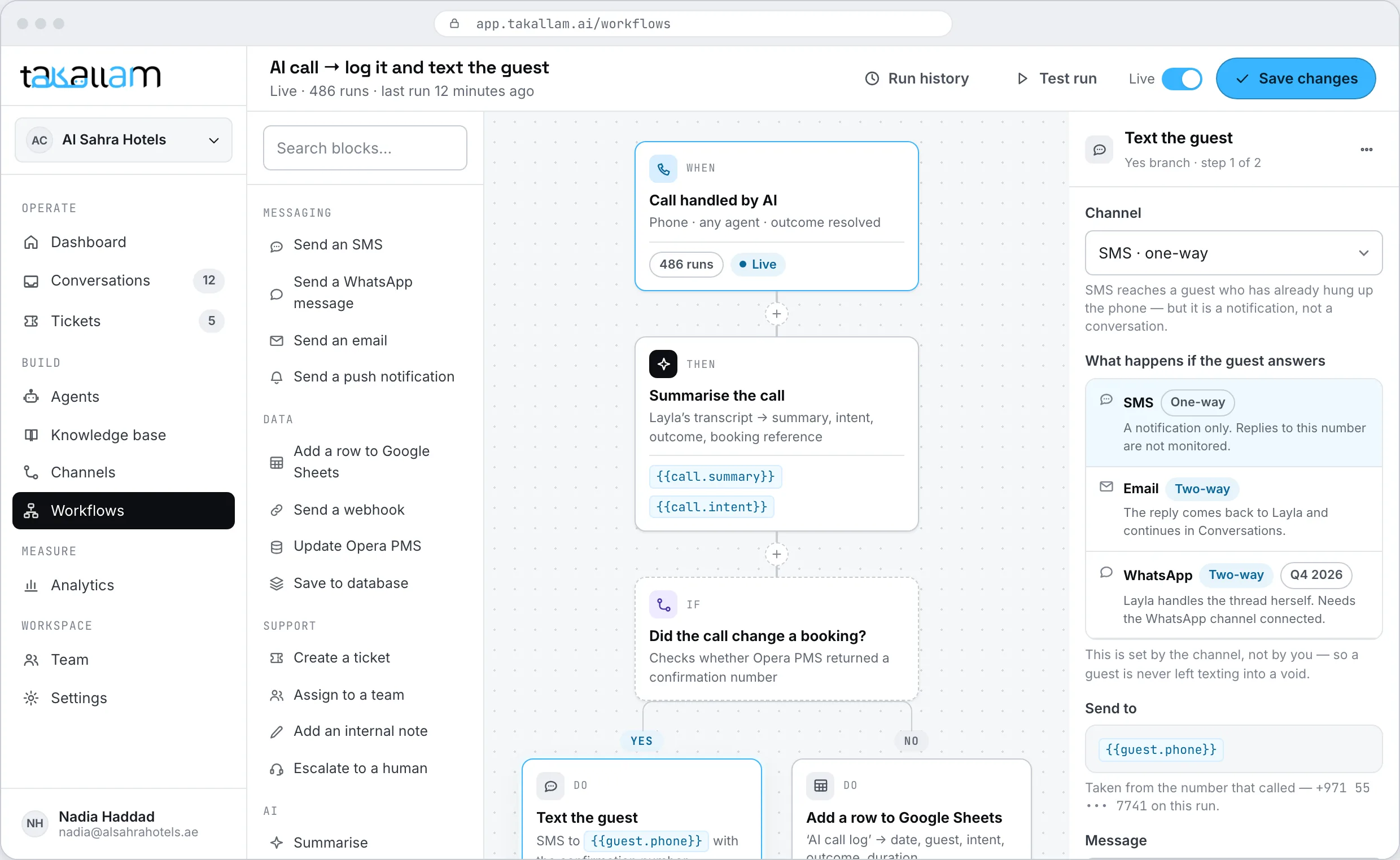
What the platform gives an insurer or a broker
These are capabilities of the platform, not results from a deployment. Takallam is pre-launch and has no published performance figures.
The parts of the product this page leans on
Security and residency
What is encrypted, what is retained and for how long, where it runs, who can see a conversation — and what Takallam is not yet certified for.
Read the security pageArabic, properly
Emirati and Gulf dialect in voice and text, at the register a regulated business needs, including callers who code-switch mid-sentence.
How Takallam handles ArabicEvery sector we cover
Banks, clinics, hotels, government and sixteen more — the same platform, with the escalation rules each one actually needs.
All 20 industriesWhat insurers and brokers ask first
Can it tell a customer whether something is covered?
It can tell them what the policy document says — the clause, the limit, the excess, the exclusions — quoted from the wording you loaded. That answers most of the calls you get today.
What it will not do is make the determination. It does not conclude "you are covered" or "that is declined", because that is a judgement someone has to be accountable for. Where the answer turns on an assessment, it says so and routes to an adjuster instead of guessing in a reassuring tone.
Can it give a claim status?
Yes, where it can read one. A workflow calls your claims system and the agent answers with the real position and what the file is waiting on — a missing invoice, an assessment, a bank detail. When the honest answer is that nothing has happened, it opens a ticket with an SLA so somebody owns it, rather than promising a callback nobody scheduled.
What happens if someone contacts you in a medical emergency?
The AI stops. An emergency routes to a human immediately, or to an emergency number you nominate, and it is treated as the highest priority in the console. Takallam does not triage a medical situation, does not assess urgency, and does not ask someone in an emergency to wait for a callback. You configure the exact wording and the exact number during setup.
Where do we put the QR code?
On the policy document and schedule, at partner garages and network clinics, in the branch, on the renewal letter and on the claim acknowledgement. Print a different code for each placement — the analytics then show you which document is generating which calls, which is often an argument for rewriting the document.
Can it actually add a dependant, or does it just collect the request?
Either, and you decide. In the agent builder you choose which actions each agent may take. Give it the amendment action and a workflow can open the case in your policy administration system once the documents are complete. Take it away and the agent will collect and validate everything, then hand a complete file to your team to action.
Does it connect to our policy administration and claims systems?
It connects to systems that can be called. Takallam gives you a workflow builder, a REST API and signed webhooks, so a workflow can read a claim status, open a case, attach a document or trigger a renewal notice in whatever you already run.
What Takallam does not do is claim a pre-built, certified integration with every policy administration or claims platform on the market. Tell us what you run and we will be straight with you about what the connection looks like.
Where does our policyholder data sit, and what are you certified for?
Takallam runs in the UAE region, me-central-1, and conversation data is resident in-region by default. Data is encrypted in transit and at rest, retention is configurable, and access in the console is role-based so not everyone can read every conversation.
On certification we will be plain: Takallam is pre-launch and does not hold SOC 2, ISO 27001 or any other audited certification today. The architecture is built to support that work, and we would rather tell you that now than let a badge on a website imply otherwise.
What does it cost?
You pay per interaction, and each channel is priced separately, because a phone call and a chat message do not cost the same to deliver. There are no per-seat licences and no minimum commitment, which matters when renewal season triples your volume for three weeks. Takallam is pre-launch, so rates are being set with the first cohort — join the waitlist and we will quote against your real volume.
Take the policy questions off the claims team
We are onboarding a first cohort of UAE insurers and brokers now. Tell us your lines of business, your monthly contact volume, which channels you need and what holds your policies and claims, and we will come back with a rate against your real numbers.
Pay per interaction · priced per channel · no seats, no minimums