
Ask in Arabic. Get an answer at 2am.
Takallam answers the questions that fill a service centre — who is eligible, which documents to bring, what the fee is, where an application has got to — from a QR code at the counter, in your portal chat, in your support inbox and on your phone line. Arabic first, English too, with conversations and data staying in the UAE region.
Six questions, most of a service centre's day
None of them need an officer. All of them are why the queue exists at nine in the morning.
Am I eligible?
Whether a resident, a visitor or a company can apply at all, and what disqualifies an application before it starts. Answered before someone takes a morning off work to be told no at a counter.
Which documents do I bring?
Emirates ID, passport copy, tenancy contract, trade licence, an attested certificate, a photo to the right specification. The list everybody gets wrong at least once.
What does it cost?
The service fee, the components added on top of it, what can be paid at the centre and what has to be paid online. Stated from your published schedule, not from memory.
Which centre, and when is it open?
Which customer happiness centre handles this service, Saturday hours, Ramadan hours, whether a typing centre can do it instead, and where to park when you get there.
Can I book an appointment?
Available slots, what to bring, whether both parties have to attend, how to move a booking without losing it. It takes the details and a workflow does the booking.
Where has my application got to?
Reference number, typical processing time, and what "returned for correction" actually means and how to fix it. It explains the process; a live status lookup happens only if you connect the system and authorise it.
Arabic is not the translation. It is the default.
Most public-service software is built in English and translated afterwards, which is why the Arabic version is usually the one with the broken form and the stiff sentence. Takallam was built here. It listens in Emirati and Gulf dialect, follows a caller who starts in Arabic and finishes the sentence in English, and answers in the register you set.
- Emirati and Gulf dialect in voice, not only Modern Standard Arabic.
- Code-switching handled, because most residents do it every second sentence.
- Right-to-left throughout the customer experience, not a mirrored English screen.
- Register is a setting — formal for a service line, plainer for a public helpline.
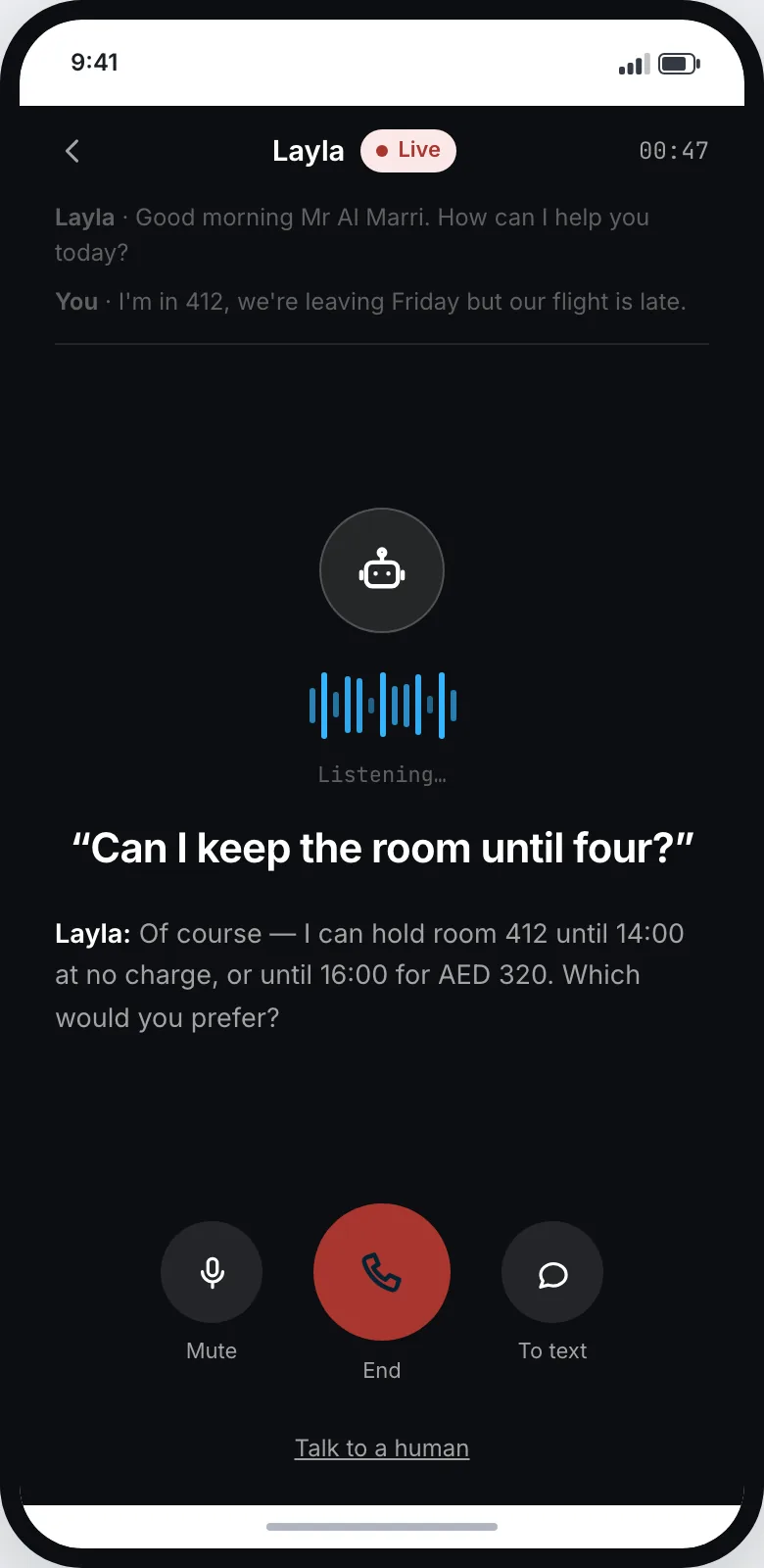
Speaking is easier than filling in a form
A form assumes a person reads the language it is written in, knows which of its eleven fields applies to them, and has the patience to work it out. Asking a question out loud assumes none of that. Voice is the route to the resident a portal was never going to serve — and it is open every hour the counter is shut.
- No app, no account, no download. A camera and a question is the whole requirement.
- Speaking instead of typing, which matters for anyone who finds forms hard, for any reason.
- Available at 2am, on a public holiday, and on the afternoon the centre closes early.
- Someone who cannot travel to a centre gets the same answer as the person standing at the counter.
- An additional route rather than a replacement — it runs alongside your existing channels and your accessibility work, it does not stand in for them.
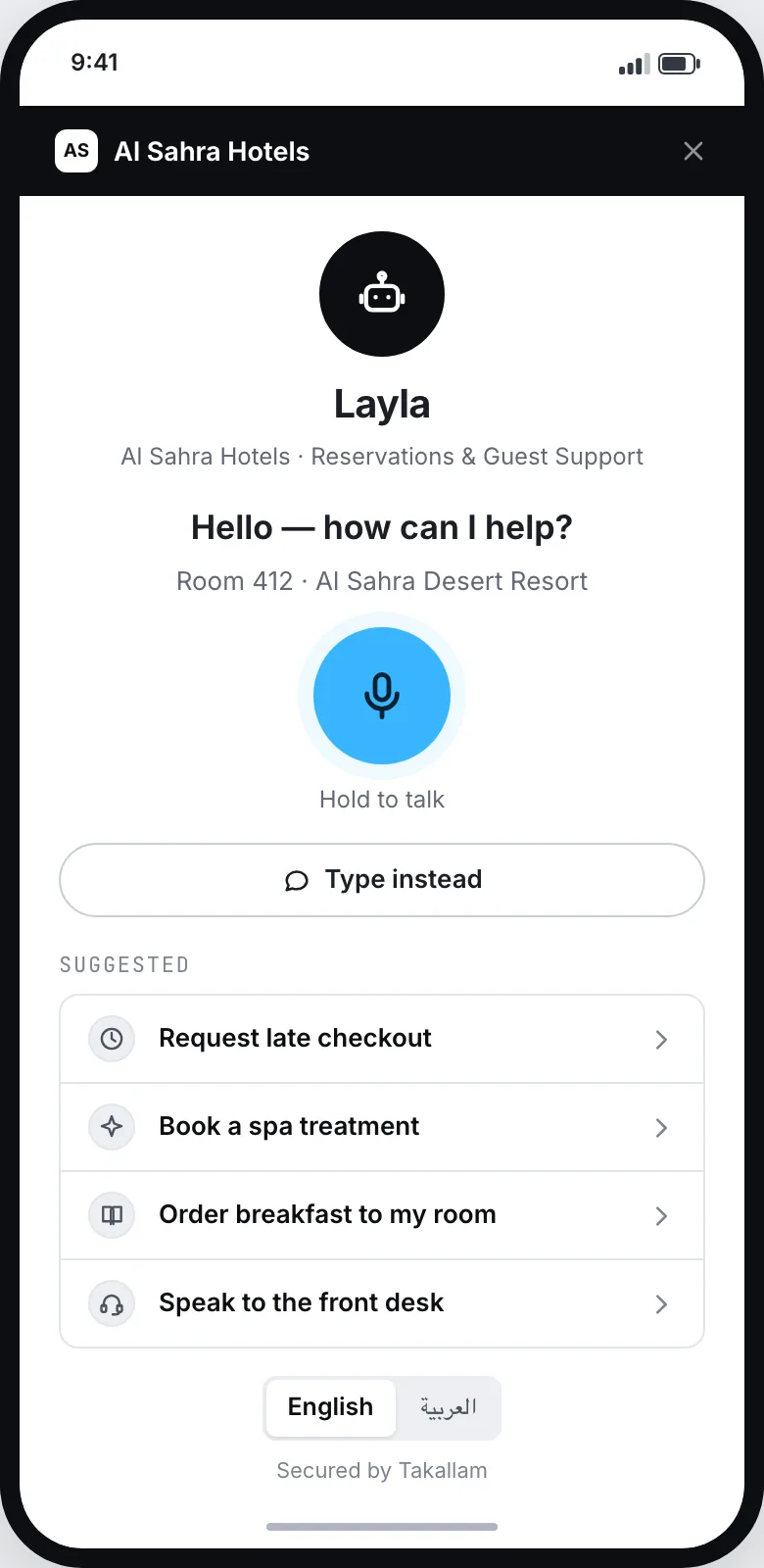
Put it where the question happens
A different code in each place, so you can see which one is actually used and what gets asked there.
At the entrance
Before the queue rather than after it. A visitor finds out a document is missing while there is still time to go and get it.
On the queue ticket
The minutes people spend watching a number are minutes they could spend having their question answered.
On the leaflet and the service card
The printed leaflet answers six questions. The code answers the seventh, and tells you what the seventh usually is.
On the form itself
Next to the field that everybody fills in wrong, so the correction happens before submission instead of after rejection.
On the decision letter
When an application is returned for correction, the letter can carry a code that explains what to fix, in Arabic, at the moment it is read.
Out in the community
Accommodation noticeboards, community centres, municipality counters, bus shelters — where the people who need the service are, not where the portal is.
One answer everywhere, changed in one place
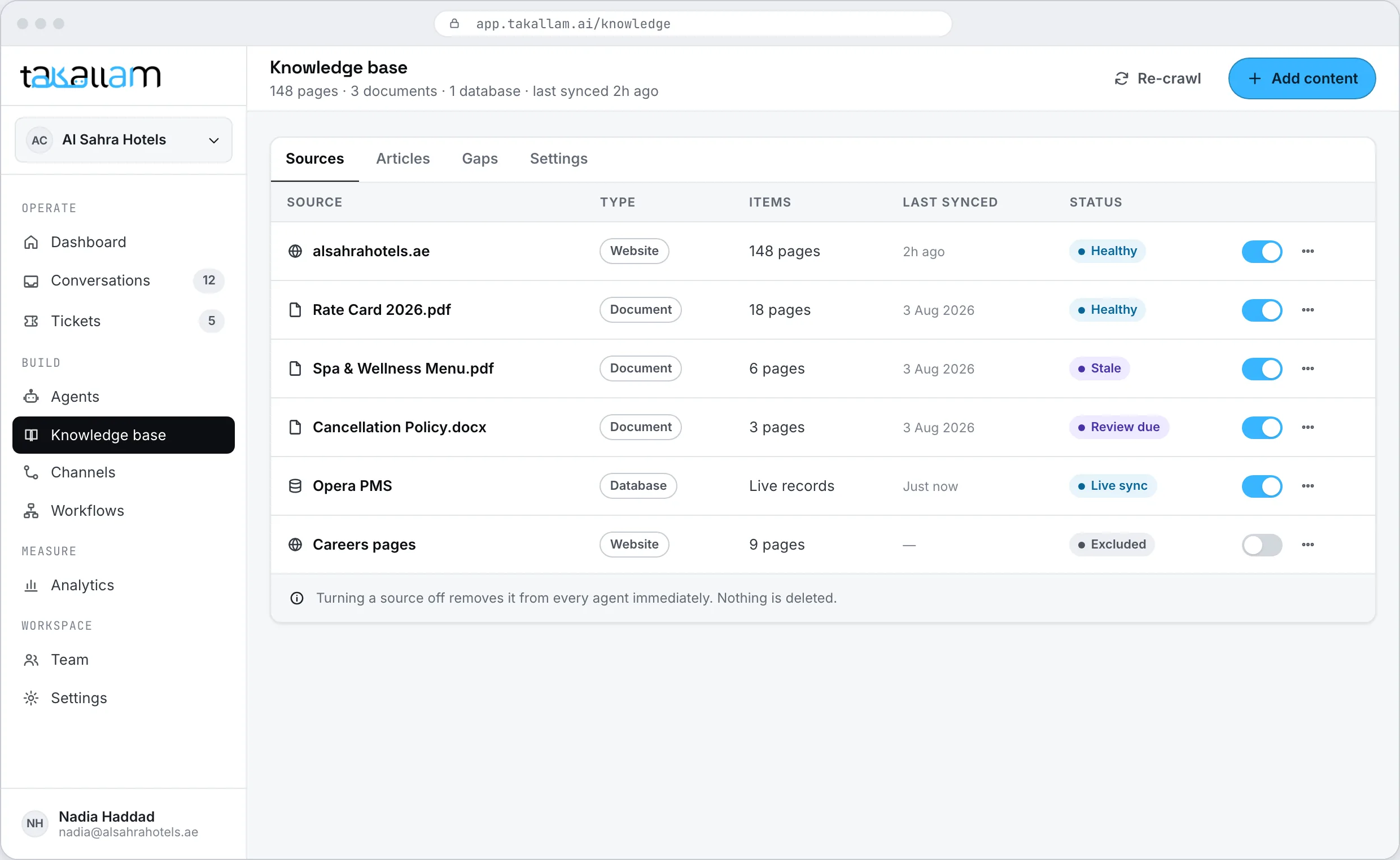
Fees change. Requirements change. A circular goes out on Thursday and the website says something else until someone has time to update it. Takallam builds its knowledge base from your site and the documents you upload, shows you exactly what it learned, and lets you correct it in one place — after which every channel says the new thing.
- You see every page and document it read, and remove anything it should not use.
- Upload the service manual, the fee schedule, the circular — not only what is on the public site.
- A correction is live on QR voice, chat, email and phone at once, not channel by channel.
- What it does not know, it does not invent. It says so and hands the conversation to your team.
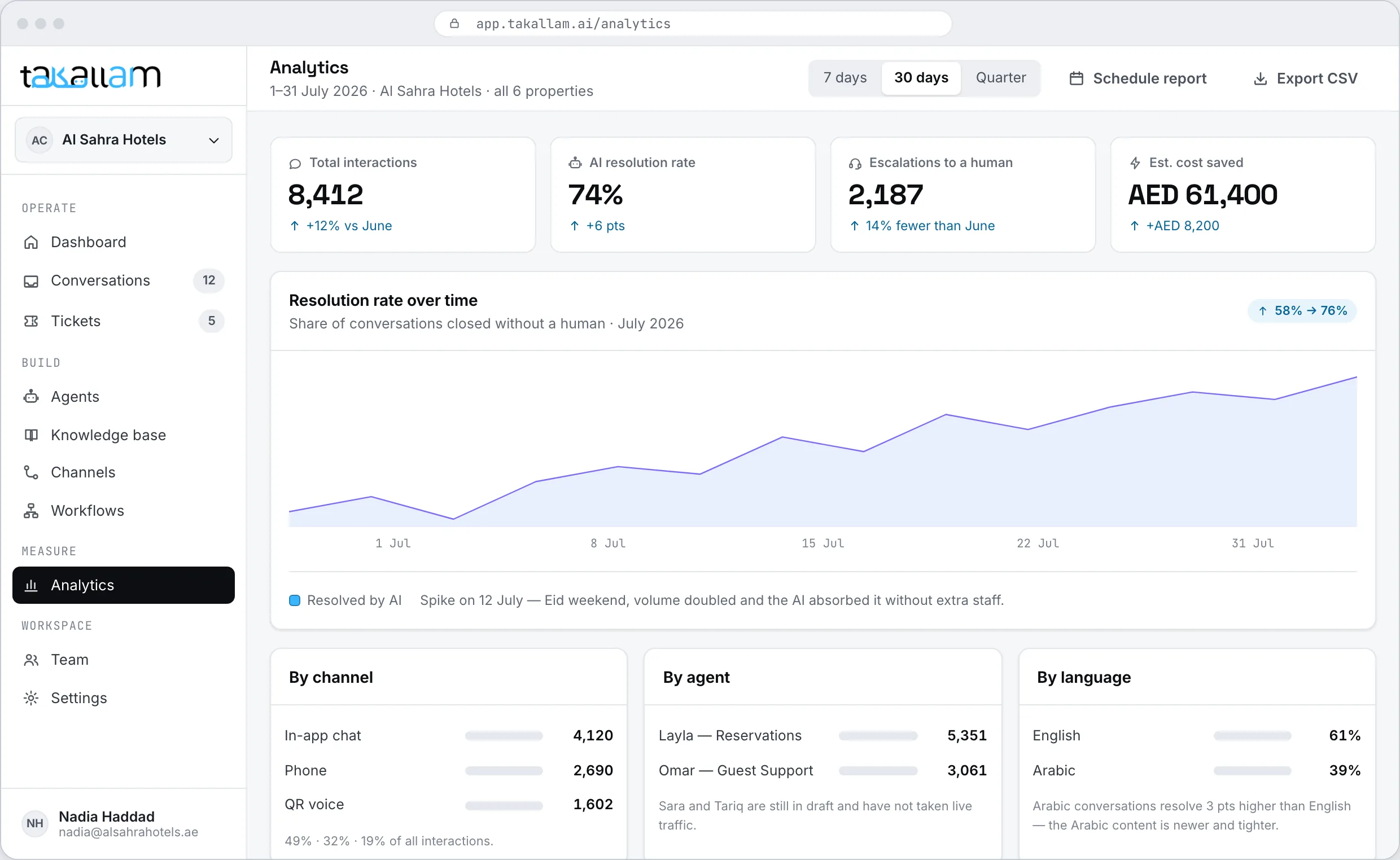
The questions are a map of where the service is confusing
Every conversation is a signal. When the same question arrives four hundred times in a week, the fix is not a better AI reply — it is a clearer sentence on the form. Takallam shows you what is asked, what could not be answered, when the volume arrives and in which language.
- Top intents, so you can see which step of a service generates the most confusion.
- Unanswered questions — which is simply the list of what your published information is missing.
- Volume by hour and by day: evidence for what after-hours demand actually looks like.
- The Arabic-to-English split, measured rather than assumed.
What the deployment looks like
Product capabilities and design properties, not published outcomes. Takallam is pre-launch and holds no accessibility or security certifications yet.
The parts of the product this page leans on
Arabic, properly
Emirati and Gulf dialect in voice and text, code-switching, and a register you set per agent.
How Takallam handles ArabicQR voice
A printed code a resident scans and speaks to. No app, no account, no queue.
See the QR channelForward the support address residents already write to. The agent answers in the thread and triages the rest.
See the email channelSecurity and residency
Where it runs, what is encrypted, what is retained, and what Takallam is not yet certified for.
Read the security pageEvery sector we cover
Utilities, education, and business setup and free zones get asked the same kind of question at the same kind of counter. Twenty sectors, the same platform, the rules each one needs.
All 20 industriesWhat public-sector teams ask
Is the Arabic real, or is it translated English?
It is real. Takallam handles Emirati and wider Gulf dialect in voice as well as text, and it follows the very normal case of a resident who starts a sentence in Arabic and finishes it in English. You also set the register, so a government service line can sound appropriately formal without sounding like a translation.
Where is the data held?
In the UAE region — me-central-1 — by default, not as an option you request later. Conversations, transcripts, recordings and knowledge bases stay in-region, and you set how long each is retained and when it is deleted.
Can it book an appointment at a centre?
It can capture everything an appointment needs — the service, the person, the preferred slot — and a workflow writes the booking into whatever system holds your calendar, then confirms it to the resident. If your booking system has no API, the agent still captures the request and hands a complete, ready-to-book conversation to your team.
Can it tell someone the status of their application?
Only if you connect the system that holds the status and explicitly authorise a read. By default it has no access to case data at all: it explains the process, the typical timeline and what a returned application means. Confirming who someone is stays with your team and your existing identity process.
What happens when it does not know?
It says it does not know and hands over rather than guessing, and the unanswered question appears in your analytics. That list is genuinely useful on its own — it tells you exactly which part of a service your published information fails to explain.
Do residents need an app, an account or a login?
No. They point a camera at the code and speak, or they use the chat on your portal, or they write to the support address they already have, or they call the number. That is deliberate: the people most likely to need help are the least likely to have an account, and asking them to create one is where most of them stop.
Which languages does it work in?
Arabic and English today, with Emirati and Gulf dialect support in voice. That is the honest answer rather than a list. If your service population needs more languages, say so during the waitlist conversation and we will tell you plainly what is and is not possible for your launch date.
What does it cost?
You pay per interaction, and each channel is priced separately, because a phone call and a chat message do not cost the same to deliver. No per-seat licences and no minimum commitment. Takallam is pre-launch, so rates are being set with the first cohort — join the waitlist and we will quote against your real volumes.
Serve the resident who cannot get to the counter
We are onboarding a first cohort of UAE public-sector teams now. Tell us which services generate the most questions and where your residents actually stand when they ask them.
Pay per interaction · priced per channel · no seats, no minimums