
It is eight on a Friday and nobody can pick up the phone
A table for six, what time the kitchen closes, where the delivery order got to, whether the biryani has nuts in it. Takallam answers all of it from a code on the table, from the chat on your site, from your inbox and on the phone — in English and Emirati Arabic — and hands anything it should not answer straight to the floor manager.
Everything the host stand gets asked
The phone rings during service and it is never the supplier
Friday, half past eight, every table turned once already. The phone is a walk-in asking whether there is anything at nine. The delivery tablet is beeping. Someone has messaged the page about a set menu for twelve. And the host has a queue at the door, a phone in one hand and a stack of menus in the other.
- The same four questions arrive by phone, by message, through the website and from people standing at the door — and get four slightly different answers.
- Calls during the rush either ring out or get answered in eight seconds by somebody who is walking.
- A catering enquiry worth real money sits unopened in a shared inbox until Monday.
- "Where is my order" is a question your kitchen cannot answer and your driver cannot hear.
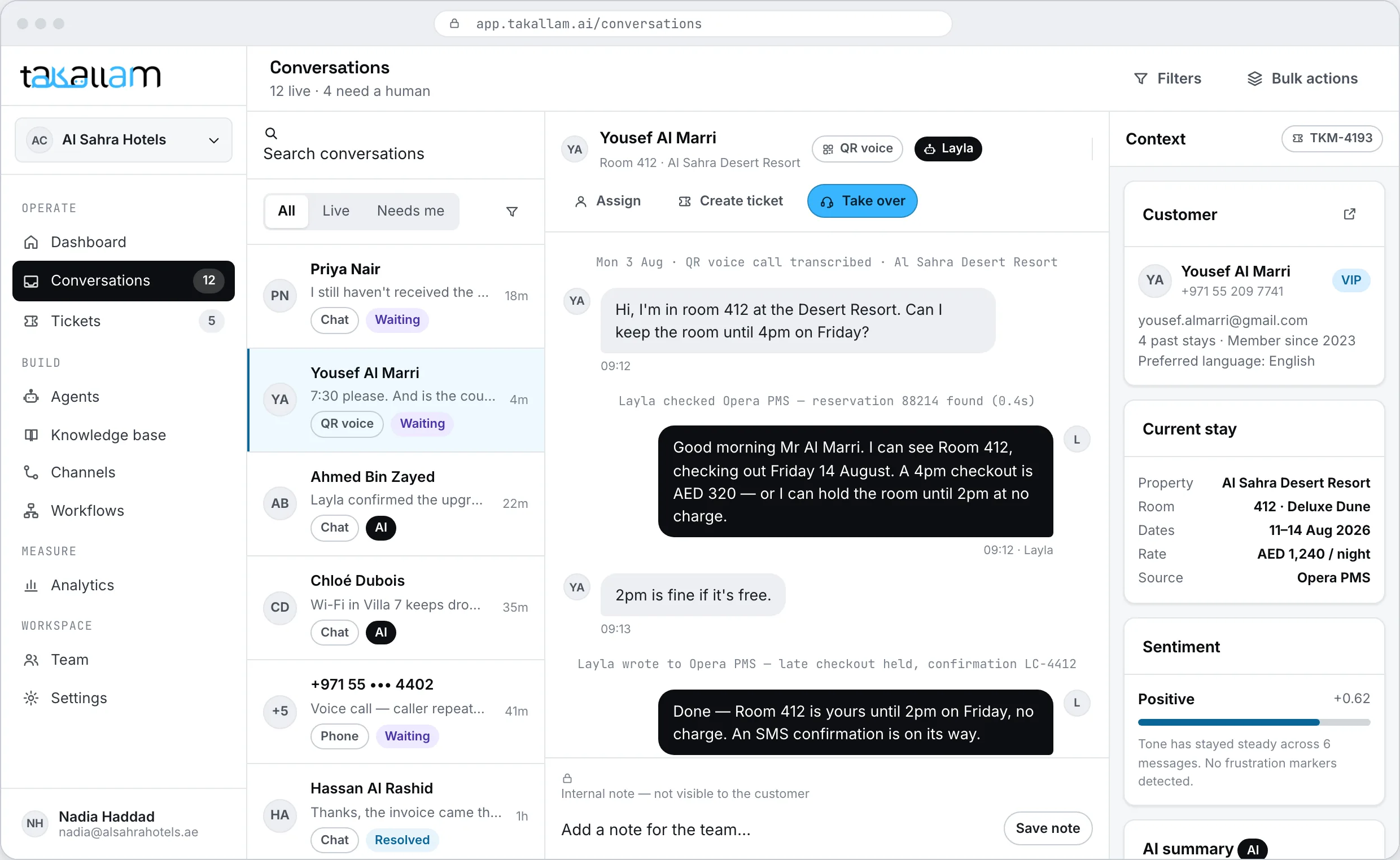
The ones that repeat every single service
Not the interesting ones. The handful that pull a host off the door and a manager off the floor, twenty times a night.
A table for six on Friday at eight
Takes the name, the party size and the time, checks what the book actually has, and offers the nearest slot when eight is gone. The same request made by phone, by chat and by scanning the table gets the same answer, because it is the same agent looking at the same diary.
Where is my delivery
Reads the order status from the system that holds it and gives the real position — picked up, on the way, twelve minutes out. When the order is genuinely late it opens a ticket with the order number and a clock on it, instead of telling the customer to call back.
Tickets and SLAsThe menu, the prices and the set menu
Answers from the menu you loaded, not from what a model thinks a restaurant serves. Prices, portion sizes, what is on the business lunch, what changes during Ramadan. Change it in one place and every channel changes with it.
How the knowledge base worksLarge groups and private dining
Fourteen for a birthday, a minimum spend, whether the room has a door on it. The agent gives your real terms, collects the date, the headcount and the occasion, and hands a written enquiry to whoever owns the diary — instead of a voicemail nobody returns.
Catering enquiries that arrive by email
Replies in-thread from your own address, asks the three things you always have to ask anyway — date, headcount, delivered or on-site — and tags it so a real enquiry stops being a Monday-morning discovery.
The email channelHours, location, parking and valet
What time the kitchen stops, whether brunch is on this Saturday, which mall entrance, is there valet, is parking free after seven. This is the volume that never justified a person answering it, and you pay for it by the interaction.
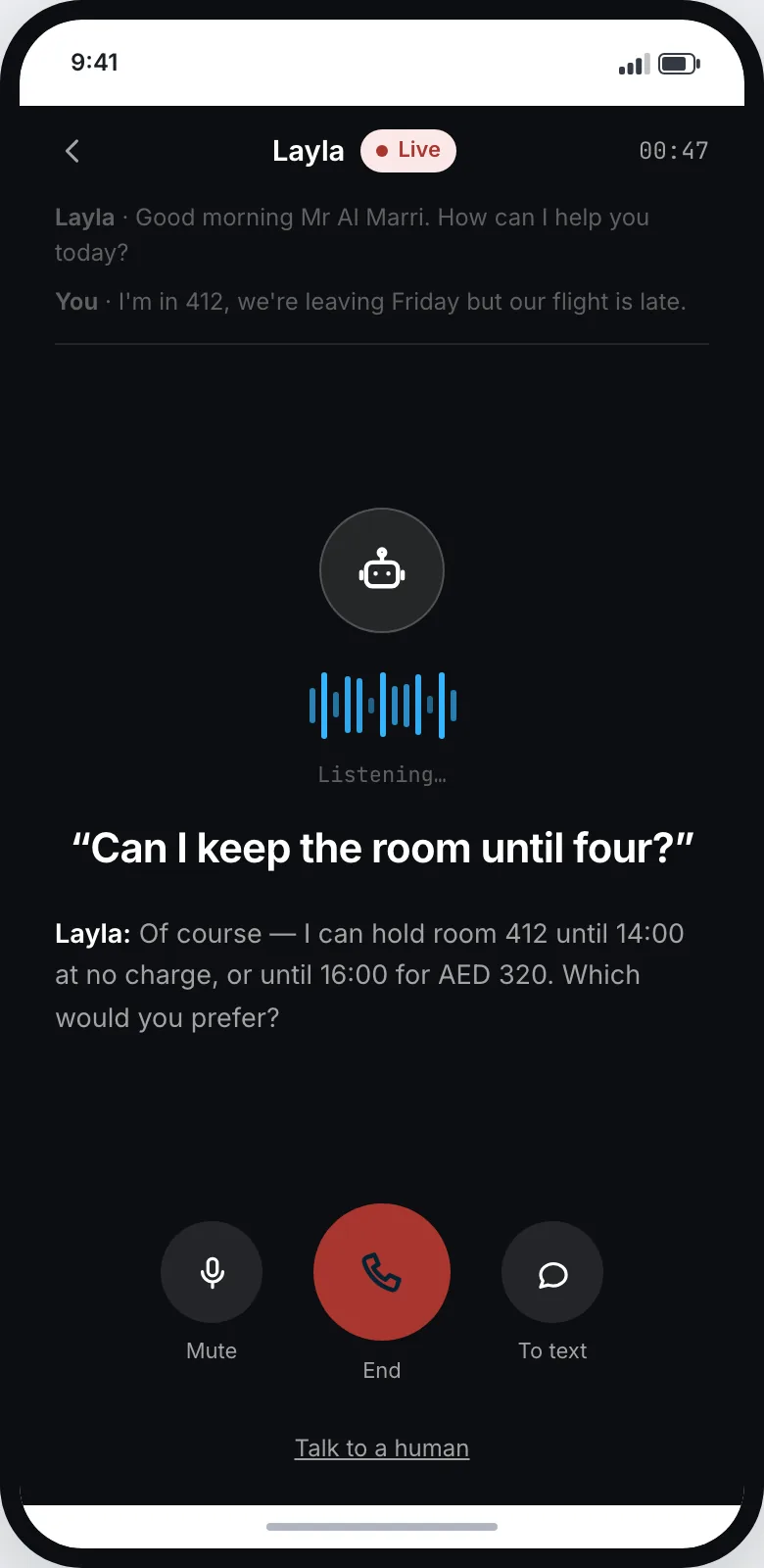
How pricing worksThe guest scans the corner of the table tent and just talks
No app to download, no number to dial, no waiting for the host to come back past. The guest points a camera at a code and speaks. It works for the couple deciding between two dishes, for the person waiting at the door for a table, and for the delivery customer standing in a lobby with a bag going cold.
- Opens straight into voice, and switches to text mid-conversation when the room is loud — which in a restaurant it usually is.
- Every scan carries the code it came from, so a question from table 12 is not the same as a question from a delivery bag.
- Answers in English or Emirati Arabic, and follows a guest who starts the sentence in one and finishes it in the other.
- The guest who scanned at the table and calls the next day about a jacket left on a chair gets the same agent, with the earlier conversation already there.
Where the code goes
Put it where the question happens. A code on the table answers table questions; a code on a delivery bag answers delivery questions. Print a different one for each spot and you find out which places generate which questions.
On the table
The table tent, the stand by the condiments, the edge of the wooden menu holder. This is where "does this have nuts in it", "how long is the wait on the mixed grill" and "can we get the bill" are asked — usually to whoever walks past first.
On the menu itself
Printed on the back page or the inside cover. The guest is already holding it and already has the question, and the alternative is flagging down a server who is mid-service on another section.
On the delivery bag
The sticker that seals the bag. "Where is my order", "the sauce is missing", "how do I reheat this" — all asked from a sofa, and none of them reach you until they land as a one-star review instead.
At the door, for the queue
For the group waiting for a table. How long is the wait really, can we put a name down, is there anywhere to park, is the terrace open tonight. The questions that keep the host talking instead of seating.
On the receipt
The end of the meal is where feedback, the lost-property call and "can I get a VAT invoice" live. A code on the bill catches all three while the guest still remembers the detail.
A different code per placement
Separate codes for the table, the bag, the door and the receipt. The analytics show which placement earns its ink and what guests actually ask in each spot — which is rarely what you would guess.
Inside the consoleAn allergy question is a safety question, not a support question
This is the one thing on this page we will not be relaxed about. The agent answers allergen questions only from the menu and ingredient data you have loaded and signed off, dish by dish. It does not reason about what is probably in a dish. It does not infer that a curry contains nuts because most curries do, and it does not infer that one does not. Where the verified data does not cover the question, it says so plainly and hands the conversation to the kitchen or the manager on shift, in the same thread, immediately.
- Answers only from the allergen data you loaded and approved — never from what a model assumes a dish contains.
- Says "I cannot confirm that" out loud rather than producing a confident sentence. A hedge is safer than a guess.
- Any allergy question it cannot answer with certainty escalates on the spot — to the kitchen, to the duty manager, or to a number you nominate.
- It does not tell a guest a dish is safe. It tells them what the recipe data says, and who is confirming it.
- Cross-contamination questions always escalate. No ingredient list can answer those. A chef can.
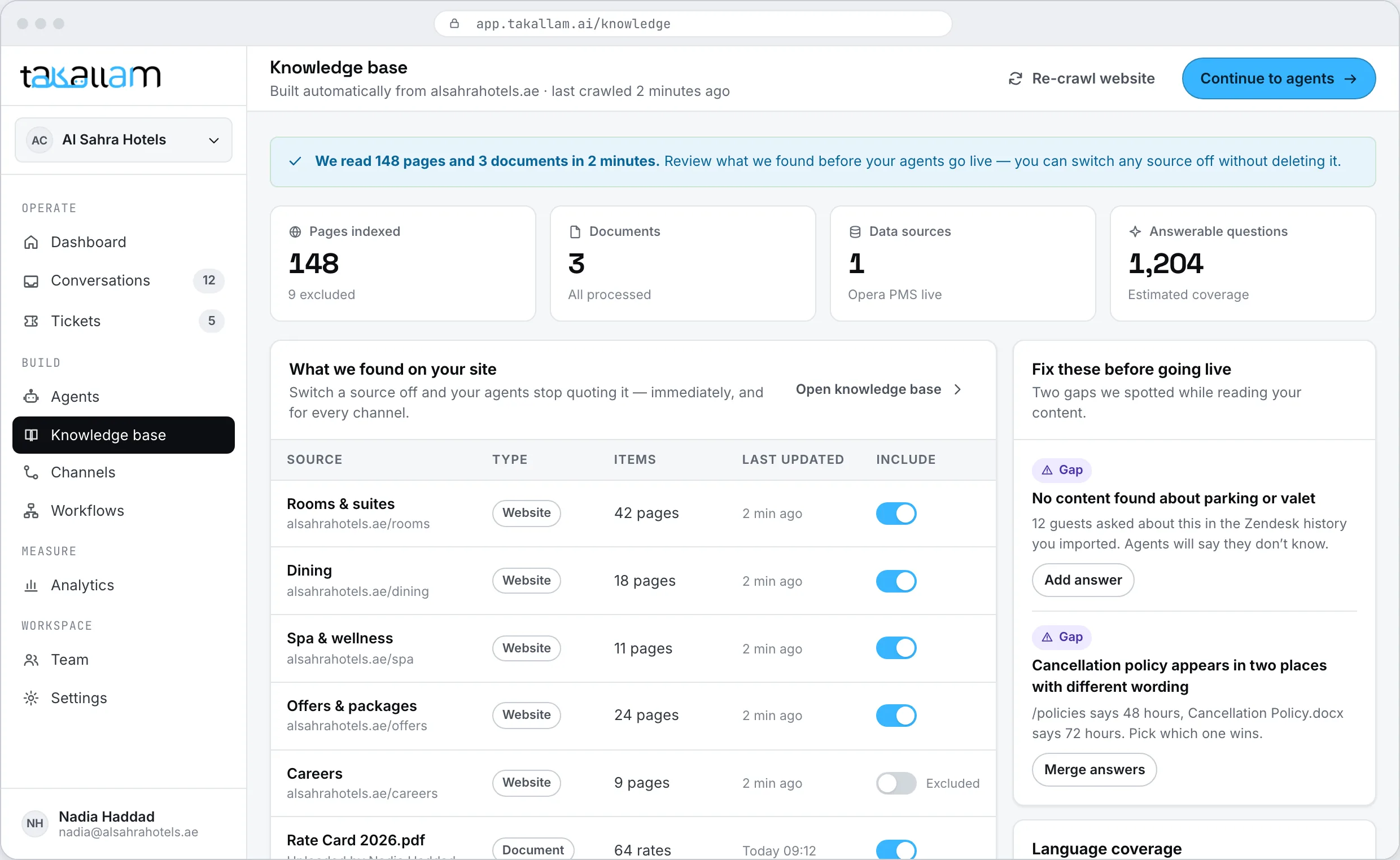
A booking that actually lands in the book
Telling a guest they have a table at eight is half the job. The other half is the table being held, the host seeing it on the floor plan, and the guest getting it in writing. That part is a workflow: when this happens, do that, and if this other thing is true, do something else instead.
- When a booking is confirmed, write it to your reservation system, send the guest the confirmation, and put the party size in front of the kitchen.
- When a guest asks where an order is, read the status from the system that holds it, answer with the real position, and open a ticket when it is genuinely late.
- When a catering enquiry arrives, capture the date, the headcount and the budget, route it to whoever quotes, and chase it if nobody has replied in a day.
- Takallam does not ship a pre-built connector for every reservation platform and POS. It ships a workflow builder, a REST API and signed webhooks — if your system can be called, a workflow can call it.
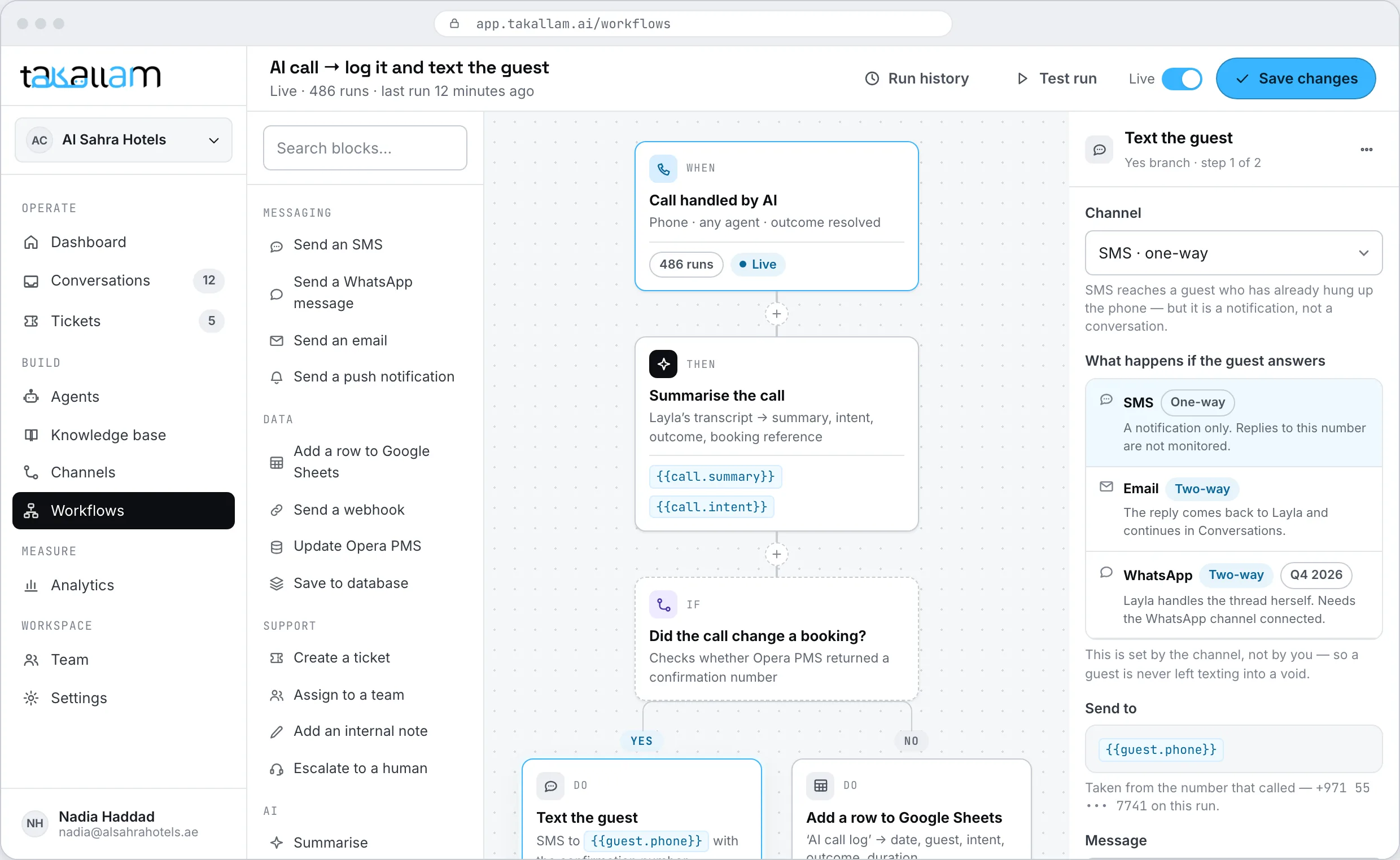
What the platform gives a restaurant or a group
These are capabilities of the platform, not results from a deployment. Takallam is pre-launch and has no published performance figures.
The parts of the product this page leans on
Arabic, properly
Emirati and Gulf dialect in voice and text, including the guest who orders in Arabic and finishes the sentence in English.
How Takallam handles ArabicThe support console
One inbox across all four channels, human takeover in the same thread, tickets with a clock on them, and who on the floor can see what.
Inside the consoleEvery sector we cover
Hotels, clinics, retail, banks, government and fifteen more — the same platform, with the escalation rules each one actually needs.
All 20 industriesWhat operators ask before they put a code on a table
Can it actually take a booking, or does it only answer questions?
Both, and you choose which. In the agent builder you decide what each agent is allowed to do. Give it bookings and it can check availability, hold the table, write it to your reservation system through a workflow and send the guest the confirmation. Take the action away and it will answer questions about availability but leave the booking to your team.
What happens when a guest asks about an allergy?
It answers only from the allergen and ingredient data you loaded and approved, dish by dish. It will not infer an ingredient, and it will not tell a guest a dish is safe.
If the verified data does not cover the question — or the question is about cross-contamination, which no ingredient list can answer — it says plainly that it cannot confirm it, and hands the conversation to the kitchen or the manager on shift immediately, in the same thread. We would rather it escalate ten allergy questions a night than answer one of them confidently and be wrong.
Can it tell a customer where their delivery is?
Yes, if it can read the status. A workflow calls the system that holds the order, and the agent answers with the real position rather than an apology. When the order is genuinely late it opens a ticket with the order number, a priority and a clock, so somebody owns it instead of the customer calling three times.
Where do we put the QR code?
Wherever the question happens: the table tent, the back page of the menu, the sticker on the delivery bag, the stand by the door for people waiting, and the receipt. Print a different code for each placement so you can see which one guests actually use and what they ask in each spot.
Does it connect to our reservation system and our POS?
It connects to systems that can be called. Takallam gives you a workflow builder, a REST API and signed webhooks, so a workflow can check availability, write a booking, read an order status or push a catering enquiry into whatever you already run.
What Takallam does not do is claim a pre-built, certified integration with every reservation platform and POS on the market. Tell us what you use and we will be straight with you about what the connection looks like.
Can it handle a large group or a private dining enquiry?
It handles the first ninety per cent — your real terms, the minimum spend, what the room seats, and collecting the date, the headcount and the occasion. Then it hands a written enquiry to the person who owns the diary. Group bookings are worth too much to close on autopilot, so the default is that a human confirms them.
Does it answer Arabic-speaking guests properly?
Yes — Emirati and wider Gulf dialect in both voice and text, including guests who switch between Arabic and English mid-sentence, which is how most people in the UAE order food. Today the platform covers English and Arabic. That is what Takallam does well, and we would rather say so than claim forty languages.
What does it cost?
You pay per interaction, and each channel is priced separately, because a phone call and a chat message do not cost the same to deliver. There are no per-seat licences and no minimum commitment, which matters when a venue has a dead Tuesday and a full Friday. Takallam is pre-launch, so rates are being set with the first cohort — join the waitlist and we will quote against your real volume.
Put a code on the table and see what guests ask
We are onboarding a first cohort of UAE restaurants and groups now. Tell us roughly how many covers, how much delivery, which channels you need and what holds your bookings, and we will come back with a rate against your real volume.
Pay per interaction · priced per channel · no seats, no minimums