
Nobody can answer the phone mid-blow-dry
How much is it, how long will I be there, is my usual therapist in on Thursday, how many sessions are left on my package. Takallam answers all of it from a code at the mirror, in the chat on your site, in your inbox and on the phone — in English and Emirati Arabic — and hands anything clinical to a person before it answers a word of it.
What reception gets asked between clients
Saturday at six, every chair is full and the phone is ringing
The busiest hour to call is the busiest hour to be on the floor. One person is on the desk, and she is taking a payment, checking a client in and looking for a towel at the same time. The phone rings — somebody wants to know what balayage costs and whether there is anything tonight. It goes to voicemail, and that booking goes to the salon two doors down.
- The same three questions — how much, how long, who is free — arrive by phone, by email and from the person standing at the desk, and get three slightly different answers.
- A client mid-colour with foils in has forty minutes and a question, and no one to ask.
- Package and voucher balances sit in the booking system, and nobody wants to go and look them up in the middle of a service.
- Clients who would rather speak Arabic get a proper answer only when the right person is on shift.
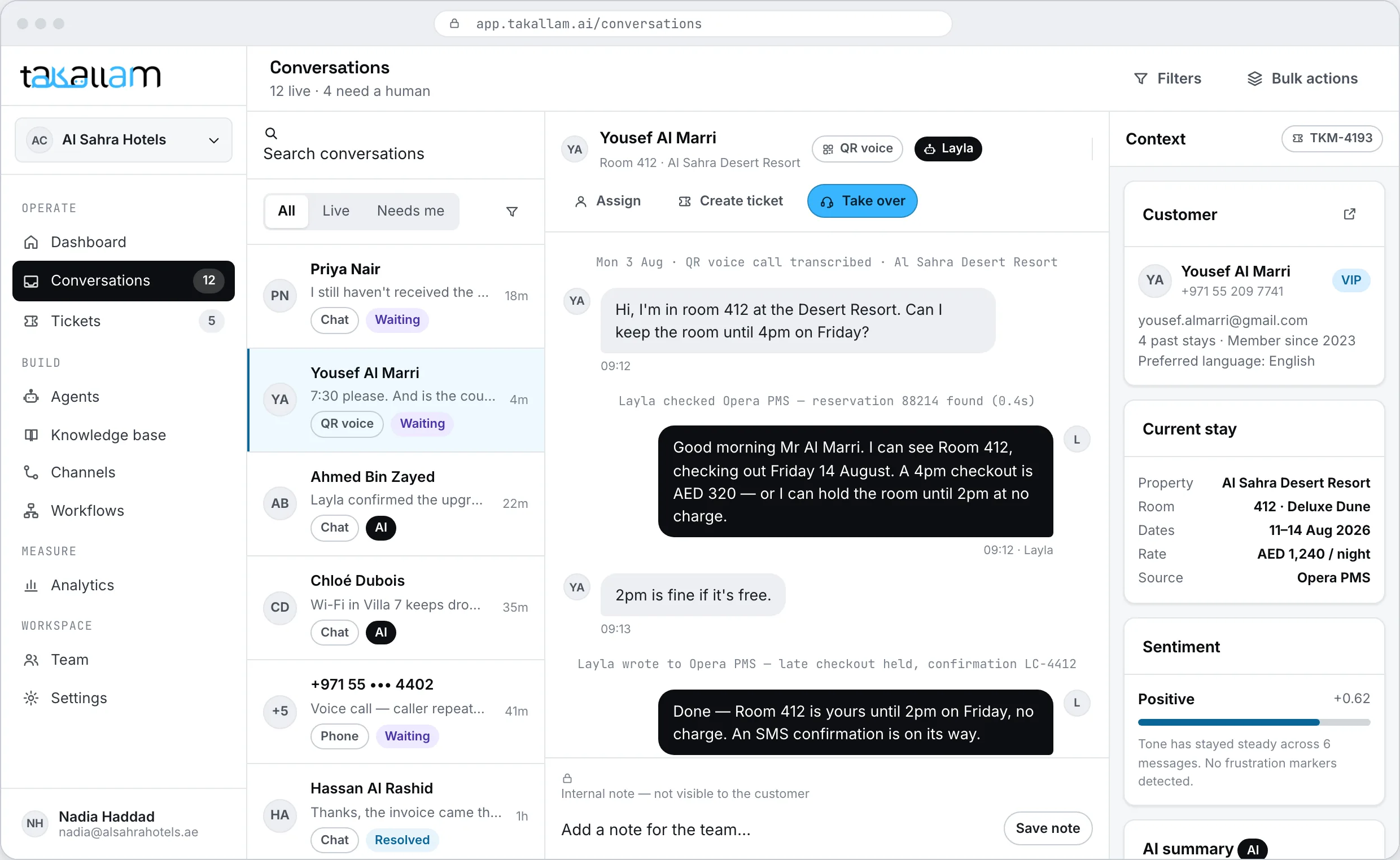
The questions that repeat every single day
Not the complicated ones. The six that interrupt a stylist mid-service and take four minutes each to answer properly.
Book, move or cancel
The agent reads the diary, offers the times that actually exist, and blocks the right amount of chair time for the treatment being booked. A client who needs to move Thursday to Saturday does it in one conversation instead of three missed calls.
How bookings reach your systemHow much, and how long will I be here
Price and duration together, because nobody asks for one without the other. Root touch-up versus full colour, gel versus builder, a sixty-minute massage versus ninety. It reads your own price list rather than guessing, and it says so when a treatment has to be quoted after a consultation.
Is Reem in on Thursday
The most loyal-client question there is, and the one most likely to lose you the booking if it goes unanswered. The agent checks who is on the roster, books with that person, or offers the next time they are free instead of quietly booking someone else.
How many sessions are left on my package
Six-session laser packages, ten-class memberships, a gift voucher from a wedding. The agent reads the balance from your booking system, says how many are left and when it expires, and books the next one while the client is still asking.
Inside the consoleAftercare, before and after
Do not wash it for forty-eight hours. No sauna, no gym, no sun after a peel. Exfoliate two days before the wax, not the morning of. The agent repeats the aftercare you wrote, word for word, in the language they asked in — and it does not improvise a new version.
Ladies-only hours and who is on the floor
Whether the floor is ladies-only and at what times, whether the room is screened, whether the therapist will be female, whether a husband can wait inside. In the UAE this is not a detail — it decides whether the client books at all, so it gets a precise answer from your own policy.
A code on the mirror, asked while she is still in the chair
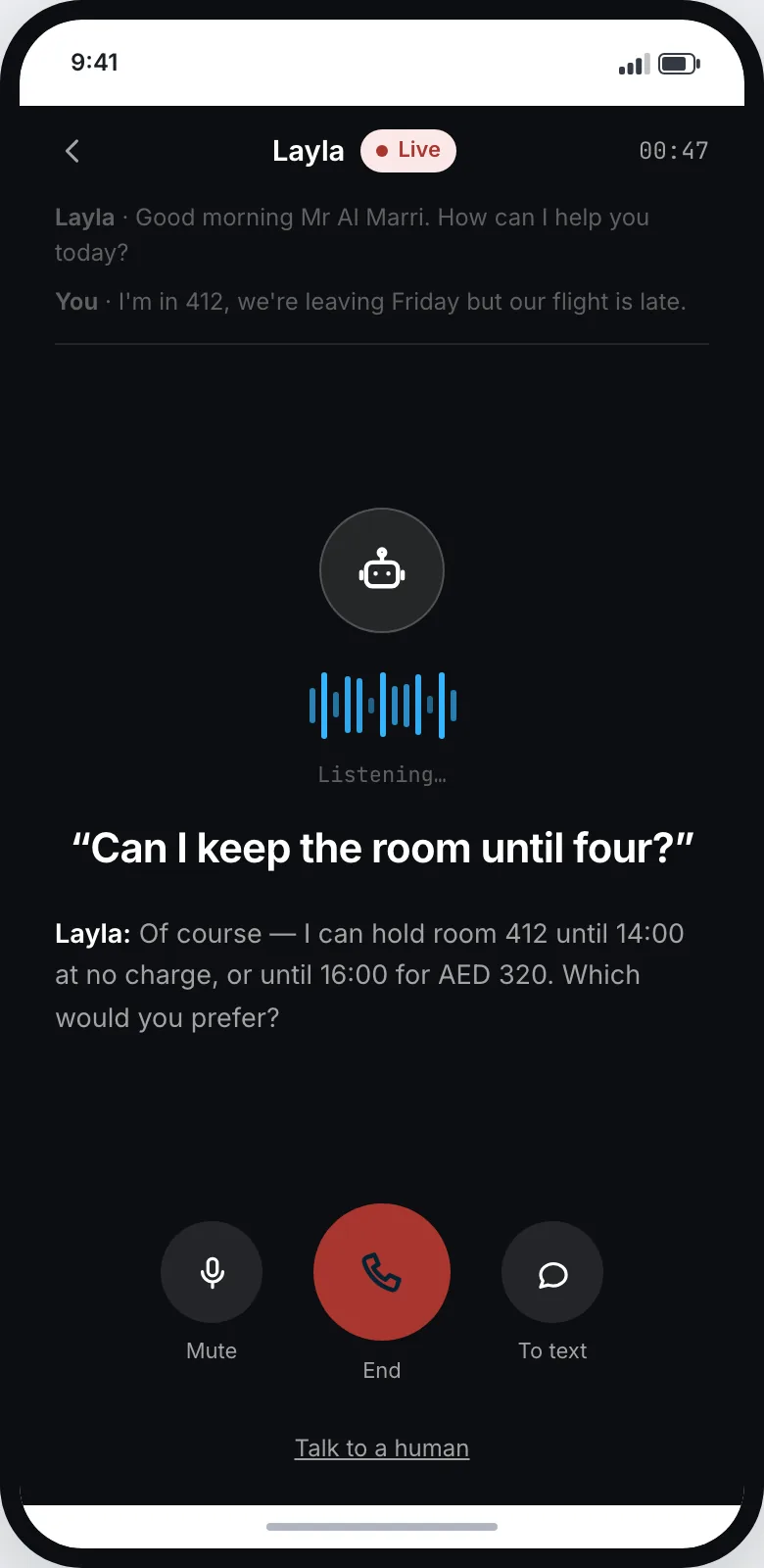
There is no app to download and no number to dial. She has foils in, forty minutes of waiting, and she wants to book her next appointment and find out whether the voucher her sister gave her has anything left on it. She points her camera at the code taped to the corner of the mirror and just talks.
- Opens straight into voice, and switches to text mid-conversation — a salon floor with three dryers running is not a quiet place to talk.
- Every scan carries the code it came from, so a question from the treatment-room door is not confused with one from reception.
- It works at eleven at night, when someone finally remembers she needs Thursday at six.
- A client who scanned at the mirror and calls next week reaches the same agent, with that conversation already there.
Where the code goes
Put it where the question forms. The question at the mirror is not the question at the price list, and the question outside a treatment room is not either of them.
Reception, next to the card machine
The queue at the till is where people rebook, ask what the next appointment should be and remember they wanted to buy the product you used on them. It is also where the desk is most likely to be busy.
The mirror at every station
The single best placement in a salon. A client sits in that chair for forty minutes with a phone in her hand, and the code is at eye level the entire time.
The price list and the treatment menu
Print it in the corner of the menu. Someone reading a list of nine facials wants to know which one is right and what the difference actually is, and that is the moment to answer it.
The treatment-room door
For the client waiting to go in — how long is this, do I take everything off — and for the one coming out, who has just been told three aftercare rules and remembers one of them.
The loyalty card and the gift voucher
A code on the card turns a plastic rectangle into a balance check. How many sessions are left, when the voucher expires, and can she book the next one now.
Inside a hotel, a mall or a clinic group
A lot of UAE spas sit inside a hotel and a lot of aesthetic rooms sit inside a clinic. The codes, the agent and the console work the same way in all of them.
All 20 industriesIt books the treatment. A clinician decides whether you should have it.
This is the most important rule on the page. In this sector the commercial question and the medical question arrive in the same sentence: "how much is the peel, and is it okay with my melasma?" The first half is a price. The second half is a judgement about a specific person's skin, made by someone qualified who can look at it. Takallam answers the first half, hands over the second, and never blends them into one confident-sounding reply.
- Suitability is never answered — pregnancy, medication, a skin condition, a previous reaction, whether a laser is safe on a skin tone. The agent takes the details, books a consultation and tells your team.
- A reported reaction — burning, swelling, a rash after a treatment — is escalated in the moment and flagged, not answered and not left sitting in a queue.
- Aftercare is repeated exactly as you wrote it. The agent does not adapt it, shorten it, or reassure anyone that something "should be fine".
- Anything under a medical licence — injectables, lasers, prescription-grade peels — is scoped to booking and information only, unless you decide otherwise, per agent.
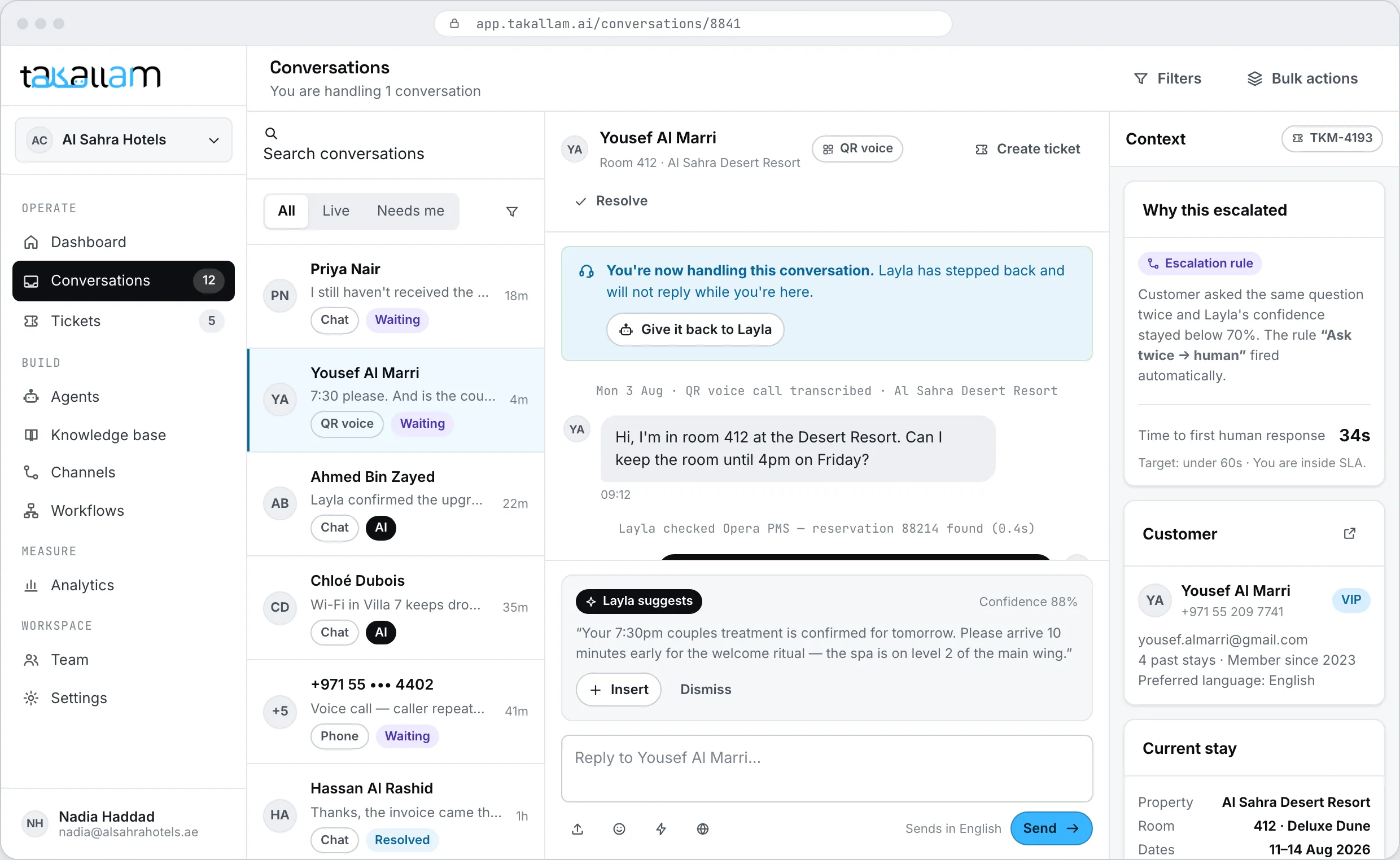
A booking that actually lands in the diary
Telling a client Thursday at six works is half the job. The other half is the slot held against the right person for the real duration of the treatment, the confirmation going out, the reminder landing the day before, and the package balance going down by one. That part is a workflow: when this happens, do that, and if this other thing is true, do something else instead.
- When an appointment is confirmed, hold the slot for the treatment's real duration, send the confirmation, and send a reminder the day before.
- When someone cancels inside your notice window, apply your policy and offer the slot to whoever asked for that time and could not get it.
- When a package session is used, deduct it and tell the client what is left before they have to ask.
- Takallam does not ship a pre-built connector for every salon booking system. It ships a workflow builder, a REST API and signed webhooks — if your booking system can be called, a workflow can call it.
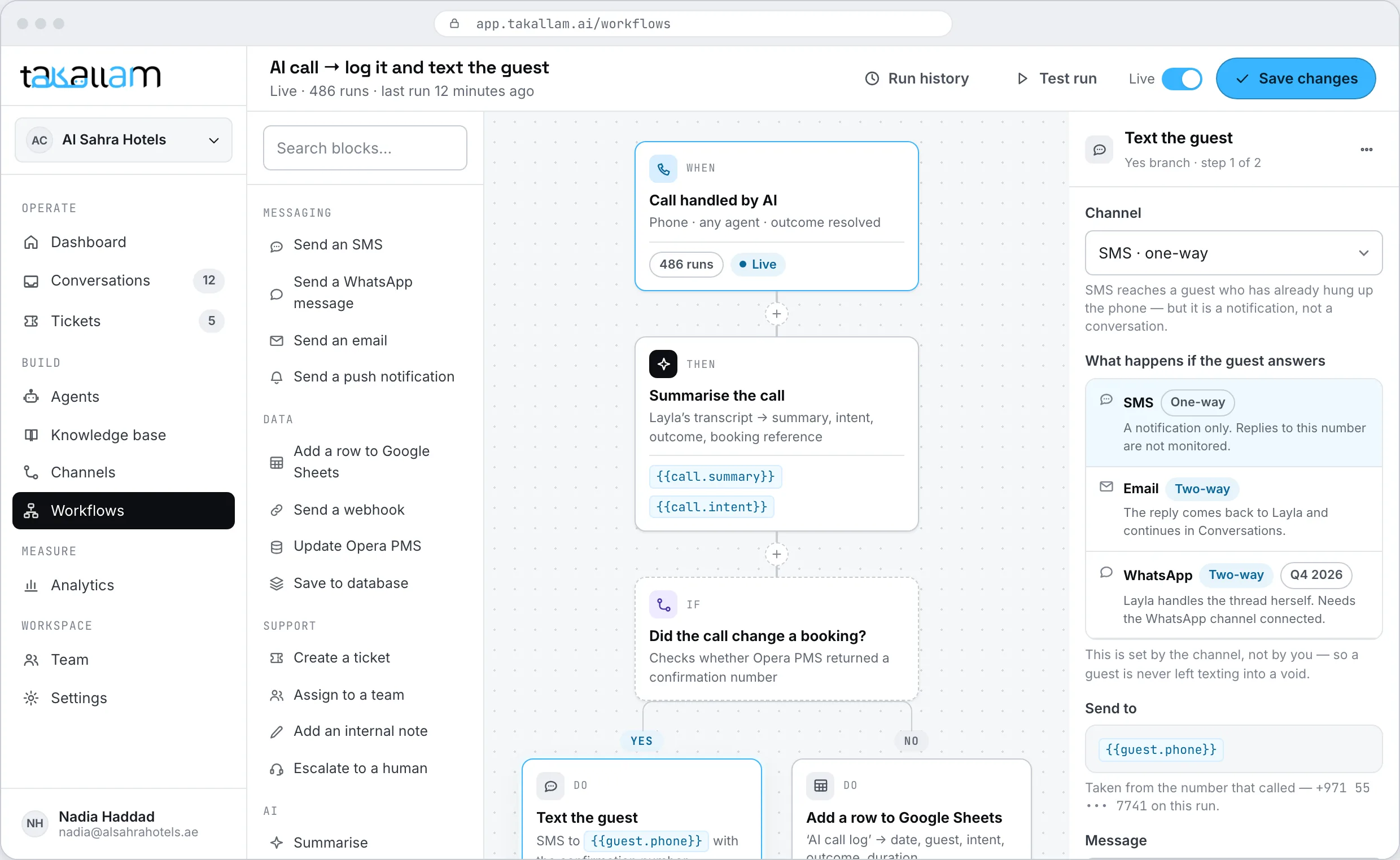
What the platform gives a salon, a spa or a clinic
These are capabilities of the platform, not results from a deployment. Takallam is pre-launch and has no published performance figures.
What salon and clinic owners ask first
Can it actually book, or does it just take a message?
Both, and you choose. In the agent builder you decide what each agent is allowed to do. Give it booking and it reads your diary, offers real times, blocks the correct duration and writes the appointment back through a workflow. Take the action away and it will answer the price, the duration and the availability question but leave the booking to your desk.
Will it tell a client whether a treatment is safe for her?
No. That is the one thing it is built not to do. Suitability for a treatment — pregnancy, medication, a skin condition, a laser on a particular skin tone, a reaction she had last time — is a clinician's call, not the agent's.
What it does instead is take the details, book a consultation with the person who can actually assess it, and put the conversation in front of your team. If a client reports a reaction after a treatment, that conversation is escalated immediately and flagged, not answered.
Can it tell a client how many sessions are left on her package?
Yes, if your booking system can be read. The agent checks the balance, says how many sessions remain and when the package or voucher expires, and offers to book the next one in the same conversation. Every lookup is logged against the conversation that caused it.
Where do we actually put the QR code?
The mirror at each station is the best single placement — a client sits there for forty minutes with a phone in her hand. After that: reception next to the card machine, the corner of the price list, the treatment-room door, and the loyalty card or gift voucher. Print a different code for each spot so you can see which one clients use and what they ask at each one.
Does it know which therapist is working, and can a client request one?
Yes, when the roster is in a system a workflow can read. The agent answers whether that person is in, books with them, or offers the next slot they have rather than silently assigning someone else — which is the fastest way to lose a client who books for a person, not a salon.
How does it handle ladies-only timings and gender-specific rooms?
From your own written policy, precisely. Which hours are ladies-only, whether the room is screened, whether a male therapist is on the floor, whether a partner can wait inside. The agent does not soften or generalise these answers, and anything your policy does not cover goes to a person rather than getting a best guess.
Does it handle Arabic-speaking clients properly?
Yes — Emirati and wider Gulf dialect in both voice and text, including clients who start a sentence in Arabic and finish it in English. This is the reason Takallam exists rather than being an English-first product with translation added afterwards. Today the platform covers English and Arabic.
What does it cost, and does it suit a single-branch salon?
You pay per interaction, and each channel is priced separately, because a phone call and a chat message do not cost the same to deliver. There are no per-seat licences and no minimum commitment, which is what makes it workable for one salon rather than only for a chain. Takallam is pre-launch, so rates are being set with the first cohort — join the waitlist and we will quote against your real volume.
Put a code on the mirror and see what clients ask
We are onboarding a first cohort of UAE salons, spas and aesthetic clinics now. Tell us how many chairs or rooms you run, which channels you need and what your booking system is, and we will come back with a rate against your real volume.
Pay per interaction · priced per channel · no seats, no minimums