
It is registration week and the office phone hasn't stopped since eight
Which documents do we need, when does term start, why is the bus late, how do the instalments work, where do I get a transcript. Takallam answers all of it — from a code at reception, inside your parent app, in the admissions inbox and on the phone, in English and Emirati Arabic. Anything about a child goes straight to a person instead.
What the school office is asked every day
One office, four hundred families, the same eleven questions
The fee schedule went out on Sunday. By Monday morning two people at the front desk have explained the second-instalment date thirty times — at the counter, on the phone, and in an admissions inbox that is now four hundred messages deep. None of those questions needed a person. All of them got one, because there was nothing else to answer them.
- Registration week and the first week of term produce more questions than the rest of the year, and they land on the same two desks.
- The answer to "which documents do I bring" is in a PDF the parent cannot find, so the parent rings the office instead.
- A bus running twenty minutes late generates forty calls at exactly the moment nobody is free to take them.
- Parents who would rather ask in Arabic get a proper answer only when the right person happens to be at the desk.
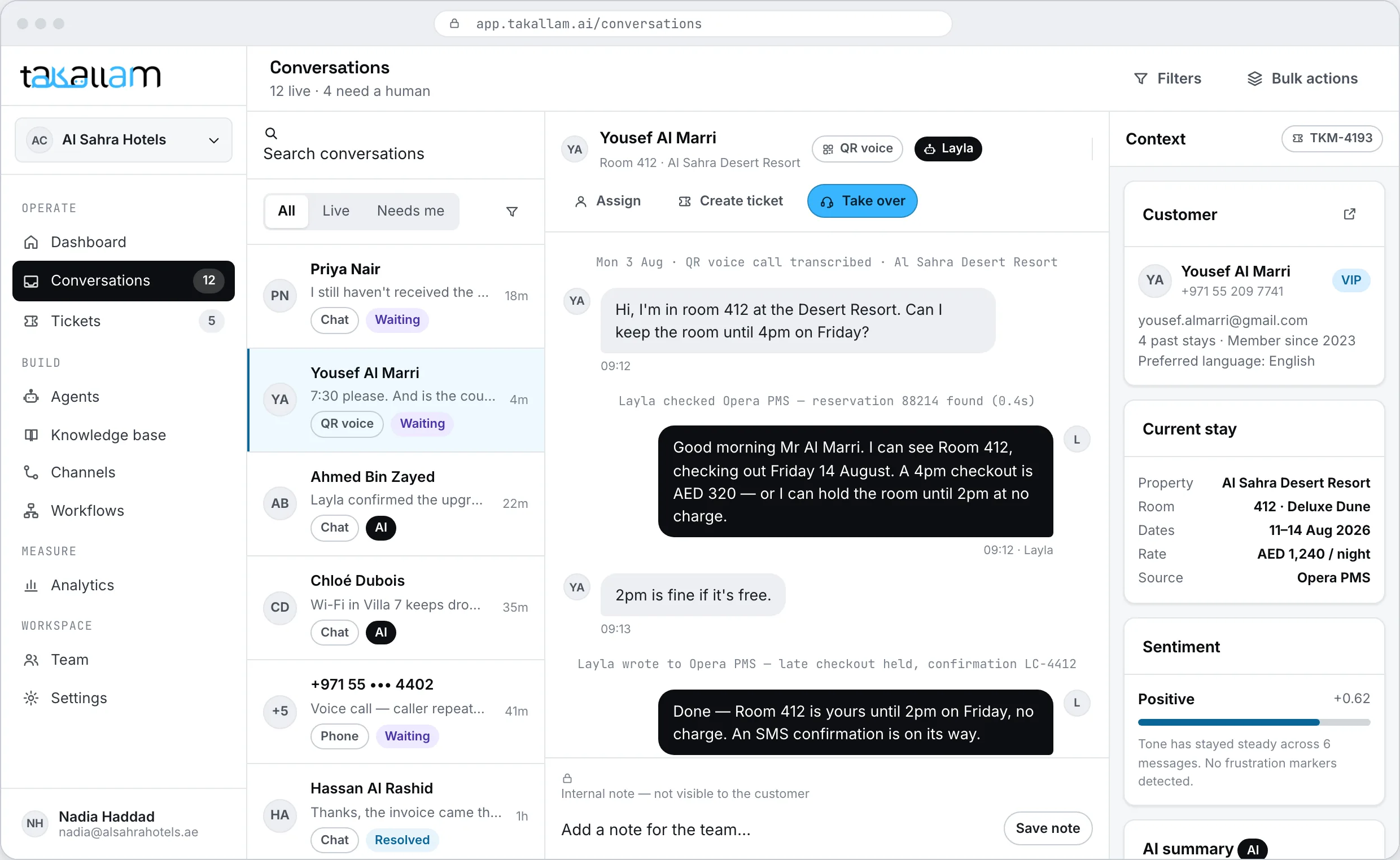
The eleven questions, and who they were really for
Almost none of these need judgement. They need an accurate answer at nine at night, which is when a working parent finally sits down to deal with school admin.
Admissions: the steps and the documents
What order the stages happen in, whether there is an assessment, what a mid-year transfer needs, and the document list — passport copy, Emirates ID, the last two school reports, the transfer certificate, the vaccination record. The agent reads it from your admissions pages, not from a guess.
How the knowledge base is builtFees, instalments and what is not included
When each instalment falls due, what the fee covers and what sits outside it — bus, uniform, trips, exam entry — and how a sibling reduction applies. It quotes your published schedule. It does not negotiate, and a request to change a family plan goes to your finance team.
The email channelTerm dates, holidays, uniform and supply lists
When the term starts, which days are half days, when the break is, what to buy and where. This is pure volume — hundreds of identical questions in the two weeks before term — and it is exactly the volume that never justified another hire. You pay for it by the interaction.
How pricing worksThe bus: route, stop and the morning it runs late
Which route serves an address, the pickup and drop times, the cost per term, and how to change a stop. A delay becomes one ticket with the route on it, routed to transport, instead of forty separate calls to a desk that cannot see the bus either.
Tickets and SLAsAbsence, late arrival and early collection
A parent calls at 7:10 to say a child will not be in. The agent takes the name, the class and the date, logs it, and confirms in writing. The moment the reason is medical — or anything else about the child — it stops and puts a person on it. That boundary is set out in full below.
Transcripts, certificates and portal access
A transcript request, an attested certificate for a visa, a reference for a university application, a parent-portal login that stopped working. Each becomes a ticket with the student name, the graduating year and the deadline, routed to the registrar with a clock on it.
A parent at the gate scans the sticker and just asks
Pickup is at 2:15. The parent is in a queue of cars with a phone in one hand, and the question is whether Thursday is a half day. There is no app to install, no portal password to remember and no number to ring. They point the camera at the code on the gate, speak, and get the answer before the queue moves.
- Opens straight into voice, and switches to text mid-conversation when the parent would rather read the answer.
- Emirati and wider Gulf Arabic in speech, not the formal register nobody uses at a school gate — and it follows a parent who starts a sentence in Arabic and finishes it in English.
- The grandmother collecting on Thursday and the father emailing at midnight get the same answer, because it is the same agent and the same knowledge base.
- Every scan carries the code it came from, so a question from the bus arrives tagged as transport and not as admissions.
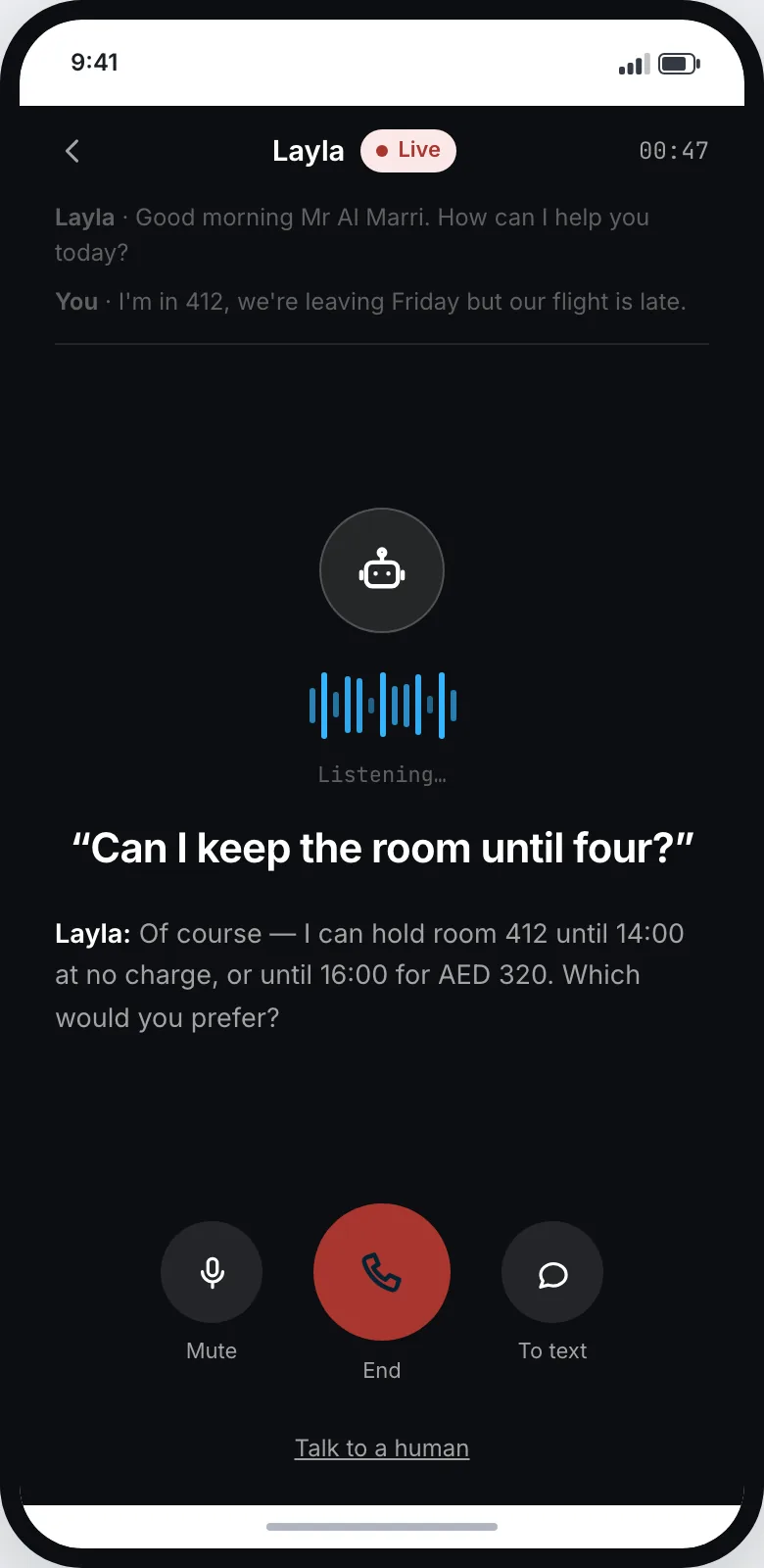
Where the code goes
Put it where the question happens. A code at reception answers admissions questions; a code on the bus answers transport questions. Print a different one for each and you find out what each place actually generates.
The reception desk
For the walk-in who wants a prospectus, the parent chasing a form, the delivery, and the visitor asking where the admissions office is. The desk keeps the conversations that need a human and hands the rest over.
On the bus, by the door
A sticker at the front of every bus. Route number, stop change, the day it is running late, what happens if a child misses it. The questions the driver cannot answer and should not be answering while driving.
The gate at pickup
Two fifteen is the busiest fifteen minutes of the school day and the worst possible time to hold a conversation. A code on the gate takes the half-day question, the club-timing question and the uniform question off the staff standing there.
The parent handbook and the offer pack
The handbook holds every answer and nobody reads it. A code on the inside cover means a parent can ask it a question instead of scanning forty pages for the term dates.
The admissions office and a code per place
On the desk, on the enquiry form, in the offer letter. Separate codes for reception, the bus, the gate and admissions, so the analytics show which placement earns its ink and what parents ask in each spot.
Inside the consoleOne school, or a group of them
A group running a nursery, two schools and a university campus prints its own codes per site while keeping one knowledge base, one inbox and one set of escalation rules. Takallam works the same way across other sectors.
Every sector Takallam coversAnything about a child goes to a person. Not to an AI, and not to a queue.
This is the first question a principal asks, so here is the flat answer. Safeguarding, a child's welfare, anything medical and anything disciplinary are not answered by the agent. They are not attempted because confidence looked high. They are not summarised into a ticket and left overnight. They are routed the moment they are detected to a named member of staff you nominate — your safeguarding lead, the school nurse, the head of year — and the parent is told a person is coming.
- A parent who says a child is unwell, injured, or has a condition the school should know about gets a person. The agent takes the name, the class and the time, then stops.
- Anything that reads as a welfare or safeguarding concern is escalated on the first message, and the routing is logged with a timestamp.
- Discipline, exclusions, incidents between students and any complaint about a member of staff are human-only from the first word.
- The agent never gives medical advice, never comments on a child's progress or behaviour, and never confirms who is authorised to collect a child.
- Everything the agent already saw travels with the handover, so the staff member opens the full conversation, not a summary of it.
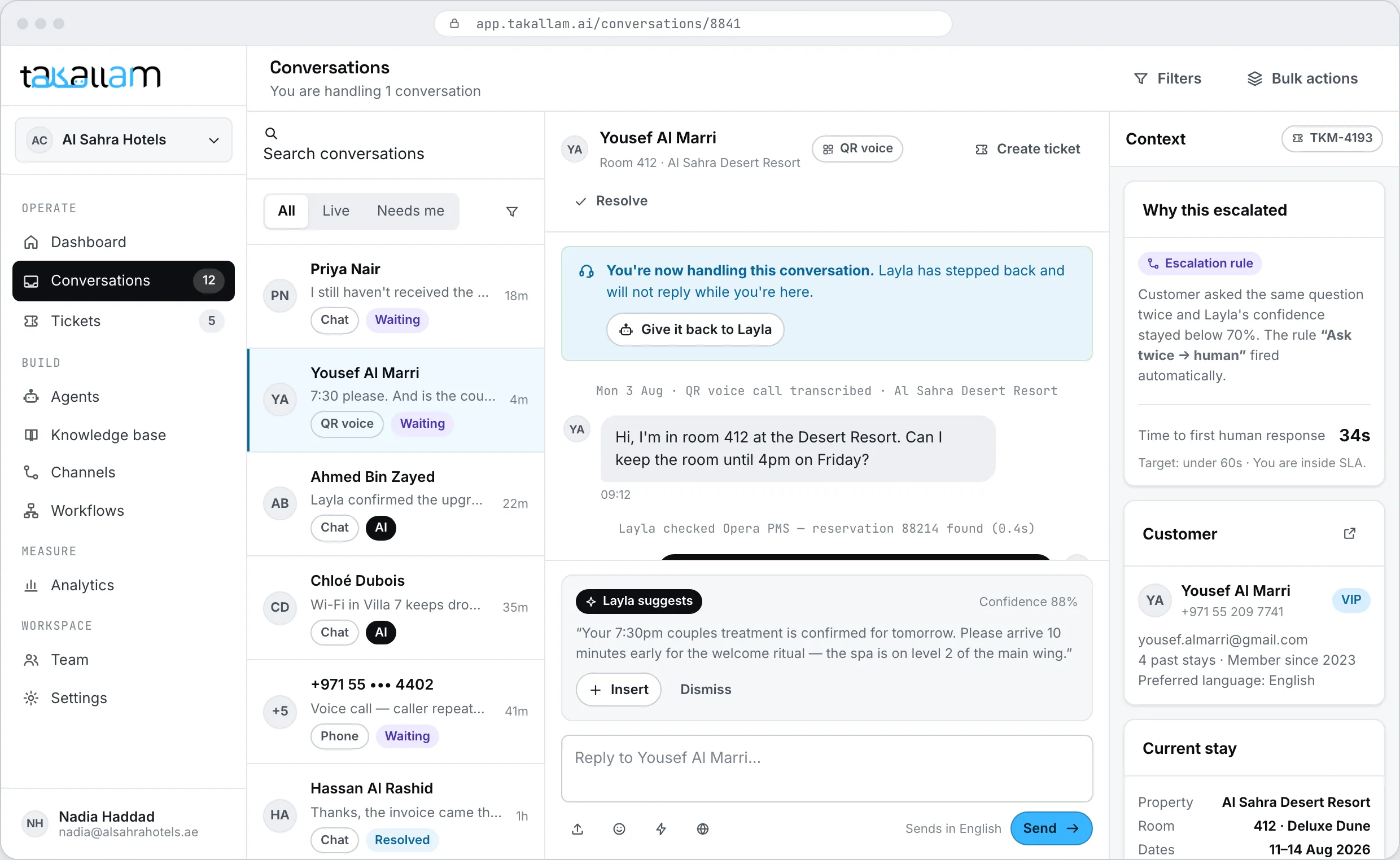
An absence that actually reaches the register
Telling a parent "noted" is half the job. The other half is the absence appearing against the right student in the right class, the class teacher seeing it, and the parent getting it in writing. That part is a workflow: when this happens, do that, and if this other thing is true, do something else instead.
- When an absence is reported, write it against the student and the class in your student information system, then confirm to the parent in writing.
- When a transcript is requested, open a ticket with the student name, the graduating year and the deadline, and route it to the registrar.
- When a fee question needs a real balance rather than the published schedule, read it from your billing system at the moment of asking.
- Takallam does not ship a pre-built connector for every student information system. It ships a workflow builder, a REST API and signed webhooks — if your SIS can be called, a workflow can call it.
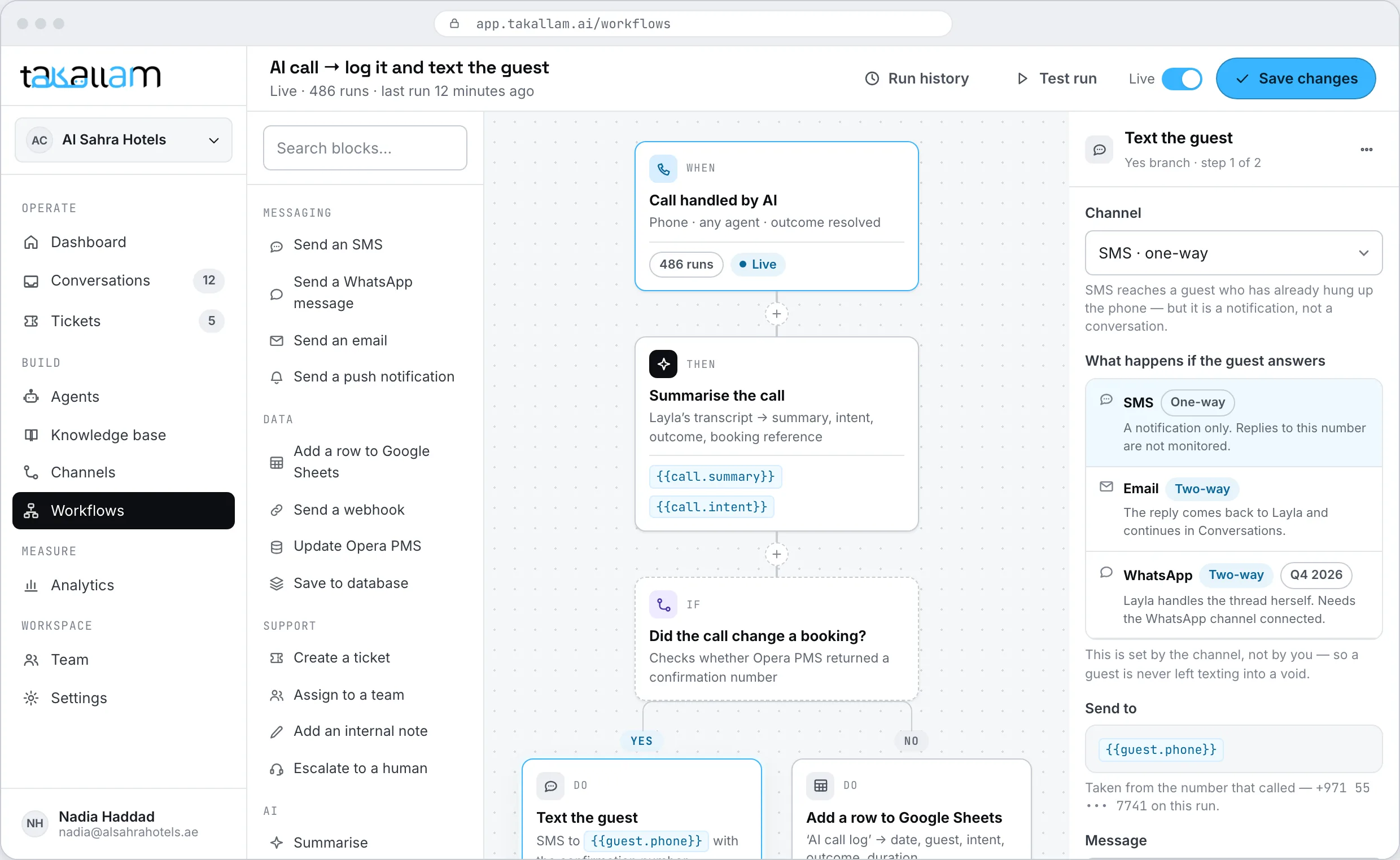
What the platform gives a school
These are capabilities of the platform, not results from a deployment. Takallam is pre-launch and has no published performance figures.
What schools ask before they let anything near a parent
Will an AI be answering questions about my child?
No. Anything that touches a child specifically — welfare, safeguarding, a medical matter, behaviour, discipline, or who may collect them — is never answered by the agent. It is not queued, not held until morning and not attempted because the model looked confident.
You nominate who each category goes to by name, and the conversation is routed there on the first message with everything the agent has already seen attached. The agent answers school-level questions: dates, fees, documents, routes, lists, forms. Those are the ones eating your front desk.
Where do we put the QR code?
Wherever the question happens: the reception desk, the front of every bus, the gate where parents wait at pickup, the inside cover of the parent handbook, the admissions office desk and the offer pack. Print a different code for each so you can see which placement parents actually use and what they ask in each spot.
Does it connect to our student information system?
It connects to systems that can be called. Takallam gives you a workflow builder, a REST API and signed webhooks, so a workflow can log an absence, read a fee balance, raise a transcript request or write a note in any system that exposes an interface.
What Takallam does not do is claim a pre-built, certified integration with every SIS on the market. Tell us what you run and we will be straight with you about what the connection looks like.
Can it tell a parent their exact fee balance?
Only if you connect it to the system that holds the balance and give the agent that action. Without the connection it answers from your published fee schedule — instalment dates, what is included, what is not — and hands anything account-specific to finance. Every action an agent takes is logged against the conversation that caused it, so you can audit exactly what was said and why.
Does it answer the admissions inbox as well?
Yes. Forward admissions@ or connect the mailbox, and the agent reads the whole thread — attached reports and transfer certificates included — then replies in-thread from your own address, in the language the parent wrote in. Enquiries are tagged and routed, and you can run it in draft mode so a person approves every reply until you trust it.
Do parents who speak Arabic get the same service?
Yes — Emirati and wider Gulf dialect in both voice and text, including parents who switch between Arabic and English mid-sentence. This is the reason Takallam exists rather than being an English-first product with translation added later. The platform covers English and Arabic today; if your parent body needs more, tell us before you join.
Where does student data live, and how long is it kept?
In the UAE region, in-region by default. You control retention, access is role-based, and every conversation, action and handover is logged so an incident can be reconstructed. Takallam does not claim a certification it does not hold — if your board requires a specific standard, ask us and we will tell you exactly where we are rather than putting a badge on a page.
What does it cost, and how long does setup take?
You pay per interaction, and each channel is priced separately because a phone call and a chat message do not cost the same to deliver. No per-seat licences and no minimum commitment, which matters when a school year has two loud fortnights and ten quiet months. Setup is short: Takallam reads your website, builds the knowledge base from your admissions, fees and calendar pages, and drafts your first agents for you to review. Rates are being set with the first cohort — join the waitlist and we will quote against your real volume.
Put a code at reception before registration week
We are onboarding a first cohort of UAE nurseries, schools and universities. Tell us how many families you serve, which channels you need and what your student information system is, and we will come back with a rate against your real volume.
Pay per interaction · priced per channel · no seats, no minimums