
Everyone has the same question and there is one information desk
Which entrance, where do I collect my badge, does my pass get me into the workshop, which room did the keynote move to, where can I park. Takallam answers all of it from a code on the badge, from your event site, from the inbox and on the phone — in English and Emirati Arabic — and gets an exhibitor with a build problem in front of a human in minutes.
What the information desk gets asked between nine and six
Doors open at nine and the longest queue in the hall is for information
Registration is moving, the halls are filling, and the desk that exists to point people at the right door has become the bottleneck. Half of what arrives is the same six questions. The other half comes from exhibitors, and those are the ones that cannot wait — a truck at the wrong gate at 6am on build day is a completely different problem to a visitor asking where the coffee is.
- The same six questions arrive at the desk, on the phone, through the event inbox and on social, and get six slightly different answers.
- Build-up starts before your team is fully on site, and breakdown runs after most of them have gone home.
- A room change published at 10:40 does not reach the three hundred people already walking to the old room.
- Your support load exists for four days a year. Hiring for it never made sense, and neither did paying for seats in the eleven months it does not exist.
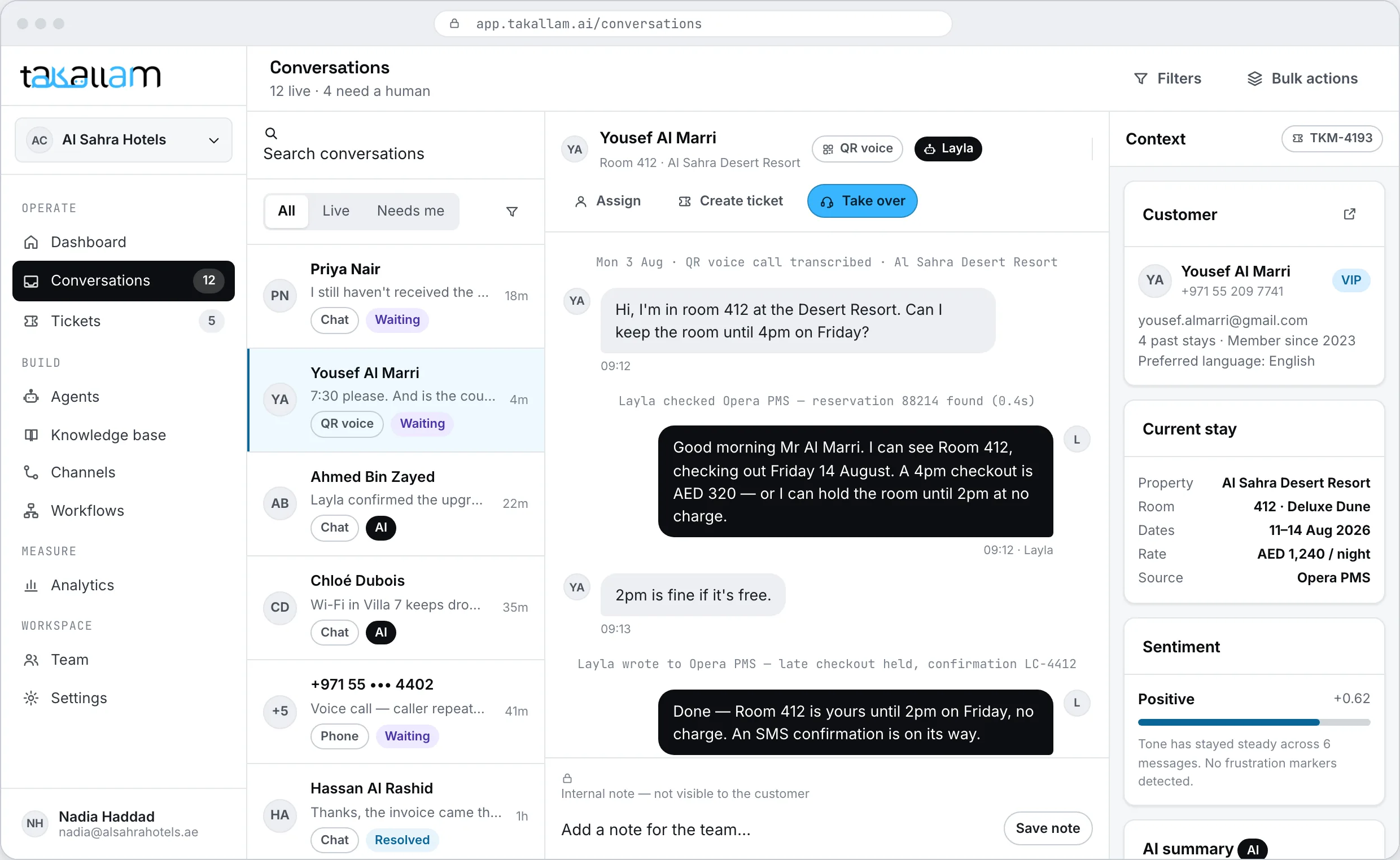
What visitors and exhibitors actually ask
Two audiences, two very different queues. Visitors want to know how to get in and where to be. Exhibitors want to know when their truck can unload.
Ticket types and what they include
Does a day pass get me into the conference track, is the expo floor free, can I upgrade at the door, what does a delegate badge cover that a visitor badge does not, is there a student rate. Answered from your real ticket matrix rather than a summary somebody remembers.
Badge collection and registration
Where to collect, what to bring, whether the confirmation email is enough, and what happens when it never arrived. The agent re-explains the process and can re-send the instruction from your own address. The badge is still printed by your registration team.
The email channelGetting there and getting in
Which entrance serves which hall, where the drop-off is, which car park still has space, when the shuttle runs, which metro exit is the near one. These are the questions that turn into a crowd at the wrong door.
The schedule, and the schedule changing
When a session starts, whether it is full, which room it moved to. Update the change once and every visitor who asks after that moment gets the new room — not just the ones who were watching the app.
Accessibility, wifi, prayer room, cloakroom
Step-free routes, wheelchair loan, the quiet room, the wifi network and password, where to leave a bag, and where lost property actually ends up at six o’clock. Small answers that take a person four minutes each, all day.
Tickets and SLAsArabic and English in the same hall
A UAE show floor is bilingual by default and the information desk usually is not, evenly. Takallam handles Emirati and wider Gulf dialect in speech and text, including visitors who start a sentence in Arabic and finish it in English.
How Takallam handles ArabicThe badge around their neck is the information desk
Every attendee is already wearing a printed code. They point a phone at it and talk. Nothing to install on the way in, no queue to join, no number to dial — and it answers four hundred people at the same time, which is exactly what happens ten seconds after a hall change is announced.
- Opens straight into voice. No app store and no download, in a hall where the wifi is already working hard.
- Switches to text mid-conversation, which is what people do while a keynote is running.
- Every scan carries the code it came from, so a question at the exhibitor gate is tagged as an exhibitor and a question in Hall 3 is tagged Hall 3.
- A visitor who scanned on day one and emails on day three gets the same agent, with the earlier conversation already there.
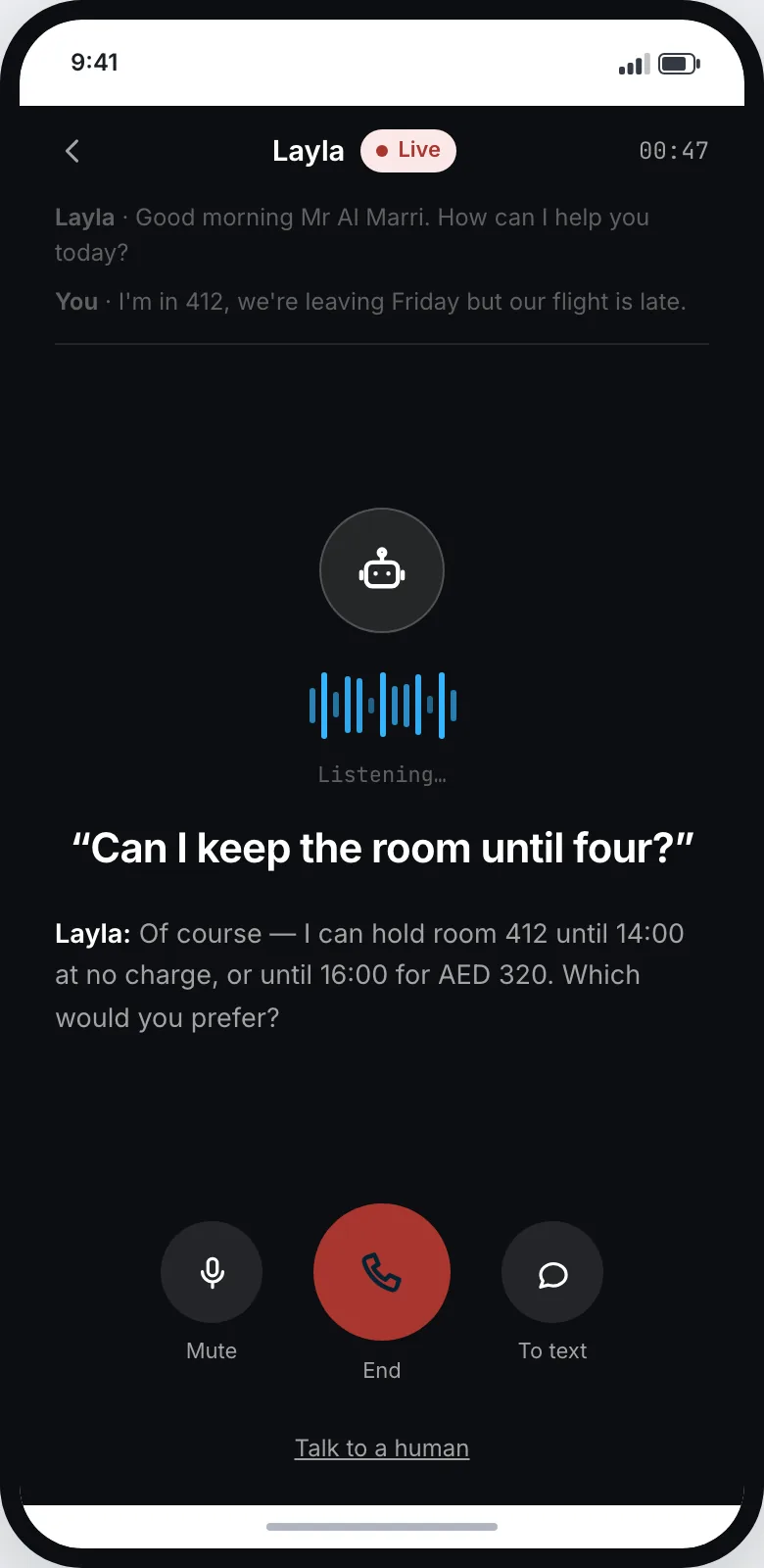
Where the code goes
Print it where the question happens. A code at the west entrance answers entrance questions; a code in the exhibitor manual answers build questions. Different codes mean you find out which door confuses people and which sign is not working.
The badge and the lanyard
The one printed thing every attendee is guaranteed to be holding, all day, for the whole run of the show. It is also what they are looking at when they realise they do not know which hall they want.
Every entrance, and the gate before it
Visitor entrances, the exhibitor gate, the loading bay, the car park lift lobby. This is where wrong-door crowds form, and where a two-line answer stops one from forming.
Wayfinding signage and floor plans
On the hall map, at the top of the escalator, at the junction where the aisle numbering changes. People already stop at signage to work something out. The code lets them ask the sign.
The exhibitor manual
Printed and PDF, on the cover and on the deadlines page. Rigging rules, power, stand height limits, delivery windows, forms and cut-off dates. The manual answers if you find the right page; the code answers if you just ask the question.
The stand itself
Exhibitors put their own code on the stand so a visitor can ask about the product, the spec sheet or a follow-up meeting without waiting for the one person on the stand who is already talking to somebody else.
A different code for every placement
Separate codes per entrance, per hall, per zone, per exhibitor. The analytics show which door generates confusion, which sign is doing its job, and what people ask in each part of the floor.
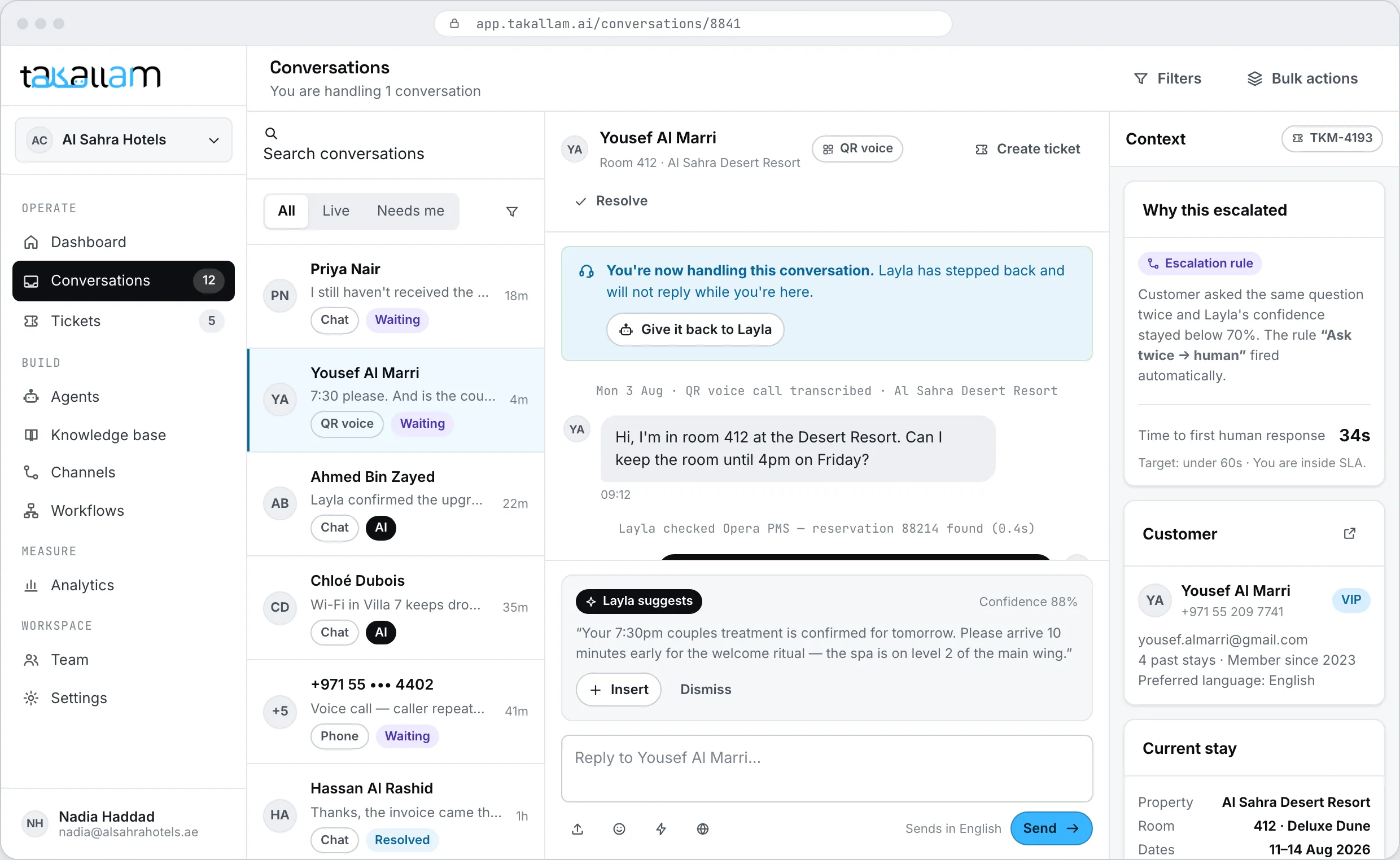
Inside the consoleOn build day, the right answer is a human in four minutes
This is the part of an event that an AI must not try to be clever about. An exhibitor whose truck is at the wrong gate, whose rigging has not gone up, whose power drop is missing, or whose stand will not be finished before doors open does not need an answer — they need your operations lead, now, with the stand number already in the message. Takallam’s job there is to recognise it in the first sentence, capture the stand number, the hall and a mobile, and route it to a named queue with a priority. It does not attempt an answer, and it says so out loud rather than stalling.
- Escalate on intent, before the agent composes anything: build, rigging, power, deliveries, damage, or anything with a deadline attached to it.
- Capture first, route second. Stand number, hall, company and contact are taken in the first exchange, so nobody has to call back to ask.
- Priority changes by day. During build-up everything exhibitor-shaped goes straight to operations; on show days a room-change question does not.
- Safety, medical and security are never AI questions. They route immediately to the number you nominate, on every channel, with no attempt at an answer.
- Whoever picks it up sees the transcript, everything the agent captured, and what it deliberately refused to answer.
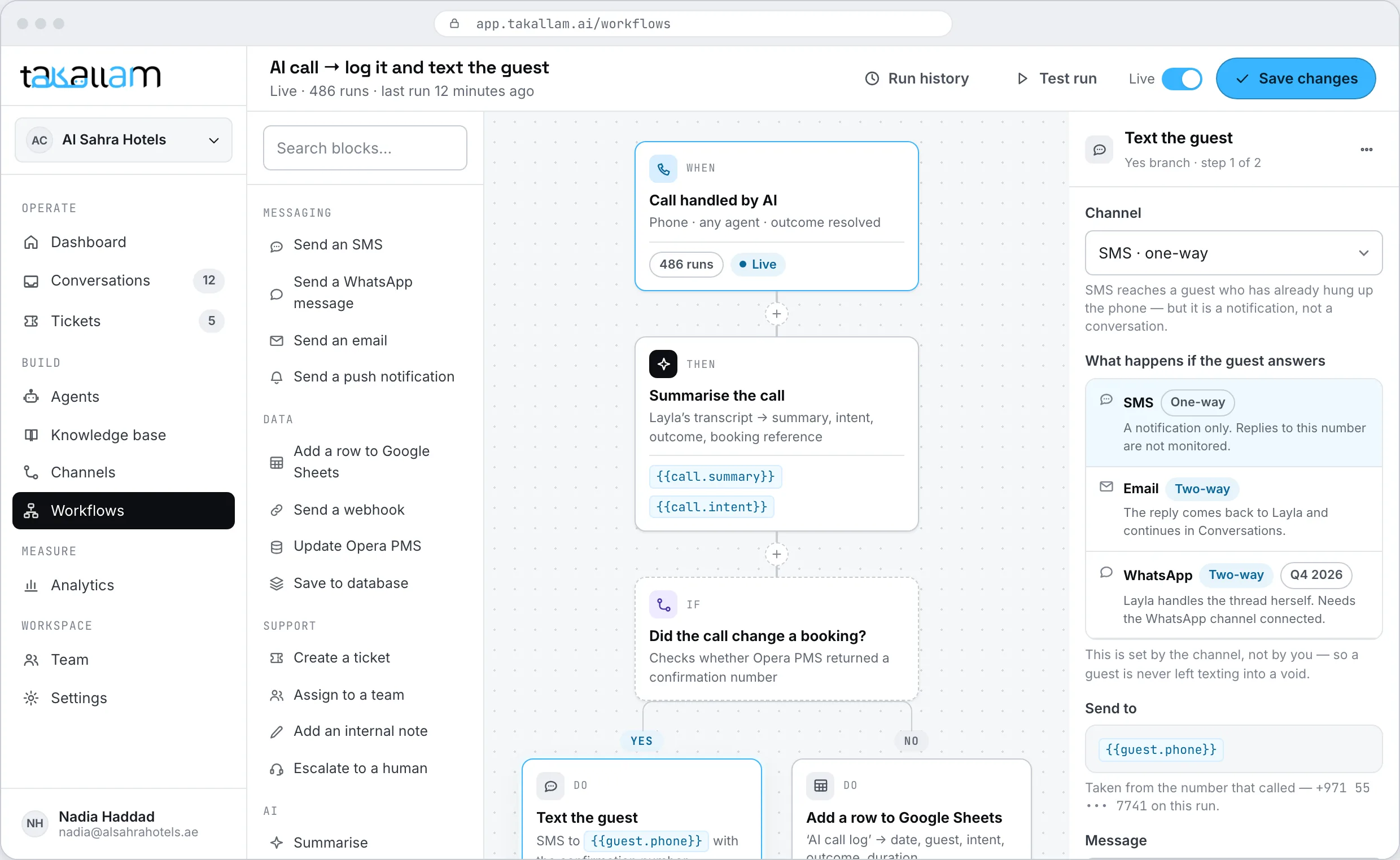
Your ticketing platform, and a support load that only exists for four days
Most status questions have an answer already sitting in your registration system. A workflow can go and read it — whether an order is paid, whether a badge has been printed, which sessions somebody registered for — and give it back inside the conversation. What it will not do is invent a status when the system is unreachable. It says the system is not responding and hands over.
- Connect your ticketing and registration platform, and a workflow can look up an order, a badge status or a session registration by reference.
- When an exhibitor reports a build problem, open a ticket with the stand number, notify operations and start the clock on it.
- When the schedule changes, update it once and every channel answers with the new room from that moment — badge scans, chat, email and phone together.
- Takallam does not ship a pre-built connector for every ticketing platform. It ships a workflow builder, a REST API and signed webhooks. If your system can be called, a workflow can call it.
- And the commercial shape matches the event shape: you pay per interaction, so a show that generates ten thousand questions in four days and almost none for the rest of the year is not sitting on seat licences in between.
What the platform gives an event
These are capabilities of the platform, not results from a deployment. Takallam is pre-launch and has no published performance figures.
What organisers ask before a show
Can it answer exhibitor questions as well as visitor ones?
Yes, and you should run them as two agents. One is built on your visitor pages — tickets, entrances, parking, schedule, facilities. The other is built on the exhibitor manual — deadlines, rigging, power, delivery windows, forms. They get different knowledge, different escalation rules and different codes, so an exhibitor question never gets a visitor answer.
What happens when an exhibitor has a build problem on site?
It escalates immediately. Build, rigging, power, deliveries and damage are hard escalation triggers evaluated before the agent tries to answer anything — because during build-up the useful response is a person in minutes, not a paragraph.
What the agent does contribute is speed: it captures the stand number, the hall, the company and a mobile in the first exchange, opens a ticket and routes it to your operations queue with a priority. Your team opens a message that already has everything they would otherwise have phoned back to ask for.
Where do we put the QR code?
On the badge and lanyard, at every entrance and the gate before it, on wayfinding signage and floor plans, in the exhibitor manual, and on the stands themselves. Print a different code for each placement so you can see which entrance confuses people, which sign is working, and what gets asked where.
The schedule changes during the show. How fast does the agent know?
As fast as you update it. Change the session or the room in the knowledge base and every channel answers with the new detail from that moment — a badge scan in the corridor, a chat on the event site, an email and a phone call all give the same room number. If your schedule lives in a system, a workflow can push the change instead of someone typing it.
Does it connect to our ticketing and registration platform?
It connects to systems that can be called. Takallam gives you a workflow builder, a REST API and signed webhooks, so a workflow can read an order, a badge status or a session registration and return it in the conversation.
What Takallam does not do is claim a pre-built, certified integration with every ticketing platform on the market. Tell us what you run and we will be straight with you about what the connection looks like.
We only run three events a year. Does the pricing model work for that?
This is the case it fits best. You pay per interaction and each channel is priced separately, with no per-seat licences and no minimum commitment — so a support load that spikes for four days and disappears for eleven months costs you for four days. Takallam is pre-launch, so rates are being set with the first cohort. Join the waitlist with your expected visitor numbers and we will quote against them.
Does it handle Arabic-speaking visitors?
Yes — Emirati and wider Gulf dialect in voice and text, including visitors who switch between Arabic and English mid-sentence. Today the platform covers English and Arabic properly rather than claiming a long list of languages. If your visitor mix needs more than that, tell us before you join so we can be honest about it.
How long does setup take before a show?
Takallam reads your event site and builds the knowledge base from your visitor pages, ticket matrix, floor plan and exhibitor manual, then drafts your first agents. You review what it learned, write the escalation rules for build days, decide which actions each agent may take, and print the codes. Your systems team is only needed if you want registration lookups inside the conversation.
Put a code on the badge before the next show
Tell us the show, the dates, roughly how many visitors and exhibitors you expect, and which ticketing platform you run, and we will come back with a rate against your real volume.
Pay per interaction · priced per channel · no seats, no minimums