
Every request starts with four questions before the real one
Which community, which tower, which unit, which piece of equipment. Takallam takes maintenance requests, technician ETAs, permits and bookings from a code stuck to the asset itself, from your resident app, from your inbox and on the phone — in English and Emirati Arabic. Anything with a safety dimension skips the queue entirely and goes to the emergency team with the location already attached.
What the helpdesk gets all day
Most of the call is spent working out where the fault is
A resident rings to say the AC is not cooling. Before anyone can raise a work order somebody has to establish the community, the tower, the unit, whether it is a split or a chiller, whether the caller is the owner or the tenant, and whether there is already a job open on it. Ten minutes later the same resident rings back to ask when the technician is coming, and that call starts from the beginning again.
- Every request opens with the same four location questions, and the answers get typed into the work-order system by hand.
- "When is the technician coming" is the highest-volume call in the business and it produces no work at all.
- Faults noticed in a corridor, at the pool or in the car park never get logged, because there is nowhere to log them from.
- Evenings and weekends are exactly when a leak starts, and the on-call phone is one person deciding on their own what counts as urgent.
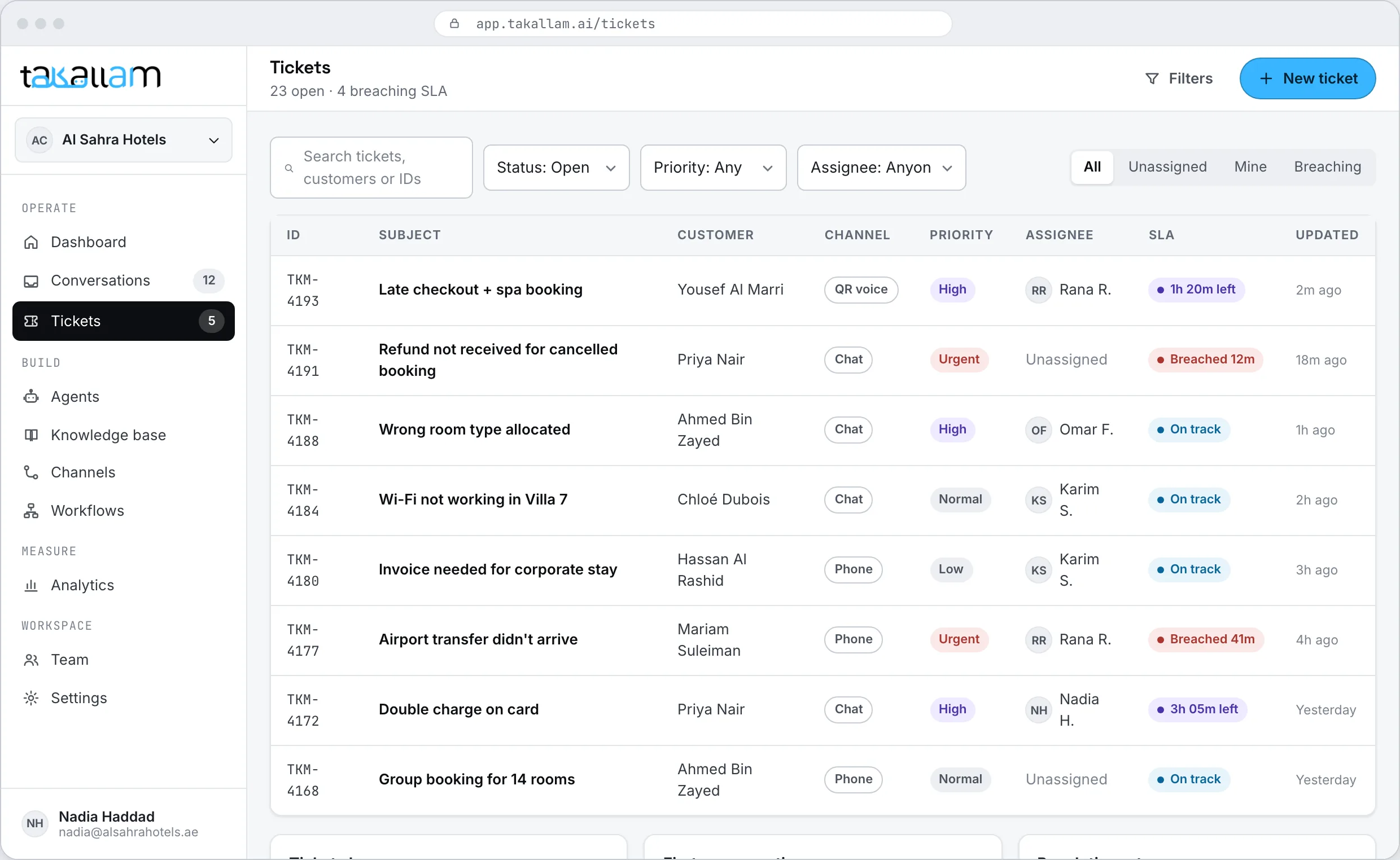
The requests that arrive every single day
None of these are hard. All of them take a coordinator several minutes each, hundreds of times a week, and most of that time is spent establishing facts a printed code already knows.
Log a maintenance request
The AC is not cooling, the tap drips, a socket is dead, the door handle came off in someone's hand. The agent takes the description, asks only the questions that decide the trade, and raises the job with the unit, the community and the asset already filled in.
When is the technician coming?
The highest-volume question in facilities management and the one that creates nothing. The agent reads the real status out of your work-order system and gives the window, the trade and the job reference — and a workflow can tell the resident when that window moves, instead of letting them find out.
Tickets and SLAsAC servicing, filters, cleaning and pest control
When the planned service is due, whether the filter change is included, how often the coil gets cleaned, and how to book a deep clean or a pest treatment for Saturday morning. Scheduled maintenance and on-demand bookings answered from the same place.
Move-in, snagging and handover
The snag list, who is fixing what, when the inspection is, what the deposit covers and what happens at move-out. A handover generates more questions per unit than anything else in the calendar, and they all land in the same fortnight.
Access permits and contractor passes
A moving permit, a lift booking, a fit-out approval, a gate pass for a contractor arriving at seven in the morning. The agent explains what the permit needs, collects the documents and routes the approval — instead of the resident and the contractor both phoning security.
Common areas and service charge
The corridor light on level 7, water in the basement car park, a treadmill out of order, the pool temperature. Plus the question nobody enjoys: what the service charge covers, when it is due and why it changed. Answered from your published budget and statements, not from an opinion.
Where the answers come fromThe code on the unit already knows which unit it is
This is the part that actually matters in facilities. A resident scans the sticker on the indoor unit in apartment 1802 and says the thing is not cooling. The request arrives as apartment 1802, that tower, that specific fan coil, with its service history behind it. Nobody asked which building. Nobody typed a unit number. The technician is dispatched to a location that came off the asset rather than off a phone call.
- Opens straight into voice, so somebody standing under a dripping ceiling does not have to type anything.
- Every code is tied to a place and an asset — a unit, a plant room, a lift lobby, a specific chiller — and the request carries that with it.
- The resident can switch to text mid-conversation and send a photo of what is broken.
- The same resident calling back later about the same job reaches the same record, not a fresh call.
- Codes work for technicians too: scan at the asset to pull up its history and close the job where the work happened.
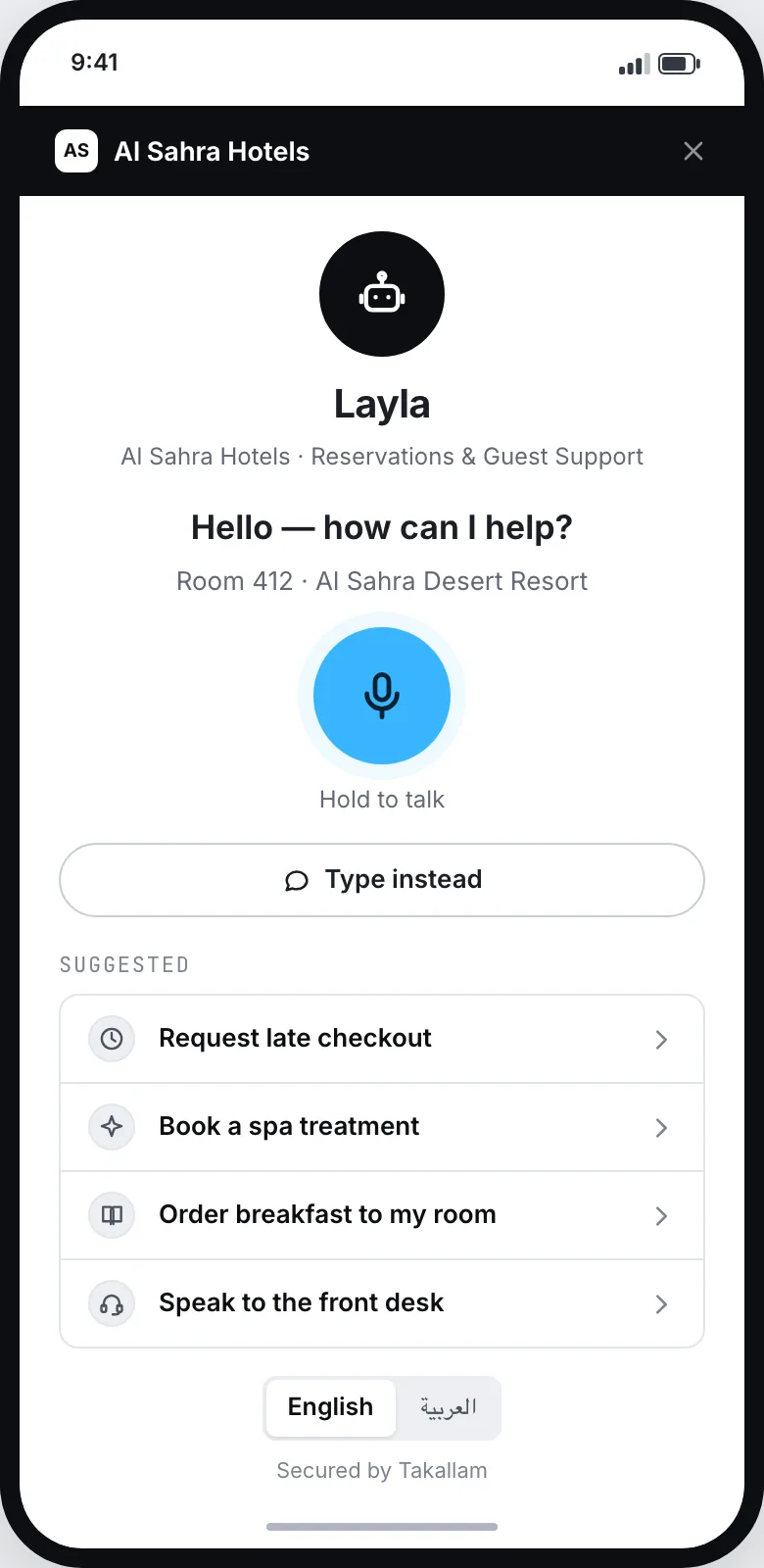
Where the code goes
Stick it to the thing that breaks. A code on the fan coil reports the fan coil; a code in the lift lobby reports the lobby. Print a different one per asset and the request never needs a location typed into it again.
On the indoor AC unit and in the FCU cupboard
Where the most common fault in the country gets discovered. The resident is already standing in front of the thing that is broken, and the code turns that into a work order with the asset attached.
The lift lobby and the letterboxes
Every resident passes it twice a day. This is the code for common-area faults — the light that is out, the door that will not close, the smell coming from the bin room.
The plant room door and the riser cupboard
For technicians and contractors rather than residents. Scan at the asset to pull up its history, log what was done, and close the job in the place the work happened instead of in the van afterwards.
The tenant handbook and the move-in pack
The document every resident is handed and nobody reads. A code on the cover answers what is inside it out loud, which is more than the handbook itself manages.
The community noticeboard, the gym and the pool
Where problems are spotted by people who are not standing in their own unit, and who right now have no way of reporting anything at all.
A different code per asset and per building
Separate codes by tower, by floor, by plant room, by unit type. The analytics show which assets generate the most requests, which is a maintenance planning input as much as a support one.
Conversation analyticsA leak does not join the queue
Everything else on this page is about absorbing volume. This is the opposite. Water coming through a ceiling, a burning smell from a distribution board, a smell of gas, a fire panel in alarm, somebody stuck in a lift — the agent is written to recognise these in the first sentence, in either language, stop trying to help, and route straight to the emergency team. The location and the asset are already attached, because the code knew them before the person started speaking.
- It does not triage a safety report. No clarifying question, no confidence threshold, no queue position — the escalation fires immediately and the on-call team gets the unit, the asset and the transcript.
- For a lift entrapment it also tells the caller to press the car alarm and use the intercom. An AI answering a call is not a substitute for the emergency system already installed in the shaft.
- Anything electrical, anything involving water, anything with smoke or a smell of gas, and anything where a person is hurt or trapped sits on the never-handle list by default. You can add to that list; nobody should be removing from it.
- The rest of the queue keeps moving. A tap washer reported in the same minute is still handled normally — separating the two is the entire point.
- Every escalation is logged with what was said, when it fired and who picked it up, so the incident has a record before anyone asks for one.
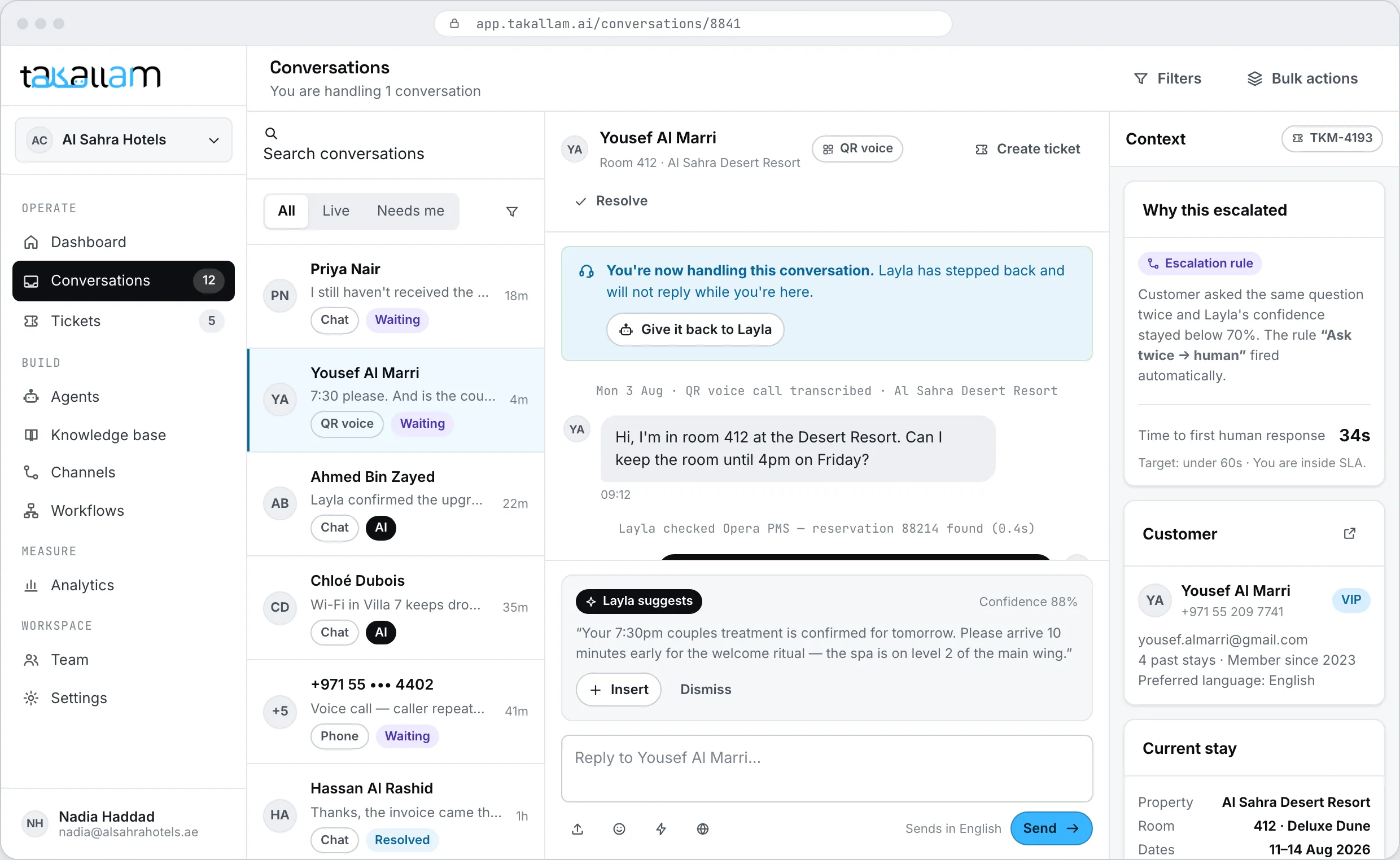
The work order raises itself
A request that gets answered but not logged is a request you will hear about again on Sunday. The point of connecting Takallam to your CAFM or work-order system is that the conversation and the job become the same event — the resident describes the fault, the work order exists, and the reference goes back to them in the same breath.
- When a request comes in, create the work order in your CAFM with the asset, the unit and the community from the code, assign it to the trade, and send the resident the reference.
- When a technician closes a job, message the resident on the channel they used, ask whether it is actually fixed, and reopen it if the answer is no.
- When a resident asks where their job is, read the real status out of the work-order system rather than guessing at it.
- When a permit is requested, check the documents attached, route it to the community team for approval, and issue the pass reference.
- Takallam does not claim a pre-built connector for every CAFM on the market. It ships a workflow builder, a REST API and signed webhooks — if your system can be called, a workflow can call it.
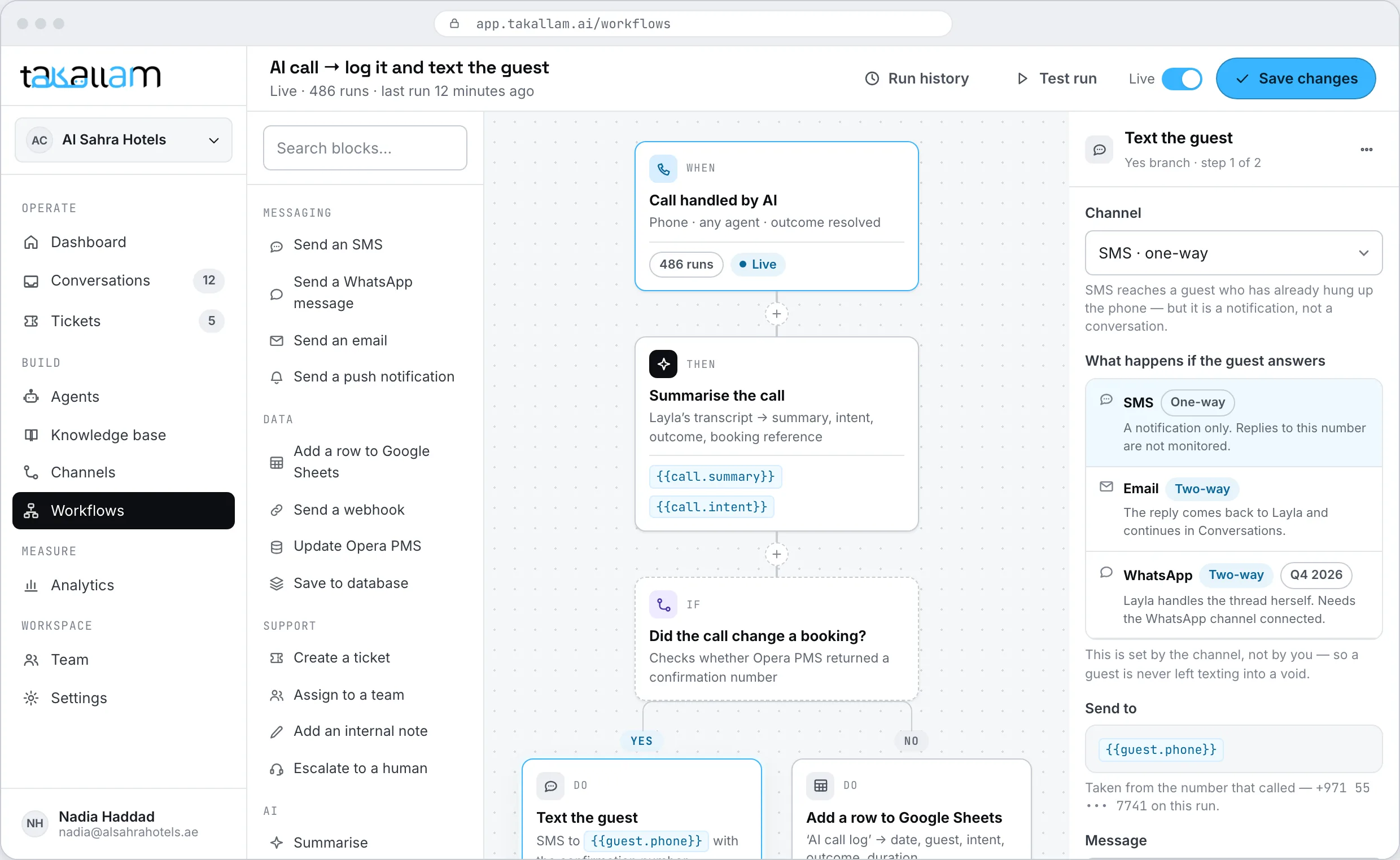
What the platform gives an FM team
These are capabilities of the platform, not results from a deployment. Takallam is pre-launch and has no published performance figures.
What FM teams and associations ask first
Someone reports a leak, or is stuck in a lift. What happens?
It bypasses everything. The agent is written to recognise a safety report in the first sentence, in either language, stop answering and route straight to the on-call team with the unit, the asset and the transcript attached. For a lift entrapment it also tells the caller to press the car alarm and use the intercom, because the emergency system in the shaft is the one that matters and an AI is not a replacement for it. Water, electrical faults, smoke, gas and anyone trapped or hurt are on the never-handle list by default.
Does a request arrive with the location already on it?
Yes, when it came from a code. Every code is tied to a place and an asset, so a scan on the fan coil in apartment 1802 arrives as that unit, that tower and that piece of equipment with its history behind it. On phone and email the agent asks once and stores the answer against the resident, so the next request does not start with the same four questions.
Does it connect to our CAFM or work-order system?
It connects to systems that can be called. Takallam gives you a workflow builder, a REST API and signed webhooks, so a workflow can create a work order, read a job status, attach a photo or close a ticket in any system that exposes an interface.
What it does not do is claim a pre-built, certified integration with every CAFM on the market. Tell us what you run and we will be straight with you about what the connection looks like.
Can it book a job, or does it only log one?
Both, and you decide which. An agent can be read-only, or it can be allowed to raise a work order, book a scheduled AC service, hold a slot for a deep clean or a pest treatment, and request a contractor pass. Every action it takes is logged against the conversation that caused it, so you can see exactly why a job was created.
Can a resident check where their job is without calling us?
Yes, and this is usually the largest single category in an FM helpdesk. The agent reads the real status from your work-order system and gives the window, the trade and the reference. A workflow can also message the resident when the window moves, which removes most of that call before it is ever made.
Can our technicians and contractors use it as well as residents?
Yes. A code at the plant room door or on the asset itself gives a technician the history and lets them log what was done where the work happened, rather than in the van afterwards. Contractors can use the same route for pass requests and access questions, which on most sites is the security desk's entire phone volume.
Does it work in Arabic for residents who prefer it?
Yes — Emirati and wider Gulf dialect in both voice and text alongside English, including the resident who switches between the two mid-sentence. In a UAE building the residents are not one language group, and somebody reporting a fault should not have to find the right words in a second language before anyone understands them.
What does it cost, and how long does setup take?
You pay per interaction and each channel is priced separately, because a phone call and a chat message do not cost the same to deliver. There are no per-seat licences and no minimum commitment. Setup is short: Takallam reads your website and your handbooks to build the knowledge base and draft your agents, you review what it learned and decide what each agent may do, then you print the codes. IT is only needed when you want a workflow writing into the CAFM. Takallam is pre-launch, so rates are being set with the first cohort — join the waitlist and we will quote against your real volume.
Put a code on the AC unit and see what comes in
We are onboarding a first cohort of UAE facilities managers, owners associations and home service companies. Tell us how many units you cover, which channels you need and what your CAFM is, and we will come back with a rate against your real volume.
Pay per interaction · priced per channel · no seats, no minimums