
Answer the question. Escalate the account.
Most of what fills a retail queue is not a transaction — it is hours, eligibility, documents, or where an application has got to. Takallam answers those in Arabic and English at any hour, and hands anything that touches money or identity to a person, with the whole conversation attached.
What people are actually calling about
Very little of it needs an agent with system access. Almost all of it currently ties one up.
Branch, ATM and Ramadan hours
Which branch opens on Saturday, which one takes cheque deposits, what changes during Ramadan, where the nearest cash-deposit machine is. The most-asked question in retail banking, answered without a queue.
Eligibility and documents
Minimum salary, whether salary transfer is required, Emirates ID, salary certificate, the AECB report, how to request a liability letter. Answered from your published criteria — as information, never as a decision.
Statement and fee questions
When the cycle closes, what a fee on the statement is for, how to change a statement address, what a standing instruction does. The published answer immediately; the account-specific part to a person.
A card lost at midnight
The agent recognises it in the first sentence, tells the caller exactly what protects them and what happens next, and escalates with priority instead of dropping them into a morning queue. It never touches the card itself.
Claim and application status
Where a motor claim has got to, which documents are still missing, whether the card has been dispatched. It explains the process and the paperwork; a real status lookup only happens if you connect the system and authorise it.
Peak-day overflow
Salary day, a card-network outage, the first week of insurance renewal season. Takallam answers as many callers as arrive at the same time, so nobody is thirty-eighth in a queue for an answer that took nine seconds.
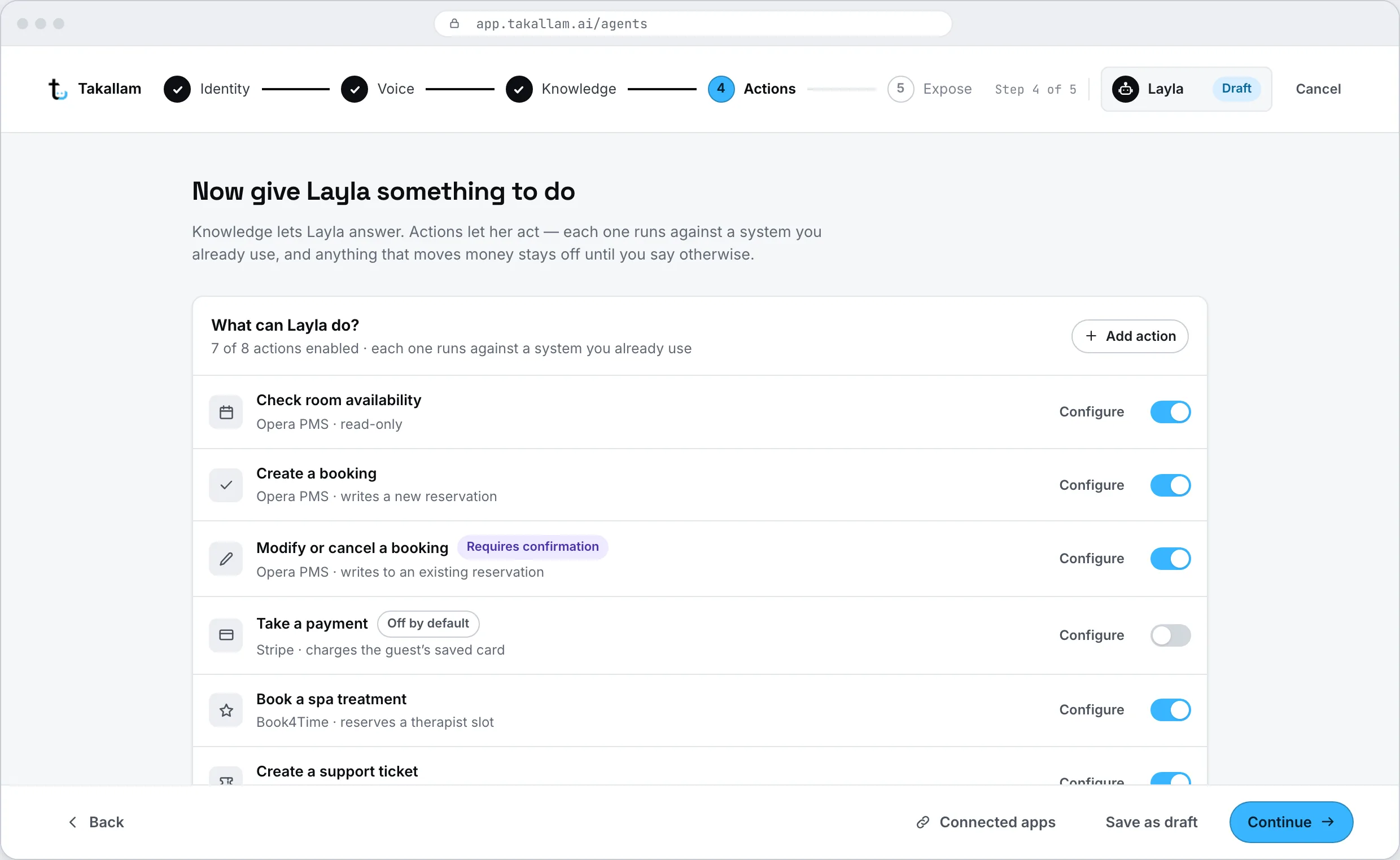
The agent only does what you have ticked
Every action an agent can take is one you explicitly turned on. As it comes, it answers from your knowledge base and nothing else: it does not move money, it does not change a customer record, and it does not decide who someone is. If you want it to read something from a core system, you connect that system and define exactly which field it may read — and it still cannot write.
- Read-only by default. Anything that writes back is a separate, deliberate switch.
- No payments, no transfers, no card issuance, no limit changes. They are not on the menu to turn on.
- Identity verification stays with your team and your existing process.
- Refusal wording is yours — you write the sentence it says when it is asked to do something it may not.
Anything touching money or identity goes to a person
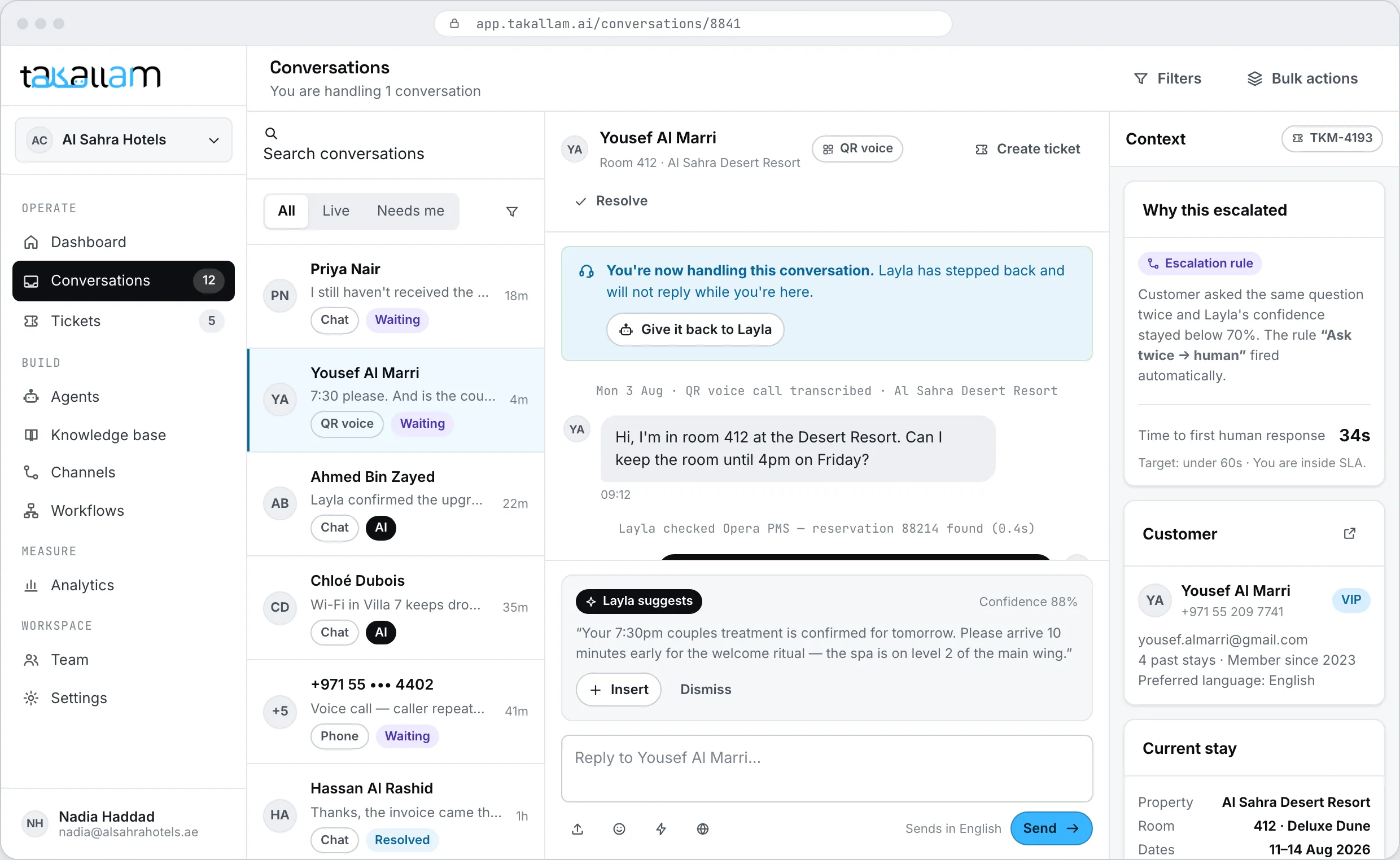
Escalation is not a fallback that fires when the AI gives up. It is a rule you write in advance. A dispute, a fraud report, a lost card, a complaint, an angry tone, or a request the agent is not permitted to fulfil can each be forced to a named human queue with a priority — before the agent attempts an answer.
- Escalate on intent: the words "fraud" or "dispute" route first and answer second.
- Escalate on confidence: if it is not sure, it says so and hands over rather than improvising.
- Escalate by channel and by hour — a 2am fraud call can reach your on-call rota while a 2am branch-hours question does not.
- The person who picks it up sees the full transcript, what the AI tried, and what it deliberately refused to do.
Decided before it answers anyone
Six things your risk and compliance teams will want to see set, all of them settings rather than promises.
Permitted actions
An allow-list per agent. If it is not switched on, the agent cannot do it, and it says so in the wording you approved.
Escalation triggers
By intent, keyword, confidence, sentiment, channel and hour. Written per agent, so a collections line and a general enquiry line behave differently.
Approved knowledge only
It answers from the documents and pages you approved, not the open web. Change a policy in one place and every channel is updated at once.
Who sees what
Role-based access in the console. Not everyone on the floor needs sight of every conversation, and you decide the split.
Retention windows
How long transcripts and call recordings are kept, set per channel, deleted on a schedule rather than kept indefinitely by default.
Data region
The UAE region by default, not as an upgrade. Where the data lives is a deployment property, not a support ticket you file later.
Read the security pageA ticket, an SLA, and a transcript you can show someone
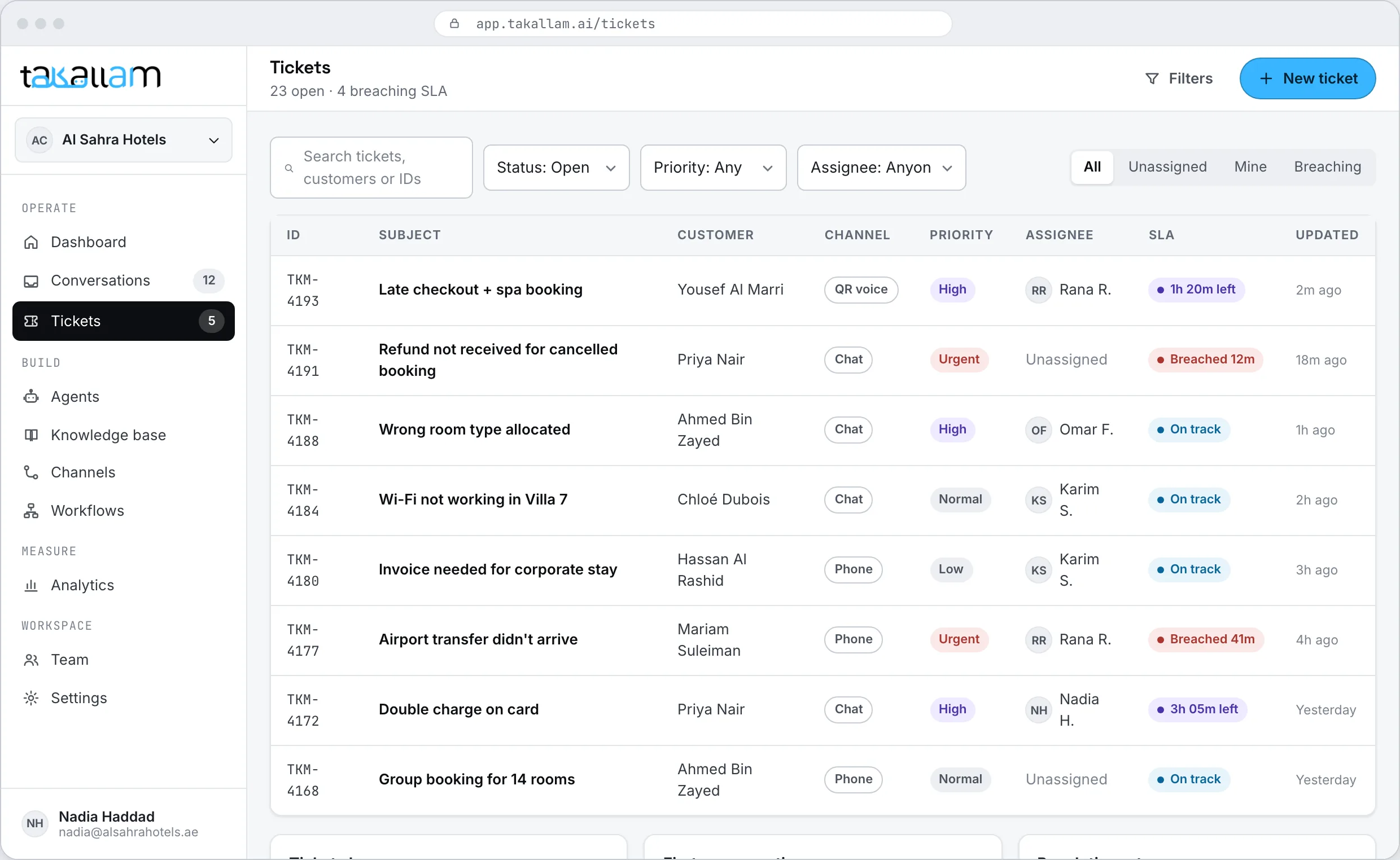
Complaints and claims need tracking, not just answering. Anything the agent escalates becomes a ticket with an owner, a due time and a status the customer can be told. What was said — by the AI and by your team — stays attached to it, on one record per customer regardless of which channel they used.
- SLAs per queue, so a complaint and a document request are not treated the same.
- One customer history across QR voice, chat, email and phone — not four systems that disagree.
- A record of who answered, when, and in what words, for internal review.
- Readable in the console, or pulled through the API into wherever you keep your case records.
In the UAE by default, not on request
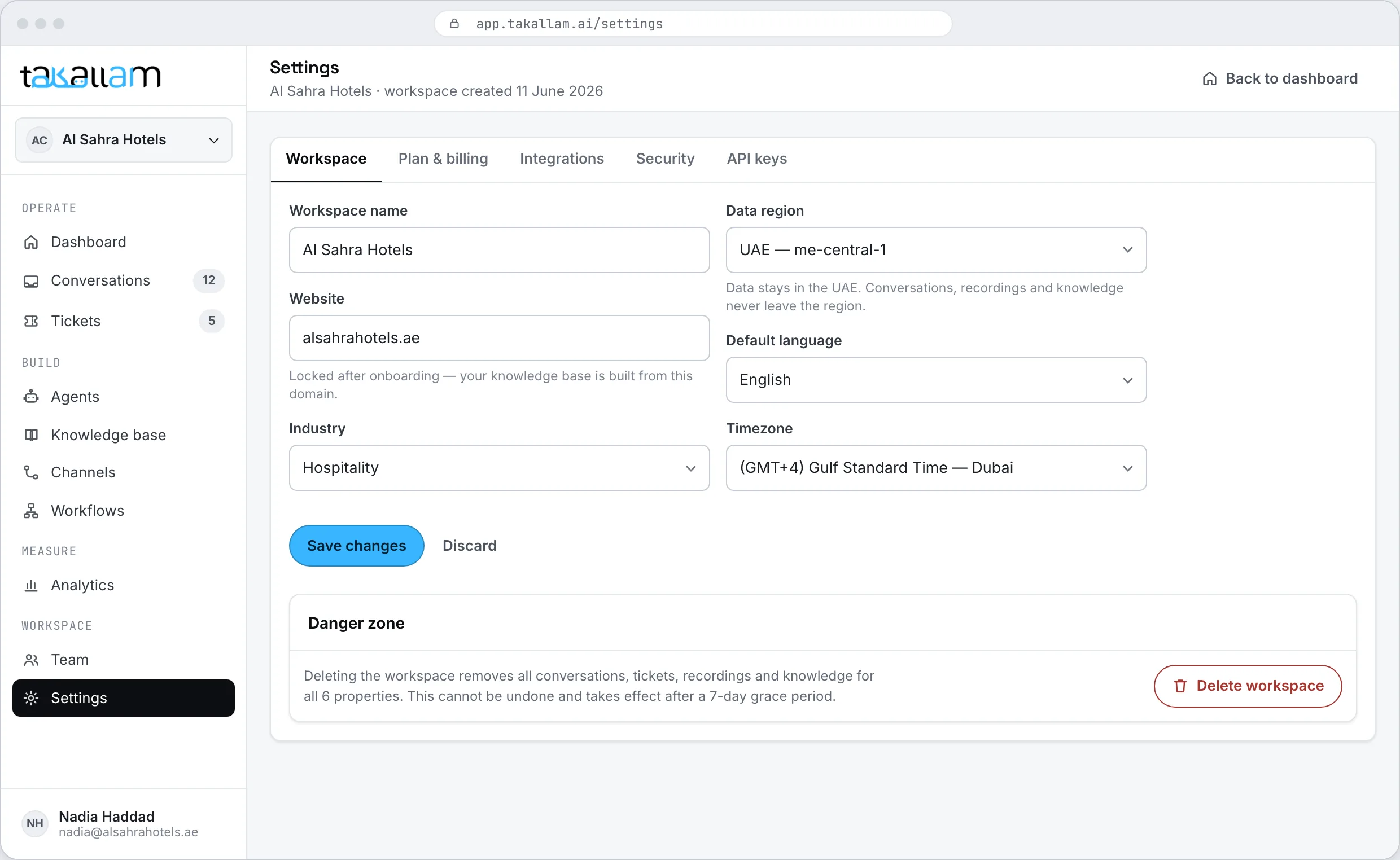
Takallam runs in the UAE region — me-central-1 — and conversations, transcripts and knowledge bases stay in-region by default. You control retention, who on your team can see what, and what gets deleted on a schedule. That is architecture we can describe and show you, rather than a certificate we are borrowing from someone else.
- Data resident in the UAE region by default, not as a paid regional add-on.
- Encrypted in transit and at rest; console access controlled by role.
- Retention set per channel, including voice recordings, with scheduled deletion.
- Built to support the controls a bank risk team asks about — and explicit about what is not certified yet.
The facts your risk review will ask for first
These are product capabilities and design properties, not customer results. Takallam does not hold PCI DSS, SOC 2 or ISO 27001 certification today and does not claim otherwise.
The parts of the product this page leans on
Security and residency
What is encrypted, what is retained, where it runs, and what Takallam is not yet certified for.
Read the security pageThe support console
Human takeover in the same thread, tickets, SLAs and role-based access for the floor.
Inside the consoleArabic, properly
Emirati and Gulf dialect in voice and text, at the formal register a bank needs, including callers who code-switch.
How Takallam handles ArabicEvery sector we cover
Insurance and exchange houses have pages of their own now, alongside eighteen more — the same platform, with the escalation rules each one actually needs.
All 20 industriesWhat risk, compliance and contact-centre teams ask
Can the agent look up a customer balance?
Not by default — out of the box it has no account access at all and will say so. If you connect a core system and explicitly authorise a read, it can retrieve only the fields you named, and it still cannot write anything back. Verifying who the caller is remains your process, on your side.
What happens if someone calls to report a lost or stolen card?
It recognises the intent in the first sentence, tells the caller what protection applies and what happens next, and escalates immediately on a priority queue you defined — including out of hours, to whoever is on call. It does not block, cancel or reissue the card itself. That stays with a person and your existing controls.
Are you PCI DSS compliant?
No. Takallam does not hold PCI DSS, SOC 2 or ISO 27001 certification today, and we will not imply otherwise while we are pre-launch.
What we can describe is the architecture: UAE data residency by default, encryption in transit and at rest, role-based access, retention windows you set, and an agent that has no payment capability to begin with. If a certification is a hard requirement for your procurement, tell us during the waitlist conversation so nobody wastes a quarter.
Can it tell a customer whether they qualify for a personal loan or a card?
It can state your published criteria and list the documents needed — minimum salary, salary transfer, tenure, which papers to bring. It does not make an eligibility decision, does not commit the bank to anything, and hands the application itself to your process. That boundary is a setting, not a hope.
What about an angry customer or a formal complaint?
It does not argue, and it does not try to talk anyone down. Sentiment and complaint intents can be set to escalate before the agent answers at all, so a person picks up with the full transcript in front of them. The complaint becomes a ticket with an owner and an SLA rather than a call that ended.
Where does our data live, and how long is it kept?
In the UAE region by default — conversations, transcripts, recordings and knowledge bases. Retention is yours to set per channel, with scheduled deletion, so you are not storing voice recordings for years because a default said so.
Does it cover the support inbox as well as the phone line?
Yes — email is a fourth channel alongside QR voice, chat and phone. You forward your support address to Takallam or connect the mailbox, and the agent reads the whole thread and replies in it, from your own address. The same boundaries apply: anything touching an account, money or identity is escalated with the full thread attached rather than answered. Attachments are read too, so a salary certificate or a statement sent in with the question is part of what it works from, and you can run email in draft mode while your team is still building trust in it.
Is its Arabic good enough for a bank?
It handles Emirati and wider Gulf dialect in voice and text, including callers who switch between Arabic and English mid-sentence, and you set the register — a bank line usually wants something more formal than a retail one, and that is configurable per agent.
What does it cost?
You pay per interaction, and each channel is priced separately, because a phone call, an email and a chat message do not cost the same to deliver. No per-seat licences and no minimum commitment. Takallam is pre-launch, so rates are being set with the first cohort — join the waitlist and we will quote against your actual call, chat and email volumes.
Take the questions off the queue, keep the accounts with people
We are onboarding a first cohort of UAE banks, insurers and finance companies now. Tell us which intents you want answered and which must always reach a human, and we will show you exactly how those boundaries are set.
Pay per interaction · priced per channel · no seats, no minimums