
A number that answers on the first ring, at 3am
Take a new number, or point the one already on your business cards at Takallam. Every caller is answered immediately, in Emirati Arabic or English, however many of them call at the same moment. There is no hold music, because there is no queue.
The caller talks. It answers. That is the whole interaction.
No menu, no "press 1 for reservations". The caller says what they want, in the words they would use with a person, and the agent answers from your knowledge base. If the request needs something done, and you have allowed it, the agent does it.
- Answered immediately — every call, every hour of the day.
- Emirati and Gulf dialect by voice, and English, including a caller who switches halfway.
- The caller can ask a follow-up without starting the explanation again.
- Every call is transcribed, so nothing depends on someone remembering it correctly.
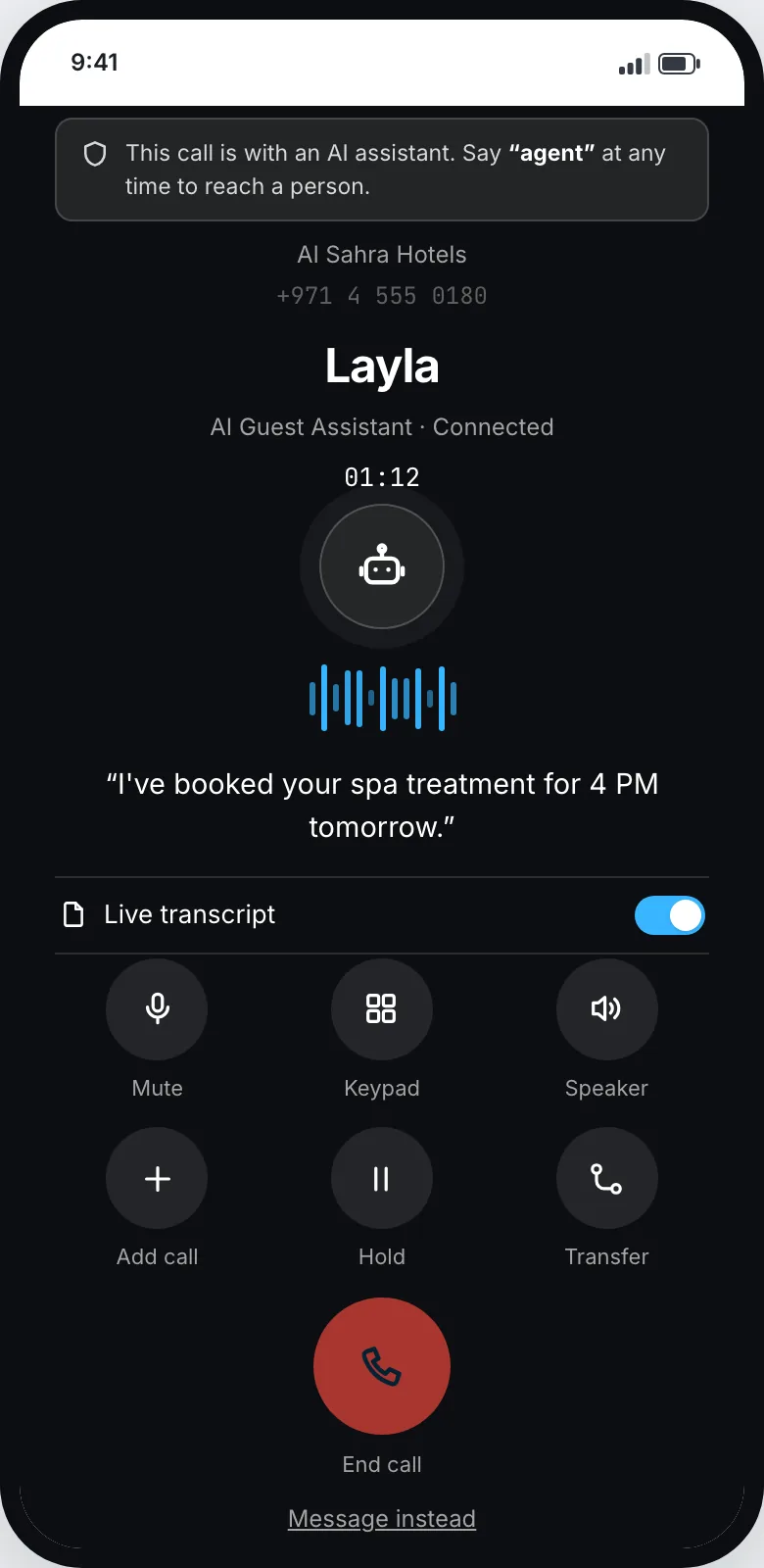
What a Takallam phone line does
Capabilities of the channel, not results from a customer. Takallam is pre-launch and has no published performance data.
A new number, or the one already on your signage
Takallam can give the agent a new UAE number, or you can point your existing line at it from your telecom provider. Nothing you have already printed has to change.
- Take a new number and put it live the same day you build the agent.
- Or forward your current number — all of it, or only outside working hours.
- Route different numbers to different agents: reservations, billing, service.
- Change which agent answers without changing the number anyone dials.
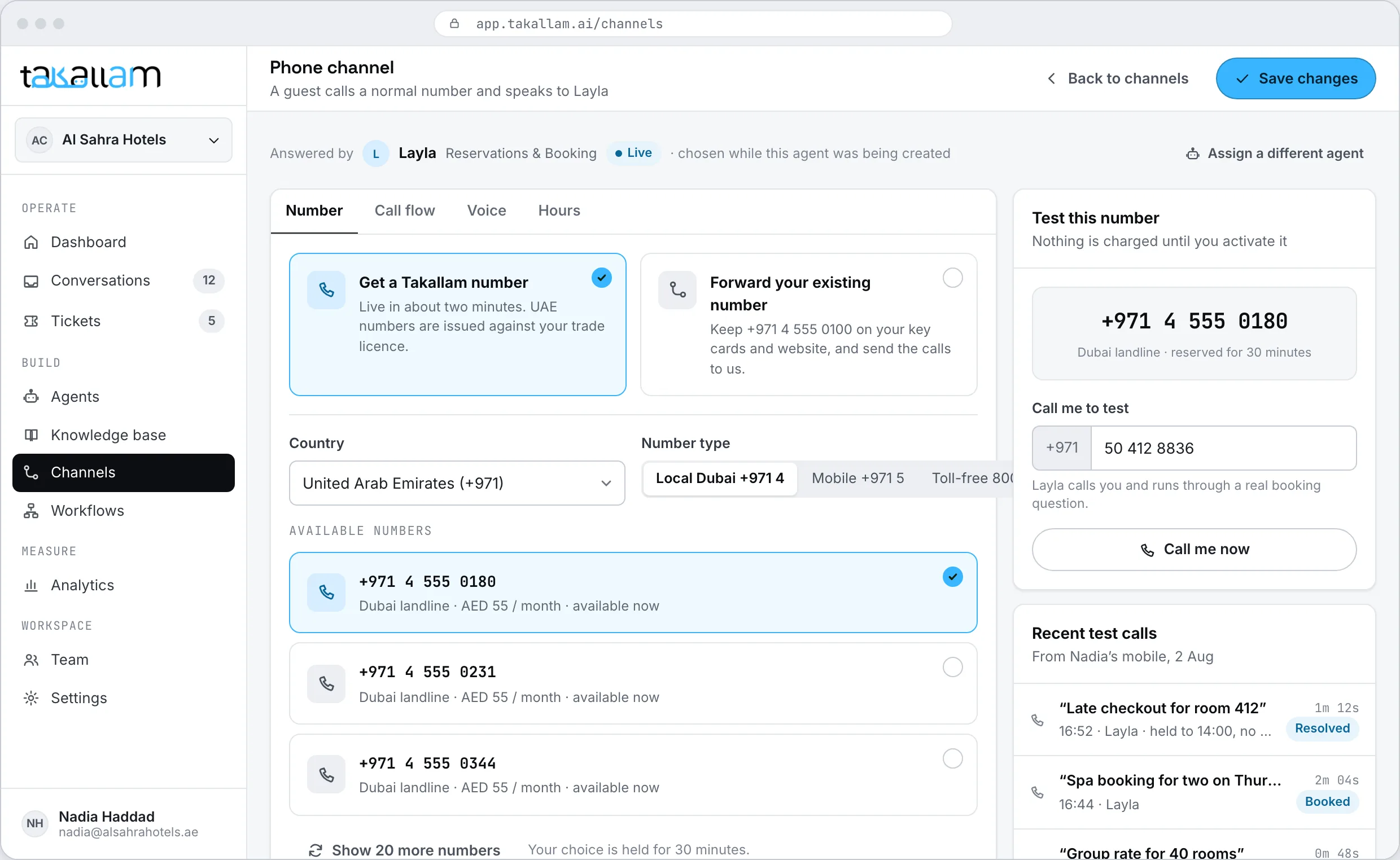
You decide what happens at 11pm
The default at most businesses is a voicemail box nobody listens to. Takallam gives you the choice, and you can set it differently for each number.
Answer as normal
The agent handles the call exactly as it would at 11am. Most questions never needed a person in the first place.
Answer, then open a ticket
It answers what it can, records the rest as a ticket with the transcript, and your team picks it up when they are in.
Ring whoever is on call
For the calls that genuinely cannot wait, escalate to the on-call phone with the summary already written.
Hand it to a workflow
Send the caller a message afterwards, update a record, or notify a channel — whatever should happen next.
See the workflow builderWhen it hands over, it hands over the whole call
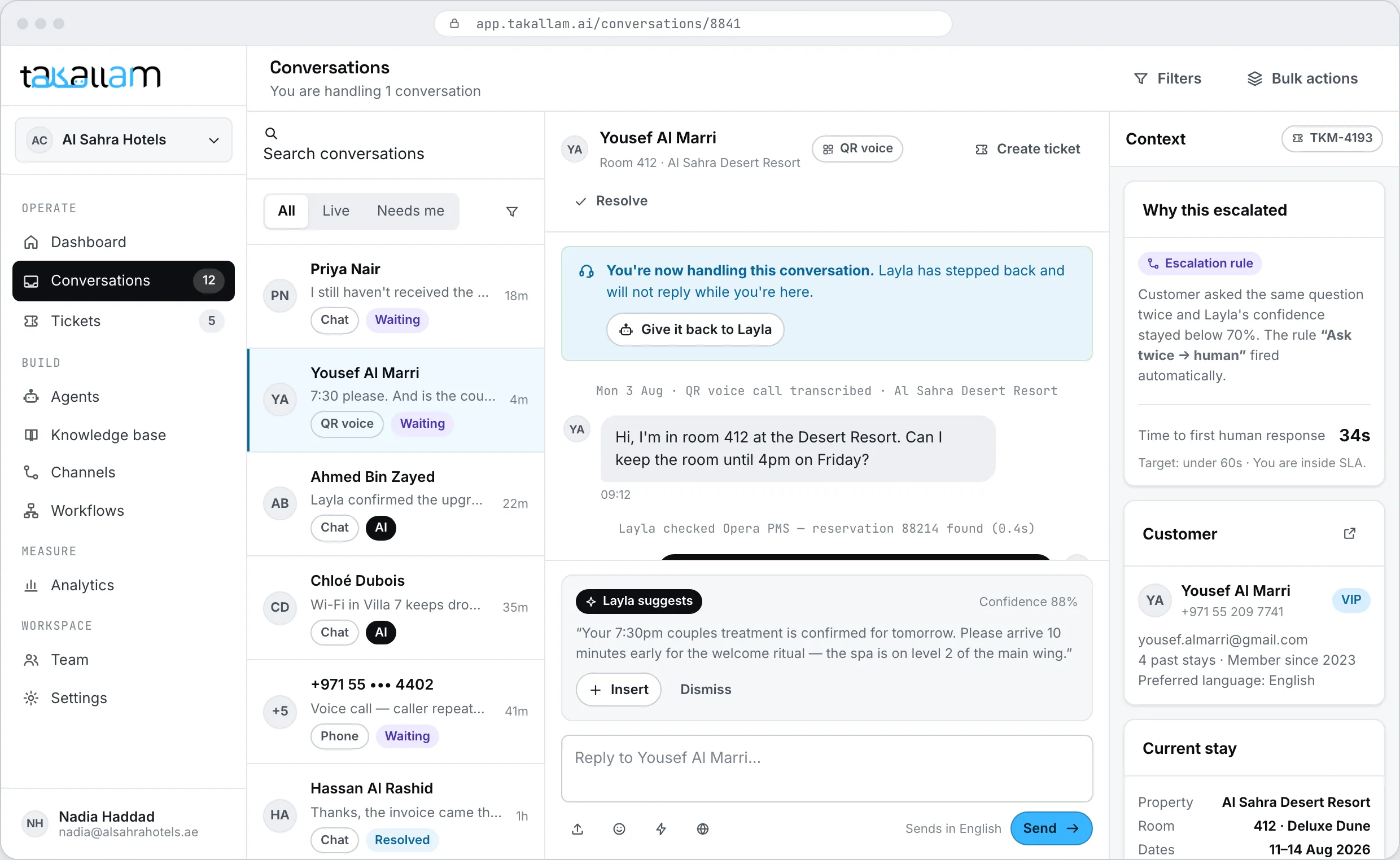
The agent escalates when it is not confident, when the caller asks for a person, or when the request is one you have not allowed it to fulfil. Your team gets the conversation with the transcript already attached, so nobody asks the caller to start again.
- Transcript, summary and what the AI already tried, before your agent says hello.
- Escalation rules you write, per agent and per channel.
- The same customer can continue in chat or by email later without repeating themselves.
- Tickets and SLAs for anything that needs following up after the call ends.
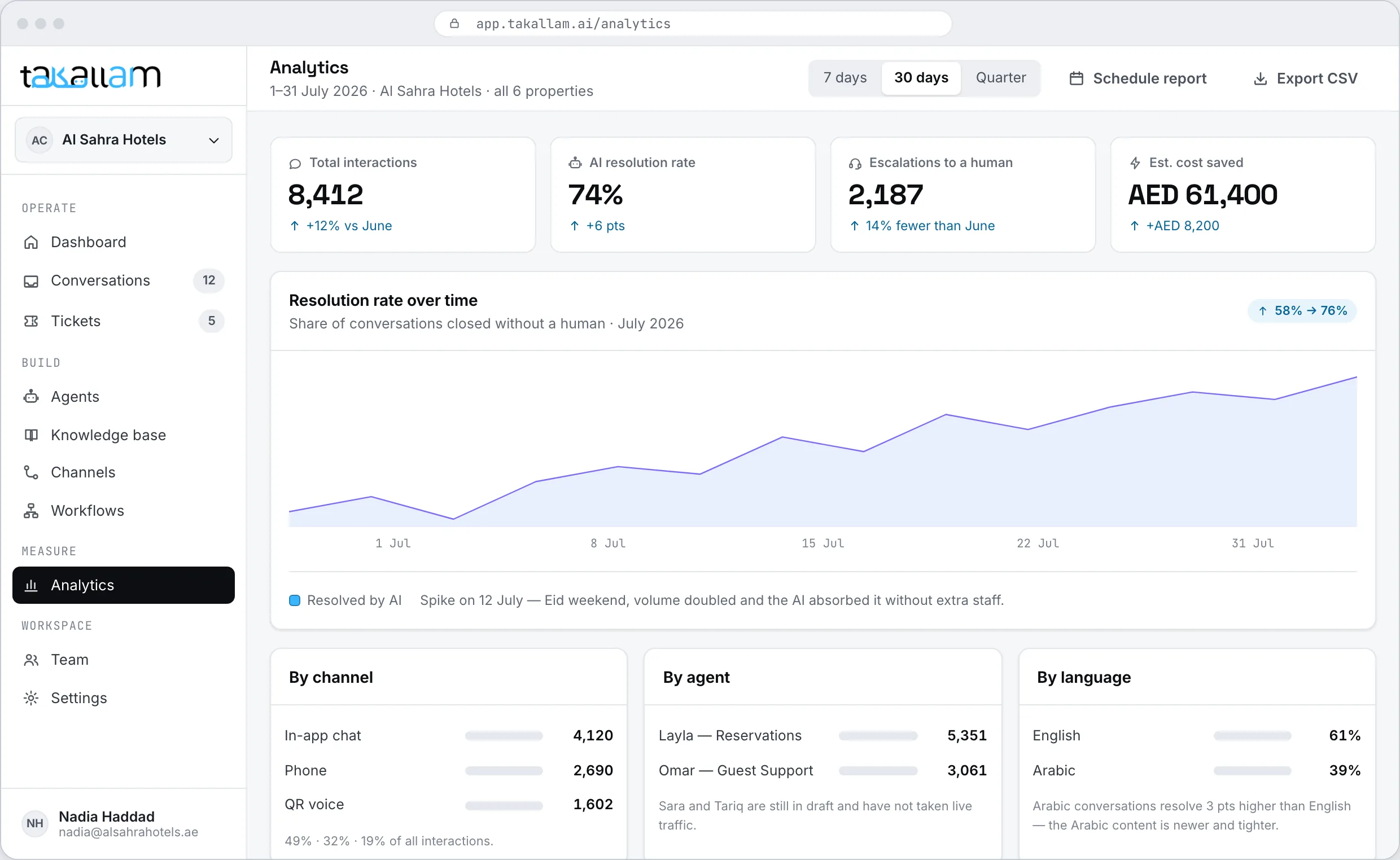
What people actually phone you about
Every call is transcribed and grouped by topic, so the question that keeps coming up stops being a feeling somebody has and becomes a line you can act on — a page to fix on your website, an answer to add to the knowledge base, a step to automate.
- Volume by number, by hour and by language.
- The topics that escalate most often, so you know what to teach the agent next.
- Searchable transcripts, instead of call recordings nobody ever plays back.
- The same view across QR, chat, email and phone, so you can compare like with like.
Not a phone tree, and not a voicemail box
An IVR menu is predictable and cheap to run, and on a line where every caller wants one of three things it does the job well. Voicemail never misroutes anyone. Both fail at the same point: the caller with a question the menu does not contain, at an hour when nobody is in.
| Takallam phone | IVR phone tree | Voicemail | |
|---|---|---|---|
| Caller asks in their own words | |||
| Gets an answer on the call | |||
| No hold queue | |||
| Ten callers at the same moment | Depends on your lines | ||
| Emirati Arabic and English | Recorded prompts only | ||
| Handles a question not in the menu | |||
| Hands to a person with the transcript | |||
| Reports what callers asked about | Which keys were pressed | ||
| Changing an answer | Edit the knowledge base | Re-record the menu | Not applicable |
| After-hours behaviour you configure | |||
| Works with your existing number |
A comparison of approaches rather than of specific telecom products — capabilities vary by provider and plan. Many businesses keep a simple menu in front of Takallam for routing, and let the agent handle everything behind it.
Same agent, three more places to reach it
The phone covers the customer who wants to talk to someone now. The other three cover the ones who would rather not call at all.
QR voice
A printed code the customer scans and speaks to — on a door, a shelf edge or a delivery box. No app, no download, no number to dial.
See the QR channelIn-app & web chat
One script tag on your site, or an SDK inside your app. It picks up the call from an hour ago without the customer repeating it.
See the chat channelForward your support inbox, or connect the mailbox. The agent replies in-thread from your own address, and escalates with the history attached.
See the email channelWhat people ask about the phone channel
Do we need a new phone number?
No. You can point your existing number at Takallam from your telecom provider, or take a new UAE number if you would rather keep the two separate. Some businesses forward only outside working hours to start with.
What happens if ten people call at the same time?
All ten are answered. Calls run in parallel rather than in a line, so there is no hold queue and no callback list. Capacity is not a number of seats you buy.
Does it answer at night and on public holidays?
Yes, and you decide what that means. It can answer as normal, answer and open a ticket for the morning, ring whoever is on call, or trigger a workflow — set differently for each number.
What if the agent cannot help the caller?
It escalates to your team with the transcript and a summary already attached, so nobody asks the caller to explain it again. You write the rules for when that happens, per agent and per channel.
Does it really speak Emirati Arabic?
Yes — Emirati and wider Gulf dialect by voice, not only Modern Standard Arabic, and English alongside it. A caller who starts in Arabic and finishes in English is handled as one conversation.
Can it do more than answer — change a booking, for example?
Yes, for the systems you connect and the actions you allow. What happens after the call — updating a record, sending a confirmation, opening a ticket — is a workflow you build by dragging blocks rather than filing a request with engineering.
Where do call transcripts live?
In the UAE region by default, alongside your other conversations, and you decide what is retained and for how long. Transcripts are searchable in the console rather than sitting in an audio archive nobody opens.
How is the phone channel priced?
You pay per interaction, and each channel is priced separately, because a phone call and a chat message do not cost the same to deliver. No per-seat licences and no minimum commitment. Takallam is pre-launch, so rates are being set with the first cohort — join the waitlist and we will quote against your real call volume.
Give your number something that always picks up
We are onboarding a first cohort in the UAE now. Tell us your call volume and your opening hours, and we will come back with a rate against them.
Pay per interaction · priced per channel · no seats, no minimums