
What your customers actually ask
Not how many tickets you closed. What people came to you about, which channel answered them, where the AI ran out of knowledge, and which printed code on which door is doing the work. You can only see that when every channel is answered by the same platform.
Split your channels across vendors and this report cannot exist
A voice vendor can tell you call minutes. A chat widget can tell you sessions. A helpdesk can tell you ticket volume. None of them can tell you that the same question is being asked in all three places, because none of them can see the other two. Takallam answers every channel, so there is one record to analyse rather than three exports to reconcile.
- One customer, one history, whichever channel they used.
- Calls are transcribed, so voice is analysed the same way text is.
- Comparisons across channels are like-for-like, not stitched together in a spreadsheet on a Friday.
- Nothing is lost in the gap between vendors, because there is no gap.
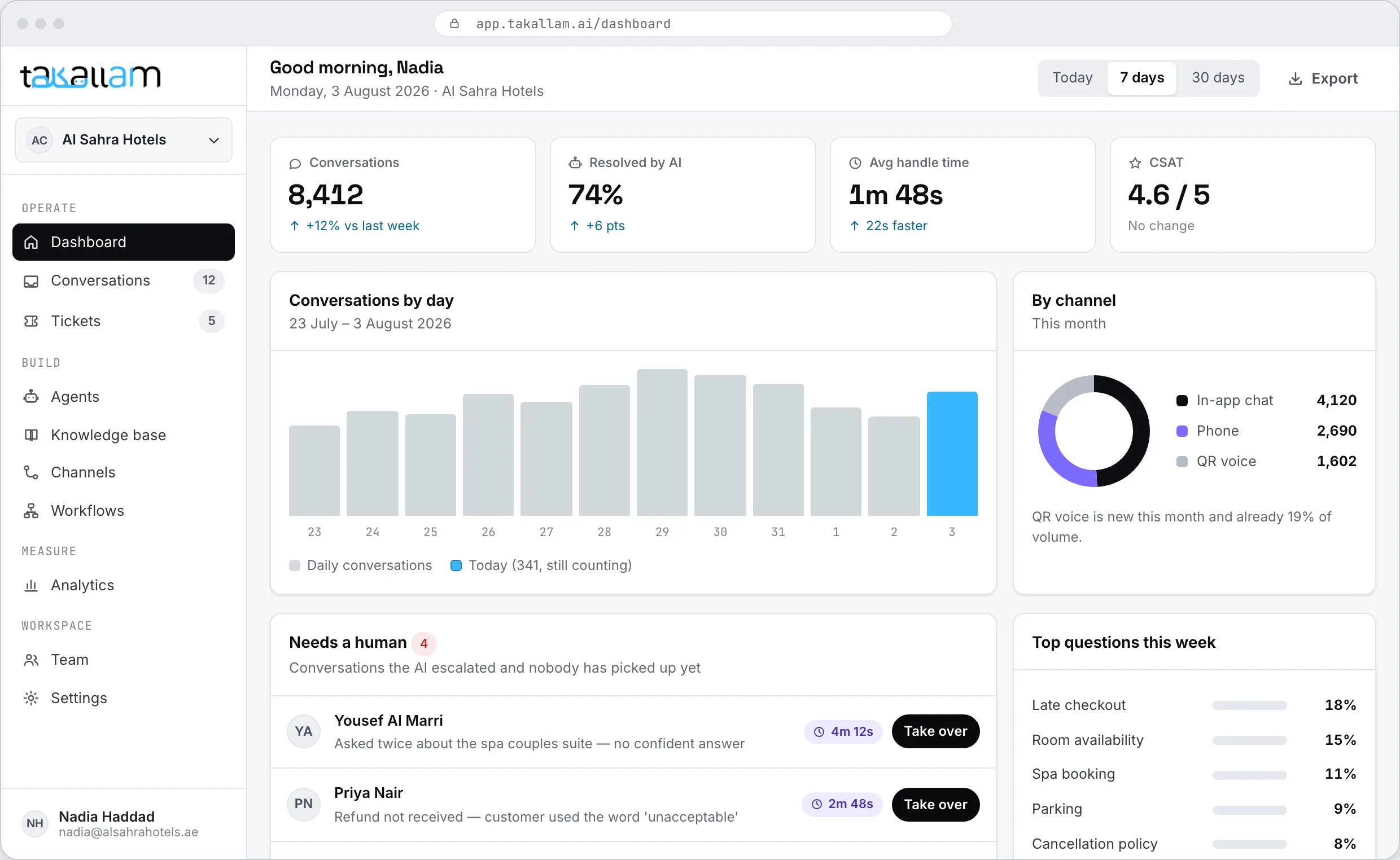
Six questions it answers without being asked
These are the measures the analytics are built around. They describe what is tracked, not results anyone has achieved — Takallam is pre-launch.
What customers ask
Conversations are grouped into topics in the words your customers used, so the handful of things generating most of your volume become visible instead of anecdotal.
Resolution rate by channel
How much of each channel — QR voice, chat, email, phone — finished without a person, on a single definition of resolved that applies everywhere.
Resolution by agent
Per AI agent and per teammate: what they handled, what they escalated, how long they took, and how that changes as you edit the agent.
Where the AI escalates
Every escalation carries its reason — low confidence, a restricted action, a tone flag, an explicit request for a human — so escalation is a category you can act on.
Which knowledge gaps cause it
Escalations are traced back to the question the knowledge base could not answer, which turns into a list of pages worth writing.
The knowledge base in the consolePer-QR-code performance
Every printed code is its own source. See which door, shelf, counter or delivery box gets scanned, and what people ask when they are standing there.
The questions you are actually being asked
Takallam clusters conversations by what they were about, across all four channels and both languages. You see the shape of your support load: which topics are growing, which ones the AI closes on its own, and which ones always end with a person.
- Topics come from the conversations themselves, not from a tag someone forgot to apply.
- Arabic and English conversations about the same thing land in the same topic.
- Open a topic and read the conversations behind it, in full.
- Watch a topic and have a workflow fire when it appears.
Every escalation is a page you have not written yet
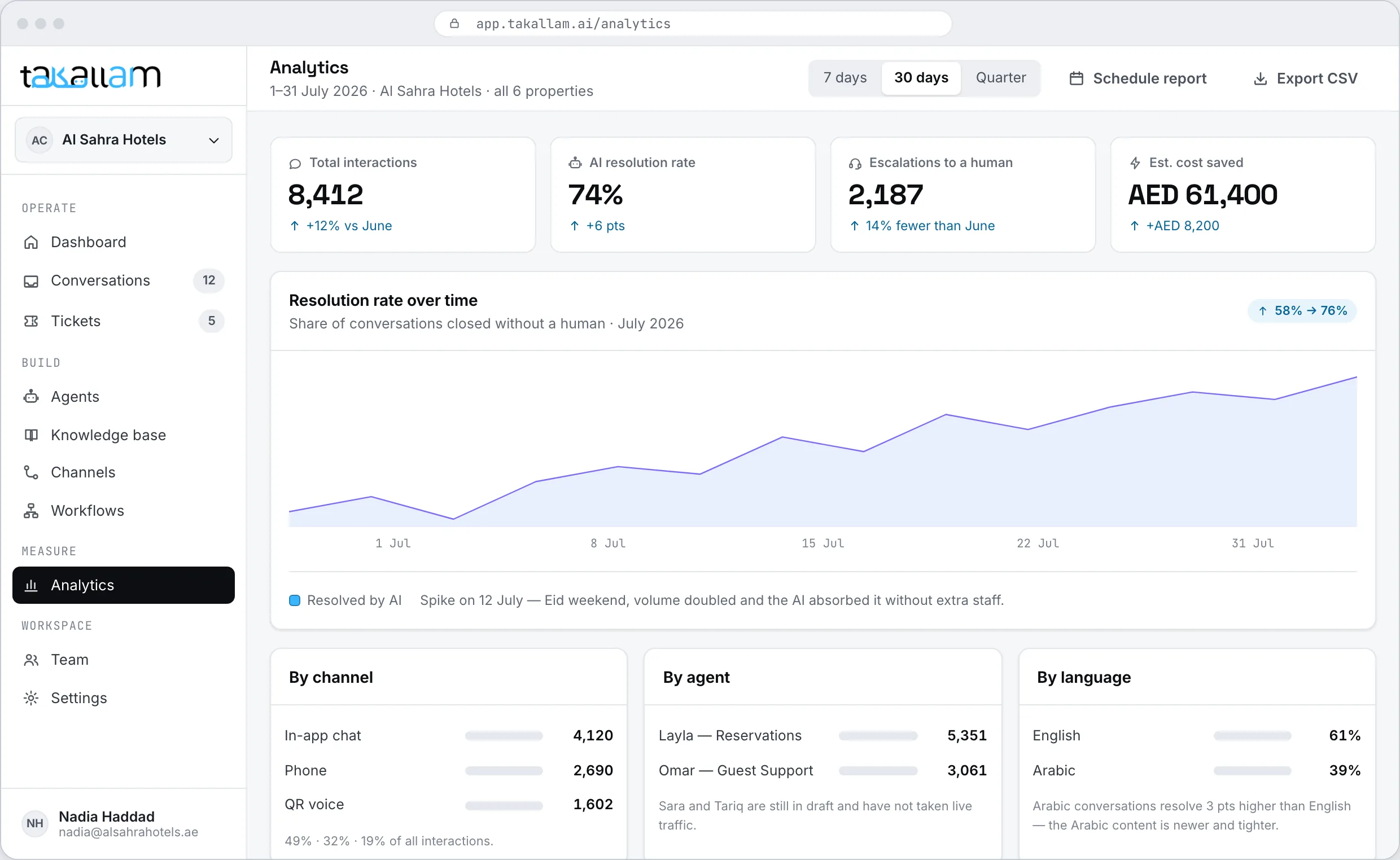
The useful thing about an escalation is that it names the gap. Takallam links the conversations that failed back to what the agent did not know, so the fix is a specific edit to the knowledge base rather than a general instruction to try harder.
- Gaps ranked by how many conversations each one caused.
- Edit the knowledge base and the next conversation uses the new answer.
- Answer sources are visible, so you can see which page an answer came from.
- The same view shows what the agent is refusing on purpose, which is not a gap at all.
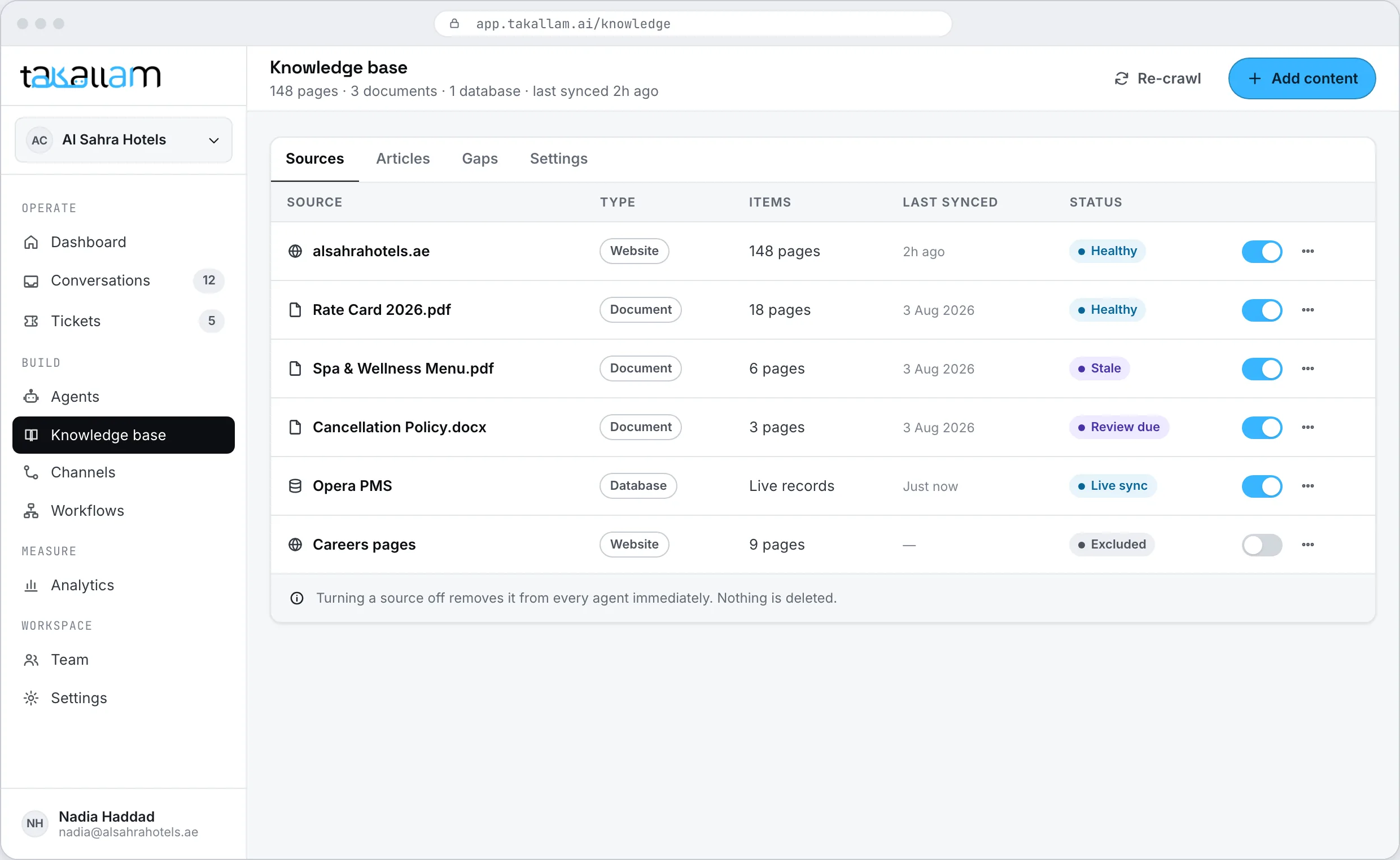
Slice it the way you actually run the business
By QR code
Each code is a location. Compare the lobby, the room, the shelf edge and the delivery box, and print more of the one that works.
By channel
QR voice, chat, email and phone side by side, on the same definition of resolved and the same clock.
By language
Arabic and English, including the conversations that switched between them mid-sentence.
How Takallam handles ArabicBy agent
AI agents and people on the same chart, because the question is what got resolved, not who is a machine.
By time
Hour of day and day of week — which is usually how a team discovers that a third of its volume arrives after everyone has gone home.
By outcome
Resolved by AI, resolved by a person, escalated, ticketed, or abandoned before an answer arrived.
What one platform can measure that three cannot
This is not an argument about which reporting screen looks nicer. It is about what is knowable when the conversations are in the same database to begin with.
| Takallam | Ticketing suite + AI add-on | Voice API + chat widget | |
|---|---|---|---|
| Voice, chat and email in the same report | |||
| Email answered and analysed too | |||
| Topics clustered across every channel | |||
| One definition of resolved everywhere | |||
| Escalation reasons, not just counts | |||
| Gaps traced back to the knowledge base | |||
| Per-QR-code performance | |||
| Arabic and English in one view | |||
| One customer history across channels |
Capability categories rather than named products. Ticketing suites have mature, deep reporting on email in particular, and years of case history behind them; voice APIs hand you raw call data you can analyse however you like. The difference here is coverage, not chart types.
Questions this answers on a Monday morning
Take the data somewhere else
Everything on the analytics screen comes out of the same API you can call. Pull conversations with their channel, language, topic, outcome and escalation reason, and push them into your own warehouse or dashboard.
- Filter conversations by channel, date, language and outcome.
- Cursor pagination, so large exports do not fall over.
- Webhooks fire as conversations close, if you would rather stream than poll.
# Every phone conversation the AI resolved this year
curl -G https://api.takallam.ai/v1/conversations \
  -H "Authorization: Bearer $TAKALLAM_KEY" \
  --data-urlencode "channel=phone" \
  --data-urlencode "outcome=resolved_by_ai" \
  --data-urlencode "since=2026-01-01" \
  --data-urlencode "limit=100"

# each conversation carries: channel, language, topic,
# outcome, escalation_reason, agent_id, qr_code_idWhat people ask about the analytics
What does Takallam actually measure?
What customers asked about, how much of each channel was resolved without a person, how AI agents and human teammates each performed, why conversations were escalated, which knowledge gaps caused those escalations, and how each individual QR code is performing.
Where do the topics come from?
From the conversations themselves. Takallam groups conversations by what they were about rather than relying on tags an agent remembered to apply, so a topic exists whether or not anyone thought to create it in advance.
Can we compare phone, email, chat and QR on the same chart?
Yes, and this is the main reason the page exists. Because all four channels are answered by the same platform, they share one definition of a conversation and one definition of resolved. If your channels sit with different vendors, that comparison is normally a manual spreadsheet exercise.
How do we find out why the AI escalated?
Every escalation records a reason — low confidence, a restricted action, a tone flag, or the customer asking for a person. You can group by reason, and from there open the underlying conversations and see the exact question the agent could not answer.
Can we tell which QR code is doing the work?
Yes. Each printed code is its own source, so you can compare the code on the hotel room door with the one at reception, see which locations generate conversations, and see what people ask when they are standing in each place.
Does it analyse Arabic conversations too?
Yes. Arabic and English conversations about the same subject group into the same topic, and conversations that switch between the two mid-sentence are handled rather than discarded. You can also filter by language to see whether the same question gets a different outcome in each one.
Can we export it into our own BI tool?
Yes. Conversations, tickets and workflow runs are all available through the REST API with cursor pagination, and signed webhooks fire as conversations close if you would rather stream events than poll for them.
Are the numbers in your screenshots real results?
No. Every screenshot on this site is the Takallam prototype filled with sample data — the business names, the people and the figures in them are invented for the demo. Takallam is pre-launch, and we do not publish customer results we do not have.
Find out what your customers are actually asking
Join the waitlist and we will set Takallam up against your own website and channels, so the first report you see is about your business rather than a demo.
Pay per interaction, priced separately for each channel. No seats, no minimums.