
Your front desk answers the same ten questions all day
Late checkout, wifi, breakfast hours, a spa slot, a taxi to the airport. Takallam answers all of them from a code on the door card, from inside your app, from your support inbox and on the phone — in English and Emirati Arabic — and passes everything else to your team with the room number already attached.
Everything the front desk gets asked
At 11:40 the phone rings for the fourth time this hour
It is always the same hour and always the same question. Checkout is at noon, a delayed flight has just landed, one person is on the desk, and the phone is asking whether room 1104 can stay until two. Meanwhile a guest at the pool wants extra towels, someone in the lobby wants the wifi password, and a message about a spa booking is sitting unread in a shared inbox.
- The same four questions arrive by phone, by message, by email and in person at the desk, and get four slightly different answers.
- Nights, Fridays and the hour after a late arrival are covered by whoever is on shift.
- A request made at the pool never reaches housekeeping, because there was no way to log it where it happened.
- Guests who would rather speak Arabic get proper service only when the right person is working.
The requests that never needed a human in the first place
Not the interesting ones. The ten that repeat every single day and take your team away from the guest standing in front of them.
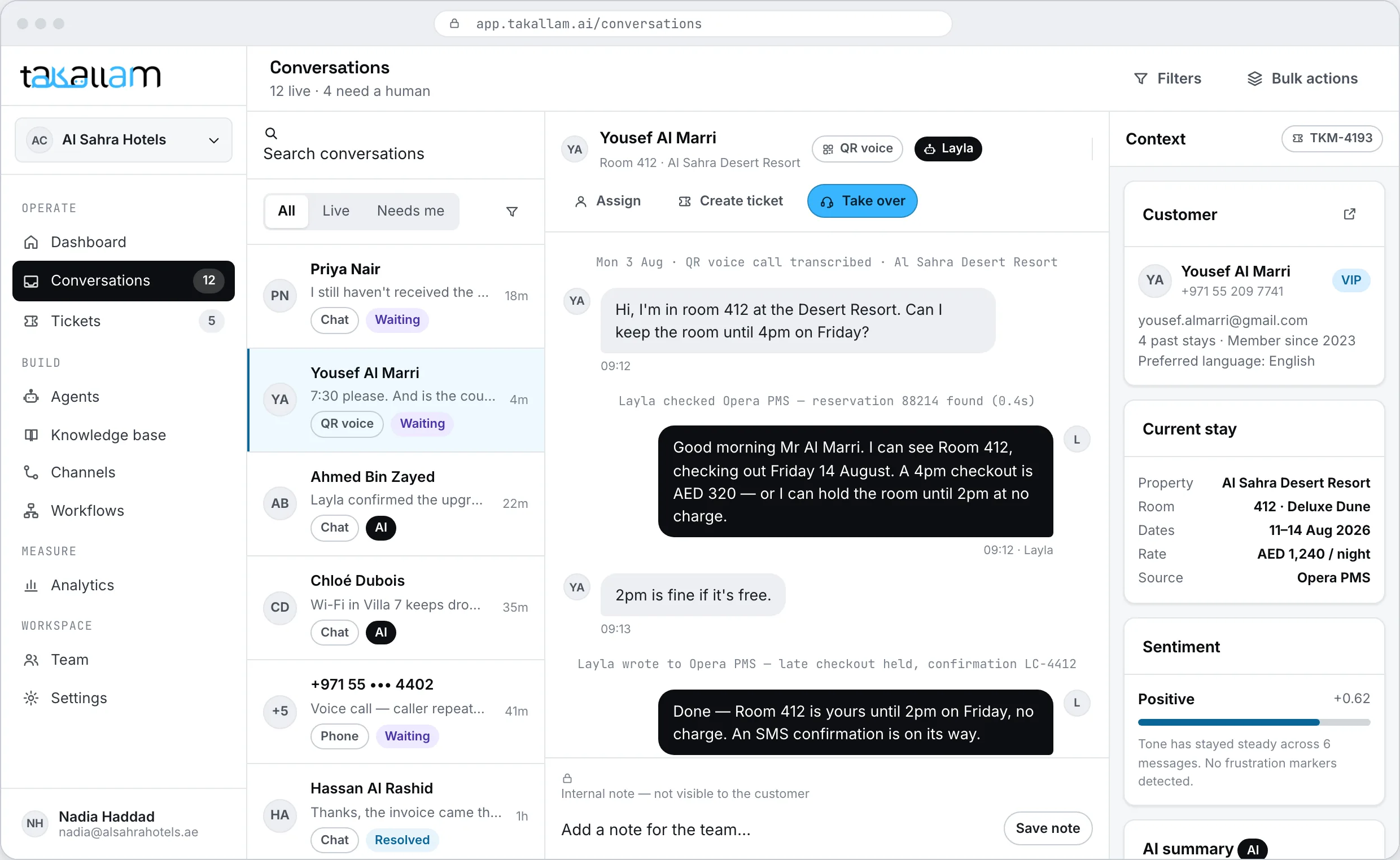
Late checkout, asked at 11:40
The most common request in any hotel, and the one that always needs someone to look at the arrivals for that room. The agent checks, confirms the time it can actually give, and offers luggage storage when the answer is no.
Room service and in-room dining
Takes the order by voice, reads it back, and puts it in front of the kitchen with the room number on it. The menu, the allergens and the closing time come from what you gave it, not from a guess.
Spa, restaurant and activity bookings
Checks what is open, takes the time and the party size, and sends the confirmation. The same request emailed a week before arrival gets the same answer, in the same thread, from your own address. Anything it cannot confirm goes to the team that owns the diary, with the request already written down.
The email channelHousekeeping and maintenance
Extra towels, another pillow, a tap that drips, a safe that will not open. Each one becomes a ticket with a room number, a priority and a clock — routed to the right floor instead of written on a pad.
Tickets and SLAsWifi, parking, hours and directions
The password, the parking validation, when breakfast closes, whether the pool is heated, where the prayer room is. This is the volume that never justified a night-shift hire, and you pay for it by the interaction.
How pricing worksTransfers and cancellation terms
Pickup time, vehicle, flight number and cost for the airport run. And your real cancellation terms read back to the guest in the language they asked in — not a paraphrase somebody remembered.
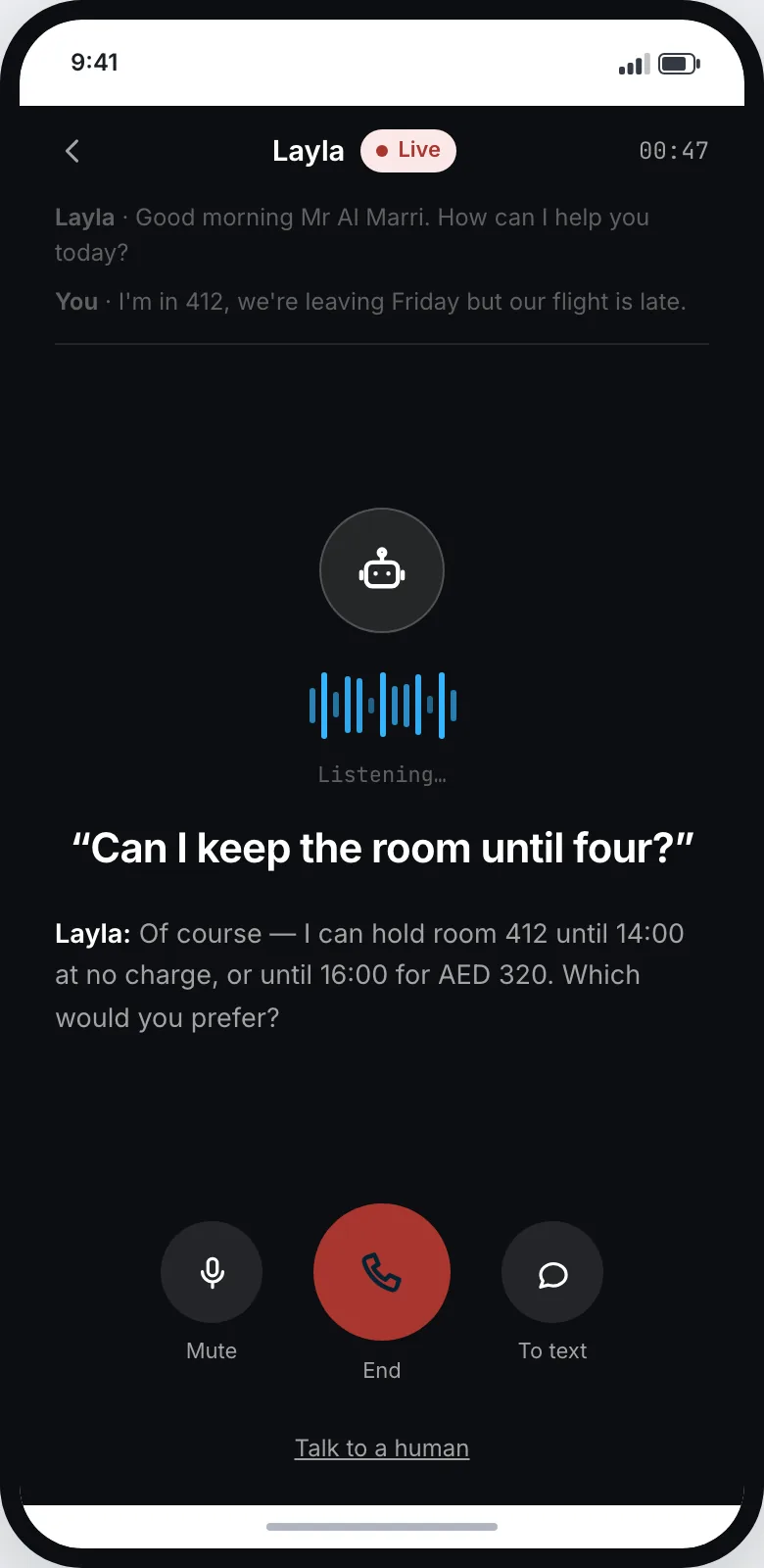
The guest scans the card on the door and just talks
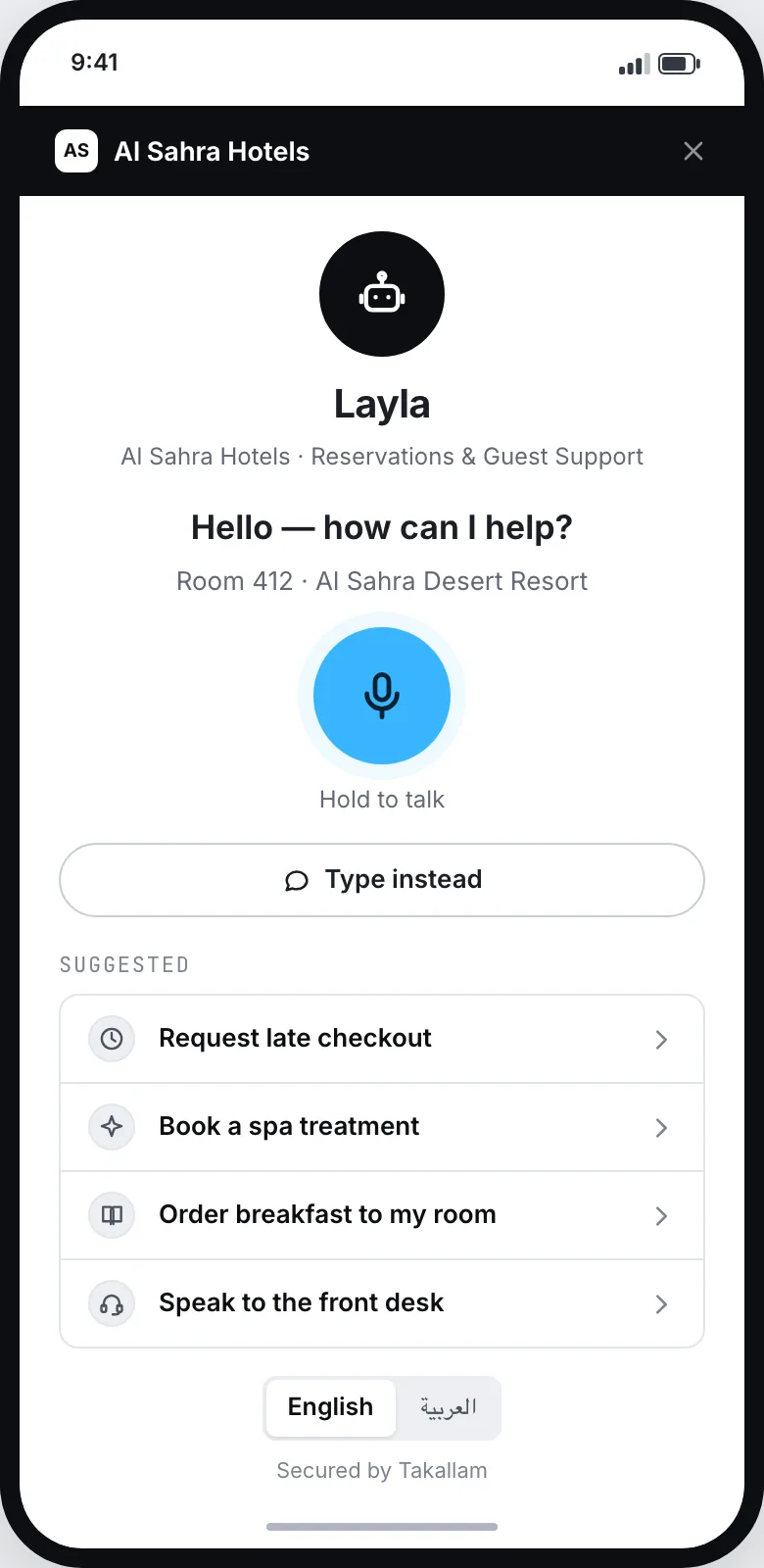
There is no app to download, no number to dial and no queue to sit in. The guest points a camera at a code, speaks, and gets an answer. It works at 2am, it works when both hands are full of shopping bags, and it works for the whole floor at once when a delayed flight finally lands.
- Opens straight into voice. No app store, no download, no reception extension to remember.
- The guest can switch to text mid-conversation — useful at 2am with someone asleep in the next bed.
- Every scan is attached to the code it came from, so you know the request came from room 1104 and not from the lobby.
- A guest who scanned at the pool and calls later gets the same agent, with the earlier conversation already there.
Where the code goes
Put it where the question happens. A code in the lobby answers arrival questions; a code at the pool answers pool questions. Print a different one for each spot and you find out which places generate which requests.
The door card and the key-card wallet
The one piece of print every guest is guaranteed to hold. It is also where they are standing when they realise they do not know the wifi password or what time checkout is.
The in-room compendium and the desk
A code on the desk replaces the folder nobody opens. The difference is that the code answers the question instead of listing a phone extension for it.
The lobby and the concierge desk
For the queue at check-in, the guest waiting on a room that is not ready, and the arrival at 1am who wants to know whether the kitchen is still open.
The pool and beach menu
A guest on a sunbed will not walk to the bar to ask what time the kitchen closes. They will scan the corner of the menu and ask, and order while they are there.
Restaurant table tents and the spa reception
Allergens, set-menu times, whether the treatment room is free at six. The questions that interrupt a host mid-service and take four minutes to answer.
A different code per placement
Separate codes for the lobby, the pool, the spa and each floor. The analytics show which placement earns its ink and what guests ask in each spot.
Inside the consoleEvery sector we cover
A resort is several businesses at once — restaurants, a spa, an events team, a facilities crew. Each has its own page, its own codes and its own escalation rules on the same platform.
All 20 industriesThe guest from Riyadh and the guest from Manchester get the same answer
A UAE hotel serves Gulf guests and international guests in the same corridor, and one of those groups usually gets a worse experience. Takallam handles Emirati and wider Gulf dialect in voice and text, not only Modern Standard Arabic, and follows a guest who starts a sentence in Arabic and finishes it in English.
- Emirati and Gulf dialect in speech, not a formal newsreader register nobody uses at a reception desk.
- Code-switching handled, so a guest never has to repeat themselves in the other language.
- The whole guest-facing experience is right-to-left in Arabic, not an English screen with translated labels.
- English and Arabic today. That is what Takallam does properly, and we would rather say so than claim forty languages.
A late checkout that actually reaches the PMS
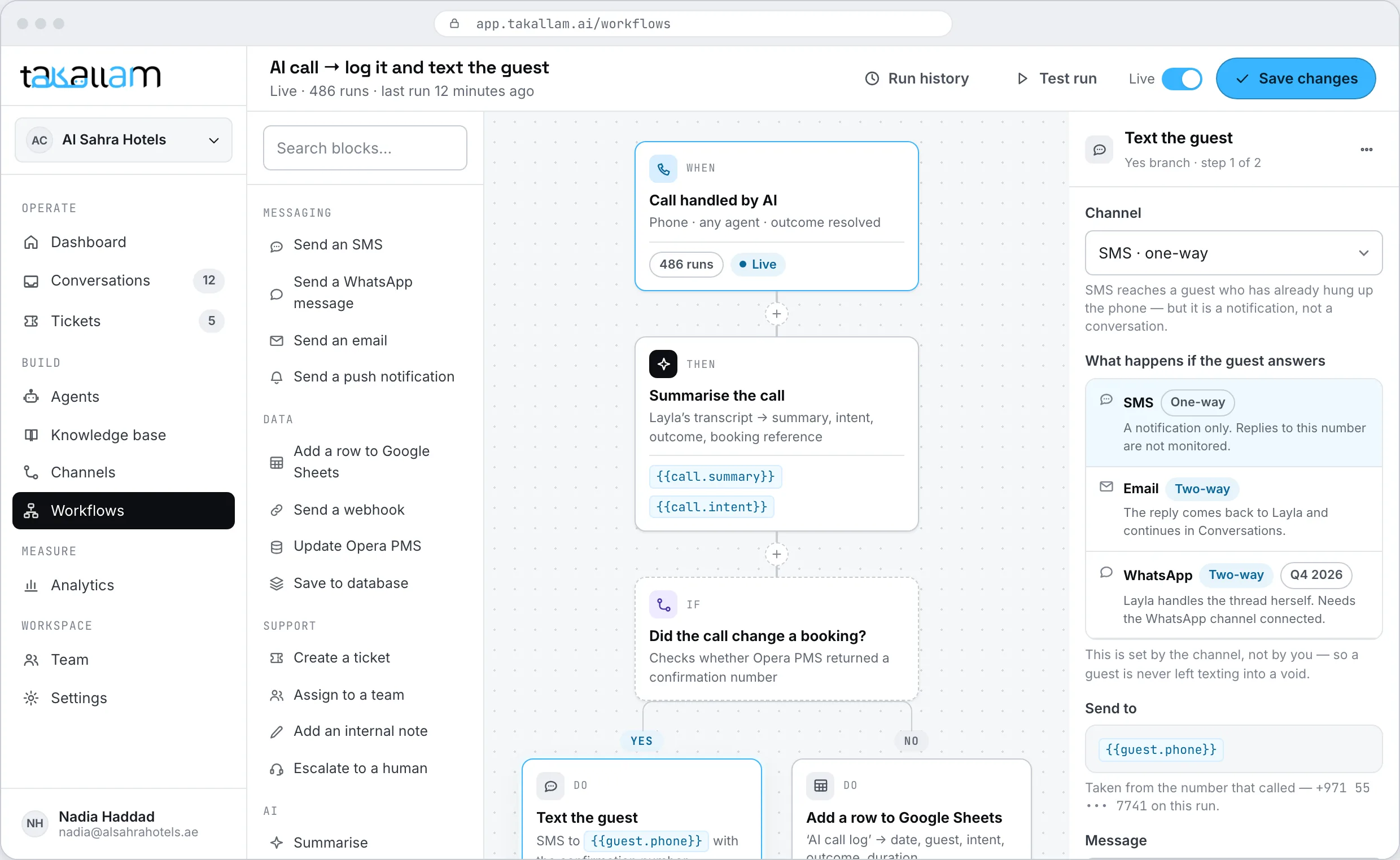
Telling a guest they can stay until two is half the job. The other half is the room status changing, housekeeping being told, and the guest getting it in writing. That part is a workflow: when this happens, do that, and if this other thing is true, do something else instead.
- When a late checkout is agreed, check the arrivals for that room, update the PMS, and text the guest the new time.
- When a housekeeping request comes in, open a ticket with the room number, notify the floor supervisor, and close it when housekeeping confirms.
- When a call ends, write the summary into the guest record so the next shift does not start from nothing.
- Takallam does not ship a pre-built connector for every PMS. It ships a workflow builder, a REST API and signed webhooks — if your system can be called, a workflow can call it.
What the platform gives a property
These are capabilities of the platform, not results from a deployment. Takallam is pre-launch and has no published performance figures.
What hotel operators ask before they trial anything
Can a guest actually get a late checkout without calling the front desk?
Yes, if you let the agent do it. In the agent builder you decide which actions it is allowed to take. Give it late checkout and it can check whether the room is needed, confirm a time within the rules you set, update the property system through a workflow and text the guest. Take the action away and it will answer the policy question but leave the decision to your team.
Where do we put the QR code?
Wherever the question happens: the door card, the desk in the room, the compendium, the lobby, the pool menu, the spa reception, table tents in the restaurant. Print a different code for each placement so you can see which one guests actually use and what they ask in each spot.
Does it answer email as well as calls and scans?
Yes. Forward reservations@ or your guest-services address to Takallam, or connect the mailbox, and the agent reads the whole thread — booking confirmation attached and all — then replies from your own address in the language the guest wrote in. Pre-arrival questions, amendment requests and complaints are tagged and routed, and anything it should not answer goes to your team with the thread attached. You can run it in draft mode and approve replies until you trust it.
Does it connect to our PMS?
It connects to systems that can be called. Takallam gives you a workflow builder, a REST API and signed webhooks, so a workflow can read a room status, write a note or update a booking in any system that exposes an interface.
What Takallam does not do is claim a pre-built, certified integration with every property system on the market. Tell us what you run and we will be straight with you about what the connection looks like.
What happens when a guest is angry, or the request is unusual?
It stops and hands over. You write the escalation rules per agent and per channel — low confidence, a complaint, a refund, a request outside what the agent may do. The conversation lands in your console with the transcript, the room number and everything the AI already tried, and your team continues in the same thread. The guest does not start again and there is no ticket number to quote.
Does it handle Arabic-speaking guests properly?
Yes — Emirati and wider Gulf dialect in both voice and text, including guests who switch between Arabic and English mid-sentence. This is the reason Takallam exists rather than being an English-first product with translation bolted on. Today the platform covers English and Arabic; if your guest mix needs more, tell us before you join.
Can it take a booking, or does it only answer questions?
Both, and you choose which. An agent can be read-only, or it can be allowed to take a room service order, hold a table, request a transfer or open a housekeeping ticket. Every action it takes is logged with the conversation that caused it, so you can audit exactly why a booking was made.
What does it cost?
You pay per interaction, and each channel is priced separately, because a phone call and a chat message do not cost the same to deliver. There are no per-seat licences and no minimum commitment, which matters when a resort has a loud season and a quiet one. Takallam is pre-launch, so rates are being set with the first cohort — join the waitlist and we will quote against your real volume.
How long does setup take, and does IT need to be involved?
Not long, and mostly no. Takallam reads your website, builds the knowledge base from your rates, policies and facility pages, and drafts your first agents. You review what it learned, decide what each agent may do, and print the codes. IT is only needed when you want a workflow writing back into the property system.
Put a code on the door and see what guests ask
We are onboarding a first cohort of UAE properties now. Tell us how many rooms, which channels you need and what your PMS is, and we will come back with a rate against your real volume.
Pay per interaction · priced per channel · no seats, no minimums