
Why Takallam exists
Because customer service in the Gulf is answered in a language most support tools treat as an afterthought — and because covering QR voice, chat, email and phone should not take three vendors and three contracts.
Arabic is the customer’s first language and the roadmap’s last item
Open almost any support platform and Arabic is a locale file. The interface flips right-to-left, the canned replies get translated, and the AI answers in careful Modern Standard Arabic that nobody says out loud to a hotel receptionist. Meanwhile the customer started the sentence in Emirati, finished it in English, and got back something that reads like an official circular.
- Gulf dialect is not a variant of Modern Standard Arabic. It is what people actually say.
- Real customers code-switch. A sentence that opens in Arabic often closes in English.
- Right-to-left is a layout problem. Dialect, register and tone are product problems.
- A translated interface sitting on an English-first model is still an English-first product.
Four channels, three vendors, three bills
The other half of the problem has nothing to do with language. A business that wants to answer on the phone, on its website, inside its app and in its support inbox usually ends up buying a ticketing suite, an AI add-on for that suite, and a separate voice vendor — then paying for a fourth tool to move data between them. Every one of them invoices separately. None of them share a memory of the customer.
- The same question gets three different answers depending on where it landed.
- Nobody can say what customers actually ask, because the record is split across vendors.
- Every new channel turns into a new procurement cycle.
- Per-seat pricing charges you for the size of your team, not for the work being done.
Built here, for here — then everywhere else
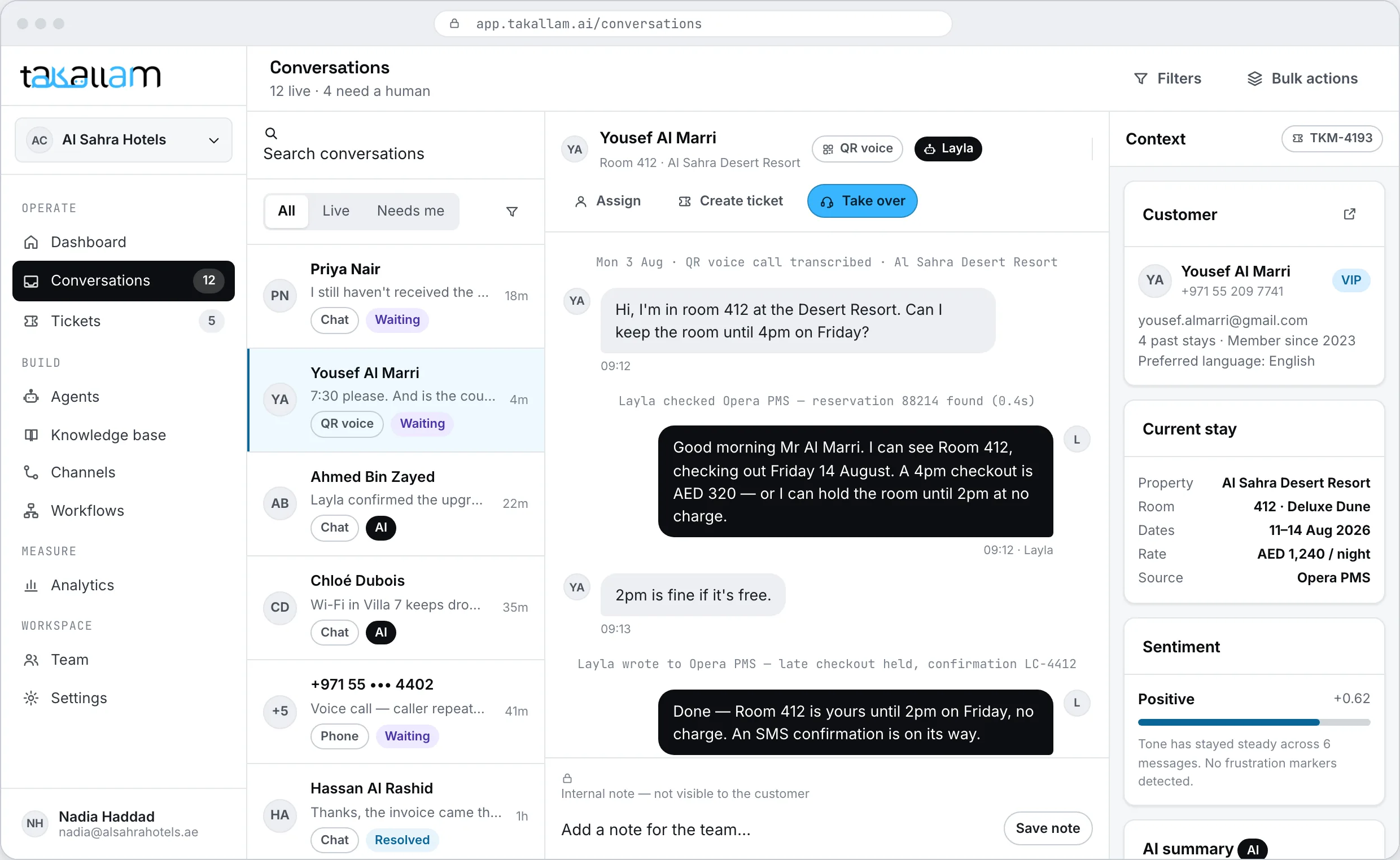
Takallam is built in the United Arab Emirates. That is not a flag on a website. It decides the order things get built in. Gulf dialect is the reference case for voice rather than a later release. Data sits in the UAE region by default. The QR channel exists because of how service actually works here — the question turns up while someone is standing in a room, at a shelf or at a counter, not while they are sitting at a desk with a support portal open.
- Emirati and Gulf dialect are the benchmark for voice quality, not an add-on.
- Conversations, transcripts and knowledge bases are resident in the UAE region by default.
- Arabic and English sit side by side in the console, because most teams here work in both.
- The product is built for businesses that answer in two languages every single day.
Four things we decided at the start
These are the calls that shaped the product. They are also the ones we would have to reverse to become a normal helpdesk, so they are worth writing down.
Voice is a channel, not a demo
A phone line and a scan-to-speak code are first-class channels with the same knowledge, the same escalation rules and the same record as chat. Voice bolted onto a text product behaves like a bolt-on, and customers can hear it.
Arabic is not a locale file
Dialect, code-switching and register are handled in the model and in the product, not in a translation table. If a customer speaks Emirati, the answer comes back in the register you chose, not in formal Arabic by default.
One record of the customer
A call at 9pm and a message at 9am are the same person and the same thread. That only works if the channels, the knowledge base, the tickets and the workflows are one system rather than four integrated ones.
Pay for work, not for seats
You pay per interaction, priced separately for each channel, because a phone call and a chat message do not cost the same to deliver. No per-seat licences and no minimum commitment — adding a colleague to the console should not cost anything.
Takallam in four numbers
Capability facts, not results. Takallam is pre-launch and has no customer outcomes to quote.
Where we actually are
Takallam is pre-launch. The screens on this site are a working prototype filled with sample data, not a live customer account. We have not shipped to a public customer yet, which is why there are no logos on this page and no case studies. Putting fake ones there would tell you nothing about whether this fits your business, and you would find out eventually anyway.
- The waitlist is real. We are onboarding a first cohort of businesses in the UAE.
- Rates are being set with that cohort, per channel, against actual volume.
- Everything on this site describes what the product does or is being built to do. Nothing is presented as a customer result.
- If something is not built yet, you will hear it on the call, not after the contract.
Three ways in
Join the first cohort
Tell us your channels, your languages and roughly how many conversations you handle a month. We come back with a rate against your real volume.
Join the waitlistBuild on the API
Every action in the console is an endpoint. If you would rather evaluate the platform by reading the API than by watching a demo, start here.
Read the developer docsAsk a direct question
Partnership, press, procurement, or a question about whether Takallam fits a specific setup. One address, and a person answers it.
Contact usWhat people ask about the company
Is Takallam live yet?
Not publicly. Takallam is pre-launch and onboarding a first cohort of businesses in the UAE. The product exists and works — the screens on this site are captures of it — but there is no open self-serve signup yet, which is why every button on this site says join the waitlist rather than start free trial.
Who is behind Takallam?
A team building in the United Arab Emirates. We have deliberately not published a leadership page while the product is pre-launch, because a team page is not what tells you whether this will work for your business. The fastest way to meet the people building it is to email [email protected] or join the waitlist — you will end up on a call with them either way.
Why are there no customer logos or case studies on this site?
Because there are no public customers yet. Every logo wall and testimonial you have seen on a pre-launch site was either borrowed, bought or invented, and we would rather be the company that says so. When there are results worth publishing, they will appear here with the customer’s name on them.
Are the numbers in the screenshots real?
No, and every caption on this site says so. The conversation counts, resolution rates, CSAT scores and names in the product screens are sample data in a prototype. They exist to show you what the interface looks like with data in it, not to imply a result.
What does "Takallam" mean?
تكلّم is Arabic for "speak" — the imperative. It is the instruction printed next to a QR code on a hotel door, and it is what the product does before anything else.
Is Takallam only for the UAE?
It is built for the UAE and the wider Gulf first, and that shows in the dialect coverage and the default data region. Nothing about the platform is limited to one country — the English side works anywhere, and other Arabic dialects are part of the same model work. But when a decision has to be made about what to get right first, it gets made for this region.
How do I get in touch?
[email protected] for anything — evaluation, partnership, press or a technical question. If you are evaluating Takallam for a business, joining the waitlist first is faster, because it captures the channels and volume we would otherwise have to ask you for.
Be one of the first businesses on Takallam
We are onboarding a first cohort in the UAE now. Tell us which channels you need and we will come back with a rate against your real volume.
Pay per interaction · priced per channel · no seats, no minimums