
Takallam vs Zendesk
Zendesk is one of the best ticketing platforms ever built. If your operation is a large agent team working a queue, it is very hard to beat, and this page will say so more than once. Takallam is a different shape: conversation-first, voice-native, four channels in the product, priced per interaction. The question is not which one is better — it is which shape fits how your customers actually reach you.
One is organised around tickets. One is organised around conversations.
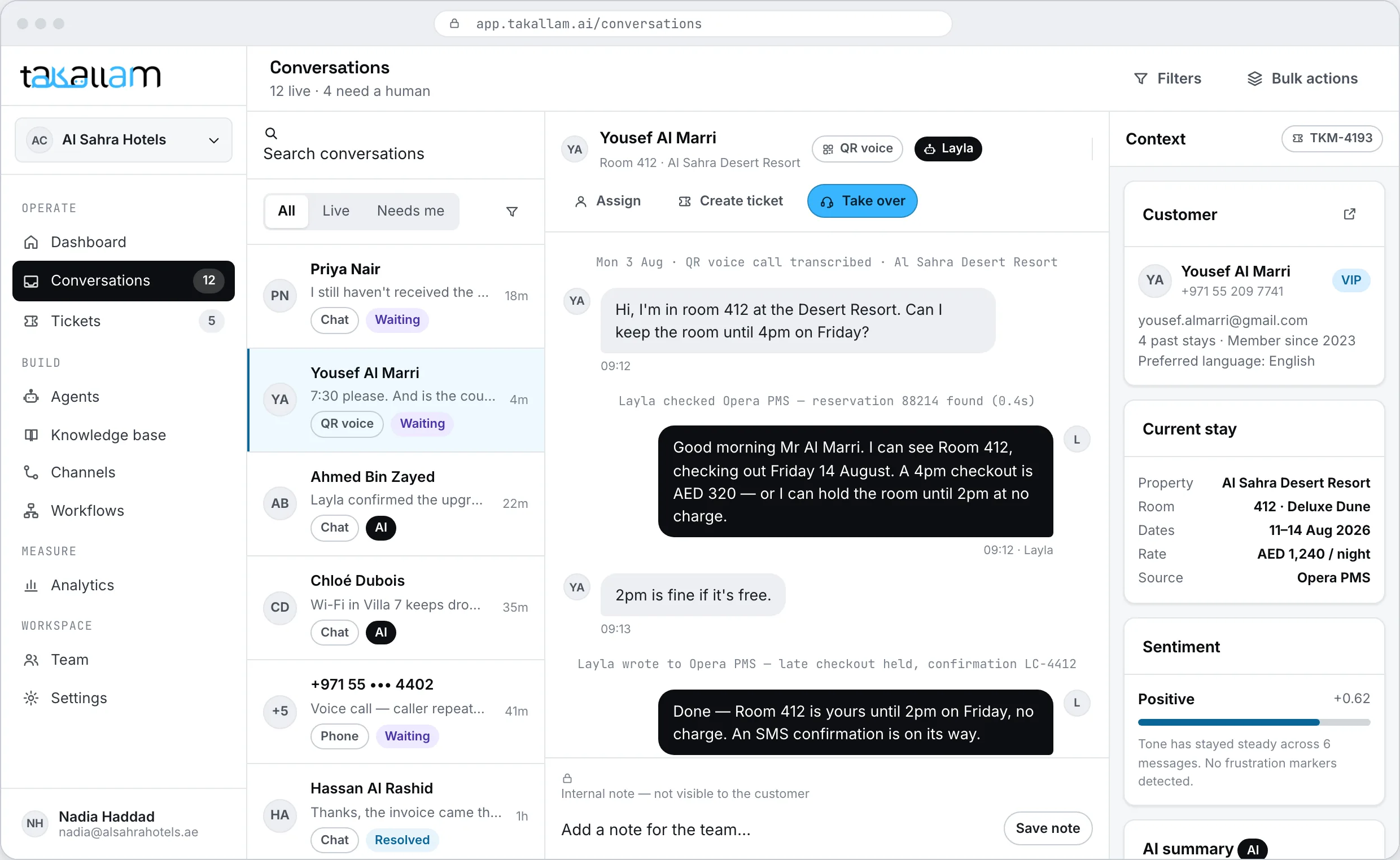
In Zendesk the unit of work is the ticket. Routing, SLA policies, reporting, forecasting and QA all exist to move tickets through a queue, and it does that better than almost anything else. Voice is something you add to that system. In Takallam the unit is the conversation, and voice is how it usually starts: a customer scans a code and talks, or calls a number, or types in your app — and it is the same agent, with the same knowledge and the same memory of them.
- Four channels are in the product rather than bought separately: QR voice, in-app and web chat, email, phone.
- The AI answers first and hands to a person in the same thread when it should. No ticket number to quote, no transfer.
- Takallam has tickets and SLAs. They sit behind the conversation instead of being the thing your team works inside.
- Priced per interaction and per channel, so the bill tracks the work rather than the number of people logged in.
What Zendesk does better than us
Three of these are not close. If any of them is load-bearing for your operation, take that seriously before you move anything.
Depth in ticketing and workforce
Years of work in routing rules, macros, triggers, SLA policies, side conversations, forecasting, shift planning and QA scoring. Email is where Zendesk grew up, and it shows. If you run a large team on rotas, that depth is real and Takallam does not match it.
A very large app marketplace
Hundreds of prebuilt integrations across CRM, billing, commerce and telephony, most of them installable without an engineer. Takallam connects through its API, webhooks and workflows, which is flexible but is not a catalogue you click.
Reporting and enterprise scale
Deep, configurable analytics, mature admin and governance controls, and a long track record at very large volumes across many regions and languages. Takallam gives you conversation analytics, not an enterprise BI layer.
Capability by capability
Compared at product level, not plan level. Where Zendesk is ahead, the table says so.
| Takallam | Zendesk | |
|---|---|---|
| Scan-and-speak QR voice channel | ||
| In-app and web chat | ||
| AI answers your support inbox | ||
| Voice included in the core product | ||
| One agent across voice, chat, email and QR | ||
| Shared inbox across every channel | ||
| Human takeover in the same thread | ||
| Tickets, SLAs and queues | Deeper and more mature | |
| Workforce management, forecasting, QA | ||
| App marketplace of prebuilt integrations | API and webhooks | |
| Knowledge base built from your website | ||
| Emirati and Gulf dialect voice | ||
| Reporting and analytics | Conversation analytics | Deeper, more configurable |
| Pricing model | Per interaction | Per agent seat |
| Data resident in the UAE by default | Region options |
Capabilities as of 2026, at product level. Zendesk plans, add-ons and regional options vary, so check the specifics of your own contract. Where Zendesk is stronger, this table says so rather than hiding it.
A code on the door, and a voice that speaks Emirati
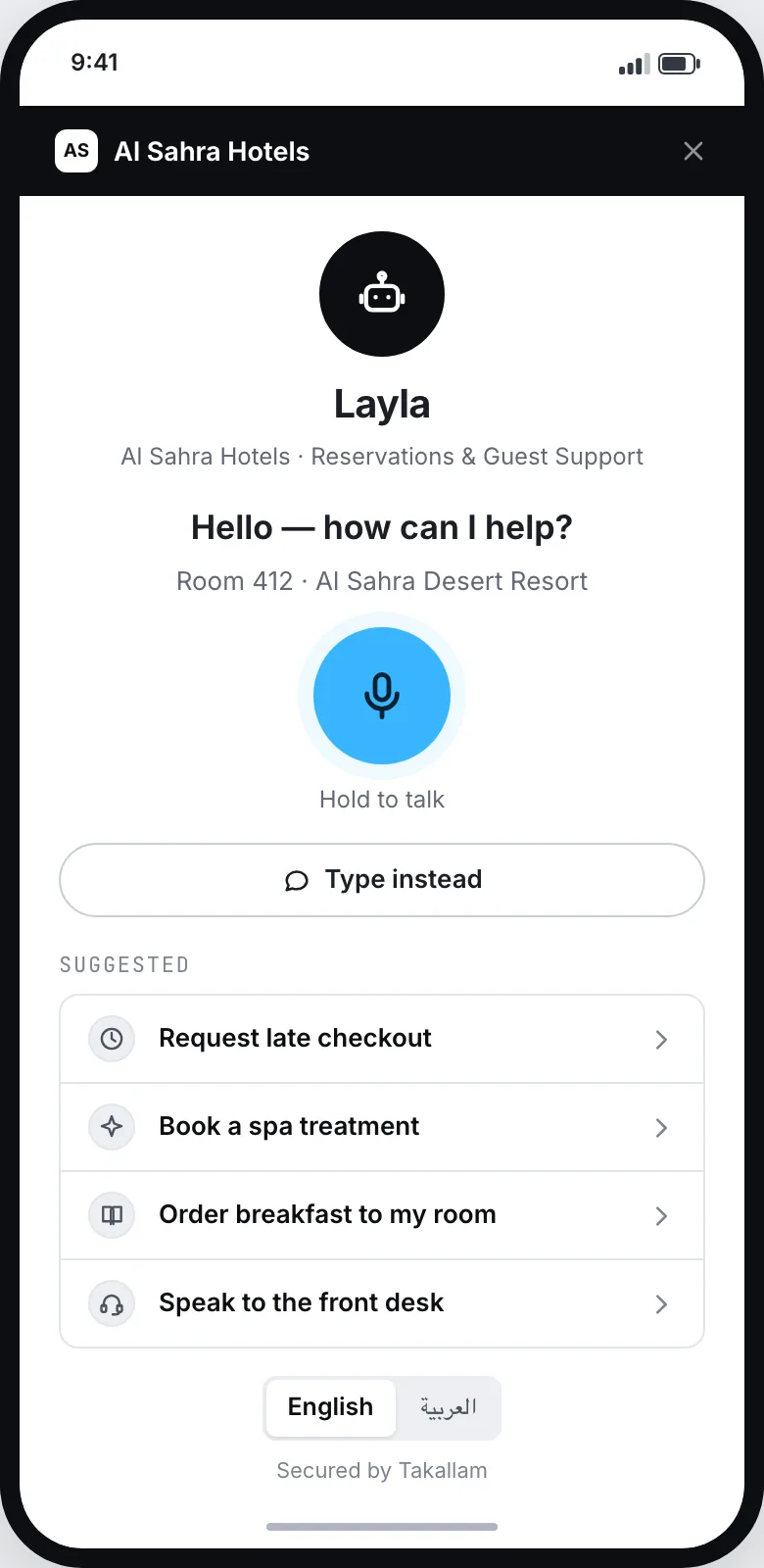
Two things are missing from every ticketing suite, because neither was ever the point of one. The first is a channel where a customer scans a printed code and simply talks — no app, no number, no queue. The second is Arabic as a first language rather than a locale setting: Emirati and Gulf dialect in voice and text, including the caller who starts in Arabic and finishes in English.
- Put a code on a hotel room door, a shelf edge, a service counter or a delivery box, and see which places generate which questions.
- It opens voice-first and can switch to text mid-conversation without losing the thread.
- Emirati and Gulf dialect for voice, not Modern Standard Arabic only.
- Right-to-left through the whole customer experience, not a translation layer over an English-first product.
- Conversations, transcripts and knowledge stay in the UAE region by default.
You do not have to choose on day one
The usual way in is not a migration at all. Takallam takes the front line — the QR code, the phone number, the chat widget — and resolves what it can. Zendesk keeps doing what it is good at behind that: the cases that need a specialist, the workflow your team already knows, the reports your managers already read. Nothing in your existing queue has to change to try this.
- Start with one channel and one agent. A QR code at a single location is a real pilot with almost no risk.
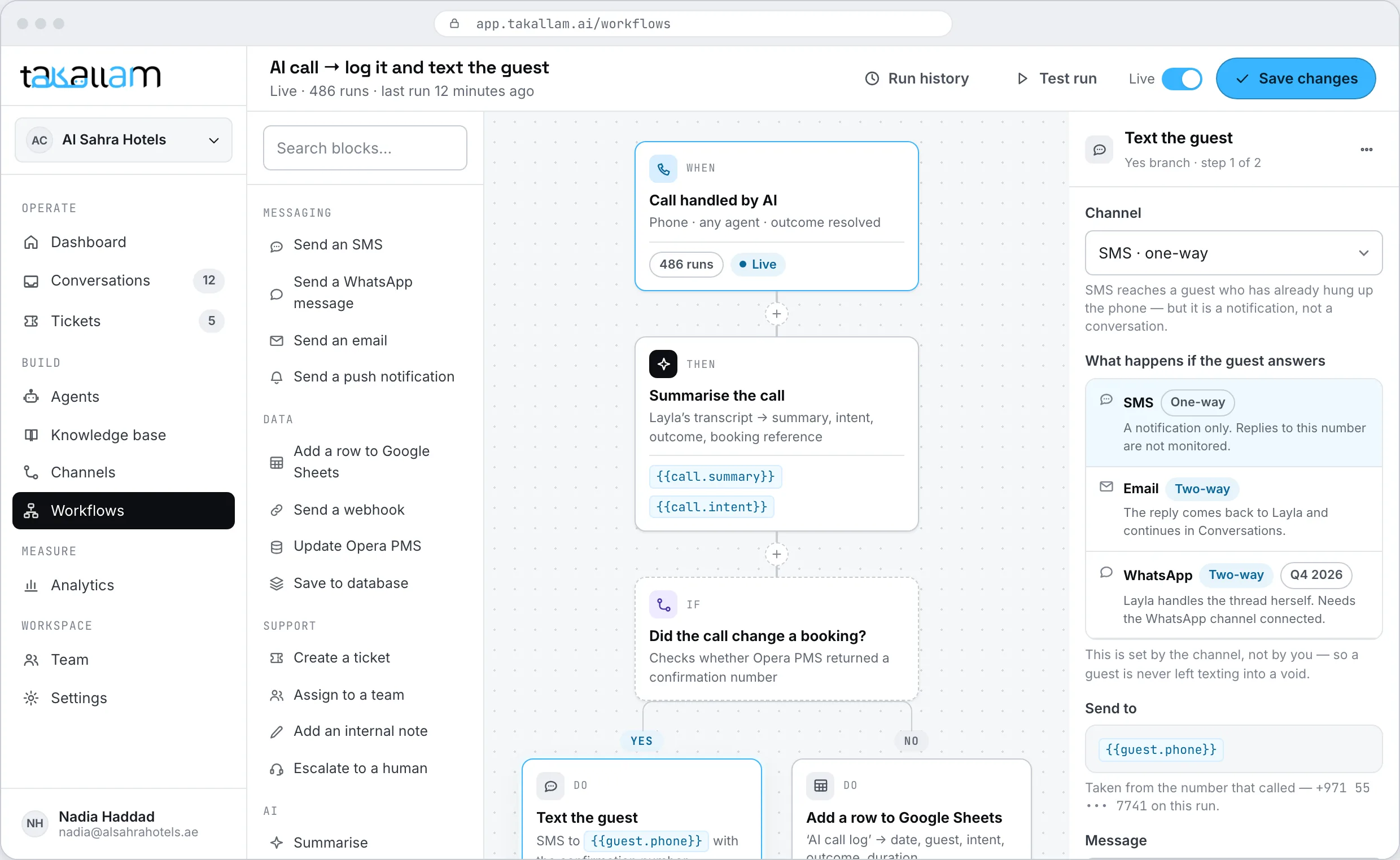
- A workflow can summarise a conversation and open or update a record in the system you already run, over the API or a webhook.
- Your agents keep working where they work today, on the cases that reach them.
- If it earns more of the surface, move channels across one at a time. If it does not, all you have lost is a code on a door.
Three reasons teams move the front line
One agent instead of three vendors
Answering by phone stops being a procurement cycle. The QR code, the chat widget, the support inbox and the phone number are the same agent with the same knowledge base, bought once, in one console, on one bill.
Arabic your customers actually speak
Emirati and Gulf dialect in voice and text, with code-switching handled mid-sentence. Not a translated interface over an English-first product, and not a service you have to staff around the clock to offer.
A bill that tracks work, not headcount
Per interaction, priced separately for each channel, with no per-seat licences and no minimum commitment. When the AI resolves more, you are not still paying for seats it made unnecessary.
Who should stay, and who should move
Stay on Zendesk if
You have a large agent team, years of macros, triggers and SLA policies, marketplace integrations doing real work, and workforce management your managers plan shifts against. That investment is worth more than a channel you can put in front of it. Run Takallam on the front line instead of replacing anything.
Move to Takallam if
Voice is where your customers actually are, Arabic matters, and your conversation volume is larger than your genuine ticketing need. Or you are early enough that you have not bought the stack yet, and you would rather buy one product than a suite, an AI add-on and a voice vendor.
What teams on Zendesk ask us
Can we run Takallam and Zendesk at the same time?
Yes, and that is what most teams do first. Takallam takes the channels you point at it — usually a QR code and the phone line — and Zendesk keeps the rest of your operation exactly as it is. A workflow can push a summary or a record into another system when a conversation needs to continue there.
Is Takallam a full helpdesk?
It has the core of one: a shared inbox across all four channels, human takeover in the same thread, tickets with SLA timers, a knowledge base, team roles and conversation analytics, plus a workflow builder for what happens around the conversation.
It does not have everything a mature suite has. There is no workforce management, no forecasting or QA scoring, and no marketplace of one-click integrations. If those are central to how you run support, Zendesk is ahead and it is worth keeping.
What about our existing macros and SLA policies?
They stay in Zendesk — nothing is imported or converted. Takallam has its own escalation rules and SLA timers, which you set per agent and per channel, and in practice teams re-create far fewer than they expect, because an AI answering first removes most of the cases a macro existed to speed up. If your macro library is the backbone of your operation, that is an argument for keeping Zendesk behind Takallam rather than replacing it.
Can Takallam use our Zendesk help centre content?
If your help centre is public, Takallam crawls it the same way it crawls the rest of your website, and shows you every page it learned from so you can remove anything it should not use. You can also upload documents directly or connect a system such as a PMS or an order database.
Can we keep our existing phone number?
Yes. You can point an existing number at Takallam or take a new one. Calls the AI cannot handle escalate to your team with the full transcript attached, so nobody has to ask the customer to start again.
Is Zendesk better than Takallam at anything?
Several things, and we would rather you heard it here. Ticketing depth — email in particular, which is where Zendesk grew up — workforce management, QA, configurable reporting, the size of the app marketplace and enterprise administration are all stronger on Zendesk. Takallam is ahead on voice as a native channel, the scan-and-speak QR code, Emirati and Gulf dialect, having all four channels on one customer record, and pricing that does not scale with seats.
How does the pricing model compare?
Zendesk is generally licensed per agent seat, with voice and AI capabilities as add-ons. Takallam is priced per interaction and separately for each channel, with no seats and no minimum commitment. Takallam is pre-launch, so exact rates are being set with the first cohort — join the waitlist and we will quote against your real volume rather than a list price.
How long does it take to get Takallam live?
You answer four questions, Takallam crawls your website and builds a knowledge base, and it drafts your first agents. The work you actually do is reviewing what it learned and deciding what each agent is allowed to do. A single QR code or one phone number is realistically an afternoon, not a quarter.
Put it in front of your Zendesk and see
One QR code, or one phone number, alongside everything you already run. Tell us which channel you would start with and roughly how many conversations a month you handle.
Pay per interaction · priced per channel · no seats, no minimums