
What you are actually choosing between
Teams shopping for AI support end up looking at two very different kinds of product: a ticketing suite that has added AI, or a voice API that engineers assemble into an agent. Both are good at what they were built for. Neither was built to be a whole support operation that answers by voice in Emirati Arabic. Here is the honest version — category by category, then product by product.
The short version
Capability facts about Takallam, not performance results. Takallam is pre-launch.
Ticketing suites that have added AI
Zendesk, Freshdesk, Intercom and Salesforce Service Cloud are mature platforms with years of engineering behind them. They are genuinely strong at what a large support team needs: email at scale, routing, queues, SLA policies, workforce planning, deep reporting, and marketplaces with hundreds of prebuilt integrations. If your operation runs on that depth, it is worth keeping.
- The unit they are built around is the ticket. AI arrives as something you add to a system whose centre of gravity is a queue.
- Voice is a separate product with its own plan, and AI answering on that voice line is usually another line item again.
- None of them ship a channel where a customer scans a printed code and starts talking.
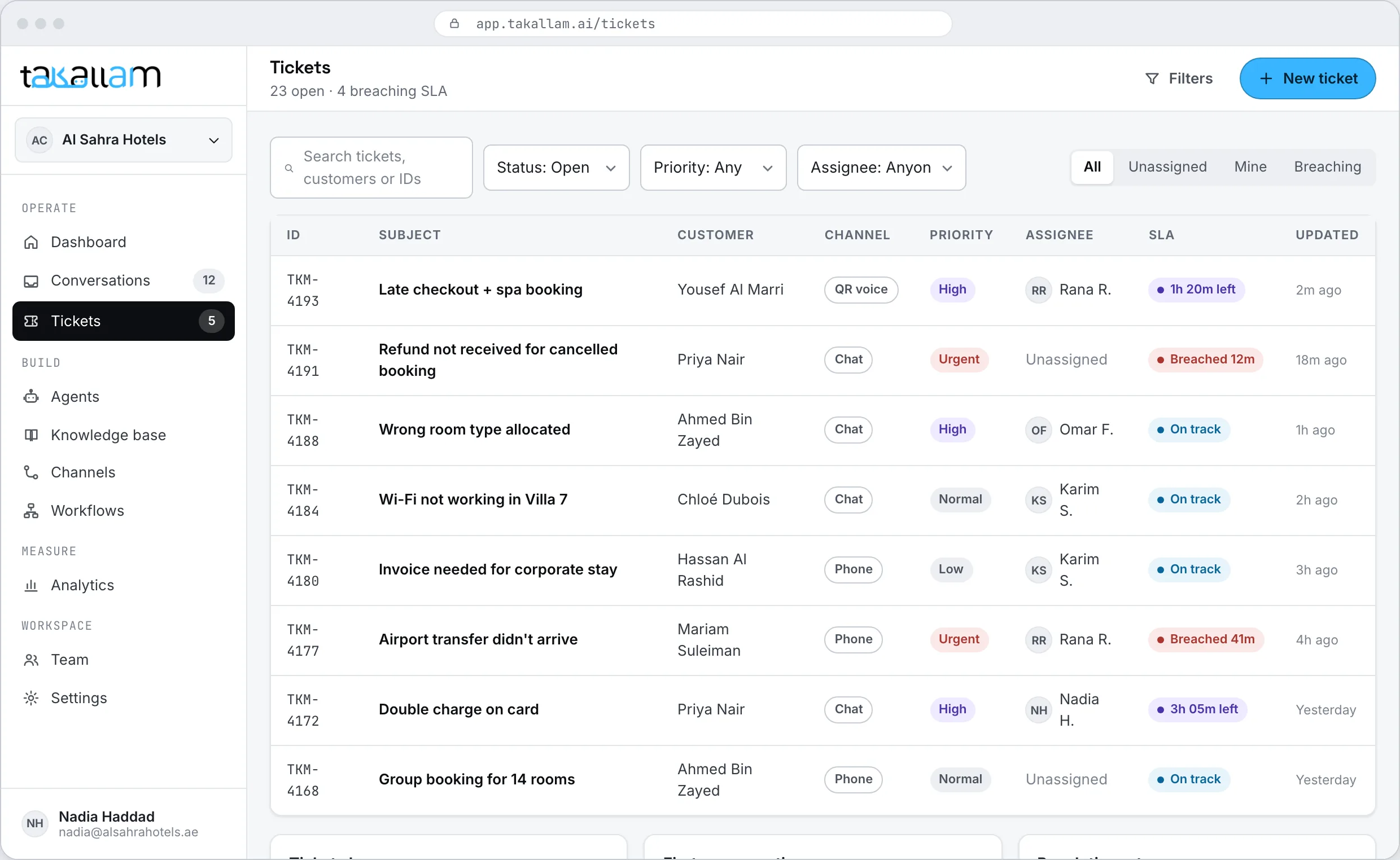
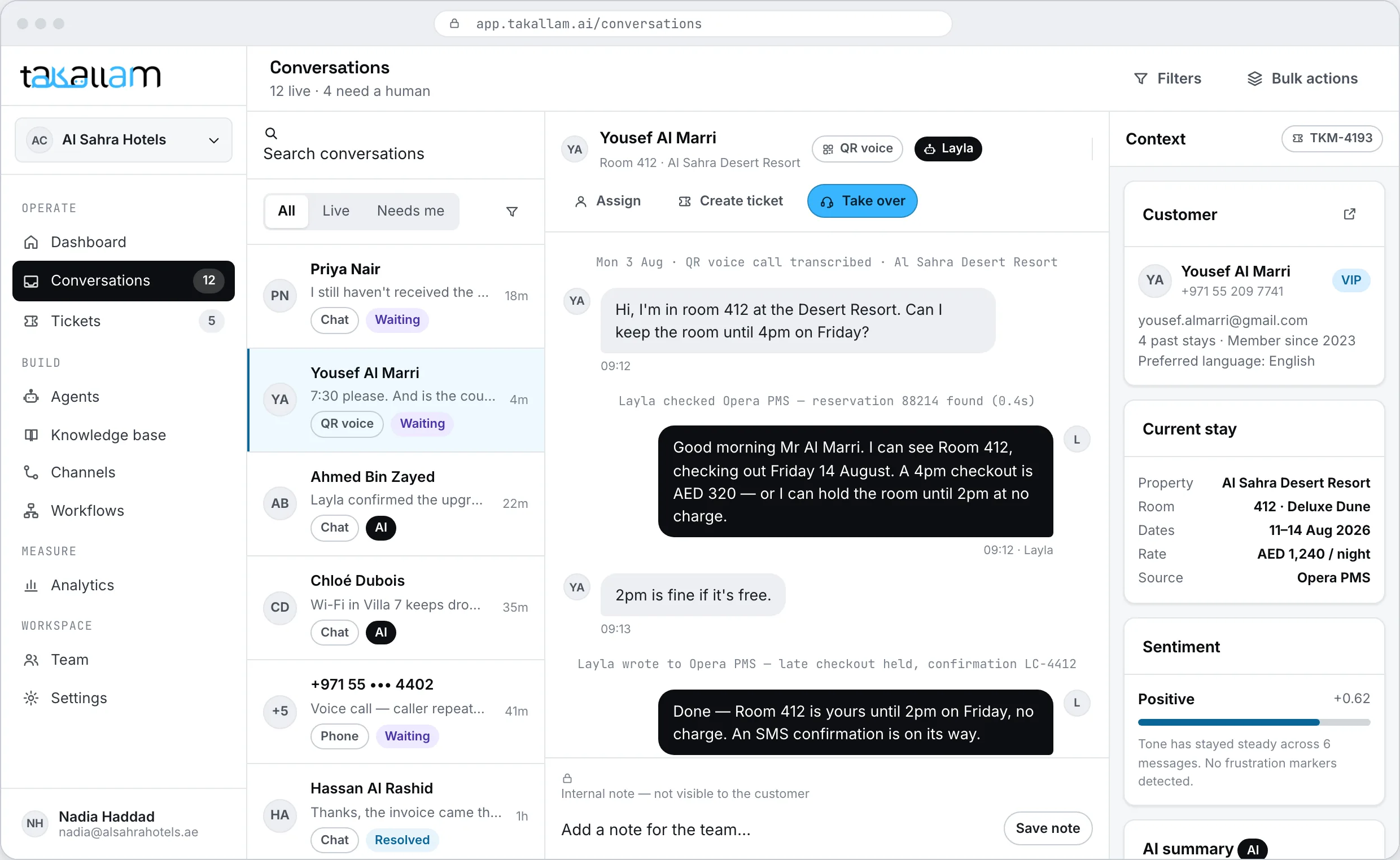
- Email is their heartland and they are good at it. The difference in Takallam is that an email thread shares one agent and one customer record with the phone call and the QR scan.
- Arabic is supported as a language. Emirati and Gulf dialect voice is not what they are optimised for.
- They are priced around agent seats, so the bill tracks headcount rather than the work the AI takes off you.
- Takallam has tickets and SLAs too — they sit behind the conversation instead of being the thing your team works inside.
Voice APIs and voice-agent platforms
Vapi, Retell AI, Bland AI, PolyAI and ElevenLabs are strong at voice itself — low latency, natural turn-taking, high-quality speech, telephony that holds up under real call volume. If you have engineers and you want a bespoke voice experience you control end to end, these are the right tools and you should use them.
- They are building blocks, not a support operation. There is no shared inbox, no ticket, no SLA, no team roster.
- When the agent cannot help, there is nowhere on your side for a person to pick the conversation up in the same thread unless you build it.
- Knowledge is something you supply and maintain in code or in your own store, not a knowledge base your operations lead edits.
- Chat and in-app messaging are secondary to the call. An email support channel and a scan-and-speak QR channel are not part of the product at all.
- You are buying voice. The rest of the support surface still has to come from somewhere.
The two categories, side by side
Capabilities, not prices. Vendors inside a category differ, so this compares what each category is built around — the named pages get specific.
| Takallam | Ticketing suite + AI | Voice API or platform | |
|---|---|---|---|
| Scan-and-speak QR voice channel | |||
| In-app and web chat | |||
| Email answered in your own inbox | |||
| Inbound phone voice | |||
| One agent across all four channels | |||
| Shared inbox across every channel | |||
| Human takeover in the same thread | |||
| Tickets, SLAs and a support queue | |||
| Workforce management and QA | |||
| Knowledge base built from your website | |||
| Workflow automation around the conversation | |||
| Emirati and Gulf dialect voice | |||
| Live without engineering time | |||
| Pricing model | Per interaction | Per agent seat | Per minute of usage |
| Data resident in the UAE by default | Region options | Varies by vendor |
Categories, not specific products. Capabilities vary by vendor, plan, region and add-on, and are described as of 2026. Where a category is stronger than Takallam, this table says so.
Neither category has a code you scan and speak to
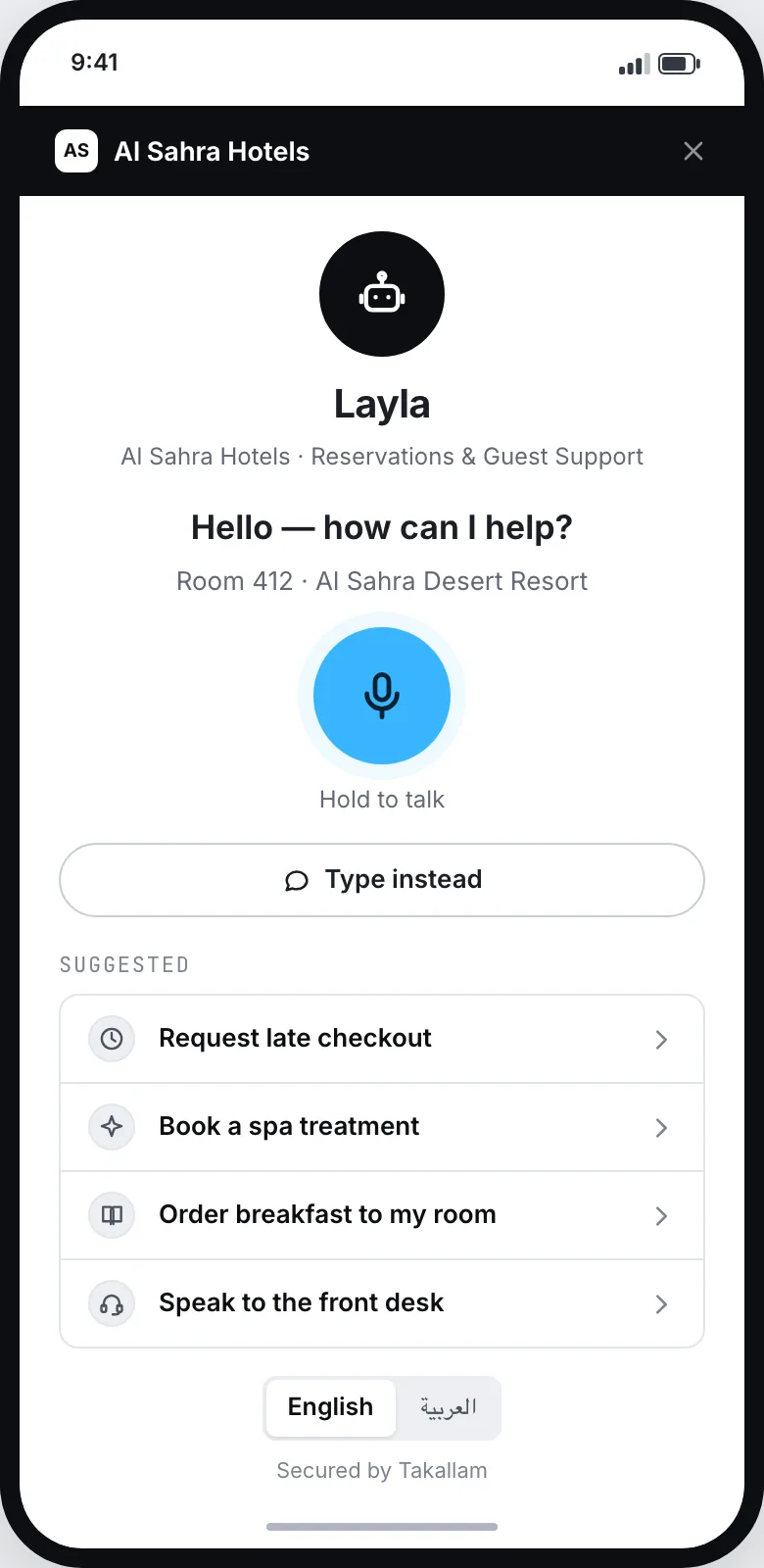
This is the part no comparison table on a competitor site will show you, because it is not a feature either category ships. A customer stands in front of the thing they have a question about — a hotel room door, a shelf, a service counter, a delivery box — points a phone at a printed code, and talks. No app to install, no number to dial, no queue to sit in.
- It opens voice-first, and the customer can switch to text mid-conversation without losing the thread.
- Different codes for different places, so you can see which locations generate which questions.
- The same agent, the same knowledge and the same customer record as your chat, your support inbox and your phone line.
- It works in Emirati and Gulf dialect as well as English, including a customer who switches mid-sentence.
Takallam against each of them
Thirteen pages, each accurate enough that we would be comfortable if the other company read it. Every one of them names what the other side does better.
Takallam vs Zendesk
A deep, mature ticketing and workforce platform with a very large app marketplace and strong reporting. Organised around tickets and priced around agent seats; voice is a product you add.
Read the comparisonTakallam vs Freshdesk
Fast to stand up, strong value, and part of a broad suite that reaches into CRM and IT service management. Still a ticket-first helpdesk, with voice as a separate product.
Read the comparisonTakallam vs Intercom
Excellent in-product messaging and one of the best chat-based AI agents on the market for deflection. Chat is where it is strongest; voice and a QR channel are not the shape of the product.
Read the comparisonTakallam vs Salesforce Service Cloud
Unmatched depth if your business already runs on Salesforce data, with enormous configurability, governance and a huge partner ecosystem. It is a platform project, not an afternoon.
Read the comparisonTakallam vs Vapi
A developer-first voice stack with real flexibility over models, providers and call flow. It gives you the call; the inbox, the tickets and the human handover are yours to build.
Read the comparisonTakallam vs Retell AI
Quick to get a production-grade voice agent live, with solid telephony and good testing tooling. Built for teams with engineers, and voice is the whole product rather than one channel.
Read the comparisonTakallam vs Bland AI
Serious control over the voice stack and a strong story for high outbound and inbound call volume. It is call infrastructure — there is no support console or knowledge base around it.
Read the comparisonTakallam vs PolyAI
Enterprise voice assistants for large contact centres, strong at containing complex calls, delivered with hands-on support. A managed engagement rather than something you switch on yourself.
Read the comparisonTakallam vs ElevenLabs Agents
Outstanding speech quality and one of the widest voice and language libraries anywhere. The agent layer sits on top of that; the support operation around it is not part of the product.
Read the comparisonTakallam vs Ziwo
A mature UAE cloud contact centre with real telephony, live agent supervision and outbound campaigns. Organised around agent seats and the call centre; Takallam answers first and prices per interaction.
Read the comparisonTakallam vs Ada
A mature, chat-first automation platform with a strong no-code builder and deflection analytics at enterprise scale. Messaging is its home ground; scan-to-speak QR voice and Emirati dialect are not the shape of it.
Read the comparisonTakallam vs Yellow.ai
A broad enterprise conversational-AI platform with wide channel coverage and deep WhatsApp automation. It is a configured enterprise deployment; Takallam is focused, self-serve and live without engineering.
Read the comparisonTakallam vs Verloop.io
Established MENA chat and WhatsApp automation with solid agent-assist tooling. Messaging-first by design; Takallam is voice-native across QR, phone, chat and email as one agent.
Read the comparisonWhen we are not the right answer
A comparison page that says the other side is worse at everything is not a comparison page. Here is where each category genuinely wins.
Stay on your ticketing suite if
You run a large agent team on shift patterns, with years of macros, triggers and SLA policies, marketplace integrations doing real work, and forecasting your managers plan against. Replacing that to gain a voice channel is a bad trade. Put Takallam in front of it instead.
Use a voice API if
You have engineers and you want to build, not buy — your own turn-taking logic, your own model choices, your own interface — and you already have somewhere for a human to take the conversation over. Those platforms will do it better than any packaged product.
Choose Takallam if
You want one agent answering on a QR scan, in your app, in your support inbox and on the phone, in Emirati Arabic and English, with an inbox, tickets, workflows and analytics already around it — and you would rather buy one thing than run three vendors to get there.
What people ask when they are comparing
Which category is Takallam in?
Neither, exactly, and that is the point. Takallam has the support operation a ticketing suite has — inbox, tickets, SLAs, knowledge base, analytics, workflows — and it is voice-native the way a voice platform is, with the phone line and a scan-and-speak QR code as first-class channels rather than integrations. It is one product where most teams currently buy two or three.
Do we have to replace our helpdesk to use Takallam?
No. The most common way in is to put Takallam on the front line — the QR code, the phone number, the chat widget, and the support inbox if you want it there — and leave your existing helpdesk doing what it already does well behind that. If Takallam earns more of the surface later, you move channels across one at a time.
When is a ticketing suite still the better choice?
When your operation is genuinely a queue of work rather than a stream of conversations. Large agent teams, complex routing, workforce management, QA scoring and years of accumulated automation are real assets, and the mature suites are better at all of them than Takallam is. Takallam does not do workforce management at all.
When is a voice API the better choice?
When you are building rather than buying. If you have engineers who want control over the model, the prompt, the turn-taking and the telephony, and you are happy to build the console, the escalation path and the reporting yourself, a voice platform will get you further than a packaged product will.
Ticketing suites already answer email. What does Takallam add there?
Email is their heartland and they are good at it — mature routing, macros, SLA policies and reporting all built around the inbox. What Takallam adds is that the email thread runs on the same agent, the same knowledge base and the same customer record as the phone line, the chat widget and the QR code, so someone who called on Tuesday and emails on Thursday does not start again. If email is the only channel you care about, a mature helpdesk is a reasonable answer. Voice-agent platforms do not offer an email support channel at all.
Can Takallam send conversations into the tools we already use?
Yes, through workflows, the REST API and signed webhooks. A workflow can summarise a call, branch on what happened and push a record into another system, text the customer a confirmation, or notify a channel your team watches. There is no marketplace of one-click connectors — that is an area where the large suites are ahead.
How current are these comparisons?
They describe capabilities as of 2026 and are written at the level of what a product is built around, not what a particular plan costs this quarter. Every vendor here ships quickly, so if you find something out of date, tell us and we will correct the page.
What is the QR voice channel, exactly?
A printed code the customer scans with their phone camera, which opens straight into a voice conversation with your agent — no app, no download, no number to dial. It can switch to text mid-conversation, and each code can be tied to a place so you can see where questions come from.
How does the pricing model compare?
Takallam is priced per interaction, separately for each channel, with no per-seat licences and no minimum commitment. Ticketing suites are generally priced per agent seat, and voice platforms generally per minute of usage. Takallam is pre-launch, so exact rates are being set with the first cohort — join the waitlist and we will quote against your real volume.
Compare it against your own volume
Tell us which channels you need and roughly how many conversations a month you handle. We will come back with a rate you can put next to the bill you are paying now.
Pay per interaction · priced per channel · no seats, no minimums