
Takallam vs Salesforce Service Cloud
Service Cloud is the most configurable service platform there is, and if your business already runs on Salesforce it is a serious advantage to keep service on the same record. Takallam is not competing for that job. It competes on how quickly you can be answering customers, and on how many surfaces — including a phone line and a printed QR code, in Emirati Arabic.
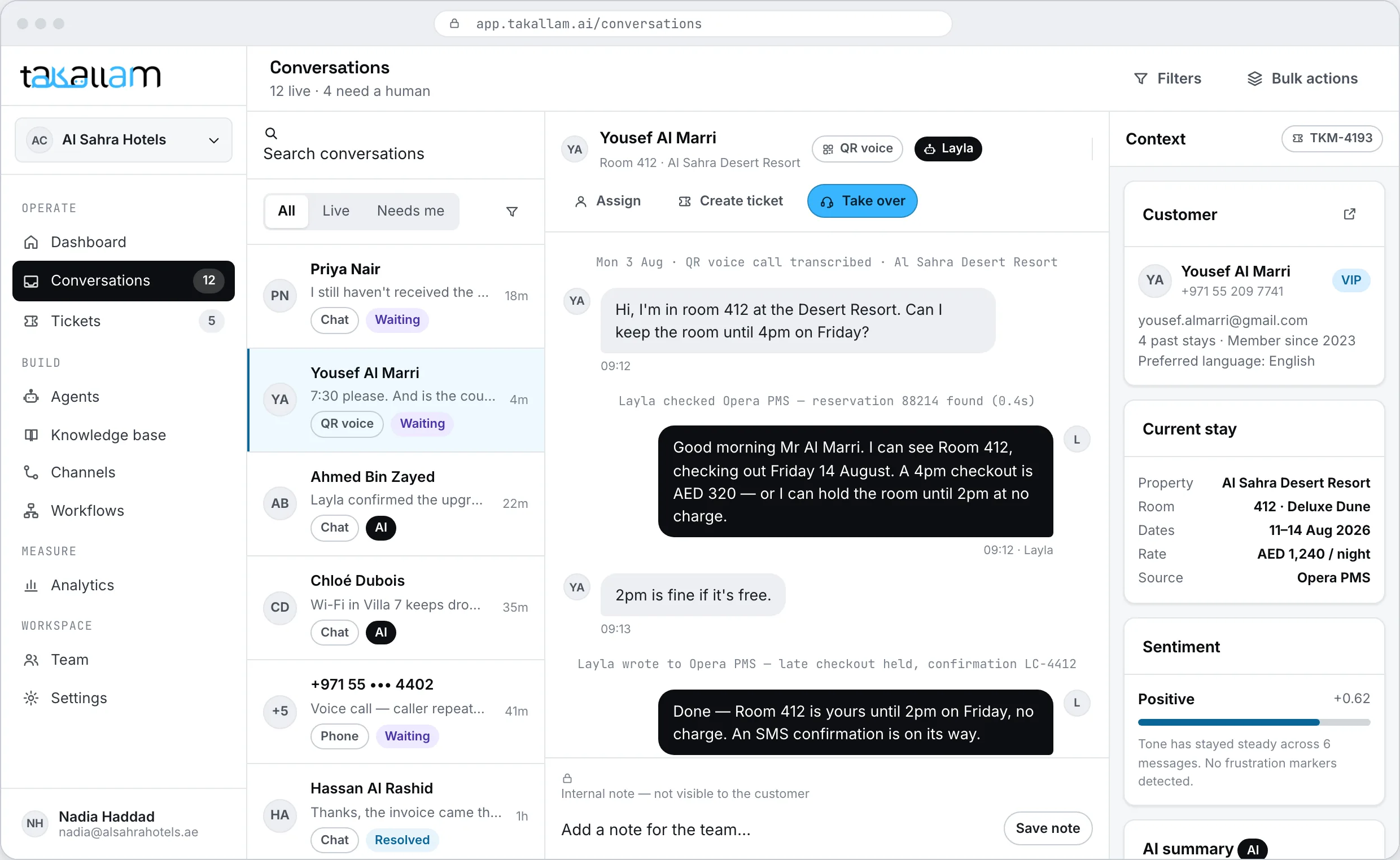
Takallam is not a CRM. It sits in front of one.
This is the most important thing on the page, so it goes first. Takallam does not hold your opportunity pipeline, your accounts hierarchy or your forecast. It answers customers across four channels, escalates to your team, and pushes what happened into whatever system of record you already keep — including Salesforce. If the reason you are looking at Service Cloud is that you want one customer record across sales and service, Takallam does not replace that. It feeds it.
- Service Cloud is a platform you configure. Takallam is a support operation that arrives assembled.
- The comparison is about time-to-live and channel coverage, not about who owns the customer record.
- Conversations, transcripts, tickets and workflow results can be written out through the API and webhooks.
What Service Cloud does that Takallam does not try to
These are not concessions, they are reasons to buy Salesforce. If any of the three is your actual problem, Service Cloud is the better product.
One record across sales and service
The same account, contact and history that your sales team works in. A service agent sees the deal, the renewal and the open opportunity without leaving the screen. Nothing bolted onto a support tool matches that, and Takallam does not pretend to.
Configurable to almost any process
Custom objects, complex approval chains, entitlement and milestone logic, industry data models, field service. If your service process is genuinely unusual, Service Cloud can be shaped to it. Most support platforms, Takallam included, cannot.
Enterprise governance
Granular permissions, sharing rules, audit trails, sandboxes and release management that a large regulated organisation can defend to its auditors. That depth is the product of two decades of enterprise deployment and it is hard to replicate.
Capability by capability
Capabilities only, and deliberately at the level of what each product is centred on rather than what a given edition includes. Service Cloud can be extended a very long way with the right budget and the right partner — the table reflects the default, not the ceiling.
| Takallam | Service Cloud | |
|---|---|---|
| Voice-first answers from a printed QR code | ||
| AI answers inbound phone calls | Via Service Cloud Voice | |
| In-app and web chat | ||
| AI answers your support email inbox | ||
| Email cases, queues and SLAs | ||
| Single customer record across sales and service | Connects to yours | |
| Enterprise governance, sharing rules and audit depth | ||
| Configurable to almost any service process | ||
| Knowledge base built from your website automatically | ||
| Human takeover inside the same conversation | ||
| Emirati and Gulf dialect voice | Not a focus | |
| Set up by the support team without an admin | Usually an admin or partner | |
| Typical time to a first live conversation | An afternoon | An implementation project |
| Priced per interaction, not per user licence | Per-user licences |
Capability-level comparison written in 2026, describing where each product is centred rather than what can be built on it. Three rows above favour Service Cloud and they are there on purpose. Salesforce documentation is the authority on Salesforce, and an implementation partner will give you a more precise answer for your own org.
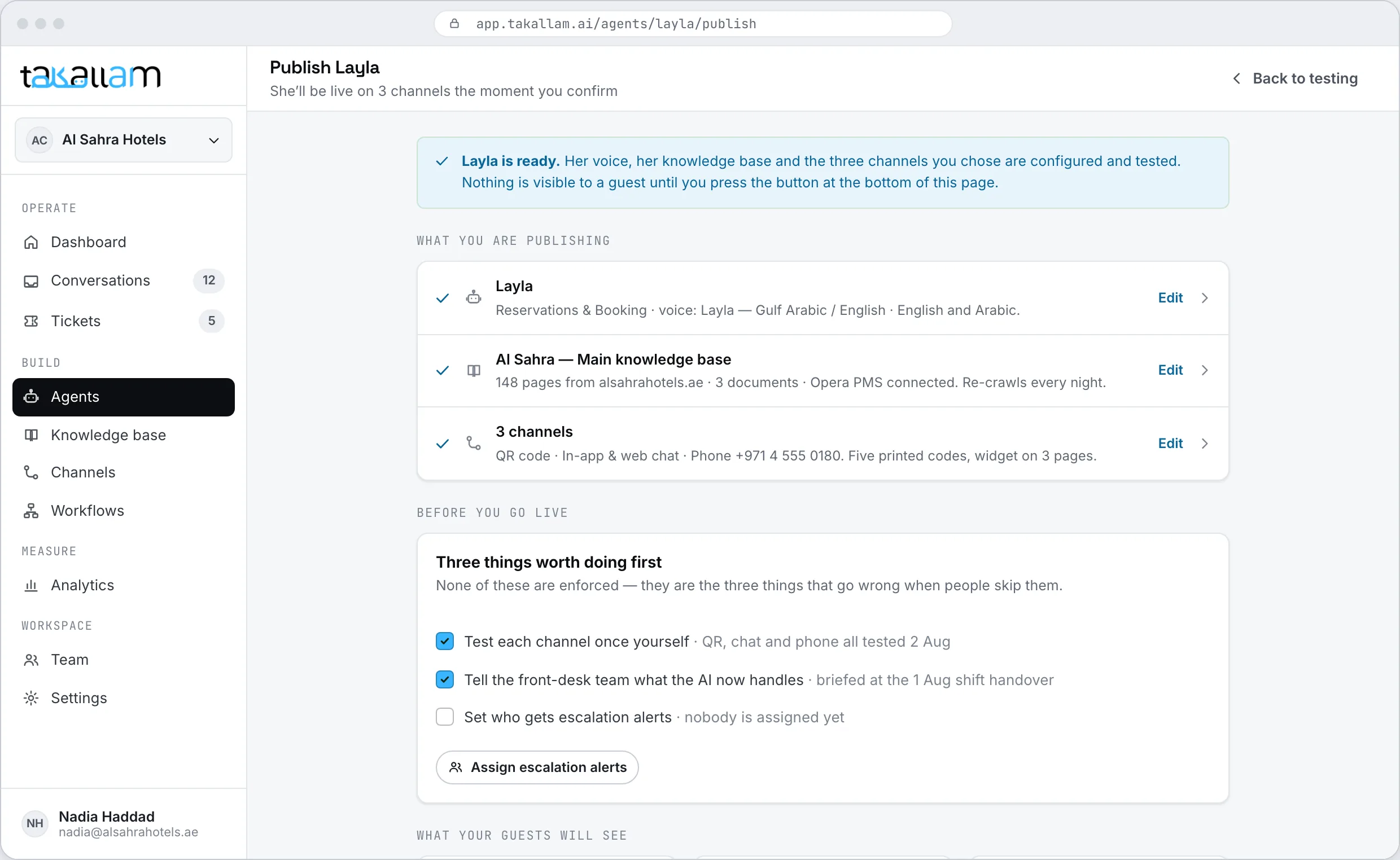
An afternoon, not a programme of work
A Service Cloud rollout is a project: discovery, data model, permissions, page layouts, testing, training, a go-live date in a plan. There are good reasons for that, and for a large organisation it is the right amount of care. Takallam is built for the other end of the scale. You answer four questions, it reads your website and builds a knowledge base, it drafts your first agents, and you review what it learned. The work you do is judgement, not configuration.
- No implementation call required to get started, and no partner to procure.
- Your knowledge base is assembled from your own site, with every page it read shown to you.
- Test the agent against real questions before anyone outside the company sees it.
A code on the door that answers out loud
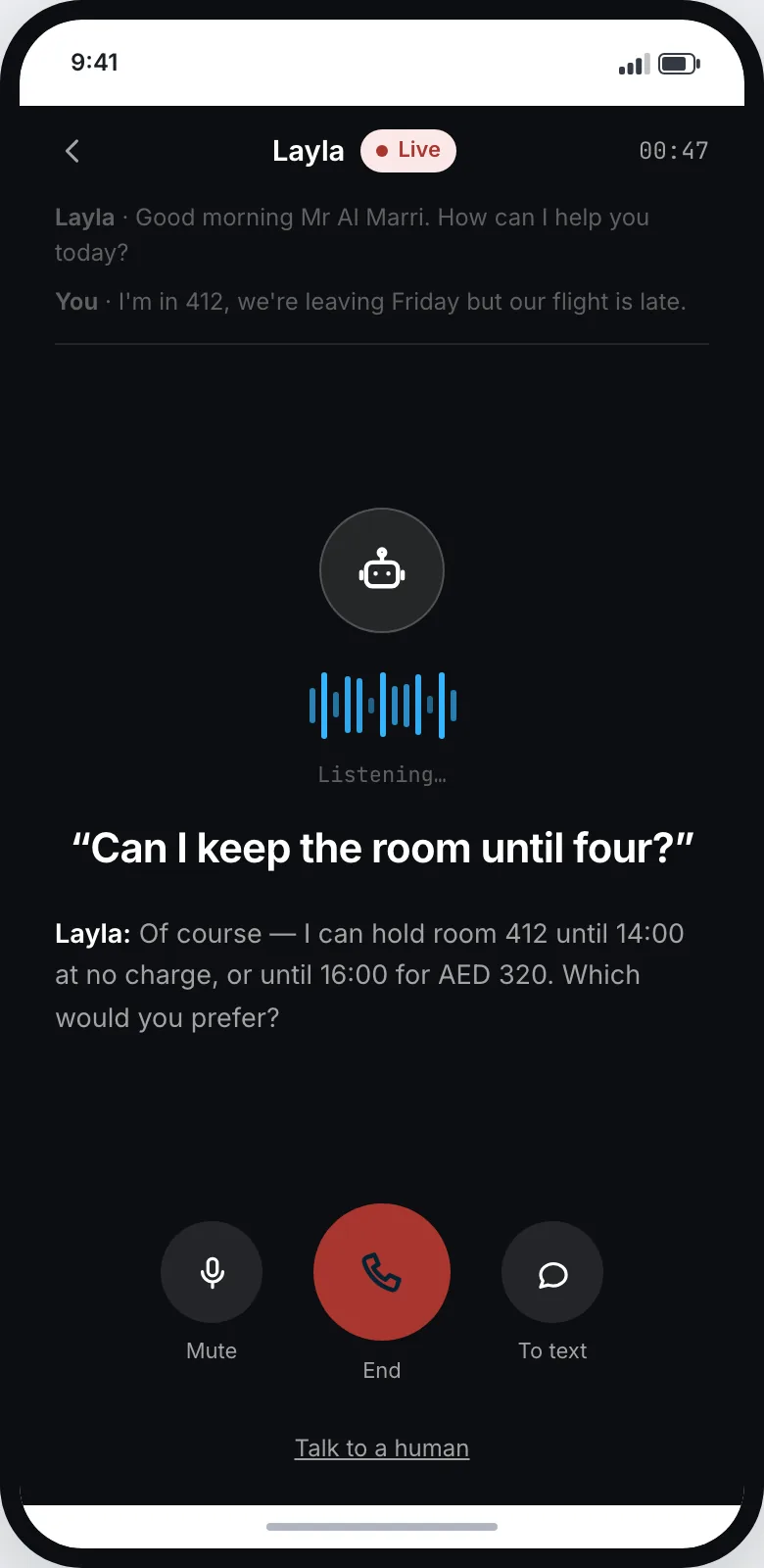
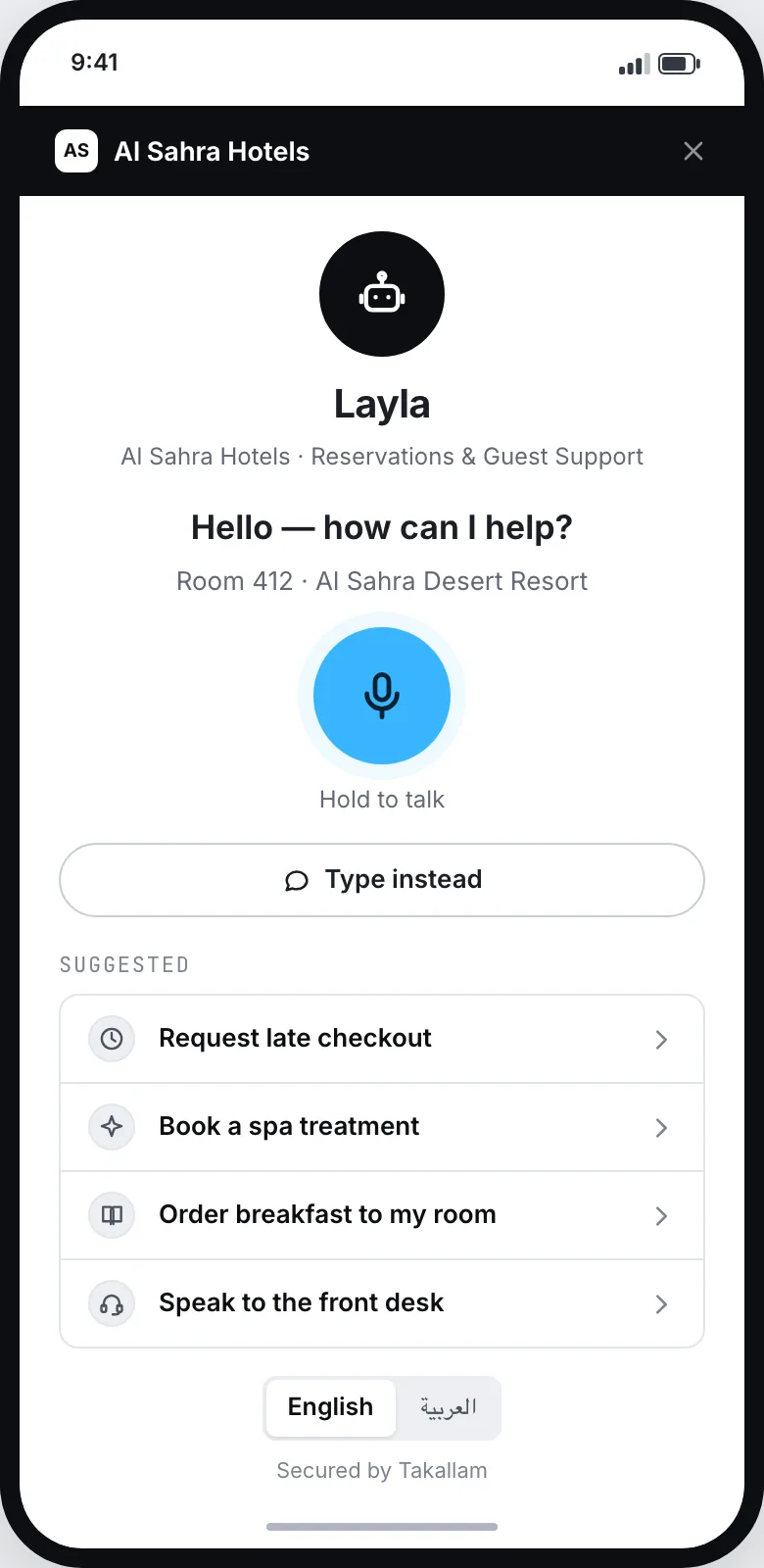
Voice and QR are where the two products differ most, because they are the centre of Takallam and the edge of Service Cloud. Print a code and put it where the question happens — a hotel room door, a shelf edge, a clinic reception, the side of a delivery box. The customer scans it and starts talking. No app, no sign-in, no number to dial, no queue.
- Opens straight into voice, in Arabic or English, and can drop to text mid-conversation.
- The same agent also answers your web chat, your support inbox and your phone line, from one knowledge base.
- Everything lands in one inbox with one record of the customer, whichever channel it came from.
Emirati out loud, not Arabic as a locale setting
Global platforms handle Arabic as localisation: the interface flips right-to-left, the knowledge articles get translated, and the AI answers in careful Modern Standard Arabic. It reads correctly and sounds wrong. Takallam handles Emirati and wider Gulf dialect in voice and text, including the caller who starts a sentence in Arabic and finishes it in English.
- Dialect in voice, not only Modern Standard Arabic in text.
- Code-switching handled inside the same turn.
- Right-to-left across the whole customer experience, not a translated skin.
- Conversations, transcripts and knowledge stay in the UAE region by default.
Which one you should actually pick
Choose Service Cloud if…
Your company already runs on Salesforce and one customer record across sales and service is the point. Your service process is unusual enough to need custom objects and approval logic. You have compliance obligations that require deep audit and permission control. Or you have an admin team and a partner and the time to do it properly.
Choose Takallam if…
You need to be answering customers this month, not this quarter. Voice matters — a phone line, or a code on a door. Your customers speak Gulf Arabic. You do not want to buy a licence for every person who might occasionally reply. Or you want a support layer in front of the CRM you already have.
What people ask when they are comparing the two
Does Takallam replace Salesforce?
No. Takallam is not a CRM. It does not hold your pipeline, your accounts hierarchy or your forecast, and it is not trying to. What it can replace is the service layer sitting on top — the inbox, the AI agent, the channels, the tickets — while your CRM stays where it is and receives what happened.
Can Takallam sit in front of Service Cloud?
Yes, and that is the most common shape we expect. Takallam answers the live channels — QR voice, chat, email and phone — resolves what it can, and pushes conversations, summaries and escalations into your existing system of record through the API and webhooks. You get a voice channel and an Arabic-speaking agent without touching the org.
Does Service Cloud not already have AI and voice?
It does, and both are real capabilities. Salesforce has invested heavily in service AI and Service Cloud Voice works well for teams that commit to it. The difference is where each product is centred: voice and QR are the first thing Takallam was built to do, so they arrive configured rather than assembled, and they are priced as channels rather than as additional licences.
How long does each take to get live?
Takallam is designed to be answering real questions the same day: four questions, a website crawl, a review of what it learned. A Service Cloud rollout is normally a project with a plan, a data model and usually a partner. That is not a criticism — a large regulated organisation should take that care. It is simply a different commitment, and worth naming before you compare anything else.
What is the QR voice channel?
A printed code a customer scans and then speaks to. No app, no download, no sign-in, no phone number. It opens in voice and can switch to text mid-conversation. It exists because a lot of questions happen away from a screen, and a case form has nowhere to live in those moments.
Which one is better for Arabic?
For written Arabic in a help centre or a case, Service Cloud will serve you and has for years. For spoken Arabic in Emirati or Gulf dialect, Takallam — it was built in the UAE for exactly that, rather than localised into the region afterwards.
How do the commercial models differ?
Service Cloud is licensed per user, with editions and add-ons on top. Takallam is paid per interaction, priced separately for each channel, with no seats and no minimum commitment — so a supervisor who logs in twice a month does not cost anything. Takallam is pre-launch and rates are being set with the first cohort, so we quote against your real volume rather than publish a table.
Where does our data live?
In the UAE region by default. Conversations, transcripts and knowledge bases stay in-region, and you set what is retained and for how long.
Put a voice channel in front of the CRM you already have
Tell us what you run today and which channels you actually need. We will come back with a rate against your real volume and show you how conversations would reach your system of record.
Pay per interaction · priced per channel · no seats, no minimums