
Most of your support volume is one question asked four hundred times
Where is my shipment. Then: can you come after six instead, what is the COD amount, do you have proof it was delivered, and what does customs need from me. Takallam answers all of it — from a code printed on the waybill, inside your app, in your support inbox and on the phone, in English and Emirati Arabic — and passes anything carrying liability to your team with the reference already attached.
What the customer-service line gets asked
"Where is my parcel" arrives four hundred times a day
The tracking page already exists. It still gets asked, because the customer does not have the number to hand, or the status says in transit and they want to know what that means for tomorrow morning. Around it sits everything else: a driver who could not find the villa, a consignee who wants the window moved to after work, a shipper chasing a POD, a receiver asking why there is a duty to pay. Each on a different channel, each worked from scratch.
- The waybill number is the whole conversation, and most customers do not have it. They have an order number, a phone number, or the name of the shop they bought from.
- The peak is not the day, it is the two hours after a failed delivery attempt and the week after a sale.
- The same enquiry arrives in chat, by email to a shared inbox and on the phone, and nobody knows the other two happened.
- E-commerce parcels move at night and on Fridays, which is exactly when there is nobody on the line.
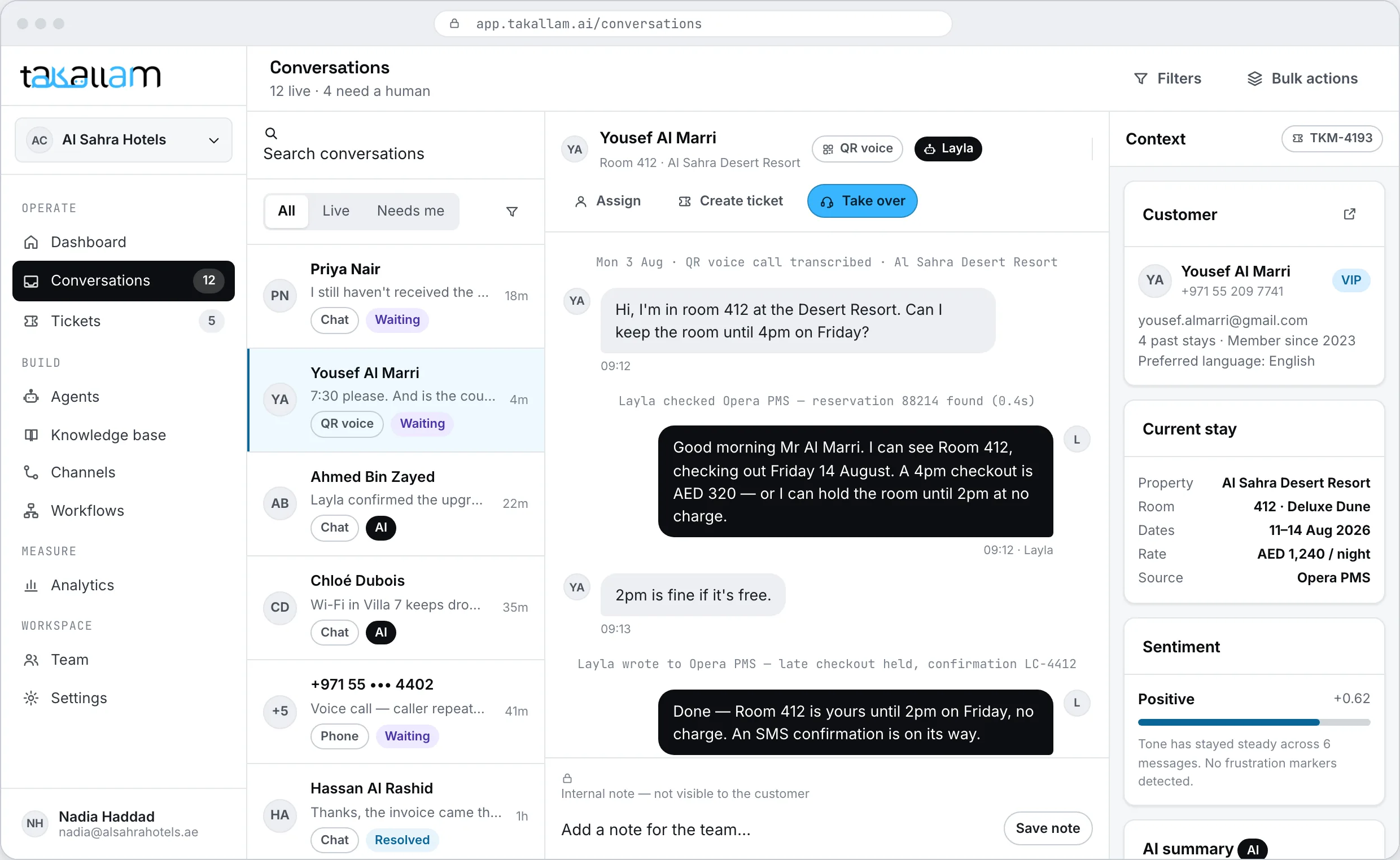
The handful of enquiries behind almost all the volume
Not the exceptions. The ones that repeat on every route, every day, on every channel — and that a person is only needed for when something has gone wrong.
Where is my shipment, in plain words
It takes the waybill number, the order number or the phone the shipment was booked against, reads the current status out of your system, and says what it actually means: out for delivery today, at the depot, waiting on customs clearance. Not a status code and a timestamp.
Move the window, or move the address
After six, tomorrow instead, leave it with the neighbour, send it to the office. It captures the change, checks it against what the route and the cut-off actually allow, and writes it back — or raises a task for the depot when it cannot.
How workflows write backProof of delivery
The signature, the timestamp, the photo at the door and the name of whoever signed. A shipper asking for a POD by email gets it in the same thread, from your own address, with the document attached — instead of waiting a day for someone to dig it out.
The email channelCustoms paperwork and duties
What documents a shipment needs, why a duty is payable and roughly how it is assessed, what a commercial invoice has to show, how personal effects differ from a commercial consignment. It explains your process and the requirement. It does not clear the shipment, and it does not promise a date.
Cash on delivery
The exact amount to have ready, what the driver can accept, what happens if the consignee is short. Getting this number wrong costs you a whole delivery attempt, so it comes from the record on the shipment, never from a template.
Damaged, short, or a returns pickup
Three boxes on the waybill and two at the door. A crushed carton. A pallet that arrived wet. Or a customer who wants a return collected. The agent gathers the reference, the photographs and exactly what happened, and opens a case your team owns from the first minute.
Tickets and SLAsA code on the label, and the parcel answers questions about itself
The waybill is already printed and it is already in the customer's hand. Put a code on it and the person holding the box can scan it and speak — no app to install, no sixteen-digit number to type, no call centre queue at eight in the evening. The code knows which shipment it is on, so the conversation starts at the answer instead of at the question.
- Opens straight into voice, and the customer can switch to text mid-conversation — useful in a warehouse, or at a gate with a driver waiting.
- A code printed per waybill carries the reference, so nobody has to read a tracking number out loud twice.
- Emirati and Gulf Arabic as well as English, including the customer who mixes the two in one sentence. That is a normal delivery call in the UAE, not an edge case.
- The same conversation continues if they email or ring later. The agent already knows which shipment they mean.
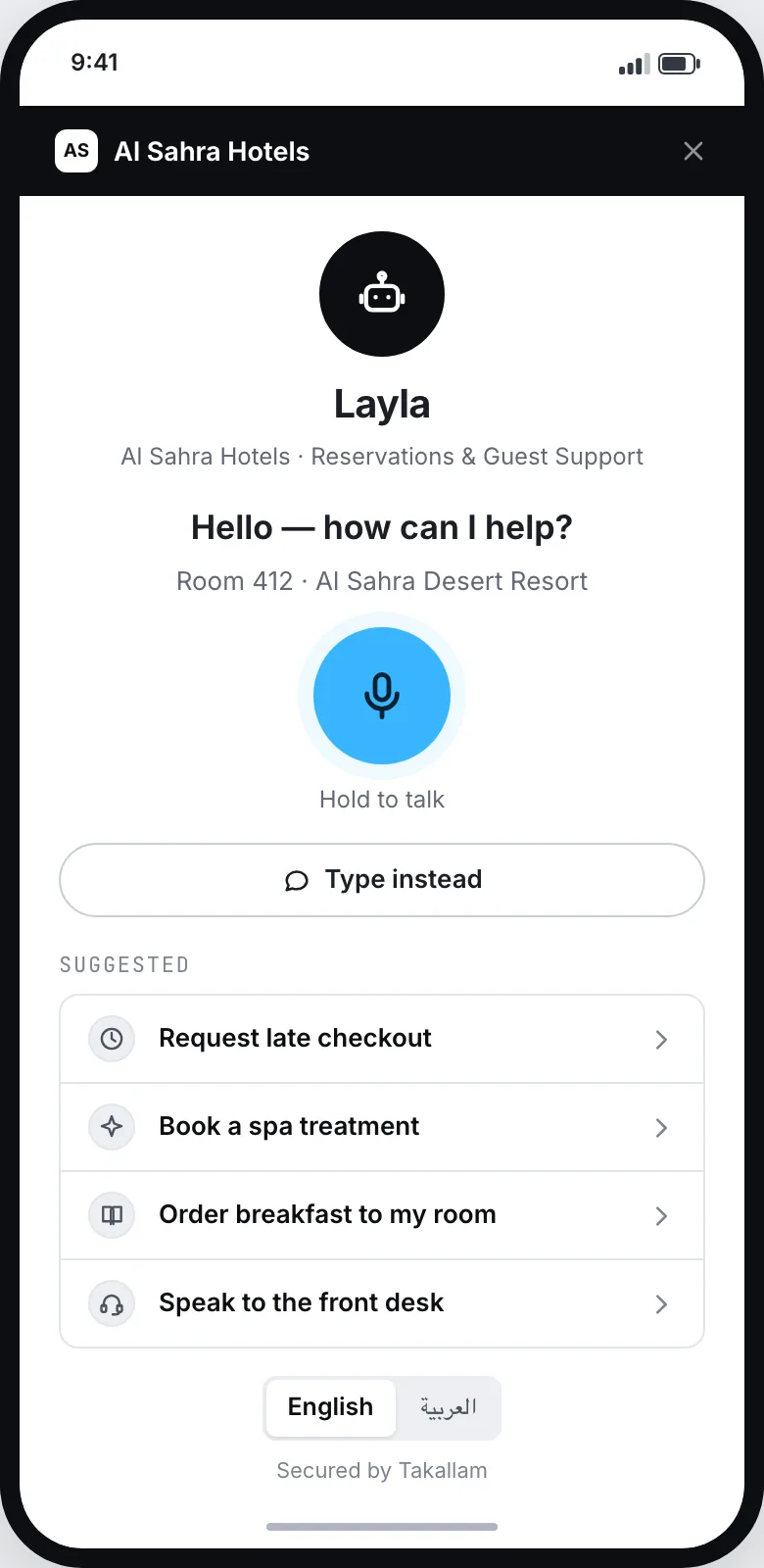
Where the code goes in a logistics operation
Print it where the shipment is and where the question gets asked. Each placement gets its own code, so a depot enquiry never looks like a doorstep one in your reporting.
On the parcel label and the waybill
The one thing that travels with every shipment. The consignee holding the box is the person most likely to have a question about it, and the code already knows which shipment they mean, so they never have to find the number.
The depot counter
For walk-in collections, held shipments, and the customer who drove over because the line was busy. A code on the counter takes the simplest half of the queue off the desk, and the desk keeps the half that needs a person.
The driver's handheld card
A small printed card the driver leaves on a failed attempt or a partial delivery. The customer scans it at the door and reschedules on the spot, instead of calling the branch the next morning and starting the story again.
Warehouse reception and the yard
Drivers waiting on a bay, suppliers arriving with inbound stock, contractors asking where to report and what PPE they need. The same five questions every day, asked at a desk that is also doing something else.
The retailer whose orders you carry
A 3PL answers for somebody else's customer. Your client's order confirmation, their app and their invoice can each carry a code that reaches an agent trained on their policy and their tone, running inside your account with its own reporting.
Takallam by industryA different code per placement
Separate codes for the label, the counter, the driver card and reception. The analytics then tell you which part of the operation generates which question — and which failure keeps generating the same one.
Inside the consoleA shipment held at customs, or reported lost, stops being a support question
This is the line, and it is drawn on purpose. The moment a shipment is held by customs or cannot be found, the conversation is about liability, paperwork and money — a declared value, an insurance claim, a duty assessment, a customer who is about to miss a contractual delivery. An AI that improvises there does real damage. So the agent does the part it is genuinely good at: it identifies the shipment, and it gathers the reference, the consignee, the contents, the photographs and exactly what the customer says happened, writes it down once, and hands the whole file to a person. It does not promise a resolution, and it does not give a date.
- No estimated release date for a held shipment and no "it should clear tomorrow". It states the current status and what the broker or the customer needs to provide next.
- A lost, damaged or short shipment opens a case with the facts already collected and goes to the team that owns liability — not to the back of a queue.
- Anything about compensation, declared value, insurance cover or a disputed duty amount goes to a human immediately, whatever the confidence score says.
- The handover carries the waybill, the full transcript, the photographs and everything the AI already checked, in the same thread. The customer does not tell the story twice.
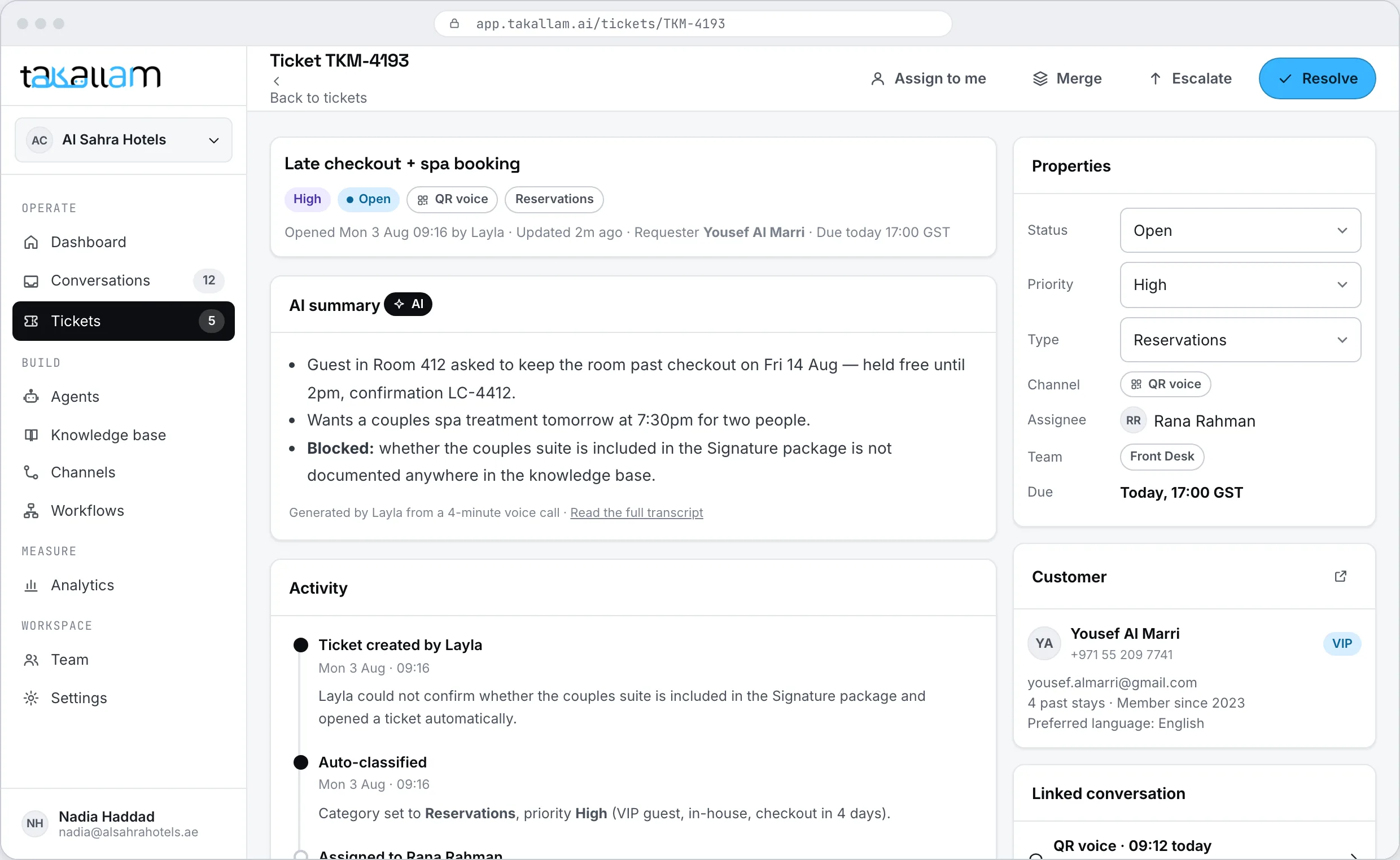
Everything useful lives in the TMS, not on the website
A status, a delivery window, a POD, a COD amount — none of it can be answered from a crawled web page. It lives in your transport management system, your warehouse system, or the order database your client pushes to you. Takallam reaches them the same way your own portal does: a workflow calls the system, takes the answer back, and the agent says it in the customer's own language.
- When a customer gives a waybill, an order number or the phone the shipment was booked against, look it up and answer with the live status.
- When a delivery window changes, write it to the TMS, notify the route, and send the customer a confirmation they can show the driver.
- When an attempt fails, open a ticket with the reason, the attempt count and an SLA, and push it to the depot that owns the route.
- Takallam does not ship a certified connector for every TMS and WMS on the market. It ships a workflow builder, a REST API and signed webhooks — if your system can be called, a workflow can call it.
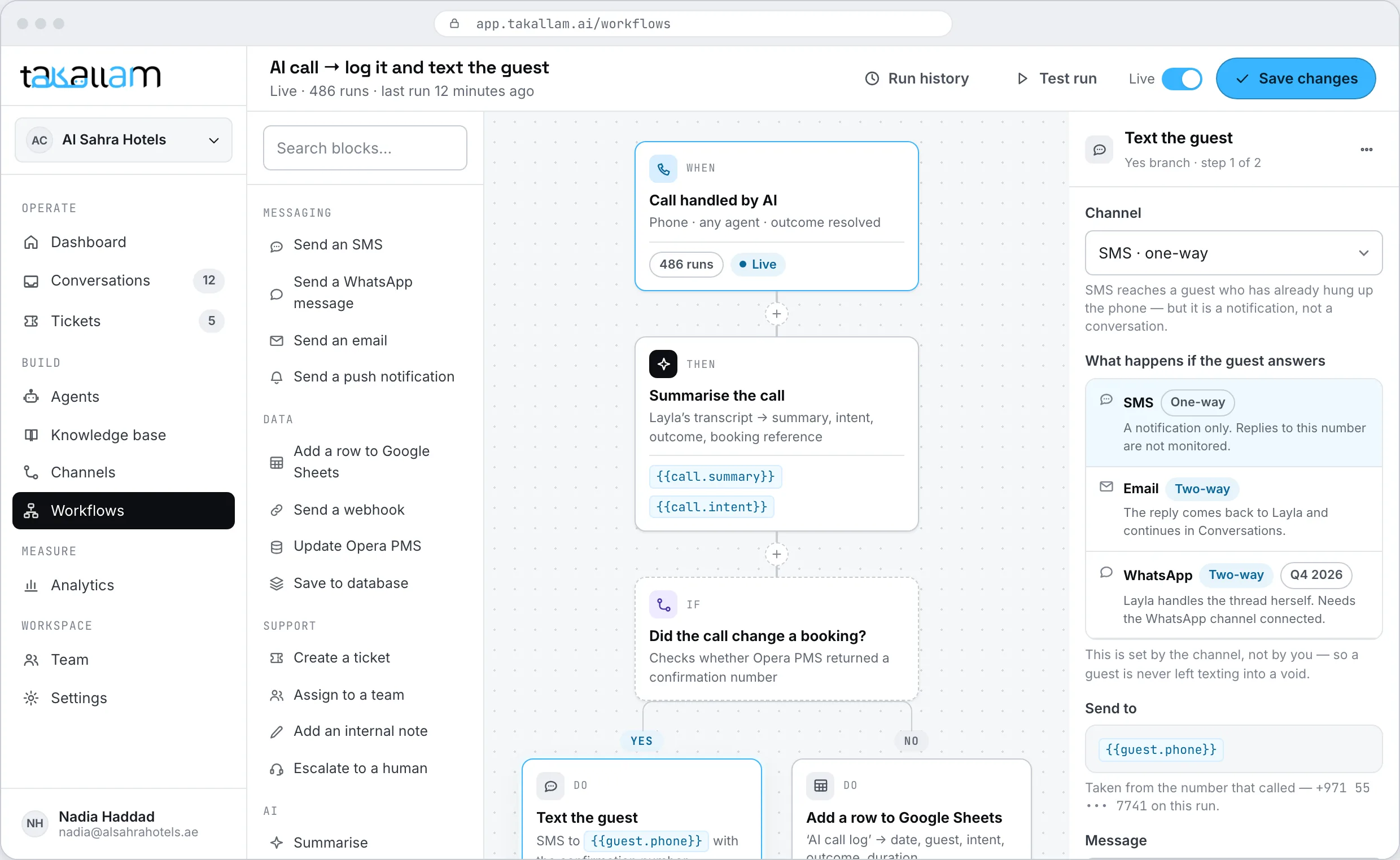
What the platform gives an operator
These are capabilities of the platform, not results from a deployment. Takallam is pre-launch and has no published performance figures.
What logistics operators ask before they trial anything
Can it find a shipment if the customer does not have the tracking number?
That depends on what your system can search, and it is the first thing worth checking. If your TMS or order database can be queried by order number, phone number or the sender reference, a workflow can look it up that way and the agent will ask for whichever one the customer has. If the only key is the waybill, the agent will say so and help them find it rather than pretending to search.
Will it tell someone when a shipment held at customs will be released?
No. It gives the current status, explains what the hold is for and what has to be provided next, then hands the conversation to the person or the broker who owns it. A clearance date is not the agent's to give, and a wrong one costs you the customer twice — once when it slips, and once when they find out it was invented.
Can it actually change a delivery window, or does it just take a message?
Both, and you choose which. In the agent builder you decide what each agent may do. Allow the reschedule action and a workflow checks the route and the cut-off, writes the new window to your system, and confirms it to the customer. Leave the action off and the agent takes the request accurately and puts it in front of the depot, which is still faster than a voicemail.
Does it connect to our TMS or WMS?
It connects to systems that can be called. Takallam gives you a workflow builder, a REST API and signed webhooks, so a workflow can read a shipment status, fetch a POD, write a rescheduled window or open a case in any system that exposes an interface.
What Takallam does not do is claim a pre-built, certified integration with every transport and warehouse system in the market. Tell us what you run and we will be straight with you about what the connection looks like and what it needs from your side.
What happens when a delivery is damaged or a box is missing?
The agent gathers, then hands over. It confirms the shipment, asks what arrived and what did not, collects photographs, records exactly what the customer says happened, and opens a case with an SLA. It does not agree a claim, quote a compensation figure or accept liability on your behalf. Your team picks it up with the facts already gathered instead of starting the interview from nothing.
Can we run it for the retailers we deliver for?
Yes. You can run separate agents with their own knowledge, tone and permitted actions — one per client — inside the same account. Each gets its own codes and its own channels, and the analytics separate them, so you can show a client what their customers actually asked and where the enquiries came from.
Does it handle customers who speak Arabic?
Yes — Emirati and wider Gulf dialect in voice and text, including the customer who switches between Arabic and English mid-sentence. Delivery conversations in the UAE are rarely in one language, and this is the reason Takallam exists rather than being an English-first product with translation added later. Today the platform covers English and Arabic.
What does it cost?
You pay per interaction, and each channel is priced separately, because a phone call and a chat message do not cost the same to deliver. There are no per-seat licences and no minimum commitment, which matters when a sale week is four times a normal one. Takallam is pre-launch, so rates are being set with the first cohort — join the waitlist and we will quote against your real volume.
Put a code on the label and see what customers ask
We are onboarding a first cohort of UAE operators now. Tell us which channels you need, what your transport system is, and roughly how many enquiries you take in a normal week. We will come back with a rate against your real volume.
Pay per interaction · priced per channel · no seats, no minimums