
Bills, meters and move-ins — and one thing that never reaches the AI
Takallam answers the questions that fill a utility contact centre: why is my bill higher, how do I open an account for a new flat, where do I send a meter reading, is the outage on my street already known. It answers them from a code on the meter, in the building lobby, on the printed bill and at the customer happiness centre. Anything that could be a safety hazard skips the agent entirely and goes straight to your emergency line.
What customers contact you about
Two weeks a month, the lines are about one thing
Bills land, and the contact centre fills with the same question asked a hundred different ways: why is this higher than last month. In between, it is move-ins — every handover date in the emirate producing an account to open, an account to close, a reading to log and a deposit to chase. And somewhere in that queue, on any ordinary day, is a caller who can smell gas.
- The bill question, the move-in, the meter reading and the fault report arrive on four channels and follow four different scripts.
- Move-in volume is not smooth. It clusters at the start and end of every month, and around every tower handover.
- A meter reading is a number and a photograph, and it currently costs a phone call or a queue ticket to submit.
- One burst pipe or one failed substation puts a whole district on the line inside a few minutes.
- The customer happiness centre absorbs everything the phone line could not, including a great deal that never needed a counter.
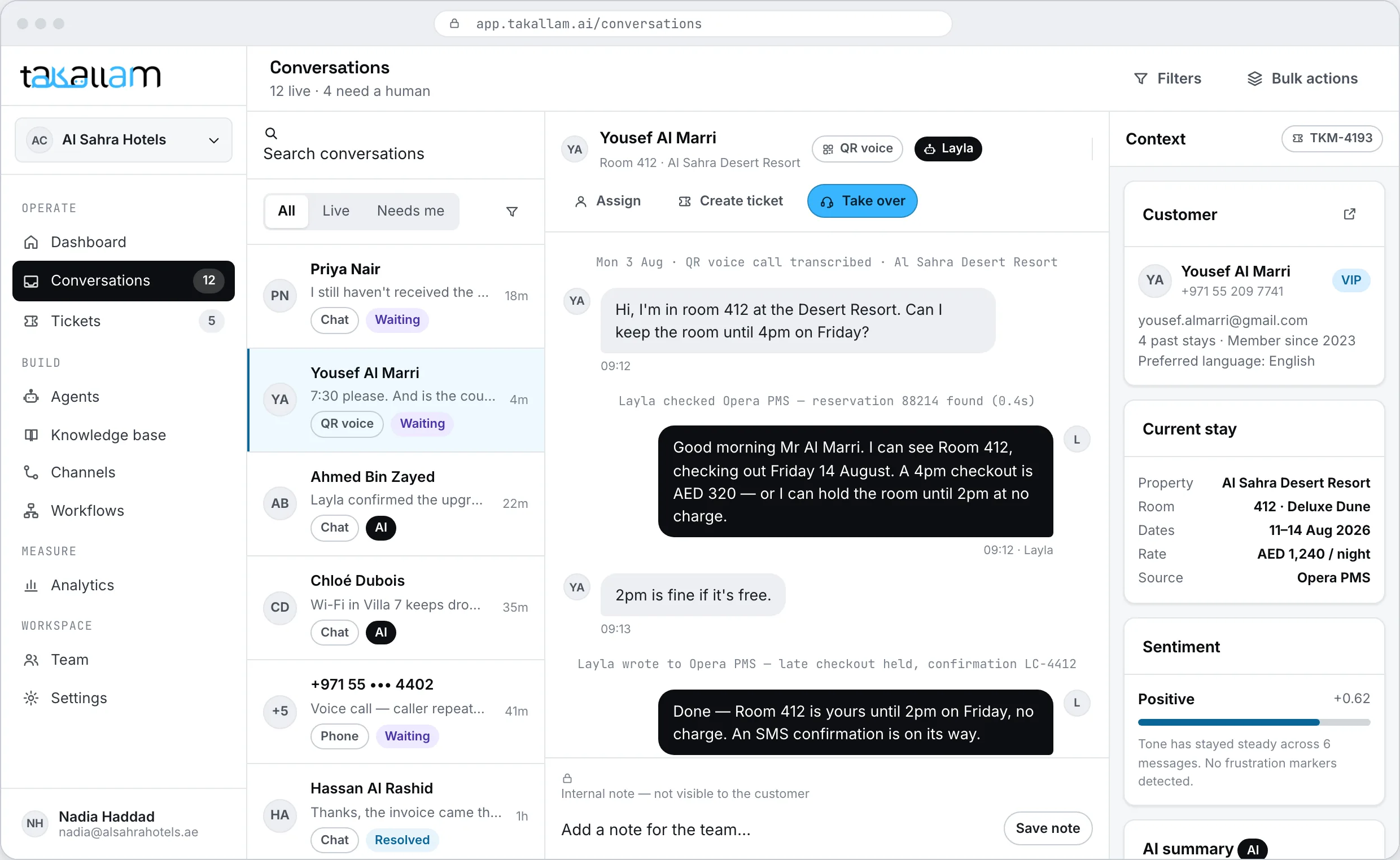
What customers actually ask
Six categories cover most of it. All six repeat, all six are answerable from what you already publish, and every one of them is currently occupying a person.
Explain my bill
Why it is higher than last month, what the slab or tariff actually means, which of the charges are fixed, and whether the estimated reading has now been corrected by a real one. The agent reads the account, names the thing that changed and explains it in the language the question came in.
The email channelMove in, move out, change the name
Opening an account for a new flat, closing one on a moving date, transferring a connection to a new tenant or owner. The agent lists exactly which documents are needed, collects what it can, opens the request, and says plainly which step has to be done in person.
Submit a meter reading
The customer stands at the meter, scans the code stuck to it, reads the number out loud and hears it confirmed back. No form, no login, no phone call — and because the code identifies the meter, the reading cannot land on the wrong account.
Report a fault, or check an outage
A corridor light out, a leak in the car park, no power in one flat while the neighbour has it. And during a real outage, hundreds of people asking the same question in the same minute, all answered at once from whatever your incident status says.
Tickets and SLAsDeposit refunds and the final bill
The most-chased request in the sector, and the one that generates the most repeat contact: where is my refund, why is the final bill this amount, has clearance been issued yet. The agent gives the actual status instead of a promise that somebody will call back.
Payment plans and consumption advice
What an instalment arrangement looks like, what happens to a disconnected account, and the practical reasons a bill jumps — a new AC unit, a filled pool, a running toilet, a guest staying a month. Real answers from what you told it, not generic conservation tips.
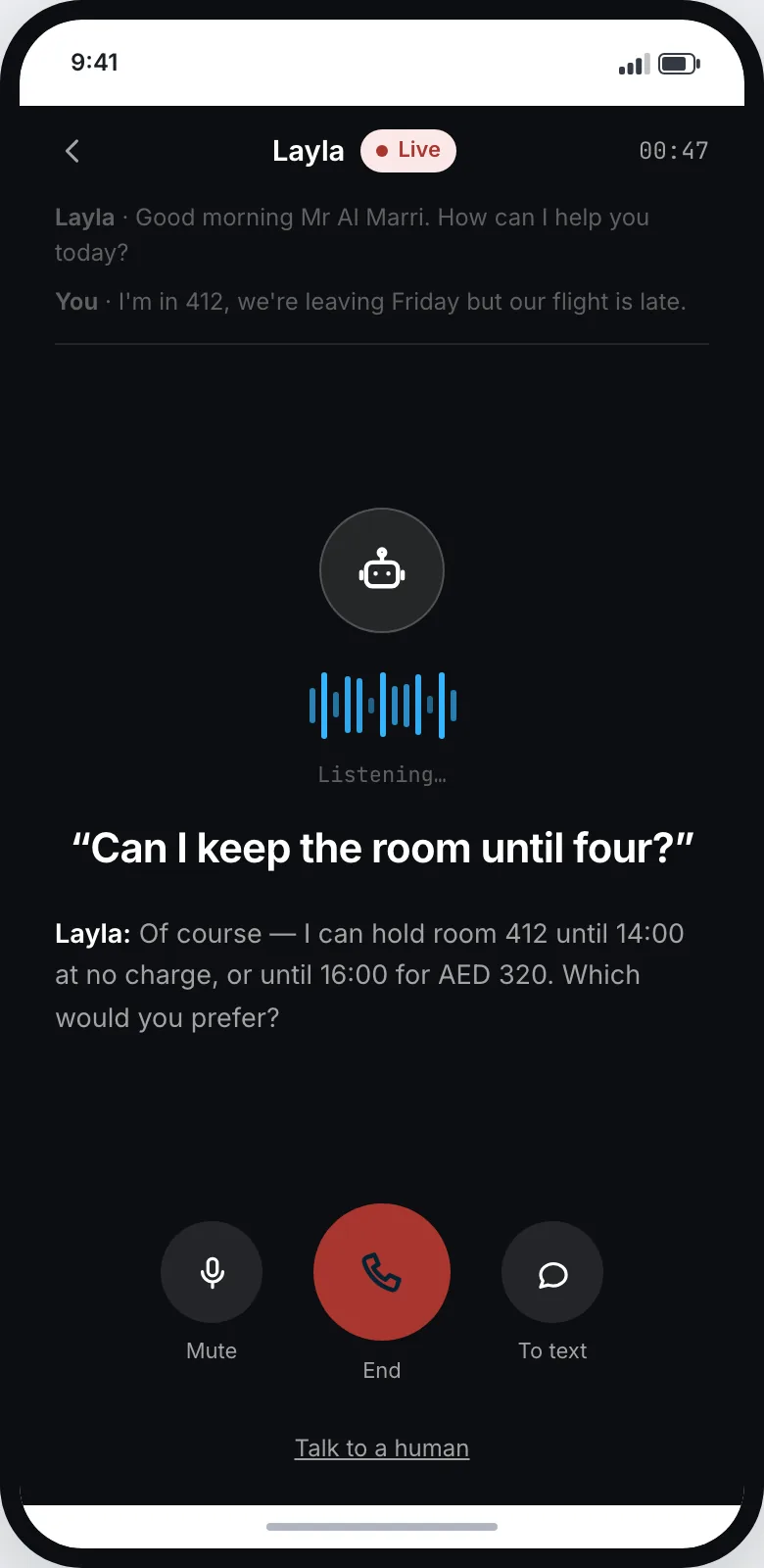
A code on the meter, and the reading never needs a phone call
The customer is standing in front of the number you need. A code stuck to the meter means they point a camera at it, say the reading out loud and hear it repeated back for confirmation. No app, no account login, no queue — and because the code identifies which meter it is, the reading cannot be typed into the wrong account.
- Opens straight into voice, and switches to text when the meter is in a loud plant room or a basement with no signal for a call.
- Each code is tied to its placement, so a scan from the lobby arrives tagged as a building question and a scan from the meter as a reading.
- During an outage it answers everybody at the same time, which is the exact hour your phone line cannot.
- It works at ten at night, which is when somebody actually gets round to reading their meter.
Where the code goes
Print it where the question happens. On the meter it collects readings. In the lobby it answers a whole building at once. On the bill it answers the bill. Four placements, four different sets of questions.
On the meter itself
The one place the customer is standing while the number is in front of them. A sticker on the meter or the meter cupboard turns a reading from a phone call into a ten-second conversation, and attaches it to the right meter automatically.
In the building lobby and by the lift
For the questions a whole tower shares at once: is the outage known, when is the water back, who handles the leak in the corridor. One code answers a building's worth of the same question without any of it reaching your queue.
On the printed bill and the reminder
Beside the amount that prompted the question. It is the shortest possible path from confusion to an answer, and it takes the pressure off the week after billing when the counter and the phone line are both full.
At the customer happiness centre
On the queue ticket and on the wall beside the waiting seats. A good share of any counter queue is a question rather than a transaction, and a question can be answered while the number is still on the board.
On the connection notice and the move-in pack
The paperwork a new tenant is handed by the building or the agent. It is the exact moment the account, the deposit and the first reading all get asked about at once.
A different code per placement
Separate codes for the meter, the lobby, the bill and the centre, so you can see which one carries the volume and what people ask while they are standing in each.
Conversation analyticsA smell of gas is not a support conversation
This is the one rule on this page that is not a preference. Some contacts must never be handled by an AI, and they are exactly the ones where two minutes of delay is the whole problem: a gas smell, sparking or exposed wiring, a burning smell from a panel, water standing near an electrical board, a fallen cable, someone in contact with a live supply. Takallam is configured to recognise these, stop answering immediately, and put the person on your emergency line — while telling them plainly what to do in the next thirty seconds.
- Safety intents bypass the agent entirely. It does not troubleshoot, does not ask qualifying questions and does not offer to book a visit.
- The customer hears one instruction — leave, switch nothing on or off, call this number — and is transferred or given the number immediately, in the language they are speaking.
- Your team is alerted at the same moment, with the location, the meter or account the scan came from, and the exact words the customer used.
- You define the hazard list, the wording and the destination for each type. This is not a black box deciding on its own what counts as an emergency.
- It is deliberately set to over-escalate. A false positive costs you one transferred call. The other kind of mistake is not acceptable, so the threshold sits low on purpose.
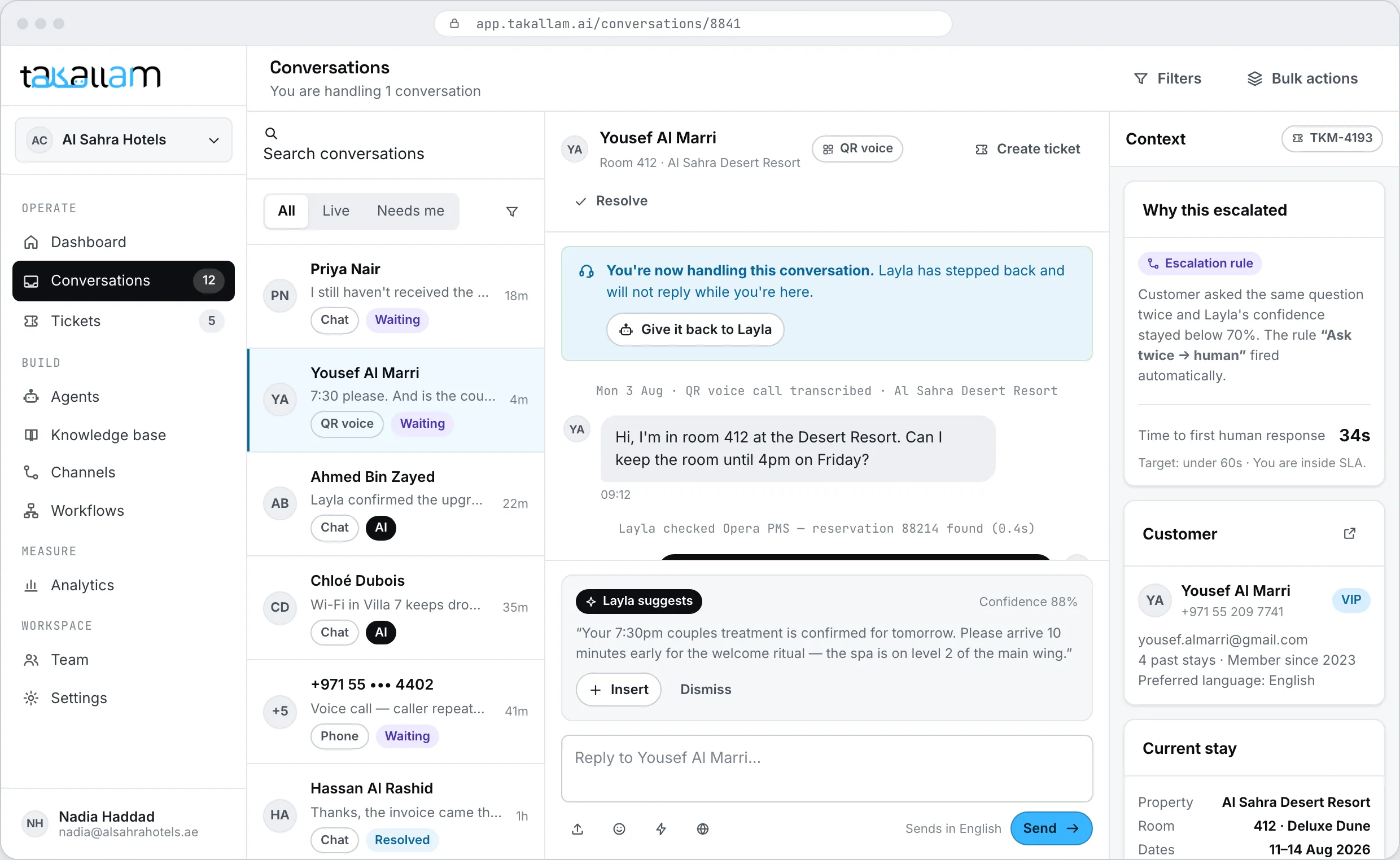
The reading has to land in billing, not in a transcript
Answering the question is half of it. A meter reading has to reach your billing and customer information system. A move-out has to produce a final bill. A fault has to become a job with an address on it. That part is a workflow: when this happens, look this up, then write that, and if this other condition is true, give it to a person instead.
- When a reading is given, validate it against the last one, write it to the billing system, and flag it for review if the jump is implausible.
- When a move-in is requested, create the account request, list the documents still missing, and notify the team that verifies identity.
- When a fault is reported, open a ticket with the address, the account and the symptoms, and route it by area and priority.
- When an outage is declared, let one status update answer every conversation waiting on it, on every channel at once.
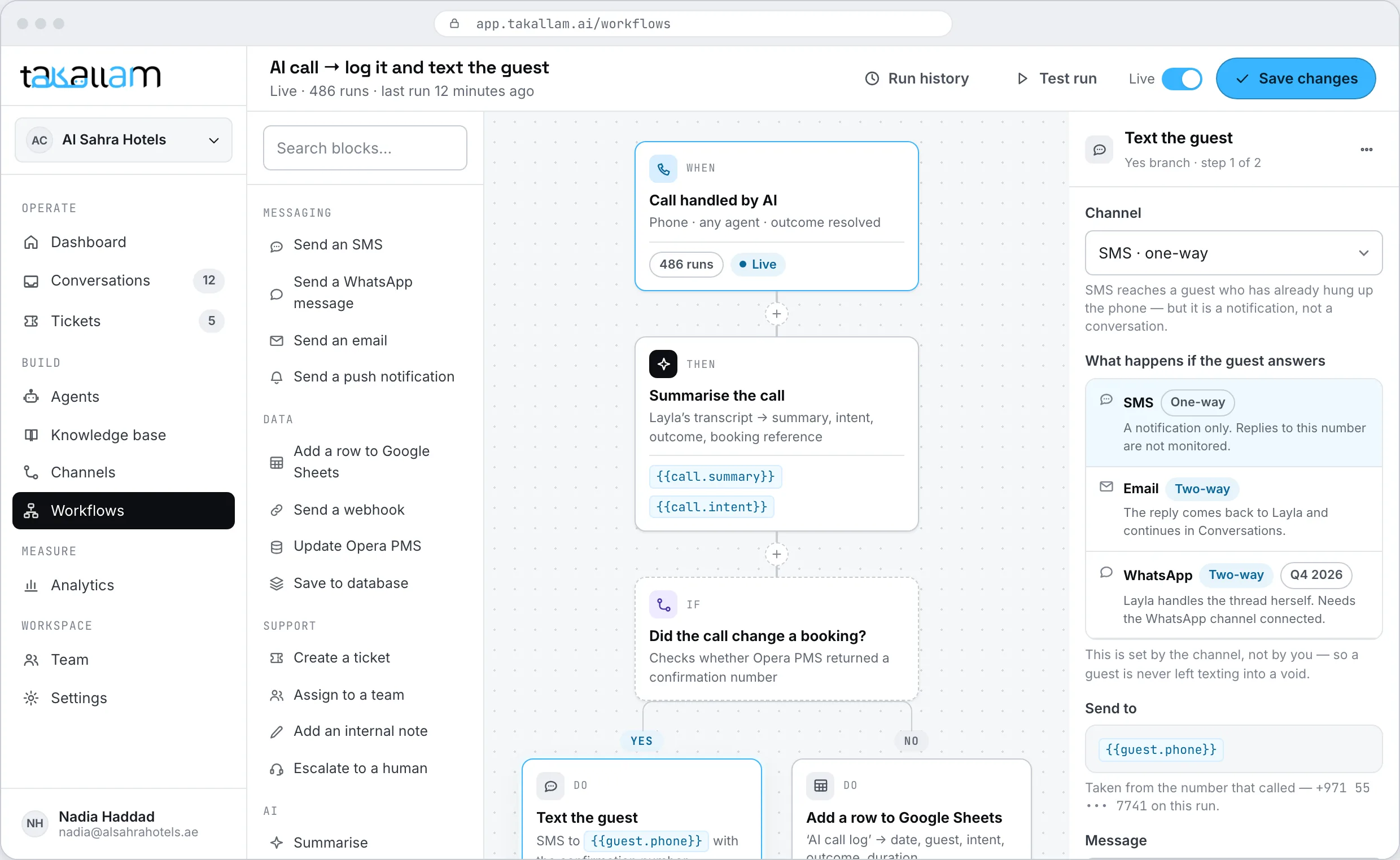
- Takallam does not claim a certified connector for every customer information system in the market. It ships a workflow builder, a REST API and signed webhooks — if your system can be called, a workflow can call it.
Three things utility teams check before they commit
Arabic, including the half-and-half sentence
Emirati and wider Gulf dialect in voice and text, including the customer who starts in Arabic, says "meter reading" and "deposit" in English, and finishes in Arabic. A utility serves everybody in the emirate, which means the Arabic has to be as good as the English.
How Takallam handles ArabicWhere the data actually sits
Account numbers, addresses and identity documents come up in almost every utility conversation. Takallam is UAE-resident by default in me-central-1, with encryption in transit and at rest, retention windows you control and access you can audit.
Security and data residencyThe sectors next door
Telecom, government services and facilities management get the same bill, the same move-in and the same fault report in a different uniform. Those pages are written the same way — real questions, real placements, and an explicit line the agent does not cross.
All industriesWhat the platform gives a utility
These are capabilities of the platform, not results from a deployment. Takallam is pre-launch and publishes no performance figures. Safety routing is a rule set you write and own — nothing on this page is a claim about emergency response times.
What utility teams ask before they trial anything
What happens if somebody reports a gas smell or exposed wiring?
It stops answering and routes them to your emergency line immediately. Safety intents are configured to bypass the agent completely — no troubleshooting, no qualifying questions, no offer to book a visit. The customer gets one clear instruction and the emergency number, or a direct transfer, in the language they are speaking.
Your team is alerted at the same moment with the location, the meter or account the conversation came from, and the exact words used. You write the hazard list and the destination yourself, and the threshold is set low on purpose — over-escalating costs one transferred call, and the alternative is not acceptable.
Can a customer submit a meter reading just by scanning the meter?
Yes, and it is the single most useful placement in this sector. A code stuck to the meter opens straight into voice. The customer says the number, hears it confirmed back, and a workflow validates it against the previous reading before writing it to your billing system. If the jump looks implausible the reading is flagged for review rather than billed, and the customer is asked to confirm or send a photo.
Can it open an account for a move-in?
It can take the whole request and everything that goes with it: the property details, the moving date, the documents, the deposit question and the first reading. What it will not do is pretend an identity check has happened when it has not. Where a step must be verified by your team or done in person, the agent says so, lists exactly what to bring, and hands over a request that is already complete instead of half-filled.
What happens during a real outage, when everyone contacts you at once?
Everyone is answered at the same time. There is no queue that has to be worked through one caller at a time — a QR scan, a chat, an email and a phone call are all answered simultaneously from the same incident status. Update the status once and every waiting conversation gets the new information on every channel. A spike costs you interactions, not a collapsed service level.
Can it explain a bill, or does it only read out the total?
It explains it, provided a workflow can reach the account. The agent compares this cycle with the last, finds what moved — a tariff slab, an estimated reading later corrected, a fixed charge, a longer billing period — and explains that specific thing. Without a connection it can still explain how your tariff structure and charges work in general, which on its own answers a large share of the volume.
Does it connect to our billing and customer information system?
It connects to systems that can be called. Takallam gives you a workflow builder, a REST API and signed webhooks, so a workflow can write a meter reading, read an invoice, create an account request or open a fault job in anything that exposes an interface. It does not claim a certified, pre-built integration with every CIS on the market. Starting does not wait on that — Takallam reads your website, builds the knowledge base from your tariff, connection and outage pages, and drafts your first agents; IT is needed only when a workflow has to write back.
Does it handle Arabic-speaking customers properly?
Yes — Emirati and wider Gulf dialect in both voice and text, including customers who mix Arabic and English in one sentence. For a utility this is not a nice-to-have: you serve everybody in the emirate, so an English-first product with translation added on top gives a worse service to a large part of your customer base. The platform covers English and Arabic today.
What does it cost?
You pay per interaction, and each channel is priced separately, because a phone call and a chat message do not cost the same to deliver. There are no per-seat licences and no minimum commitment, which matters when your volume doubles for two weeks a month and again during an incident. Takallam is pre-launch, so rates are being set with the first cohort — join the waitlist and we will quote against your real volume.
Put a code on the meter and see what customers ask
We are onboarding a first cohort of UAE providers now. Tell us roughly how many accounts you serve, which channels you need and which billing system you run, and we will come back with a rate against your real volume.
Pay per interaction · priced per channel · no seats, no minimums