
Most of your contact centre is four questions about a bill
Why is it higher this month, how do I change my plan, can you turn roaming on before Thursday, my SIM is gone. Takallam answers all of them from a code printed on the bill, from the store counter, inside your app, in your support inbox and on the phone — in English and Emirati Arabic — and stops the moment a charge is being disputed.
What subscribers call about
Bill day, and the queue starts at nine
Bills go out and for the next four days nothing else gets done. The IVR has seven options and none of them is "explain this line". The counter has a queue of people holding a printed page. The retention team spends its morning describing a pro-rated charge instead of talking to the subscribers who are actually about to leave.
- The same eight questions arrive by phone, at the counter, in the app and by email — and each channel answers them slightly differently.
- The IVR menu was built around your org chart, not around what people call about, so a share of every call lands in the wrong queue and gets transferred.
- Roaming gets asked at eleven at night, the day before a flight, when every store is shut.
- An outage puts a thousand people on the line inside ten minutes, all asking one question that has one answer.
- Subscribers who would rather speak Arabic get a genuinely bilingual answer only when the right agent happens to pick up.
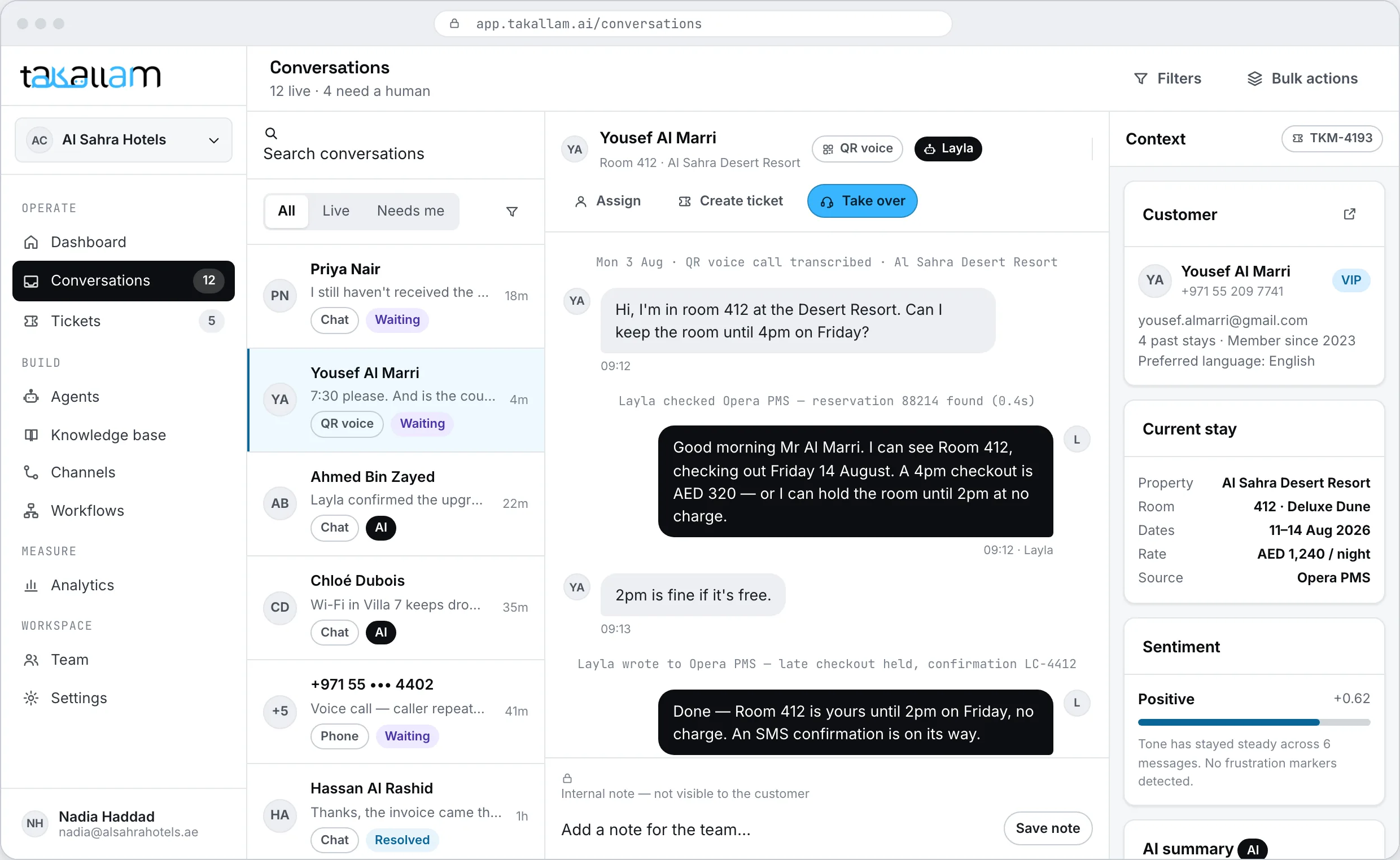
Eight questions carry most of the queue
None of them is interesting. All of them repeat every single day. And every one of them currently takes an agent for the length of a whole conversation.
Explain my bill
The biggest single driver of contact in the sector, and it is almost never fraud. It is a pro-rated plan change, a first bill after activation, an out-of-bundle charge or a subscription somebody forgot about. The agent reads the actual invoice, names the line that changed, explains why, and says what can be done about it.
The email channelChange a plan, or top up data now
What each plan gives against what this subscriber actually uses, what happens mid-cycle, and when the new plan starts. A top-up is the simplest thing on this list to hand over to an agent and one of the most common reasons somebody contacts you at midnight.
Turn roaming on before I fly
Asked the night before, often from an airport car park. The agent checks which pass covers the country they named, explains what happens when the allowance runs out, and switches it on if you have allowed that. It also warns about the thing that causes the angry call two weeks later — data used before the pass took effect.
A lost SIM, or setting up an eSIM
A replacement SIM has an identity step that has to be done properly, and an eSIM needs a code scanned on a second device — which is exactly where people get stuck. The agent walks through it, and when a branch visit is genuinely unavoidable it says so, lists what to bring, and books the slot.
Is there an outage in my area?
One tower, one street, one building's fibre — and hundreds of people asking at the same minute, which is precisely when a phone queue collapses. The agent answers all of them at once from whatever your network status says, and takes a fault report when there is no known incident.
The phone channelThe router and home internet
Which light is red, what to unplug and for how long, whether the installation slot can move to Saturday, why the speed over wifi is not the speed on the plan. Long, patient, scripted troubleshooting — the kind a person finds tedious and starts skipping steps on by the end of a shift.
Tickets and SLAsA code on the bill, so the bill can explain itself
The subscriber is already holding the thing that confused them. A code printed next to the total means they point a camera at it and say "why is this higher than last month". No app to install, no IVR tree, no fifteen minutes of hold music while the queue at the counter moves one place forward.
- Opens straight into voice, and switches to text mid-conversation when the person is somewhere loud — a store, a car, an airport gate.
- Every printed code is its own placement, so a scan from the router box arrives already tagged as a home-internet question.
- It answers several hundred people at once during an outage, which is the exact hour your phone lines are least able to.
- Someone who scanned yesterday and calls today reaches the same agent, with yesterday's conversation already in front of it.
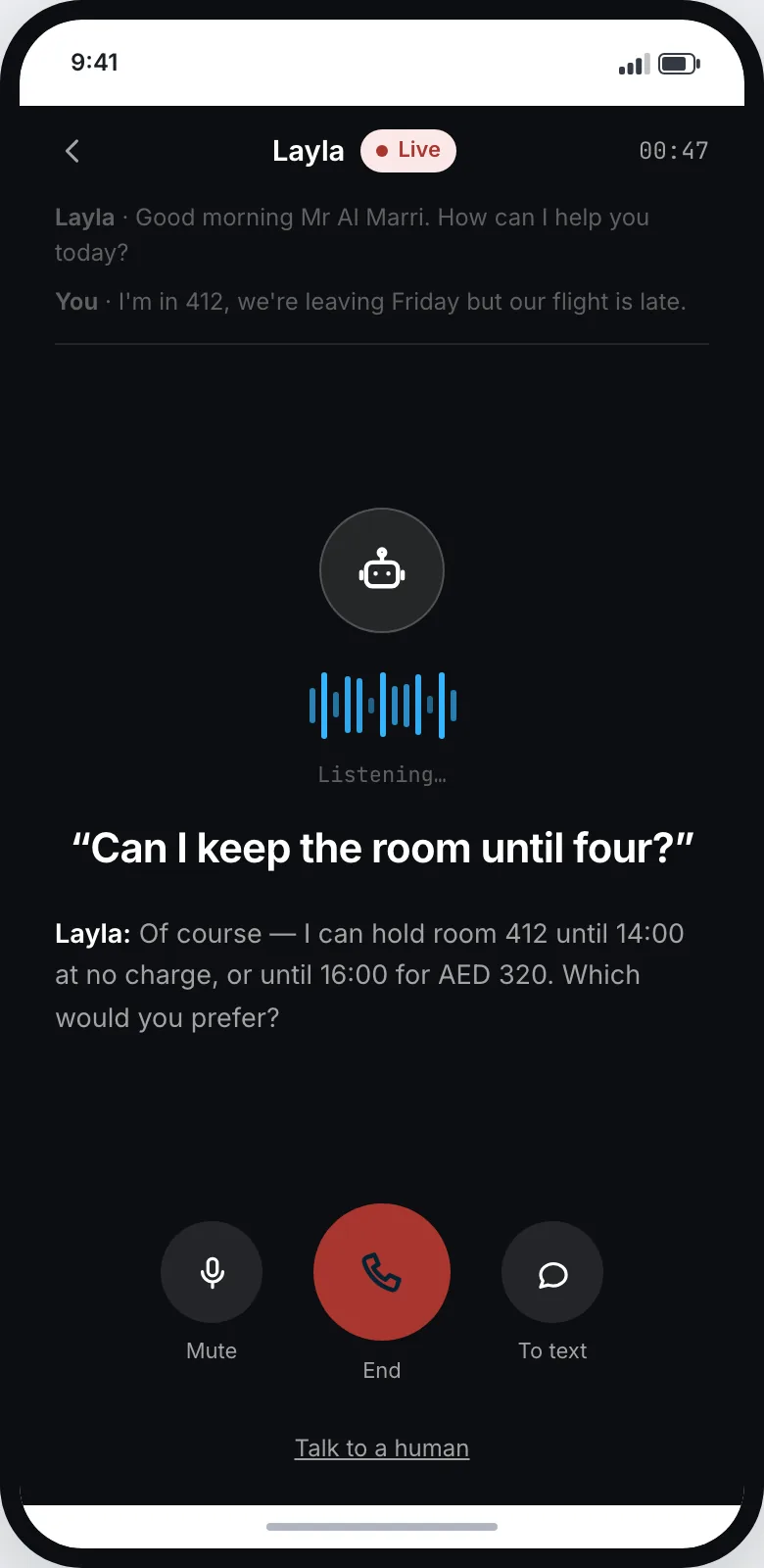
Where the code goes
Print it where the question happens. The bill, the box, the counter, the queue. Four different codes give you four different sets of questions, and analytics that tell you which one is carrying the load.
On the printed bill and the payment SMS
Right next to the total, where the question is already forming. It gives paper the one thing it never had — a way to answer a billing query at the moment somebody reads it, rather than four days later at a counter.
At the retail store counter
For the queue, and specifically for the people in it who do not need the counter at all: a top-up, a plan comparison, a balance check, a receipt. The ones who scan while waiting are the ones who leave without ever being served.
On the router box and inside the pack
The box a customer opens alone on a Friday evening with no engineer coming. A code on the lid gets them through setup, and the cases it genuinely cannot fix become a fault ticket with the model and the symptoms already recorded.
In the service-centre queue
On the ticket slip and on the wall beside the waiting seats. A large share of any service-centre queue is a question rather than a transaction, and a question can be answered while the number is still on the screen.
On the SIM and eSIM starter pack
Activation, the first bill cycle, and installing an eSIM on a second device — the exact three things a new line generates contact about in its first week.
A different code per placement
Separate codes for the bill, the store, the box and the service centre. The analytics show which placement earns its ink and what people ask while they are standing in each one.
Conversation analyticsA disputed charge is a commercial decision, and the AI does not make it
This is the line that matters in telecom. The agent will read the bill, name the charge, explain exactly what it is and lay out the options — a credit request, a plan change, a payment arrangement. It will not issue the credit. It will not close the account, cancel the contract, waive an early-termination fee or agree a settlement. Those decisions have money and a paper trail attached, and they get made by a person who is accountable for making them.
- Disputes, credits, refunds and goodwill gestures are explained in full, then handed over. The agent never commits your money.
- Cancellations and terminations go to a human every time — including the ones that open innocently as "just tell me how much I owe if I leave".
- Number transfers and changes of ownership involve identity and a regulator, so the agent gathers what is needed, confirms it, and stops there.
- The handover carries the transcript, the bill lines the subscriber was looking at and everything the agent already checked, so your retention team starts informed instead of starting again.
- You write these rules per agent and per channel. Nothing about what the agent may decide is left to its own judgement.
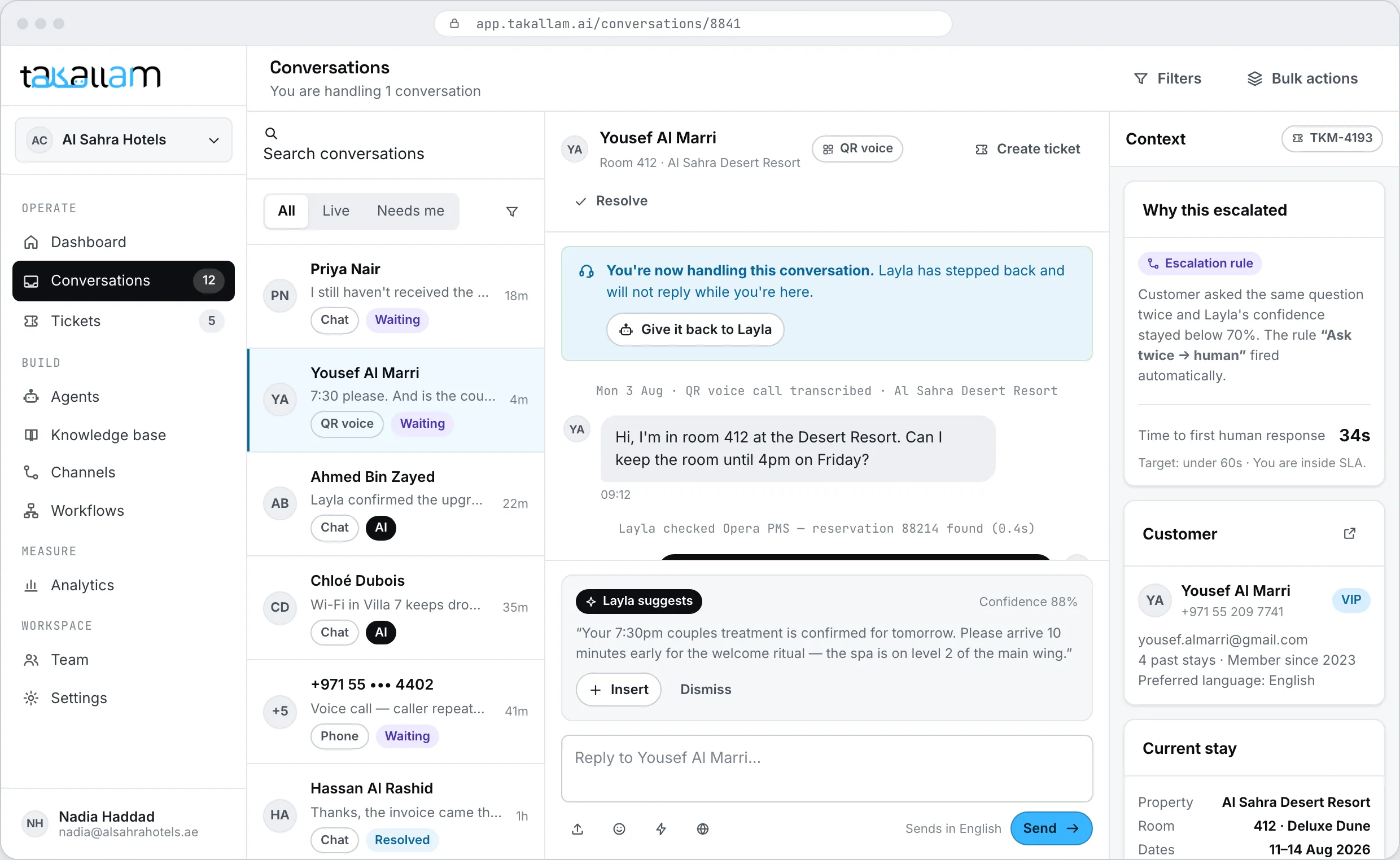
It has to read the actual bill, not a description of one
Explaining a charge is only possible if the agent can see the invoice. The same is true of a plan change that has to take effect, a top-up that has to land, and a fault report that has to exist in the system your field team works from. That part is a workflow: when this happens, look this up, then do that, and if this other condition is true, give it to a person instead.
- When a subscriber asks about a charge, pull the invoice lines from your billing system and explain the one that moved.
- When a plan change is agreed, write it to the CRM, confirm the effective date, and send the confirmation in the language the conversation happened in.
- When a fault is reported, open a ticket with the account, the address and the symptoms, and route it by area.
- When a call ends, write the summary back to the subscriber record so the next agent does not start from nothing.
- Takallam does not ship a certified connector for every billing stack on the market. It ships a workflow builder, a REST API and signed webhooks — if your system can be called, a workflow can call it.
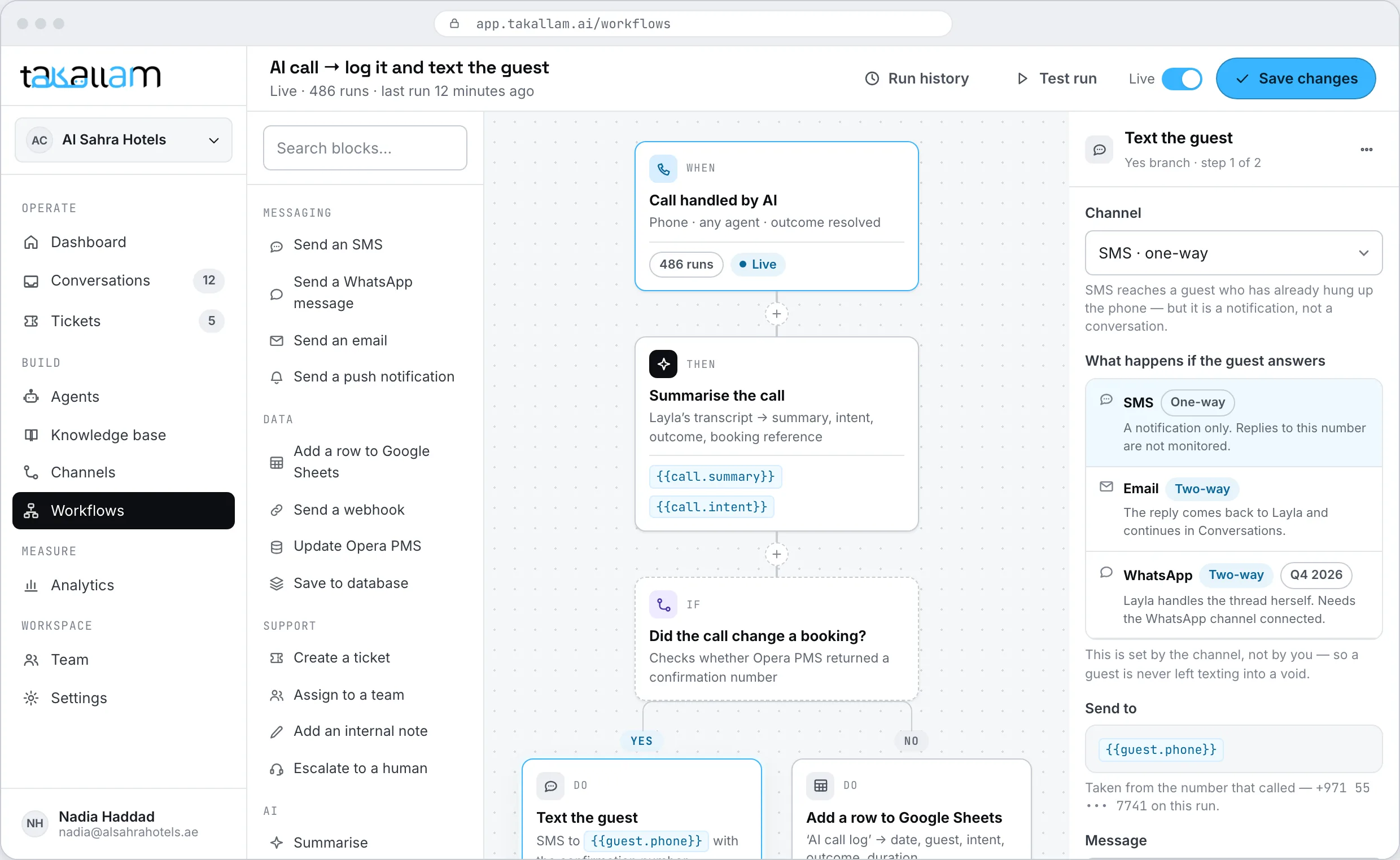
Three things telecom teams check before they commit
Arabic that survives a real conversation
Emirati and wider Gulf dialect in voice and text, including the subscriber who starts a sentence in Arabic, says "top-up" and "roaming" in English, and finishes in Arabic. Formal Modern Standard Arabic alone does not survive contact with a contact centre.
How Takallam handles ArabicOne agent across four channels
QR voice, in-app and web chat, email and phone, with one knowledge base and one subscriber record behind all of them. Someone who scanned a code, then emailed, then called is one conversation — not three tickets that never met.
The platformThe sectors next door
Utilities, banking and retail get the same bill question wearing a different uniform. Those pages are written the same way as this one — real questions, real placements, and an explicit line the agent does not cross.
All industriesWhat the platform gives an operator
These are capabilities of the platform, not results from a deployment. Takallam is pre-launch and publishes no performance figures.
What operators ask before they trial anything
Can it actually explain a bill, or does it just read out the total?
It explains it, provided a workflow can reach your billing system. The agent pulls the invoice lines for that account, compares them with the previous cycle, finds the line that changed — a pro-rated upgrade, an out-of-bundle charge, a first partial month, a subscription — and explains that specific line. Without a connection to billing it can still answer how your tariffs and charges work in general, which covers a surprising share of the volume on its own.
Will it change somebody's plan on its own?
Only if you allow it. Every action an agent can take is something you switch on in the agent builder, with your own conditions attached. Plenty of operators start with the agent read-only — it explains, compares and recommends, then hands the change itself to a person — and turn on top-ups and plan changes once they have watched a few hundred conversations.
What happens when a subscriber wants to cancel, or disputes a charge?
It hands over. A cancellation or a disputed charge is a commercial decision with a paper trail, and the agent is configured never to make one. It will explain the bill, name the charge, set out the options and answer what the exit terms actually say.
Then it stops and passes the conversation to your team with the transcript, the invoice lines the subscriber was looking at and everything it already checked. Your retention agent picks up an informed conversation rather than starting the whole thing again.
What happens during an outage, when everyone calls at once?
Everyone gets answered at the same time. That is the structural advantage of the QR, chat and phone channels together — there is no queue that has to be worked through one caller at a time. The agent gives whatever your incident status says, tells people what is known and what is not, and opens a fault report when the caller is outside a known incident. Volume spikes cost you interactions, not a collapsed service level.
Does it help with SIM replacement and eSIM setup?
Yes, and eSIM is one of the clearest wins. The agent talks the customer through installing the profile on the right device, explains what a scan needs, and troubleshoots the usual failures. Where identity has to be verified in person it says so plainly, lists exactly which documents to bring, and books the branch visit rather than sending someone in unprepared.
Does it connect to our billing system and CRM?
It connects to systems that can be called. Takallam gives you a workflow builder, a REST API and signed webhooks, so a workflow can read an invoice, write a plan change or create a fault ticket in anything that exposes an interface. What it does not do is claim a certified, pre-built integration with every billing stack in the market. Getting started does not wait on that: Takallam reads your website, builds the knowledge base from your tariff, roaming and coverage pages, and drafts your first agents — IT is only needed when a workflow has to write back.
Does it handle Arabic-speaking subscribers properly?
Yes — Emirati and wider Gulf dialect in both voice and text, including the very common case of a subscriber who mixes Arabic and English in one sentence. This is the reason Takallam exists rather than being an English-first product with translation added later. The platform covers English and Arabic today; if your subscriber base needs more than that, tell us before you join.
What does it cost?
You pay per interaction, and each channel is priced separately, because a phone call and a chat message do not cost the same to deliver. There are no per-seat licences and no minimum commitment — which matters when your volume triples for four days after billing and settles down again. Takallam is pre-launch, so rates are being set with the first cohort. Join the waitlist and we will quote against your real volume.
Put a code on the bill and see what subscribers ask
We are onboarding a first cohort of UAE operators now. Tell us your rough monthly contact volume, which channels you need and what your billing stack is, and we will come back with a rate against your real numbers.
Pay per interaction · priced per channel · no seats, no minimums