
Twenty sectors, the same ten questions, asked differently
A hotel gets asked about late checkout, a clinic about insurance networks, an exchange house about today's rate to Kerala. Takallam answers all of them the same way — by QR voice, in-app and web chat, email and phone, in English and Emirati Arabic — and hands over the moment the question stops being one an agent should answer.
The product does not change. Four things do.
Takallam is one platform in every sector on this page. The same four channels, the same console, the same knowledge base, the same workflow builder. Nobody is sold a special edition. What changes is narrower than most vendors pretend, and it is worth being precise about, because it is the whole of the setup work.
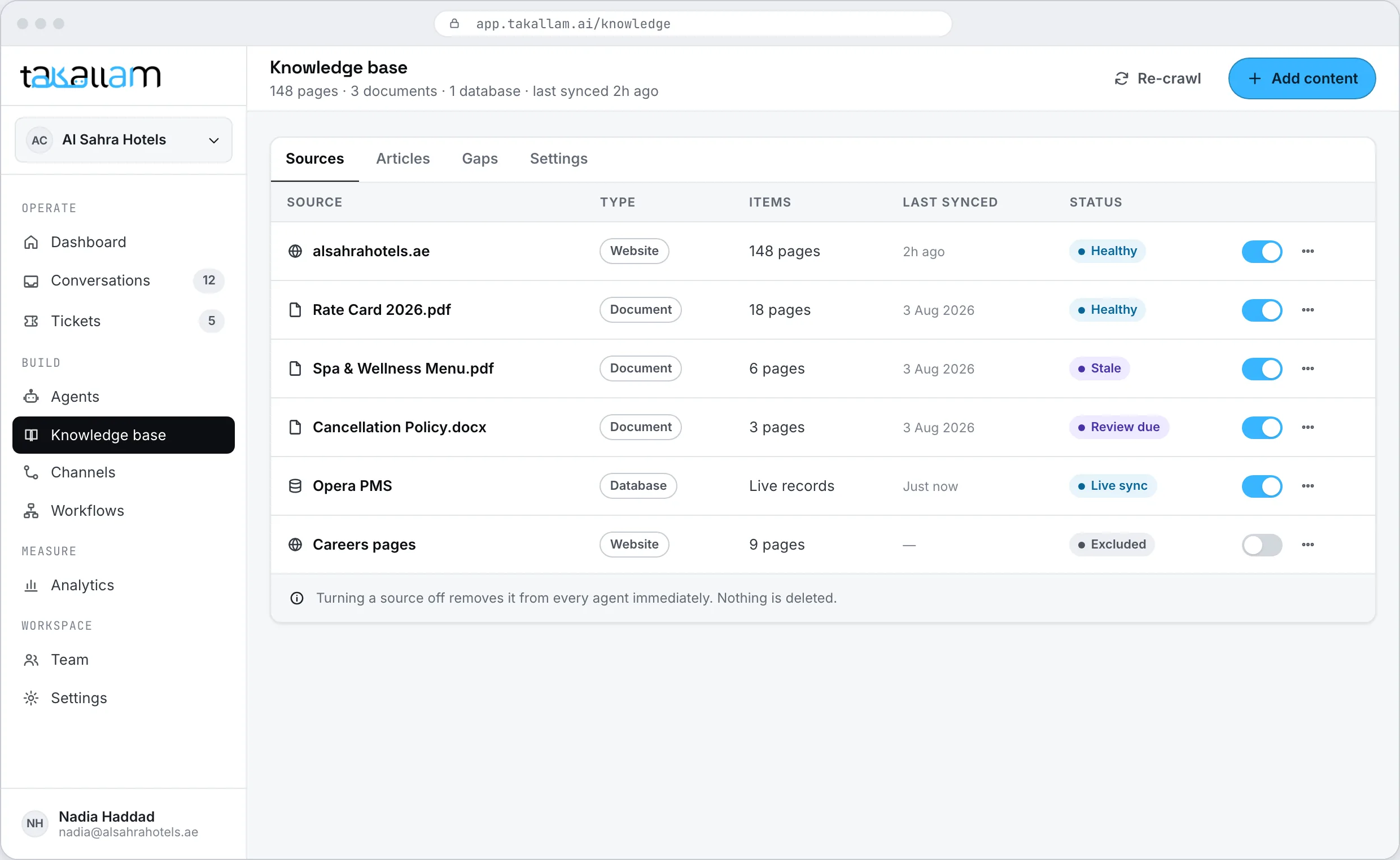
- The questions. A clinic and a car showroom get asked completely different things, so the knowledge base is built from your own website and documents rather than a sector template somebody wrote once.
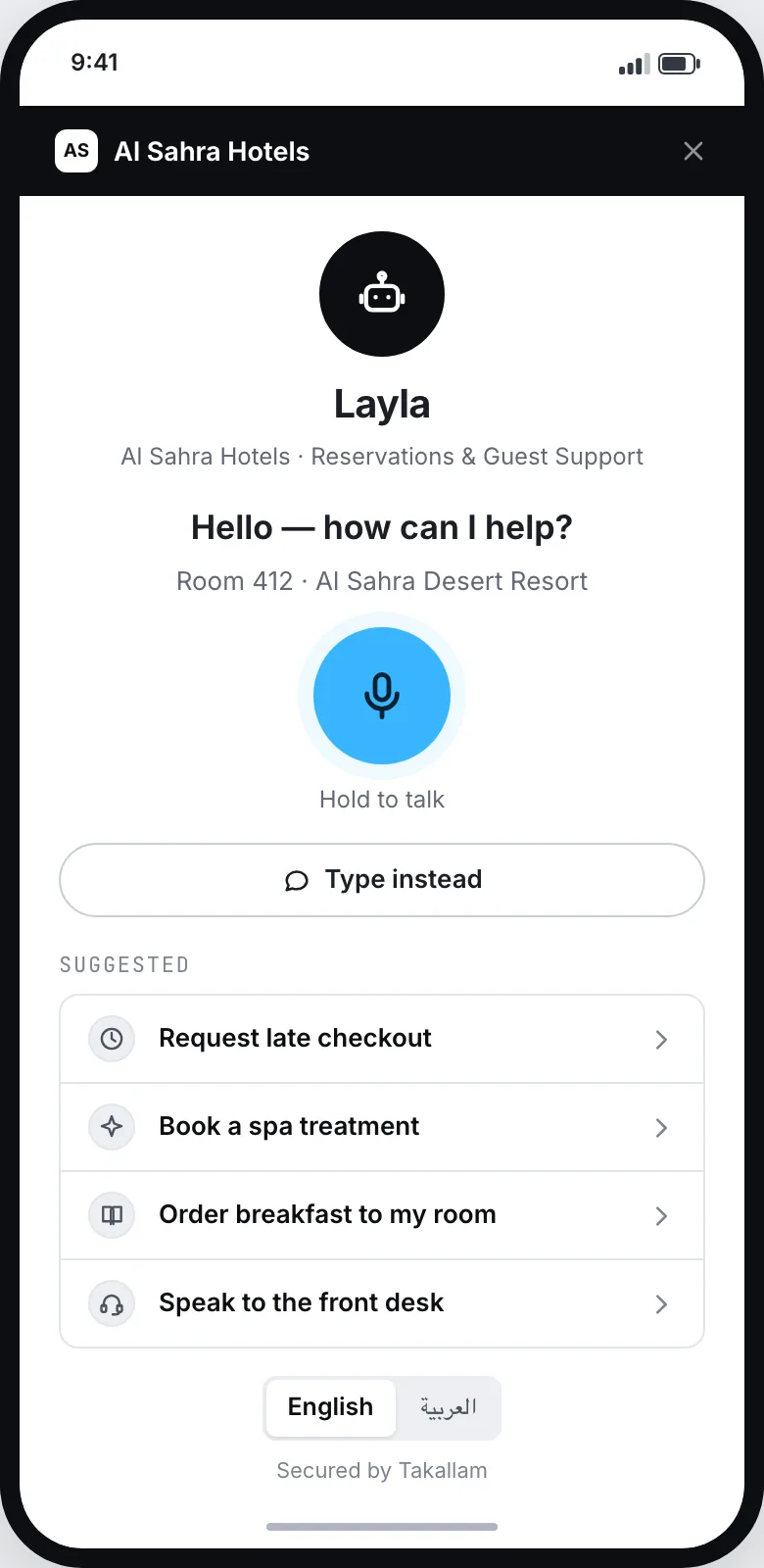
- Where the code goes. A door card in a hotel, a table tent in a restaurant, a delivery note in logistics, a meter cupboard in a building. The code belongs where the question happens.
- Which system it writes to. Your booking system, your PMS, your billing system, your CRM — reached through a workflow, a REST API and signed webhooks rather than a pre-built connector for everything.
- What it must refuse. Every sector has something the agent should never attempt, and that list is the single most important thing you configure.
Where guests and customers arrive
The sectors where somebody is standing in front of you, or about to be, and the question is time-sensitive: a room, a table, a gate, a hall.
Hospitality & hotels
Late checkout at 11:40, the wifi password, a spa slot and a car to the airport — from a code on the door card.
Hospitality & hotelsAviation & airlines
Baggage allowance, a name correction, a changed gate, and where the bag that did not arrive is now.
Aviation & airlinesRestaurants & F&B
A table at eight, what is in the sauce, whether you deliver to Al Barsha, and where the order got to.
Restaurants & F&BEvents & exhibitions
Which hall, which gate, where badges are collected, where to park, and what time the doors actually open.
Events & exhibitionsWhere things get delivered and fixed
The sectors where the customer already bought something and now wants to know where it is, when it is coming, or who is fixing it.
Retail & e-commerce
Where is my order, can I return it after fourteen days, and is that size in stock at the Mirdif branch.
Retail & e-commerceLogistics & shipping
Where the shipment is, what the customs charge was for, and whether the driver can come after six.
Logistics & shippingAutomotive
When the service is due, whether the part arrived, what a courtesy car costs, a test drive on Saturday.
AutomotiveFacilities management
The AC in 1204 is out, the lift is stuck, who is coming, and when the technician will actually arrive.
Facilities managementWhere money and identity are involved
The sectors with the tightest line between what an agent may say and what only a licensed person may decide. These pages spend most of their length on that line.
Banking & finance
A declined card, an unexplained fee, how to raise a limit — answered without the agent ever opening an account.
Banking & financeInsurance
Is this covered, what is my excess, how do I add my wife to the policy, and where has my claim got to.
InsuranceBusiness setup & free zones
Mainland or free zone, which activity, how long a visa takes, and what the licence fee actually includes.
Business setup & free zonesExchange houses & remittance
Today's rate to Kerala, why a transfer is still pending, and which documents the branch will ask for.
Exchange houses & remittanceWhere people are looked after
Appointments, terms, timetables and directions — the administrative half of the relationship, which is most of the call volume and none of the professional judgement.
Healthcare & clinics
Appointments, insurance networks, opening hours and directions — and never a word about symptoms or results.
Healthcare & clinicsEducation
Fees and term dates, bus routes, the admissions checklist, and whether there is a place in Year 4.
EducationBeauty & wellness
A slot at seven, how long the treatment takes, and which branch has the therapist she asks for by name.
Beauty & wellnessFitness & sports
Class times, freezing a membership, what the joining fee covers, and whether the pool is open today.
Fitness & sportsInfrastructure, property and public services
High volume, highly repetitive, and almost entirely status questions: where is my application, why is the bill higher, when is the power back, is the unit still available.
Real estate
Is the unit still available, is it chiller-free, how many cheques, and when can I come and view it.
Real estateGovernment & public services
Which documents, which fee, which counter, which working hours, and where an application has got to.
Government & public servicesTelecom
Why the bill went up, moving a line to a new address, when the engineer is coming, is there an outage.
TelecomUtilities
Move-in and move-out, a final bill, a meter reading, and a street that has been dark since nine.
UtilitiesOne code, twenty different places to print it
QR voice is the channel that changes most between sectors, because it is the only one with a physical address. The code has to be where the customer is standing at the moment the question forms — not on a poster in reception that nobody reads on the way out.
- Hotels and restaurants: the door card, the table tent, the pool menu, the spa reception.
- Clinics, gyms and salons: the waiting room, the treatment room door, the membership card, the class timetable on the wall.
- Retail, logistics and automotive: the shelf edge, the fitting-room mirror, the delivery note in the box, the windscreen sticker on a car in for service.
- Buildings, branches and stands: the lift lobby, the meter cupboard, the queue ticket at a counter, the badge lanyard at an exhibition.
- Print a different code per placement and the analytics tell you which spot generates which question.
Every sector has one thing the AI must never answer
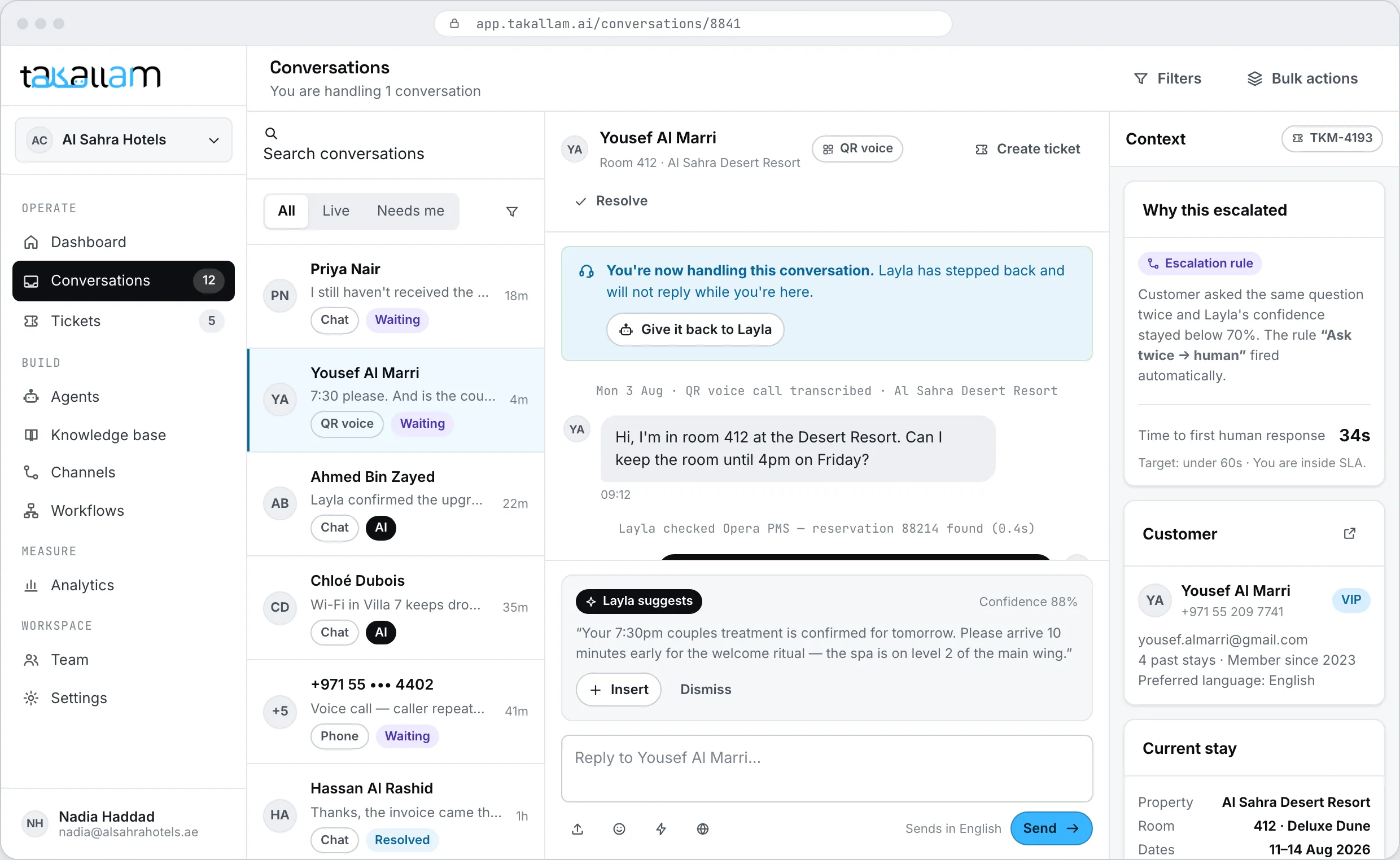
This is the setting that decides whether an AI agent belongs in your business at all, and it is different in every sector. In a clinic it is a symptom, a dosage or a lab result — the agent books, confirms and gives directions, and it does not practise medicine. In a bank it is anything specific to an account, and anything that looks like fraud. In insurance, quoting the policy wording is fine; deciding whether a claim is covered is not. In government it is a ruling on an application. At an exchange house it is a transfer where the sender's identity is in question. In real estate it is a contract term. Takallam does not guess where that line sits in your business. You draw it, per agent and per channel, and the agent stops there.
- You write the refusal list per agent, and separately per channel, so a phone agent can be more cautious than a chat one.
- Low confidence hands over on its own, before the agent invents something to say.
- Handover keeps the same thread. The customer does not start again and there is no ticket number to quote back.
- Whoever picks it up sees everything the agent already tried, including what it refused and why it refused it.
What every sector on this page gets
These are capabilities of the platform, not results from a deployment. Takallam is pre-launch and has no published performance figures.
Before you open a sector page
We are not on this list. Does Takallam work for us?
Almost certainly. These twenty are the sectors we see most often in the UAE, not a limit in the product. Takallam builds its knowledge from your own website and documents, so what it ends up understanding is whatever you actually do. Tell us your business when you join the waitlist and we will be straight with you about the fit.
Is the software different for each industry?
No. It is one platform everywhere: four channels — QR voice, in-app and web chat, email and phone — one console, one knowledge base, one workflow builder. What differs is the knowledge the agent is given, the actions it is allowed to take, the systems a workflow writes to, and the list of things it must refuse. There is no separate healthcare edition.
How does it learn our sector's answers?
It reads your website. During setup Takallam crawls your pages — rates, policies, services, opening hours, terms — builds a knowledge base from them and drafts your first agents.
You then review what it learned before anything goes live. Sector vocabulary comes out of your own documents, which is why a shipping company and a salon end up with agents that sound nothing alike.
What is the one thing the AI should never answer in our sector?
You decide, and it is the most important thing you configure. A clinic blocks symptoms, dosages and results. A bank blocks anything account-specific. An insurer lets it read the policy wording but never decide a claim. An exchange house blocks a transfer where identity is in doubt. The agent stops at the line you drew, says so plainly, and hands the conversation to a person with everything it already gathered.
Do we have to use all four channels?
No. Pick the ones that match where your customers already are, and add the rest later. Each channel is priced separately, so you are not paying for a phone number you never point at anything. Hotels usually start with QR voice, clinics with phone and chat, e-commerce with email and chat.
Does it handle Arabic properly in every sector?
Yes — Emirati and wider Gulf dialect in both voice and text, including customers who switch between Arabic and English mid-sentence. The sector vocabulary comes from your own documents, so an insurance agent uses your policy language and a logistics agent uses your shipment terms rather than a generic dictionary.
Where does our data live?
In the UAE. Takallam runs in the me-central-1 region and conversation data is resident in-region by default, encrypted in transit and at rest, with retention periods and team access controlled by you. Takallam is a young company and does not hold SOC 2 or ISO 27001 today — the architecture is built to support that work, and we would rather say that plainly than imply a certificate we do not have.
What does it cost, and how long does setup take?
You pay per interaction, and each channel is priced separately, because a phone call and a chat message do not cost the same to deliver. No per-seat licences and no minimum commitment. Setup is an afternoon for most businesses — Takallam reads your site, drafts the agents, you review the knowledge and decide what each agent may do. Rates are being set with the first cohort, so join the waitlist and we will quote against your real volume.
Open the page for your sector, or just tell us what you run
We are onboarding a first cohort of UAE businesses now. Tell us your sector, the channels you need and roughly how much volume you handle, and we will come back with a rate against your real numbers.
Pay per interaction · priced per channel · no seats, no minimums