
One delay puts four hundred people in the same queue
Where is my flight. Can I change it. Where is my bag. What do I need to transit. Takallam answers all of it — from a code in the check-in queue, inside your app, in your support inbox and on the phone, in English and Emirati Arabic — and hands anything that needs a human decision to your team with the booking reference already attached.
What the contact centre gets asked
One delay, and a month of calls arrives in an hour
A flight goes tech at 02:10. Four hundred people reach for their phones in the same minute, and almost all of them ask the same three things: what is happening, what happens to my connection, and where is my bag. Meanwhile the ordinary day carries on underneath — a name correction, an extra bag, a seat next to a child, a visa question from someone connecting through in six hours.
- Volume does not arrive evenly across a shift. It arrives in the ninety minutes after a disruption, and no roster is sized for that.
- The same passenger asks on the phone, then in chat, then by email, and gets three slightly different answers.
- The status question — the one that needs no judgement at all — is what fills the queue and buries the passenger who genuinely needs a person.
- Someone standing at the belt at 3am with no bag has nobody to talk to until the desk opens.
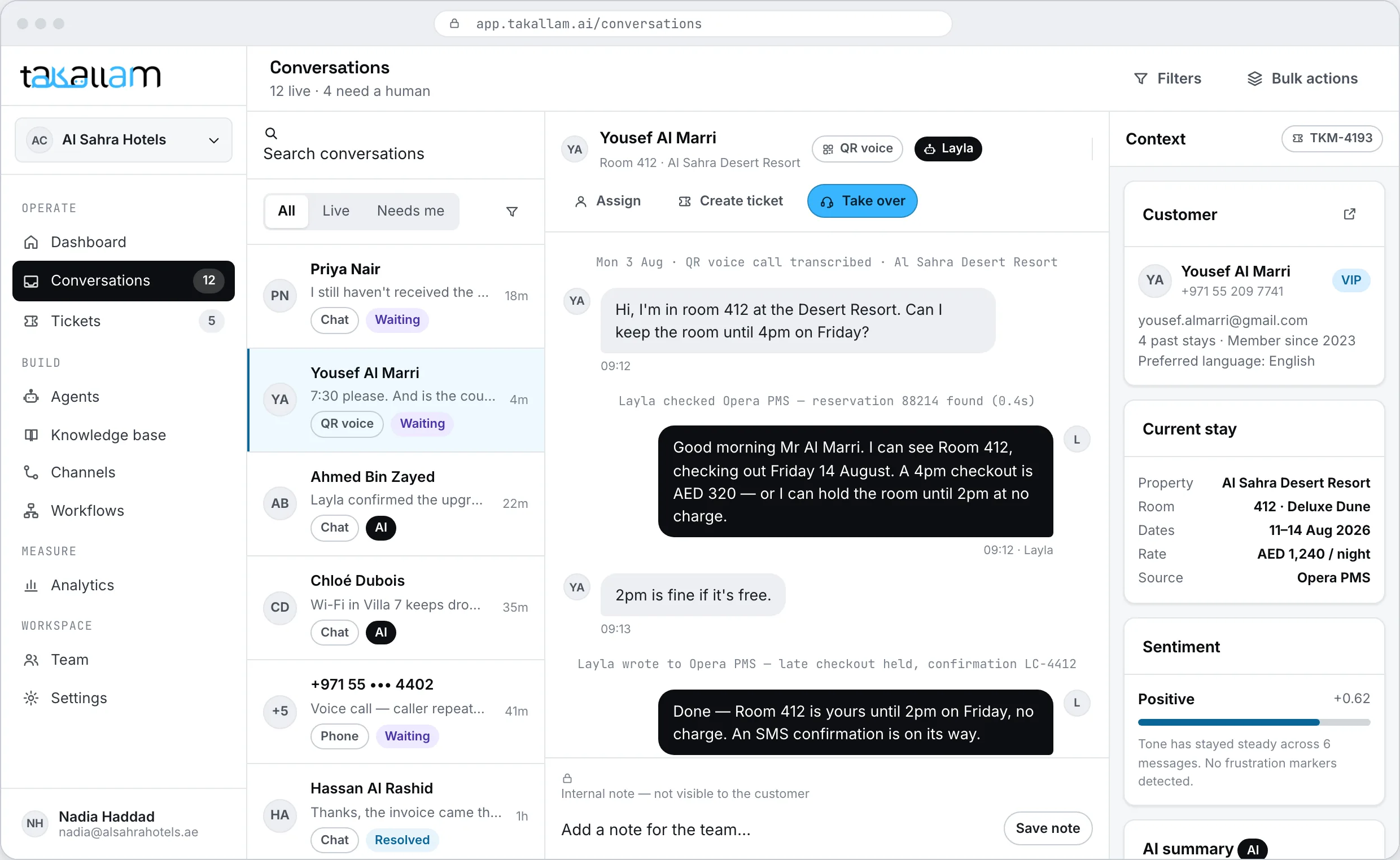
The handful of questions that make up most of the queue
Not the complicated ones. The ones that repeat on every flight, on every channel, and take your agents away from the passenger with a real problem.
Where is my flight, and how late is it
Scheduled time, current status, gate and stand, and what it means for the connection on the same booking. It reads what your systems publish. It does not guess, and it does not invent a new departure time to make the conversation easier.
Change it, cancel it, move me a day
It reads the fare conditions on the ticket the passenger actually holds, says what the change costs and what the rules are, and either does it — if you have allowed that action — or hands it to a person with the record already open.
How agent actions workAllowance, excess, and a bag that did not arrive
How many pieces, what weight, the rule for sports equipment, what excess costs at the desk versus online. And when a bag does not turn up: it takes the file reference, reads back the status, and opens the claim your baggage team then owns.
Tickets and SLAsSeats, meals, check-in and boarding times
The seat map, the paid-seat rules, whether the exit row is allowed for that passenger, special meals and the cut-off for requesting one, when online check-in opens and when the gate closes. Answered at midnight, when someone is packing and remembers.
Transit, visas and connections
Whether they need a visa to leave the airside area, how long a connection needs to be, what happens to a bag tagged through, and the rules for the passport they actually hold. It states the requirement and points at the authority — it never tells anyone they will definitely be let in.
Miles, tier and a missing-miles claim
The balance, what earns and what does not, how far off the next tier is, and how to claim for a flight that never credited. Answered from your published programme rules rather than from a guess about them.
How the knowledge base worksThe passenger at the belt scans a code and just talks
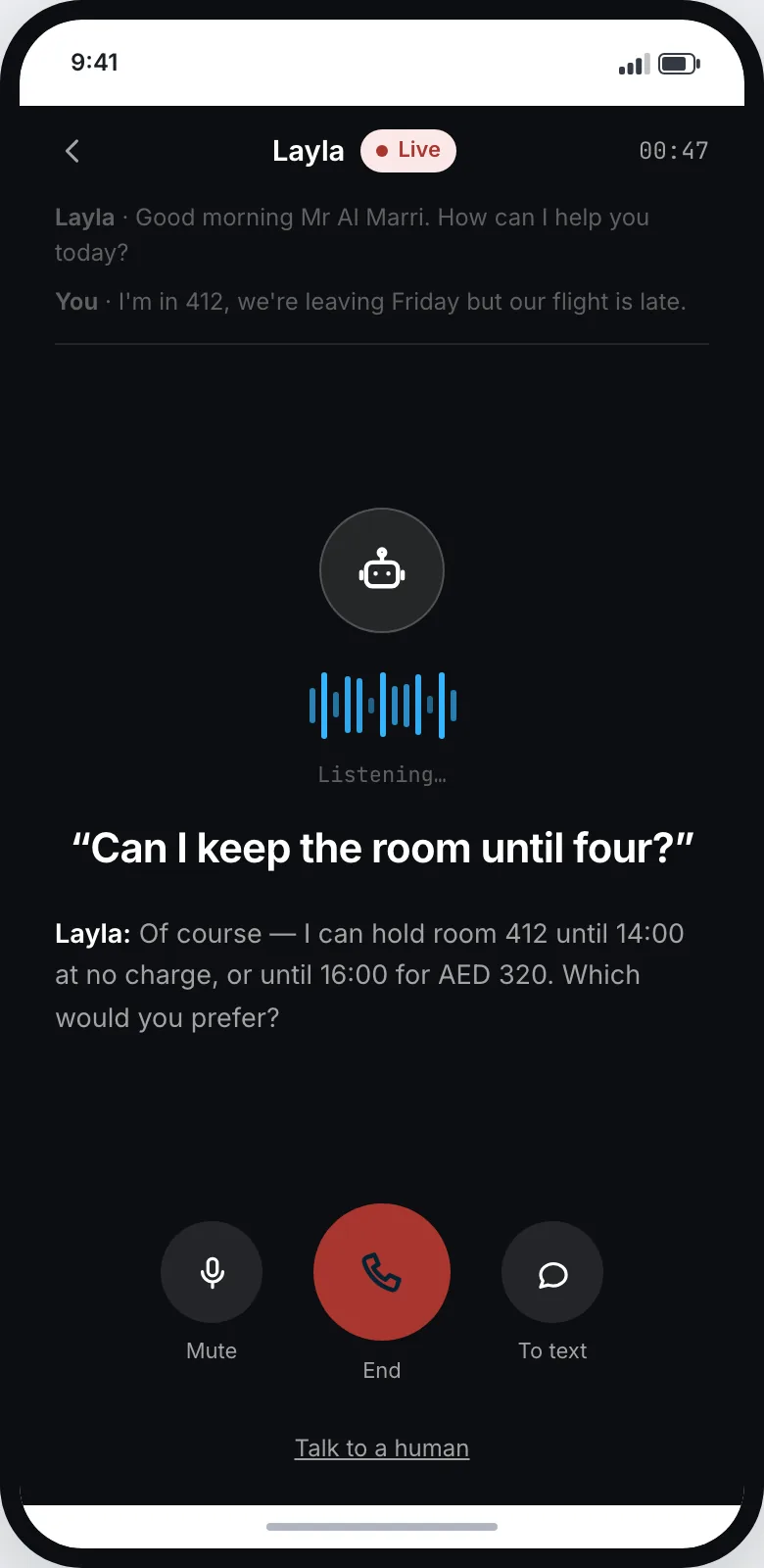
There is nothing to install at 3am in an airport you have never been to, no international number to dial, no hold music. The passenger points a camera at a printed code, speaks, and gets an answer in the language they used. It works for one person, and it works for the four hundred who came off the same aircraft.
- Opens straight into voice. No app store, no download, no roaming call to a foreign call centre, no queue.
- The passenger can switch to text mid-conversation — useful in a loud terminal or on a weak connection.
- Emirati and Gulf Arabic in speech as well as English, including a passenger who starts a sentence in Arabic and finishes it in English.
- Each code is its own placement, so a scan at the belt starts a baggage conversation and a scan at the transfer desk starts a connections one.
Where the code goes in an airport
Put it where the question is asked. The question at the belt is not the question at the lounge door, and a separate code for each spot is how you tell them apart.
The check-in queue and the bag-drop line
Twenty minutes of standing still, and everyone in it has a question about weight, documents or the closing time. A code on the queue stanchion answers it before they reach a human, and shortens the conversation at the desk when they do.
The baggage reclaim belt
The worst place in an airport to have nobody to talk to. A code on the belt display takes the tag number, reads back what the system says, and starts the file if the bag is not there — instead of a queue at a single desk.
The lounge entrance
Access rules, guest allowance, which card gets in, whether the shower suite is free, and when boarding for the delayed flight actually starts. All asked at a door with one agent behind it.
The seat-back card and the boarding pass
The only printed things a passenger reliably keeps. Most people scan them after landing — the onward connection, arrival formalities, the baggage rule for the next sector, how to claim the miles for this flight.
The transfer desk and the arrivals hall
For the passenger who missed a connection, and the one looking for the hotel shuttle or the car booked with the ticket. Plenty of those desks are run by somebody else — a ground handler, a hotel, a limousine company — and each can print its own code and run its own agent on the same platform.
Takallam by industryA different code per placement
Separate codes for departures, the belt, the lounge and each transfer desk. The analytics then show which question belongs to which part of the terminal, and which piece of print earns its ink.
Inside the consoleIn a disruption it gives status and options, then gets out of the way
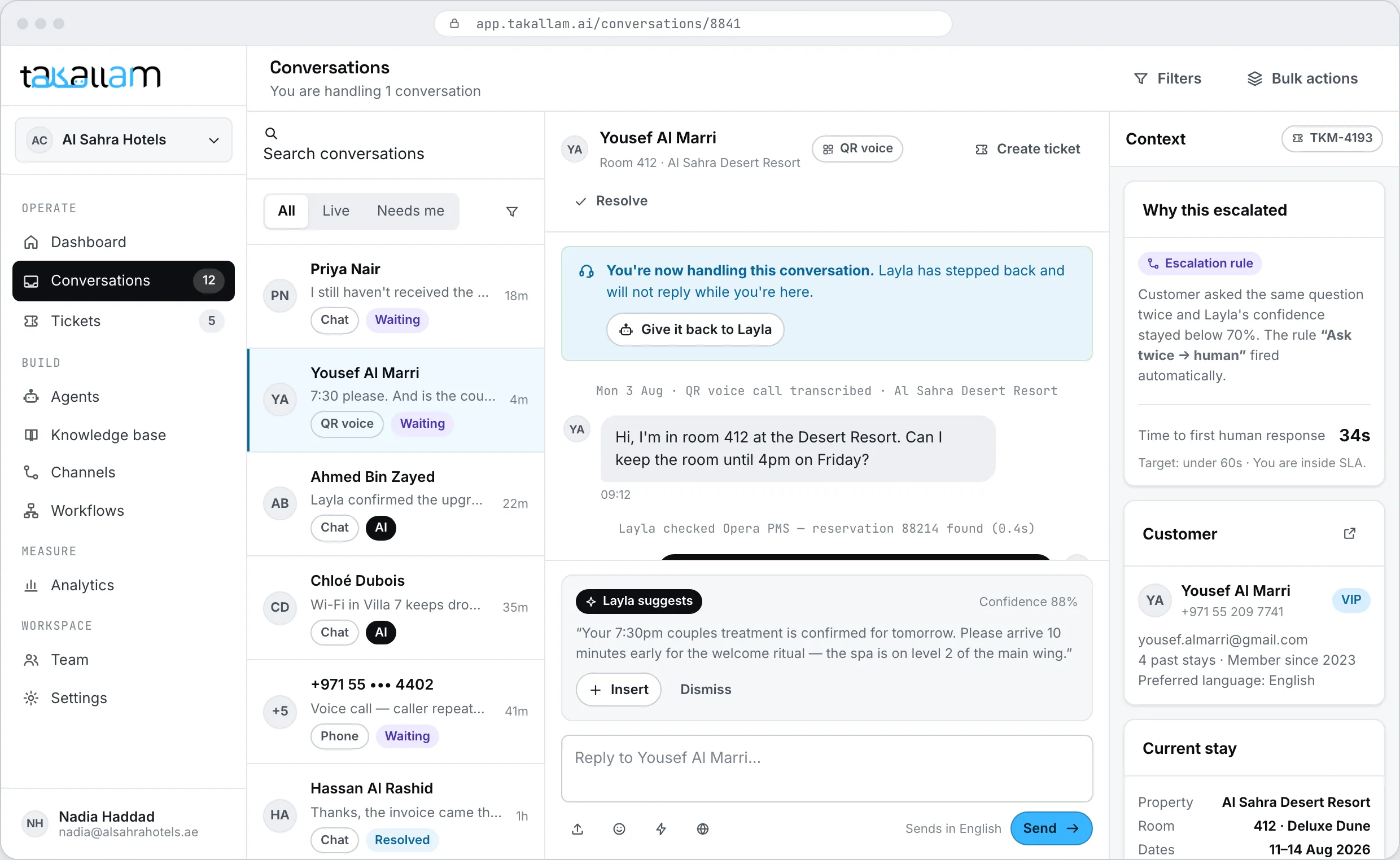
This is the line that matters in aviation, and it is drawn deliberately. Rebooking a passenger onto another carrier, authorising a hotel, agreeing compensation, deciding who gets the last seat on the morning flight — those are commercial and duty-of-care decisions with regulatory weight, and they belong to your people. So the agent does the part it is good at: it says what is known, offers only the options you have authorised, and hands over with the reference, the connection, the tier and everything already asked. And it never speculates about when a delayed flight will leave. If operations has not published a new time, the honest answer is that there isn't one yet — and that is exactly what the passenger hears.
- It states the status it can see and says plainly when nothing has been published. No estimates, no "should be about an hour", no reassurance it cannot stand behind.
- Rebooking, hotels, meal vouchers and compensation go to a person unless you have explicitly enabled the action and written its limits.
- Special assistance, medical clearance, an unaccompanied minor or a passenger in distress goes to a human immediately, whatever the confidence score says.
- The handover lands in the same thread with the booking reference, the flight, the disruption reason and the full transcript. The passenger does not start again.
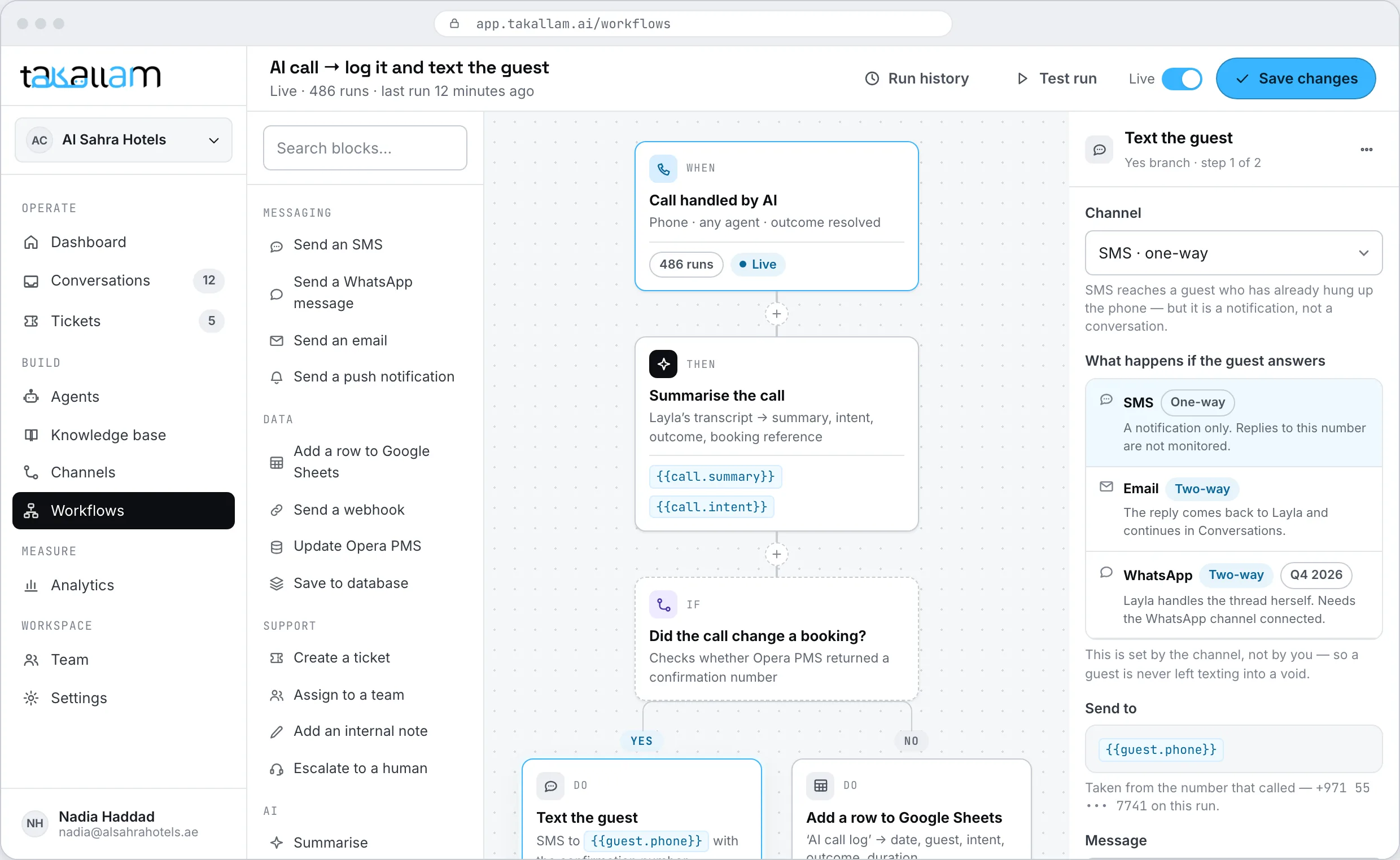
An answer is only as good as the record it came from
A flight status, a fare condition, a baggage file, a mileage balance — none of that lives on a website an agent crawled. It lives in your reservation system, your departure control, your baggage tracing system and your loyalty database. Takallam reaches them the same way your own tools do: a workflow calls the system, takes the answer back, and the agent says it out loud.
- When a passenger asks for status, read the flight from your operations feed and answer with what is actually published.
- When a bag is missing, take the tag number, look up the file, read the status back, and open a ticket with an SLA if no file exists yet.
- When a change is agreed inside the rules you set, write it to the reservation and email the new itinerary from your own address.
- Takallam does not ship a certified connector for every PSS on the market. It ships a workflow builder, a REST API and signed webhooks — if your system can be called, a workflow can call it.
What the platform gives an airline
These are capabilities of the platform, not results from a deployment. Takallam is pre-launch and has no published performance figures.
What airline and airport teams ask first
Will it tell a passenger when a delayed flight is leaving?
Only if your systems have published a time. If they have not, it says so in plain words. The agent repeats the status it can read from your operations feed — it does not estimate, and it does not soften bad news with a guess. Inventing a departure time is the fastest way to turn one frustrated passenger into four hundred.
Can it rebook someone during a disruption?
By default, no. It gives the passenger their status and the options you have authorised, then hands over. Rebooking, hotel and compensation decisions carry commercial and regulatory weight, and they belong with your team.
If you want the agent to handle one narrow case — a same-carrier move inside a window you define, for example — you enable that action in the agent builder and write the limits yourself. Everything outside them still goes to a person, with the full conversation attached.
What happens with special assistance and unaccompanied minors?
They go to a human. The agent will explain your process, the paperwork, the age rules and the deadlines, because that information is genuinely useful at midnight. It will not take the booking, confirm a medical clearance or make a judgement about a child travelling alone. Those requests are routed to the team that handles them, whatever the confidence score says.
Does it connect to our reservation and baggage systems?
It connects to systems that can be called. Takallam gives you a workflow builder, a REST API and signed webhooks, so a workflow can read a flight status, look up a baggage file, check a mileage balance or write a change back — in any system that exposes an interface.
What Takallam does not do is claim a pre-built, certified integration with every PSS, departure control and baggage tracing system in the market. Tell us what you run and we will be straight with you about what the connection actually looks like.
Does it answer email as well as calls and scans?
Yes. Forward your customer-relations or baggage address to Takallam, or connect the mailbox, and the agent reads the whole thread — the attached boarding pass, the receipt, the property irregularity report — then replies in-thread from your own address, in the language the passenger wrote in. You can run it in draft mode and approve replies until you trust it.
Does it handle passengers who speak Arabic?
Yes — Emirati and wider Gulf dialect in both voice and text, including passengers who switch between Arabic and English mid-sentence, which is normal on a Gulf carrier. That is the reason Takallam exists rather than being an English-first product with translation added later. Today the platform covers English and Arabic.
What does it cost?
You pay per interaction, and each channel is priced separately, because a phone call and a chat message do not cost the same to deliver. There are no per-seat licences and no minimum commitment — which matters when your volume is flat for a month and then triples for one night. Takallam is pre-launch, so rates are being set with the first cohort. Join the waitlist and we will quote against your real volume.
How long does setup take, and does IT have to be involved?
Not long, and only at the end. Takallam reads your website and builds the knowledge base from your conditions of carriage, baggage rules, fare pages and programme terms, then drafts your first agents. You review what it learned, decide what each agent may do, and print the codes. IT is needed when you want a workflow reading from or writing back into the reservation and baggage systems.
Put a code at the belt and see what passengers ask
We are onboarding a first cohort of UAE operators now. Tell us which channels you need, what your reservation and baggage systems are, and roughly how many contacts you take in a normal week and in a bad one. We will come back with a rate against your real volume.
Pay per interaction · priced per channel · no seats, no minimums