
Takallam vs PolyAI
PolyAI builds enterprise voice assistants for large contact centres, and builds them well. Takallam is a different shape of product: one agent that answers on a QR scan, inside your app, in your support email and on the phone, with a shared inbox, tickets and workflows behind it for your own team. Here is the comparison, written to be usable rather than flattering.
What PolyAI is genuinely good at
PolyAI is one of the strongest enterprise voice-assistant companies in the market, and it would be dishonest to open this page any other way. If you are running a large inbound voice operation and you want a partner to deliver it with you, they are a serious answer.
- Conversation handling is excellent. Interruptions, corrections and callers who change their mind mid-sentence are handled gracefully rather than restarting the script.
- It is proven at contact-centre scale, in deployments with high call volumes and hard availability expectations. Takallam is pre-launch and does not have that track record yet.
- Customisation goes deep, because the assistant is designed with their team rather than assembled by you in a builder.
- Takallam does not compete on raw voice synthesis quality, and does not claim to. If what you need is a voice API or a delivered voice assistant, buy exactly that.
A voice deployment, or a support platform
PolyAI is delivered as an engagement: you scope the assistant with their team, they build and tune it, and it goes live in front of your contact centre. Takallam is a product you sign into. You answer four questions, it reads your website, it drafts your first agents, and you open the channels yourself the same afternoon.
- Voice is the whole product at PolyAI. At Takallam it is one of four channels, and the same agent answers on all of them with one knowledge base and one record of the customer.
- There is no QR-voice channel — a printed code a customer scans and speaks to, with no app and no number to dial.
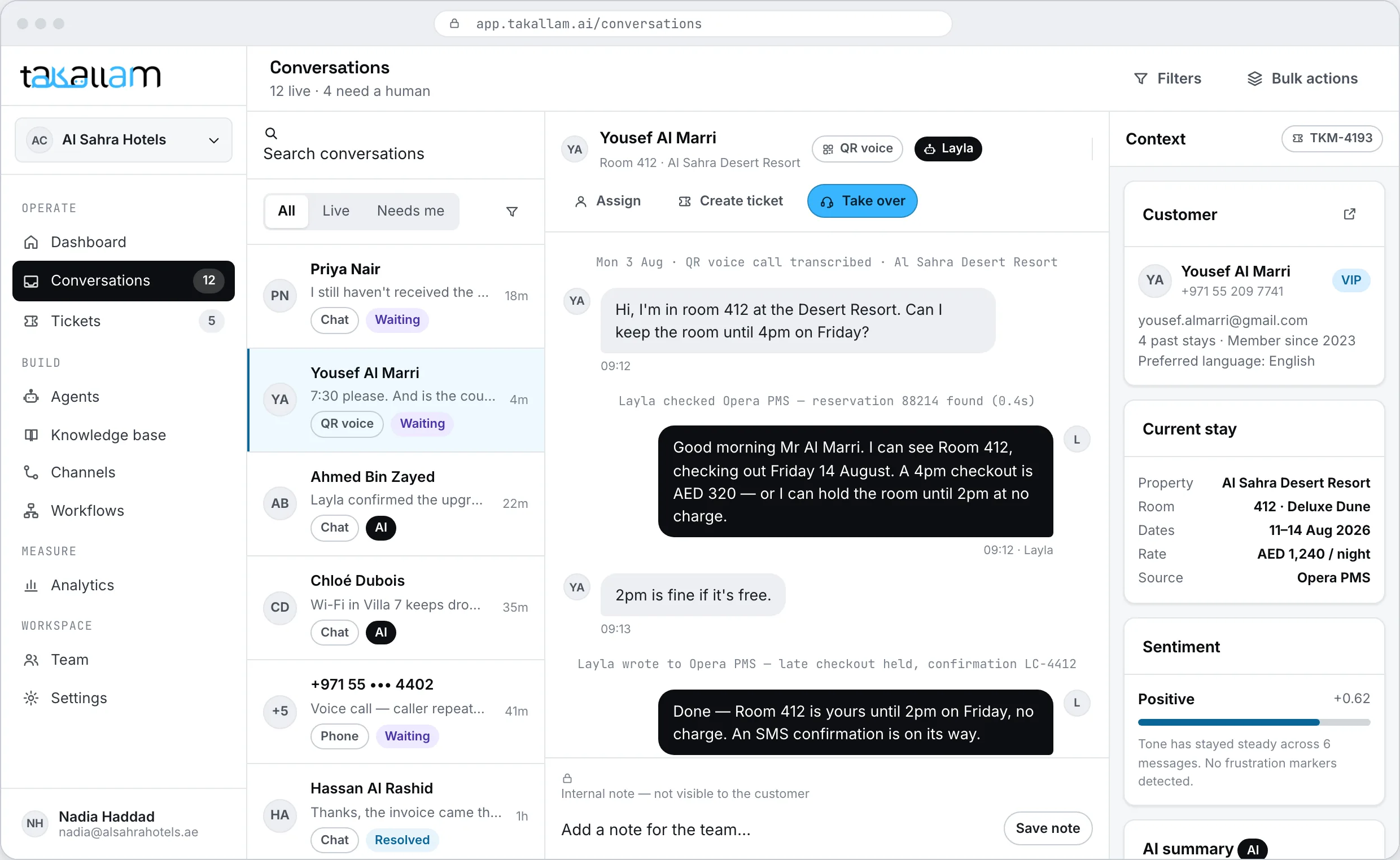
- Takallam includes the console your team works in: one inbox across channels, human takeover in the same thread, tickets and SLAs.
- Time to live and cost of change are different in kind. Changing an answer in Takallam is an edit you make. In a delivered deployment it is a request you file.
Capability for capability
Capabilities, not prices. Where a row is not a simple yes or no, the cell says what the product actually does instead of scoring it.
| Takallam | PolyAI | |
|---|---|---|
| Inbound phone voice agent | ||
| Natural, interruptible voice conversation | ||
| Proven at large contact-centre scale | Pre-launch | |
| Voice answers from a QR scan | ||
| In-app and web chat in the same platform | ||
| Answers your support email inbox | ||
| One agent shared across every channel | ||
| Support inbox included for your team | Works with your desk | |
| Human takeover inside the same thread | Transfers to your agents | |
| Tickets and SLAs included | ||
| Knowledge base built by crawling your website | ||
| Start without a sales engagement | ||
| Change an answer yourself, same day | ||
| No-code workflow builder included | ||
| Emirati and Gulf dialect voice |
Capability comparison as of 2026, based on each product as it is publicly described. Both products change — check PolyAI documentation for their current scope before deciding. Where we were not confident, the cell says "partial" rather than "no".
The parts of a support operation that come in the box
A voice assistant answers calls. A support platform also has to hold everything that happens after the call, and give your team somewhere to stand.
Scan-to-speak QR
A printed code on a hotel door, a shelf edge or a delivery box. The customer scans and talks. No app, no number, no queue — and it can switch to text mid-conversation.
See the channelsIn-app and web chat
An embed for your site or an SDK for your app, running the same agent as the phone line and picking up a conversation that started an hour ago on a call.
Your support inbox, answered
Forward [email protected] or connect the mailbox. The agent reads the whole thread, replies from your own address, and triages the rest before anyone opens the queue.
How email worksOne inbox, human takeover
Every channel lands in one queue. When a person takes over, they continue in the same thread with the transcript already there — no ticket number, no "let me transfer you".
Inside the consoleTickets and SLAs
For the things that genuinely need tracking: an owner, a due time, an escalation path. Included, not a separate helpdesk contract.
Knowledge base from your site
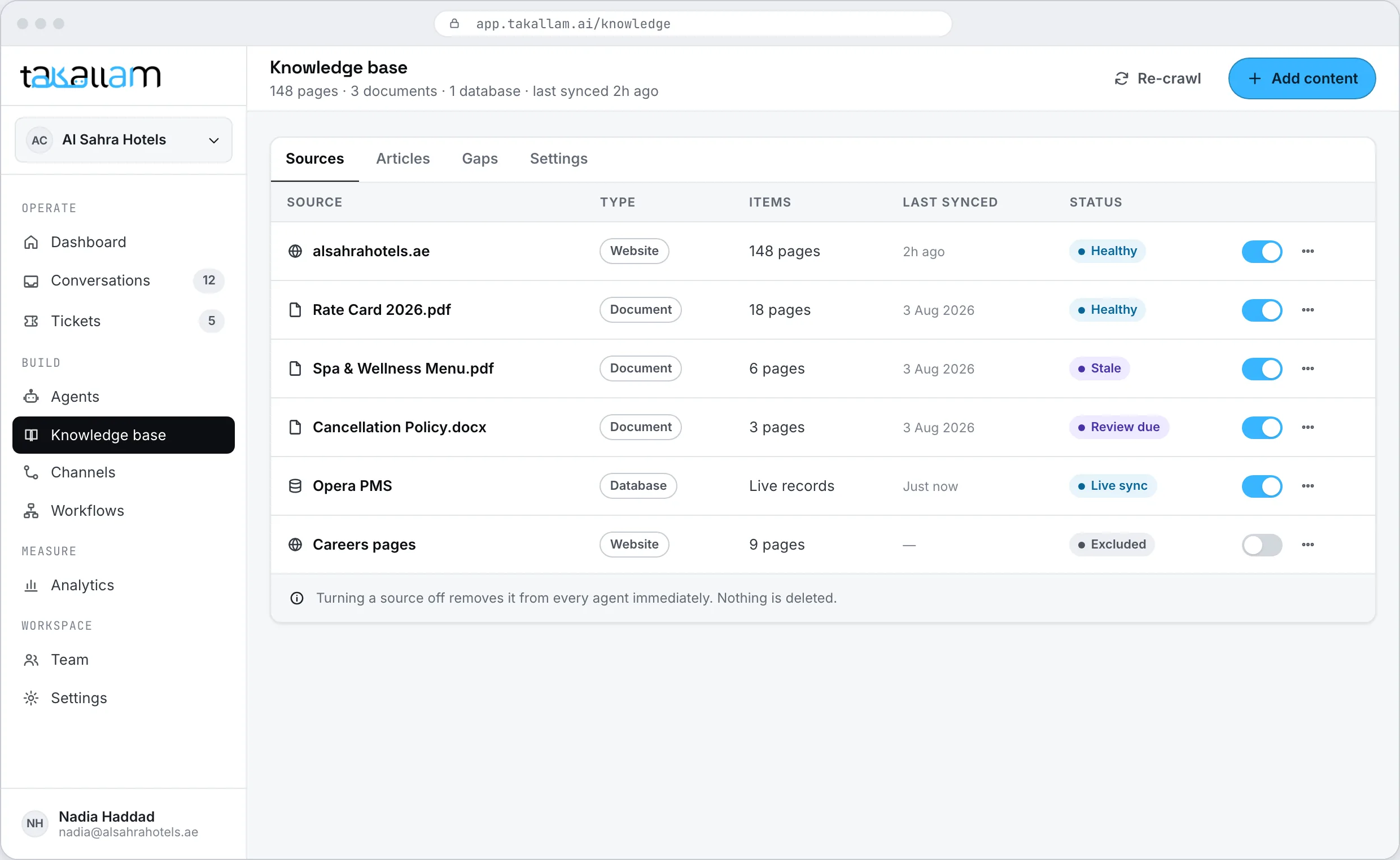
Takallam crawls your website, shows you every page it read, and lets you remove anything it should not use. Add PDFs or connect a system like a PMS.
Workflow builder
When a call is handled, summarise it, check whether a booking changed, update the PMS and text the guest. Built by dragging blocks, not by filing a request.
See the workflow builderA code on the door that talks back
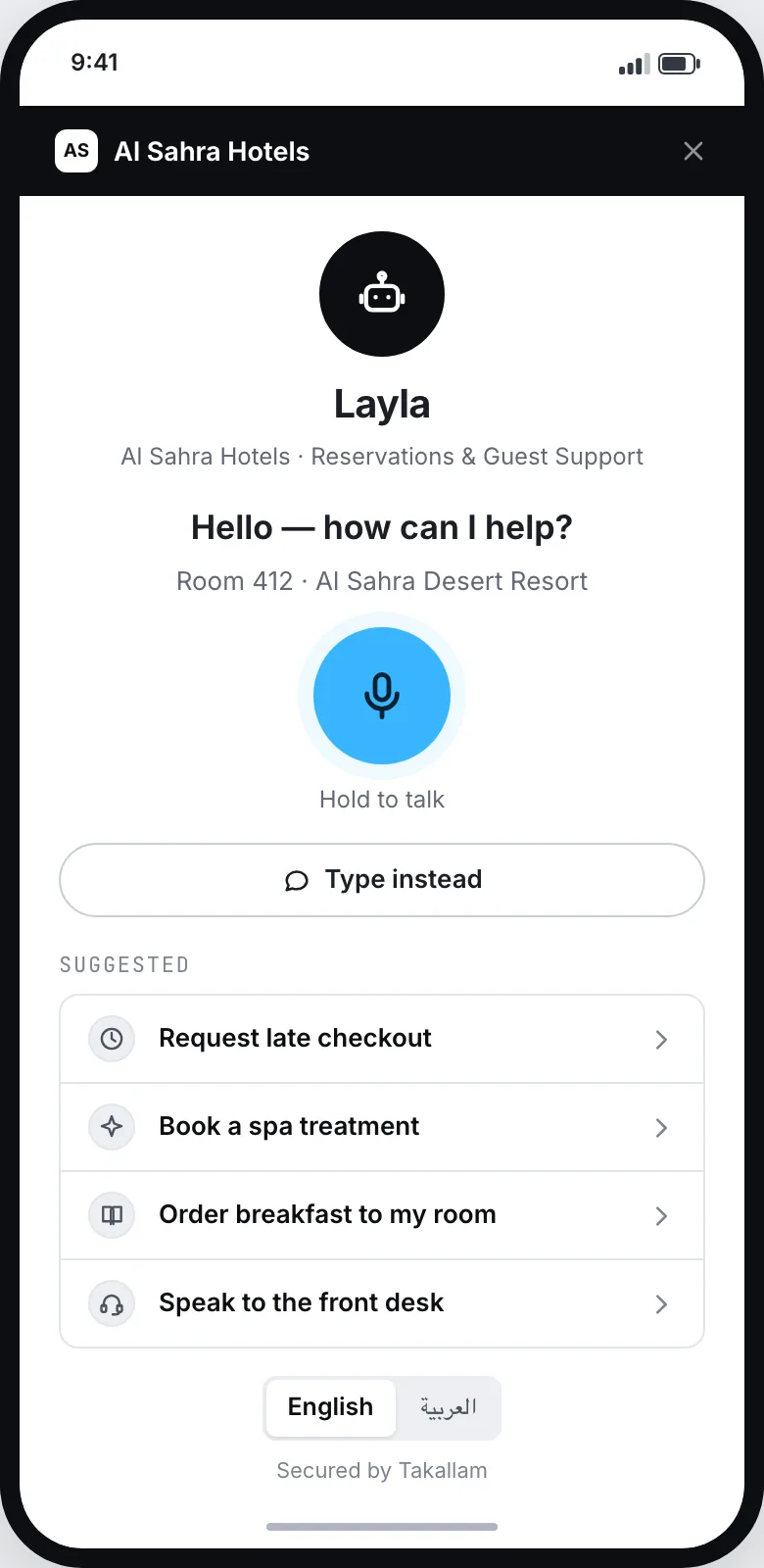
This is the difference that is hardest to argue with, because it is not a matter of degree. A guest standing in a hotel room at 11pm scans the code on the door and says "can I get a late checkout". No app to download, no number to dial, no hold music. PolyAI has no equivalent to this, and neither does anyone else.
- Opens voice-first, and switches to text mid-conversation without losing the thread.
- Different codes for different places, so you can see which location generates which questions.
- The same agent, the same knowledge base and the same escalation rules as your phone line.
Changing an answer on a Tuesday
This is where the two products diverge most in daily life. A delivered voice assistant is tuned by the people who built it, which produces a very polished result and a dependency. Takallam gives that control to whoever is running support — the checkout policy changes, someone edits the knowledge base, and the phone line, the chat widget and the QR code all say the new thing.
- Setup is four questions and a crawl of your website, not a scoping workshop.
- Every page the crawler read is listed, and you can remove anything that should not be used.
- Edits apply to every channel at once, because there is one knowledge base rather than one per surface.
- If you want the delivered-engagement model, that is a genuine reason to choose PolyAI instead. It is a real preference, not a weakness.
Pick the one that matches the problem
Choose PolyAI if
Your problem is a large inbound voice operation with a contact centre already behind it, you want a partner to design and deliver the assistant rather than build it yourself, and voice is the channel that matters. Deep customisation delivered as a managed engagement is exactly what they are built for, and a self-serve product is the wrong tool for that job.
Choose Takallam if
Your customers reach you in more than one place, you want QR voice, chat, email and phone answered by the same agent, and you need the inbox, tickets and workflows in the same product and on the same bill. Also if Emirati and Gulf dialect is a requirement rather than a nice-to-have, and you want to be live this week.
See the whole productWhat people actually ask about this comparison
Is Takallam trying to replace PolyAI?
Not for the job PolyAI is best at. PolyAI is an enterprise voice-assistant deployment, delivered with their team, aimed at large contact centres. Takallam is a self-serve multi-channel support platform. Teams compare them because both answer the phone, but the products are different in shape, not just in size.
Which one has better voice quality?
PolyAI has excellent conversation handling and a long record of tuning voice assistants at scale. Takallam is not competing on raw voice synthesis quality and does not claim to beat them at it. What Takallam adds is the rest of the support operation around the voice.
Does PolyAI do chat, email and QR as well?
PolyAI has expanded beyond voice-only, so treat chat as partially covered and check their current documentation. There is no email support channel — PolyAI answers calls, it is not a shared inbox, so a forwarded support address has nowhere to land. QR voice — a printed code the customer scans and speaks to — does not exist in their product, or in any other product we are aware of.
Can our own team take over a conversation?
In Takallam, yes, in the same thread: the AI flags low confidence or a request it is not allowed to fulfil, and your agent continues with the full transcript in front of them. PolyAI transfers to your contact-centre agents in your existing desk, which works well if you already have that desk and licences for it.
How long does each take to go live?
Takallam is designed to go live the same afternoon: four questions, a crawl of your website, a review of what it learned, then tick the channels. A PolyAI deployment is a scoped engagement with design and tuning, which takes longer and produces a more bespoke result. Neither answer is universally better — it depends on whether you want speed or bespoke.
What about Arabic?
Takallam handles Emirati and wider Gulf dialect in both voice and text, including callers who switch between Arabic and English mid-sentence, and data stays in the UAE region by default. PolyAI supports Arabic; how deeply it handles Gulf dialect is something you should test with them directly rather than take from a comparison page.
What does Takallam cost compared with PolyAI?
We will not quote their pricing, and Takallam is pre-launch so ours is being set with the first cohort. What we can say is the model: you pay per interaction, priced separately for each channel, with no per-seat licences and no minimum commitment. Join the waitlist with your real volume and we will come back with a rate.
When should we simply not choose Takallam?
If voice is your only channel, your volume is very large, and you want a vendor to design and operate the assistant with you, choose PolyAI. If you want a raw voice API to build on top of, buy a voice API. Takallam is for teams who need a whole support operation in one place.
Compare it against your own use case
Tell us which channels your customers actually use and how much Arabic is in the mix. We will tell you honestly whether Takallam is the right shape for it — and if it is not, we will say so.
Pay per interaction, priced separately for each channel. No seats, no minimums.