
Takallam vs Bland AI
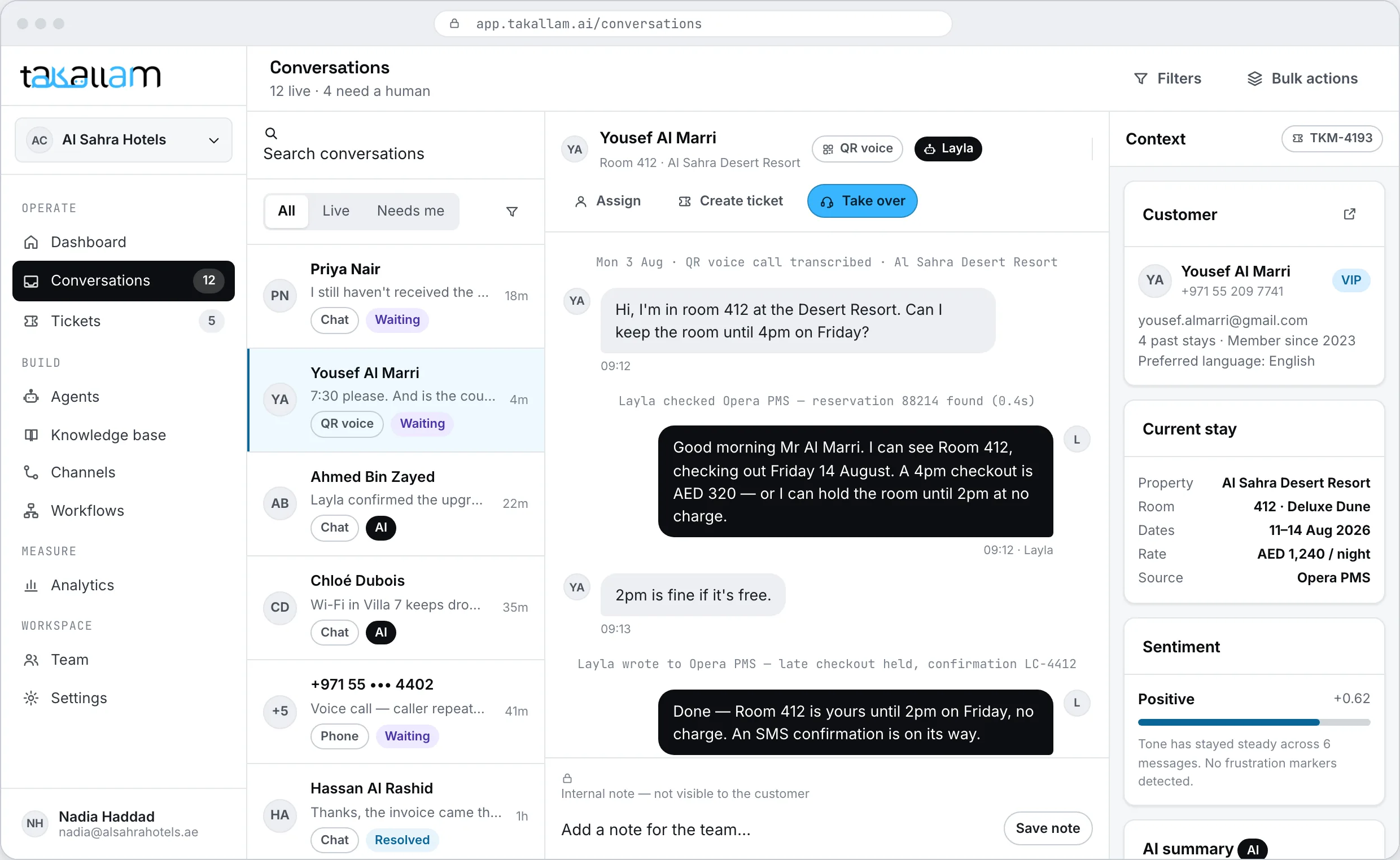
Bland AI is built for calling at scale — outbound campaigns, high-volume inbound, and programmatic control of how calls are placed and orchestrated. Takallam is not that. Takallam is inbound customer support: a QR code people scan and speak to, chat in your app, your support inbox, a phone number, and behind them a console with a shared queue, human takeover, tickets, a knowledge base, workflows and analytics. The choice is mostly about which direction your calls go.
Different directions, not different tiers.
Bland is a calling platform. It is very good at putting a large number of calls through a system reliably and letting engineers control what happens inside them. Takallam never places a campaign call. It waits for a customer who already has a question — someone standing in front of a QR code, opening your app, writing to your support address, or dialling your number — and it makes sure that person is answered, tracked and followed up.
- If your job is reaching thousands of people by phone, Bland is the right product. Takallam does not do outbound calling at scale.
- If your job is answering the people who reach you, Takallam is the finished operation and Bland is infrastructure you would build it on.
- A guest scanning a code on a hotel door, a customer messaging in your app, an email to your support address, someone calling at 3am — all four land in one queue.
- Neither of these is the beginner version of the other.
Three cases where the calling platform is the right call
These are not close calls. If one of them describes your problem, Takallam is the wrong tool and Bland is the right one.
Outbound calling at scale
Campaigns, reminders, qualification, collection, follow-up lists. Thousands of calls placed by a system rather than answered by one. Takallam does not do this, and no amount of configuration will make it.
Infrastructure-level control
Programmatic orchestration of how a call is built, routed and driven, in code, against your own systems. Bland gives engineers that level of the stack. Takallam deliberately hides it.
Volume is the requirement
When the number that matters is calls per hour rather than issues resolved, you want a platform engineered around throughput and concurrency, not a support console with a queue and SLA timers.
What each one ships with
Capability, not price — and the first two rows are the whole argument. One product is built to make calls, the other to answer customers.
| Capability | Takallam | Bland AI |
|---|---|---|
| Outbound calling at scale | ||
| Programmatic control of the call stack | ||
| Inbound phone number | ||
| Scan-a-QR-code voice channel | ||
| In-app and web chat | ||
| Email support channel | ||
| Shared inbox for your team | ||
| Human takeover mid-conversation | Live transfer on a call | |
| Tickets, SLAs and a support queue | ||
| Knowledge base built from your website | ||
| Automation after the conversation ends | In-call pathways | |
| Analytics built for a support team | Call analytics | |
| Emirati and Gulf dialect voice | ||
| Engineering required to launch | None to go live | Yes, you build it |
| Data resident in the UAE by default | Not by default |
Capability comparison as of 2026, based on public documentation for each product. A half-mark means the capability exists in some form but is scoped to the call rather than to a support operation. Bland AI is a calling platform by design, and it is strong at that — the comparison is about what each product is for.
Controlling the call is not the same as running support
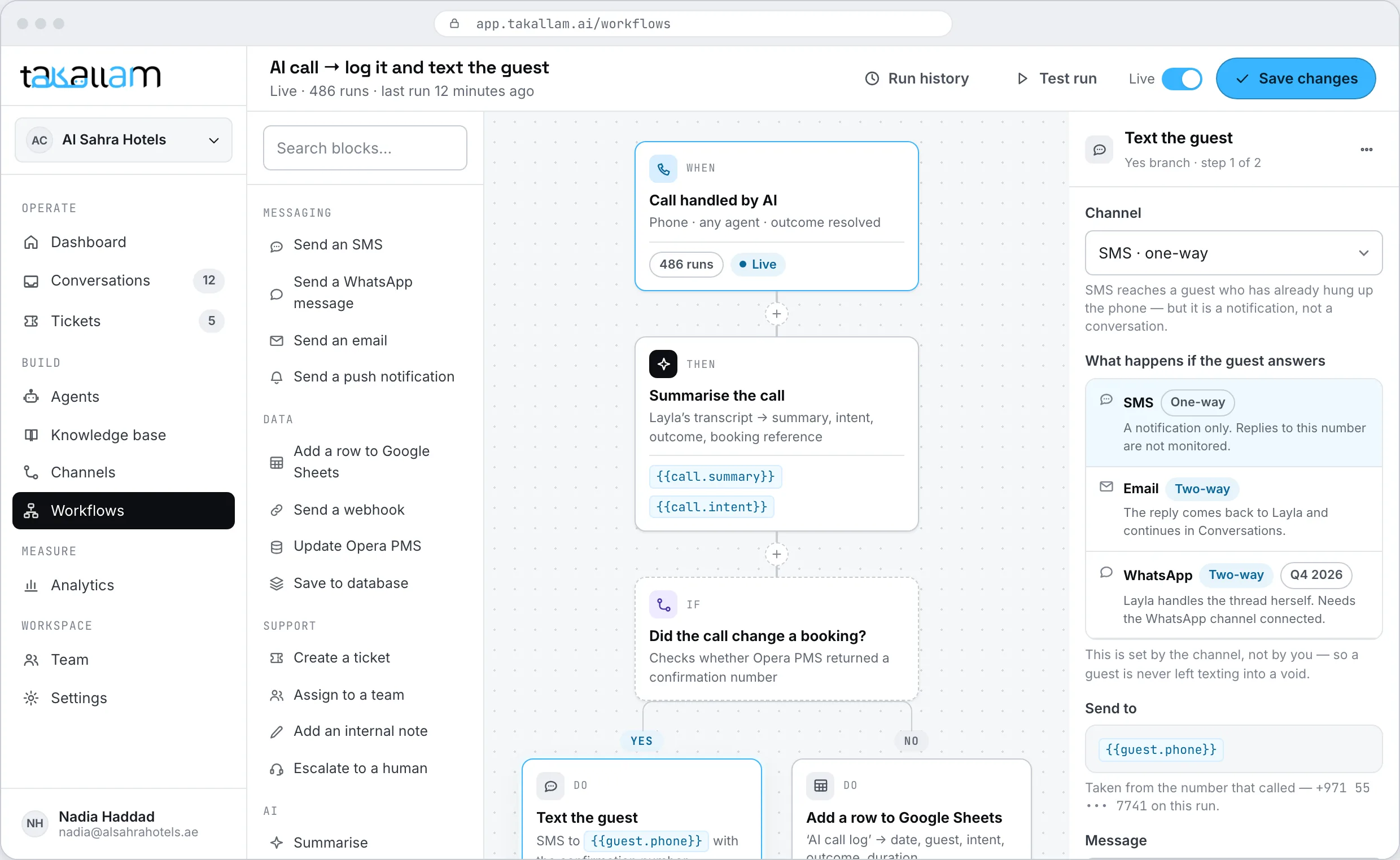
On a calling platform, automation lives inside the call: what the agent says next, which branch it takes, when it transfers. Takallam has that too, and then keeps going after the customer has gone. A workflow updates the system that owns the record, messages the customer, raises a ticket for the thing a person has to approve, and leaves a run history you can read.
- When a call is handled, summarise it, check whether it changed a booking, update the PMS and text the guest the confirmation.
- Branches, conditions and merge fields, with a preview of the message a real customer would receive.
- Escalation rules you write per agent and per channel, rather than a transfer number hard-coded into a flow.
- Run history that answers whether it actually worked, step by step.
The channel with no number to dial
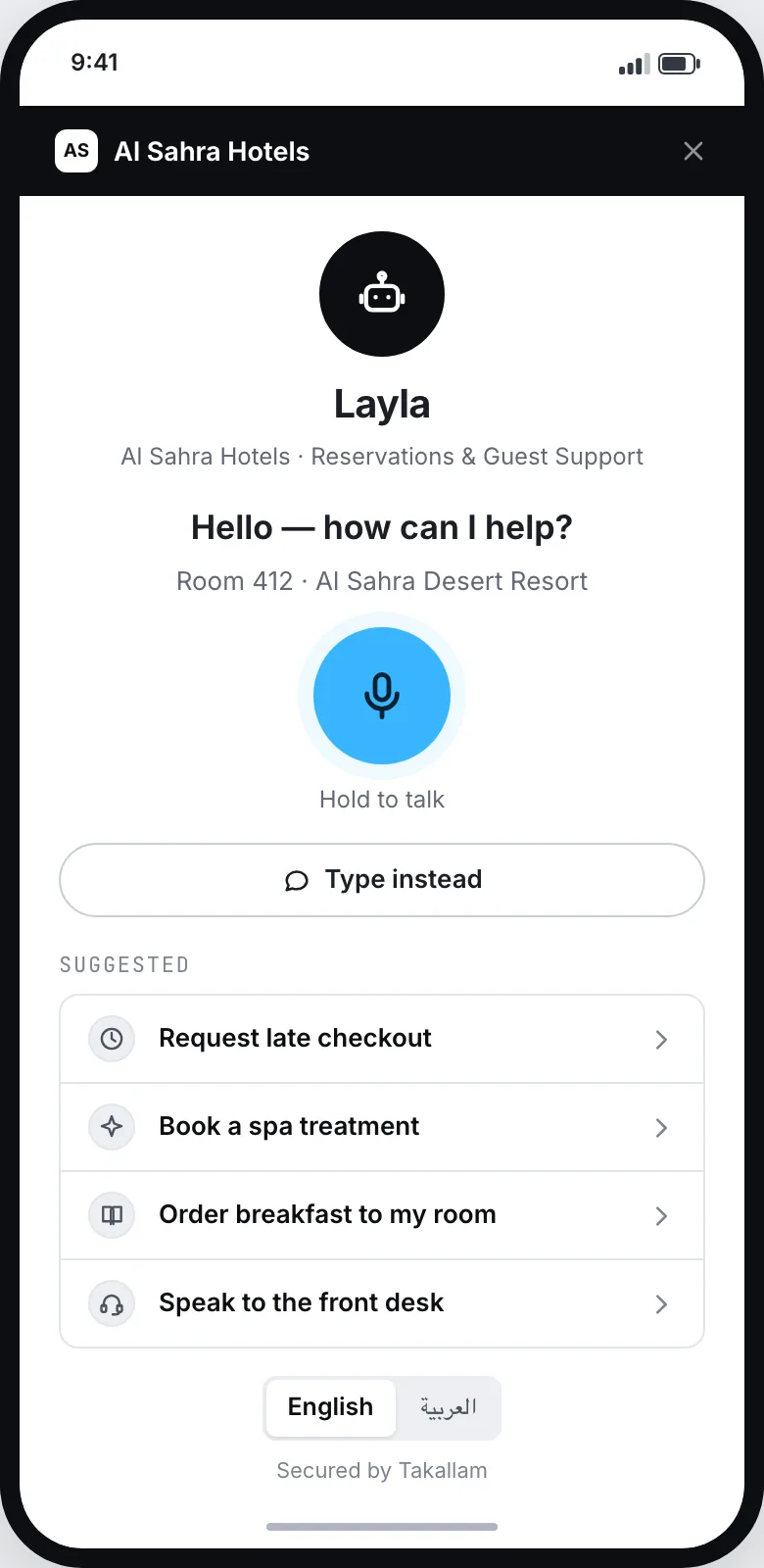
Inbound support in the UAE is not only a phone line. A guest standing at a hotel door, a shopper at a shelf edge, a resident at a service counter — they have a question right there, and dialling is the last thing they want to do. They scan a printed code, speak in Emirati Arabic, and get an answer. That channel does not exist on a calling platform.
- Scan-to-speak opens straight into voice, with no app to download and no number to call.
- Emirati and wider Gulf dialect in voice and text, including customers who switch to English mid-sentence.
- Different codes for different places, so you can see which locations generate which questions.
- Data resident in the UAE region by default, with retention you control.
What an inbound support operation actually needs
All of it configured in a console, none of it built.
A support inbox that answers
Forward [email protected] or connect the mailbox. The agent reads the whole thread, replies in-thread from your own address, and escalates the rest with the history attached.
See the email channelKnowledge base from your site
Takallam crawls your website, pulls in policies, rates and FAQs, and shows you exactly what it learned. You remove anything it should not use and add your own documents.
See the knowledge baseHuman takeover in the thread
The AI flags low confidence, an angry tone or a request it is not allowed to fulfil, and a person continues the same conversation with the transcript already there.
See handoverTickets and SLAs
Owners, priorities, due times and a queue that shows what is about to breach — created out of the conversation rather than retyped into another tool.
See ticketsConversation analytics
What customers ask, what the AI resolved, where it handed over and which questions keep coming back — across QR voice, chat, email and phone together.
See analyticsArabic that holds up
Emirati and Gulf dialect in voice and text, code-switching handled inside one conversation, and right-to-left across the whole customer experience.
See how Arabic worksBuilt and hosted here
Conversations, transcripts and knowledge bases stay in the UAE region by default, with encryption, access control and retention you decide.
See securityChoosing between them
Can Takallam do outbound calling like Bland AI?
No, and that is deliberate. Takallam is built for inbound customer support — a person who already has a question and reaches you by scanning a code, opening your app, emailing your support address or calling your number. It does not send outbound marketing email either. If your requirement is placing calls out at volume, Bland AI is the right platform and you should use it.
Is Bland AI a customer support platform?
It is a calling platform that support teams sometimes build on. It gives you strong control over how calls are placed and orchestrated, but it does not ship an agent inbox, tickets and SLAs, a support knowledge base or human takeover in a thread. Those are things you would build on top of it, and they are what Takallam is.
Could we use both?
Yes, and for some businesses that is the sensible answer. Run outbound campaigns on a calling platform and inbound support on Takallam. They do not overlap much, so you are not paying twice for the same capability.
What is scan-to-speak and why does it matter?
A printed QR code that opens straight into a voice conversation in the browser. The customer scans and talks — no app to download, no number to dial, no queue. It matters because most support questions happen in a physical place, and the phone is a bad way to ask them from a hotel corridor or a shop aisle.
Which one is better for Emirati Arabic?
Takallam, because that is the reason it exists. Emirati and wider Gulf dialect in voice and text, customers who code-switch between Arabic and English mid-sentence, and the same register across the phone, chat and QR rather than tuned for one channel.
Do we need engineers to launch Takallam?
No. You answer four questions, Takallam reads your website, builds your knowledge base and drafts your first agents, and you review and go live. A REST API and signed webhooks are there for teams that want them, but nothing about launching requires code.
How is Takallam priced?
Per interaction, priced separately for each channel, because a phone call and a chat message do not cost the same to deliver. No per-seat licences and no minimum commitment. Takallam is pre-launch, so rates are being set with the first cohort — join the waitlist and we will quote against your real volume.
Are you calling out, or being called?
Tell us how your customers reach you and what they ask for. If the honest answer is that you need a calling platform, we will say so. If you need inbound support answered across four channels, we will show you what going live looks like.
Pay per interaction · priced per channel · no seats, no minimums